
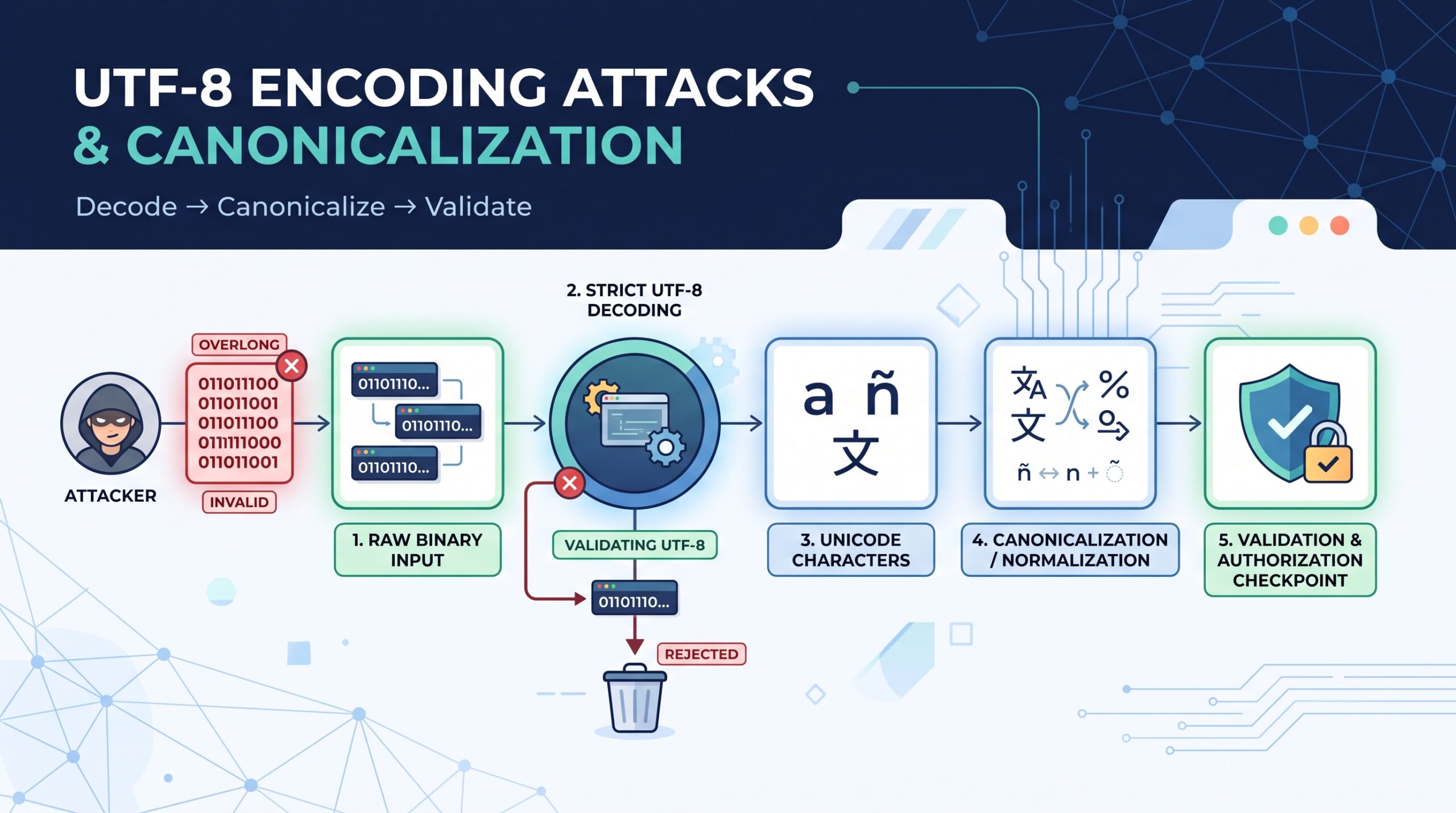

UTF 8 encoding attacks canonicalization can cause security gaps when one layer checks input differently from the component that later decodes or normalizes it. Invalid UTF-8, overlong sequences, and repeated decoding can make safe-looking input change meaning after validation. RFC 3629 warns that illegal UTF-8 sequences can lead to parser mismatches.
Secure Coding Practices focuses on practical controls such as strict decoding, consistent canonicalization, and validation after decoding. Understanding each transformation helps teams make better security decisions. Keep reading to see how these issues work and how to prevent them.
Decoding the Essentials: Fast-Track Canonicalization Wins
Navigating UTF-8 attacks requires bridging the gap between how security filters validate data and how backends actually decode it.
- Decode First, Validate Last: Always decode and canonicalize inputs into their final representation before applying security rules or authorization checks.
- Strictly Enforce UTF-8 Standards: Instantly reject malformed, overlong, or non-shortest-form byte sequences instead of allowing permissive decoders to repair them.
- Align Cross-Layer Architecture: Ensure WAFs, API gateways, frameworks, and application code use identical decoding and normalization rules to prevent parser mismatches.
What Makes UTF-8 Canonicalization a Security Problem?
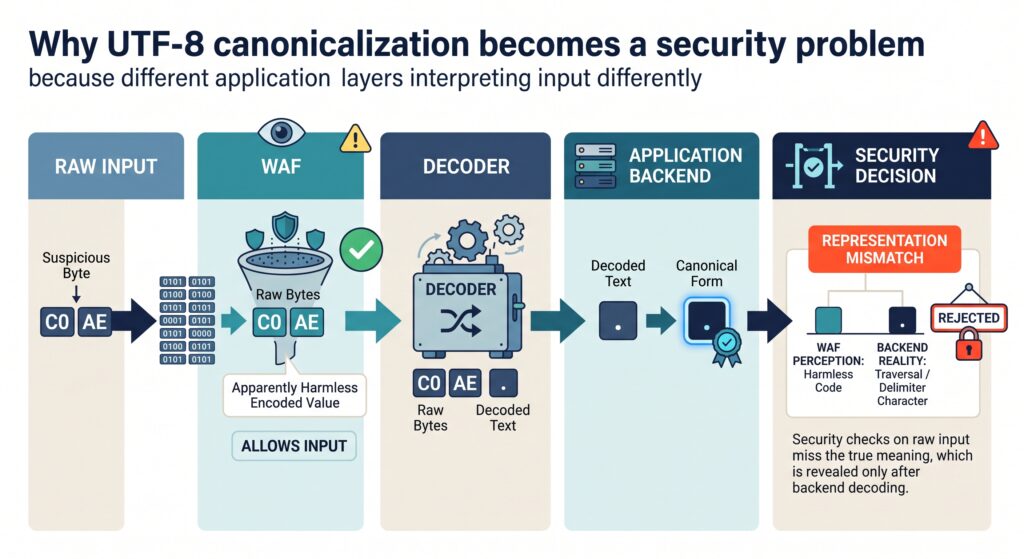
UTF-8 canonicalization becomes a security problem when different parts of an application interpret the same input differently. One layer may validate raw bytes, while another decodes those bytes into Unicode before processing them. MITRE CWE-180 describes this broader issue as validating before canonicalization.
The basic processing path looks like this:
Raw bytes → UTF-8 decoding → Unicode code points → normalization → application logic
If validation happens too early, dangerous input can appear harmless in its original form but become meaningful after decoding or normalization.
We can see this across several common boundaries:
- An edge proxy performs URL decoding.
- A WAF checks one representation.
- A framework performs Unicode decoding.
- A library parses protocol data.
- The application makes an authorization decision.
- A filesystem, database, or interpreter consumes the result.
The safer sequence is:
Decode → Canonicalize → Validate → Authorize → Process
This is where Secure Coding Practices gives us a useful engineering rule: security checks should use the same representation that the application will ultimately process. OWASP also recommends validating input after UTF-8 decoding and using centralized validation routines.
A practical review should start with understanding input canonicalization and map each transformation rather than assume UTF-8 is handled only once. Not every Unicode difference is an exploit.
A valid NFC/NFD distinction in a user’s name is different from an illegal UTF-8 sequence. The security problem starts when different components attach different meanings to the same input.
How Do Overlong UTF-8 Sequences Bypass Validation?
Overlong UTF-8 uses more bytes than allowed to represent a Unicode code point. Strict UTF-8 decoders must reject these non-shortest forms because they can create different security views of the same logical character.
For example, NUL is normally represented by the single byte 00. The sequence C0 80 is an invalid overlong representation of NUL. If one component checks the bytes while a permissive decoder later converts C0 80 into NUL, the security check and application logic are no longer working with the same value.
| Representation | Status | Possible security result |
| 00 | Valid UTF-8 | Standard NUL representation |
| C0 80 | Invalid overlong form | Weak decoder may reinterpret it |
| Shortest form | Canonical | Consistent interpretation |
RFC 3629 warns about the security risks of accepting illegal UTF-8 sequences. A shortest-form decoder rejects overlong sequences instead of converting them into ordinary characters.
The practical rule is straightforward:
- Use a strict UTF-8 decoder.
- Reject malformed and overlong sequences.
- Do not silently repair invalid input.
- Test decoder behavior at every trust boundary.
We should also distinguish UTF-8 canonicalization from Unicode normalization. Overlong encoding concerns invalid byte sequences. NFC, NFD, NFKC, and NFKD operate on valid Unicode text and address different forms of Unicode equivalence.
How Does Double Encoding Create a Similar Canonicalization Gap?
Double encoding creates a mismatch when one component decodes input once while another component decodes it again.
The sequence can look like this:
Attacker representation → First decoder → Security check → Second decoder → Final interpretation
A value may look harmless after the first transformation but become a delimiter, path component, or control character after the second.
| Validation view | Final view |
| Encoded representation | Decoded representation |
| No dangerous delimiter | Dangerous delimiter |
| Apparently allowed path | Resolved path |
A double encoding attack explained simply shows how repeated decoding can create a similar gap. It is not an overlong UTF-8 attack, but both involve alternate representations.
As highlighted by Microsoft Security Blog
“The canonical form of a UTF‑8 character is the smallest number of bits that can represent that character. The correct form for a ‘.’ character is a one‑byte escape: %2e, not a two‑byte escape: %c0%ae.” – Microsoft Security Blog
Our testing therefore records every decoding pass. If a service intentionally decodes twice, that behavior should be explicit and covered by regression tests rather than left to framework defaults.
Why Can WAF and Application Unicode Handling Disagree?
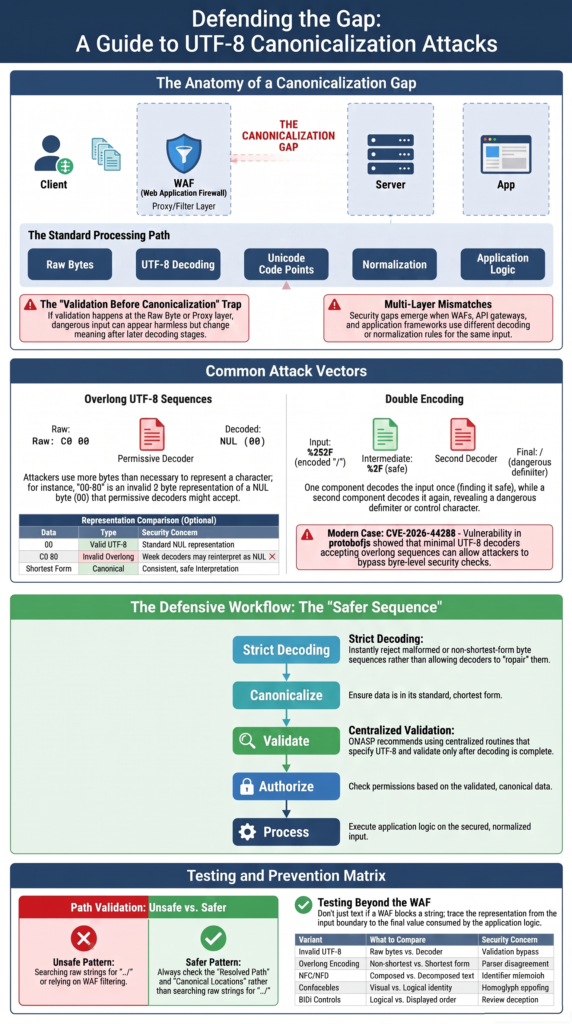
A WAF and application can use different decoding, normalization, character mapping, or parser rules, allowing one layer to approve data another layer interprets differently.
A typical architecture looks like:
Client → CDN → WAF → Web server → Framework → Parser → Application
Each component may transform a byte sequence, Unicode string, URL, hostname, or protocol field. A WAF rule that recognizes ASCII may miss a Unicode representation that the backend later converts through normalization or character mapping.
We have found that the most useful diagnostic is not simply asking whether a WAF blocks a test string. The stronger question is whether the WAF and backend reach the same canonical representation.
Teams should record:
- Input representation entering each layer.
- Decoder and normalization behavior.
- Accepted and rejected malformed UTF-8.
- Security decision at each boundary.
- Final value consumed by the application.
A virtual WAF rule can add defense, but application-level validation still needs to match the actual parser behavior. Testing should use the exact WAF version, configuration, architecture, backend runtime, and protocol parser in production.
What Does CVE-2026-44288 Teach About Modern UTF-8 Attacks?
Credits: Learn with Nick Adler
CVE-2026-44288 shows that overlong UTF-8 handling remains a modern software-security issue rather than only a historical web-server problem.
According to NVD, affected versions of protobufjs before 7.5.6, and versions from 8.0.0 through 8.0.1, included a minimal UTF-8 decoder that accepted overlong sequences and decoded them into canonical characters. The issue was fixed in 7.5.6 and 8.0.2.
The important detail is the trust boundary. An attacker could supply protobuf binary data, while application-level checks inspected raw bytes before string decoding. A byte sequence that lacked a protected ASCII character could later decode into a string containing that character.
The case gives us a useful four-step model:
- Attacker supplies protocol data.
- Application checks the raw representation.
- A permissive decoder converts an invalid sequence.
- Security-sensitive code receives a different logical value.
That does not mean every application using an affected version was automatically exploitable. The attacker-controlled protobuf path, pre-decoding security check, and security-sensitive downstream use all matter.
The lesson extends beyond one package: dependency inventories should include fallback decoders, custom parsers, character-set converters, and protocol libraries, not only the runtime’s primary Unicode APIs.
Which Unicode Variants Should Security Teams Test?
Security testing should cover invalid UTF-8, Unicode normalization, confusables, directionality controls, alternate encodings, and application-specific character mappings.
A useful matrix separates the technical mechanisms:
| Variant | What to compare | Typical concern |
| Invalid UTF-8 | Raw bytes vs decoder | Validation bypass |
| Overlong encoding | Non-shortest vs shortest form | Parser disagreement |
| NFC/NFD | Composed vs decomposed text | Identifier mismatch |
| NFKC/NFKD | Compatibility forms | Allowlist changes |
| Confusables | Visual vs logical identity | Homoglyph spoofing |
| BiDi controls | Logical vs displayed order | Review deception |
| Alternate encoding | Pre/post decoding | Filter mismatch |
Unicode security also includes invisible characters such as zero-width space, lookalike characters, and directionality controls. These are not automatically canonicalization vulnerabilities, but they can affect identity, logging, authorization, and human review.
Unicode Technical Report #36 (UTR #36) is a useful reference for broader Unicode security considerations. The correct test set still depends on the field. An internationalized name needs a different policy from a filesystem path, hostname, protocol identifier, or programming-language token.
How Should Applications Canonicalize Input Before Validation?
Decode with a defined character set, reject invalid representations, apply the required normalization and protocol canonicalization, then validate the resulting representation.
Our defensive workflow is:
- Identify the input boundary.
- Decode once according to the protocol.
- Reject malformed UTF-8 when strict UTF-8 is required.
- Apply the appropriate Unicode normalization.
- Canonicalize protocol-specific syntax.
- Validate the canonical representation.
- Authorize and process only the validated value.
Secure Coding Practices fit naturally into this workflow because centralized validation, explicit character sets, canonicalization, and post-decoding validation reduce differences between application layers. OWASP recommends specifying UTF-8, converting input to a common character set before validation, and validating after UTF-8 decoding.
As noted by OWASP
“Specify character sets, such as UTF‑8, for all input sources (canonicalization) Utilize canonicalization to address obfuscation attacks.” – OWASP
We should not automatically normalize every field with NFKC. Compatibility normalization can change characters in ways that are appropriate for identifiers but undesirable for ordinary user content. Unicode normalization forms must match the application’s semantics.
How Should Path Validation Handle Encoding and Canonicalization?
Resolve the final path representation before authorization, then verify that the resolved location remains inside the permitted directory.
The defensive sequence is:
Decode → Normalize → Resolve → Verify base directory → Access
| Unsafe pattern | Safer pattern |
| Check raw path | Check resolved path |
| Search for ../ | Resolve path semantics |
| Trust WAF filtering | Enforce application authorization |
| Compare strings | Compare canonical locations |
A path traversal canonicalization example shows why string filtering alone cannot reliably represent filesystem semantics. A path can contain encoded separators, alternate representations, or traversal components that become meaningful only after decoding and resolution.
The same principle applies to URL canonicalization, redirects, archive extraction, and resource authorization. A security decision should be based on the final location or identifier, not merely on how the attacker originally encoded it.
That said, canonicalization must be bounded and predictable. Repeatedly decoding arbitrary input until it stops changing can itself create unexpected behavior. A defined protocol pipeline is safer than an open-ended transformation loop.
How Can Teams Test and Prevent Canonicalization Mismatches?
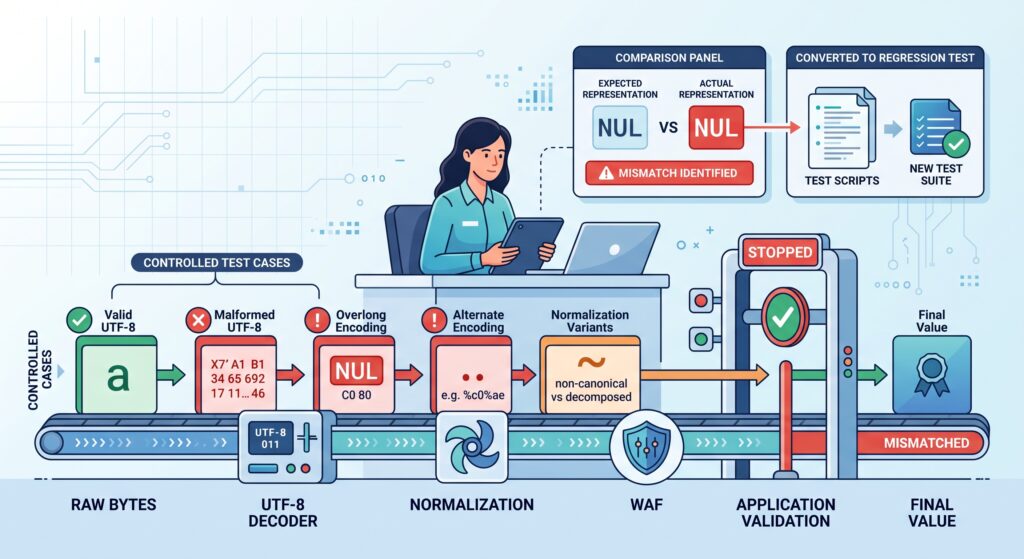
The most useful security test compares what each layer receives, transforms, and ultimately passes to security-sensitive code. Instead of testing only whether a WAF blocks a payload, we trace the representation from the input boundary to the final application value.
A practical test should capture:
- Raw bytes entering the service.
- Decoded Unicode code points.
- Normalized Unicode form.
- URL or protocol canonical form.
- WAF decision.
- Application validation result.
- Final security-sensitive value.
| Test | Expected result |
| Valid UTF-8 | Accepted |
| Invalid UTF-8 | Rejected where strictness is required |
| Overlong sequence | Rejected |
| Unexpected normalization form | Handled consistently |
| Alternate encoding | Canonicalized before validation |
| Multiple decoding passes | Prevented or explicitly controlled |
For a real assessment, we test malformed UTF-8 separately from valid Unicode normalization variants. We also test NFC, NFD, NFKC, and NFKD only where the application’s identifier rules make them relevant.
Defensive controls should make the expected behavior permanent. We recommend:
- Strict UTF-8 decoding.
- Centralized validation.
- Explicit character policies.
- Current parser and decoder dependencies.
- WAF-to-application comparison testing.
- Regression tests for discovered mismatches.
A useful regression test stores the logical input and expected canonical representation rather than only the original byte sequence.
FAQ
How can I tell whether my application accepts malformed UTF-8?
Check whether malformed UTF-8 reaches application logic instead of being rejected during decoding. Test invalid byte sequences, overlong UTF-8, non-shortest form encodings, and unexpected code points.
Compare the raw bytes with the decoded value at each boundary. If security checks see a different value from the parser, the application may have a Unicode validation failure or gatekeeper bypass.
Which Unicode normalization forms should I use for user input?
There is no single normalization form that works for every field. NFC can help when an application needs consistent Unicode equivalence while preserving normal text. NFKC may suit identifiers where compatibility characters should be treated alike.
NFD and NFKD have different effects. Choose the form based on the field’s purpose, then test it against your application’s input validation rules.
How do invisible characters create security problems?
Invisible characters can make two strings look identical even though their byte sequences differ. A zero-width space, for example, can affect username matching, logging, or authorization without being obvious during review.
Unicode security testing should include invisible characters and Unicode lookalike characters. Treat unexpected differences as potential Unicode traps, especially when they affect identity or security decisions.
Could URL canonicalization affect path traversal defenses?
Yes. A URL can contain encoded characters that become meaningful after decoding, which can change how a server resolves a path. Compare the original URL with its canonical form and final filesystem path during testing.
Pay attention to alternate encodings and traversal markers, including %c0%af. Different decoding behavior can cause the security check and final path resolution to disagree.
What should I test for a Unicode normalization vulnerability?
Start with crafted strings that represent the same text in different Unicode forms. Compare how validation, storage, lookup, and authorization handle those strings. Test NFC, NFD, NFKC, and NFKD when they apply to the field.
Also test homoglyph attacks and Unicode case folding. A normalization bypass can occur when one component normalizes input while another performs security checks on the original form.
Turn Canonicalization Findings Into Practical Defenses
Secure application design depends on predictable input handling from the boundary to authorization. Define the expected encoding, decode it correctly, normalize where needed, then validate and use the same canonical value. That’s the core defense. Every transformation should be tested.
Help developers build these habits through hands-on practice with the Secure Coding Practices Bootcamp, where secure input handling, validation, and application security techniques become practical skills for real development work.
References
- https://securecodingpractices.com/understanding-input-canonicalization/
- https://learn.microsoft.com/ar-sa/archive/blogs/michael_howard/overlong-utf-8-escapes-bite