
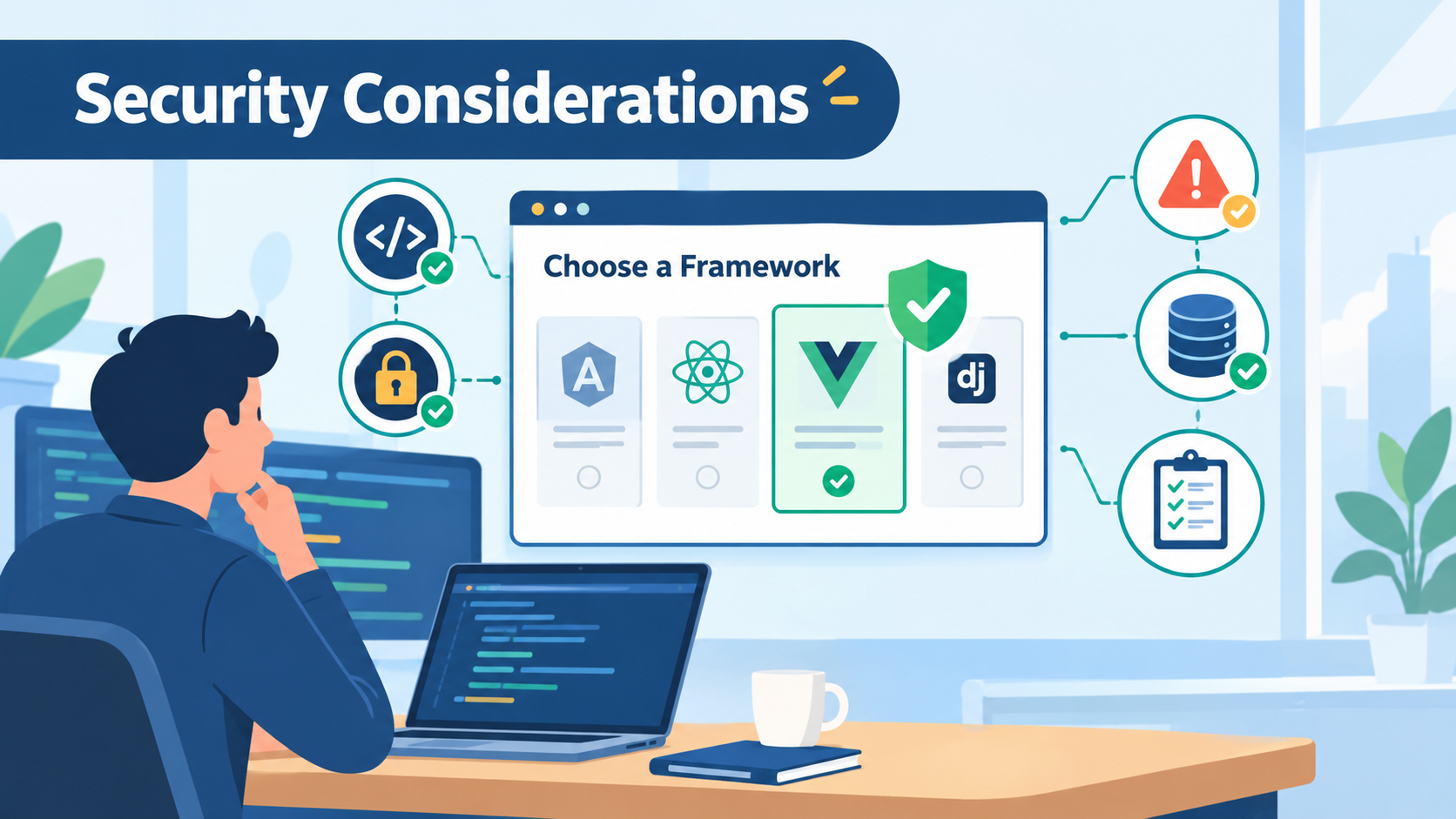

Choosing a software framework is not only about features, speed, or ease of development. Security considerations choosing framework should also be part of the decision from the start. A secure framework can reduce common risks, provide useful security tools, and support safer development.
However, the framework alone cannot protect your application. You still need strong coding practices and regular security checks. At Secure Coding Practices, we focus on practical ways to build safer software from the beginning. Keep reading to learn what to look for.
Key Points to Check Before You Choose
The right framework should support both your development goals and your security needs. Keep these three points in mind:
- Security isn’t a feature you add later, it’s a fundamental property of your foundation. The framework you choose sets the baseline.
- A framework’s security is only as good as the community and processes that maintain it. Active maintenance and a security-focused culture are non-negotiable.
- No framework makes you immune to bugs. Your own secure coding practices are the critical layer that protects the application you actually build.
Why Should Security Be a Primary Concern When Choosing a Framework?
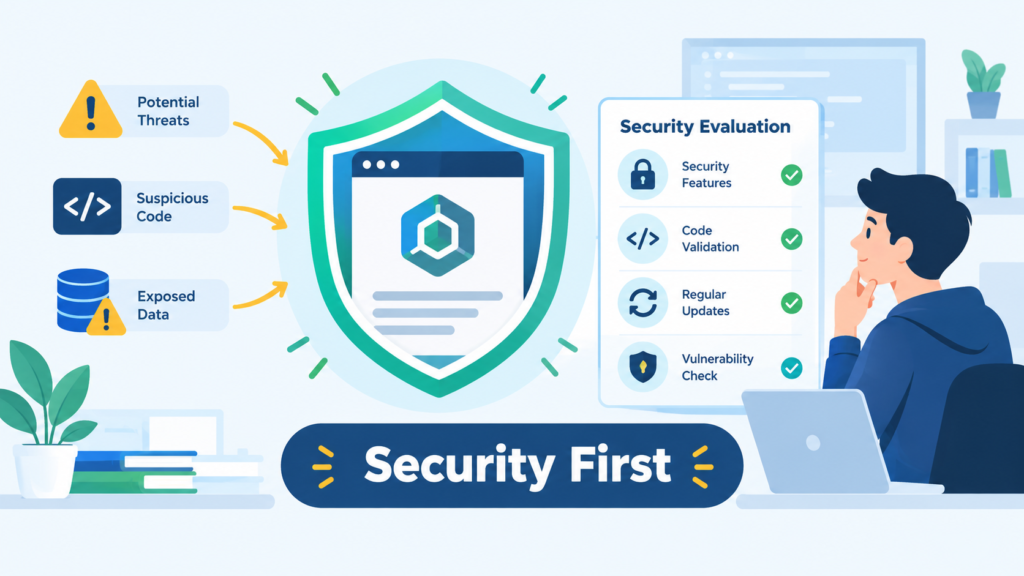
You wouldn’t start a road trip in a car with faulty brakes. The framework is your vehicle for building an application, and its security model is your braking system. It’s the first line of defense.
A framework with a weak or poorly designed security posture means you’re fighting an uphill battle from day one. Looking at its common features, such as secure defaults, validation, and authentication support, can help you understand how much security the framework provides. Every line of code you write sits on top of that foundation.
Think of it this way. The framework handles the underlying plumbing, the request/response cycles, the database interactions. If that plumbing leaks sensitive data or allows unauthorized access, your fancy features on top don’t matter much.
You’re responsible for the application’s security, but the framework determines how hard that job will be. A good one gives you safe defaults and tools to do the right thing easily. A bad one leaves dangerous gaps you must constantly remember to fill.
Look for frameworks that bake security in, not bolt it on.
- Built-in protection against common attacks like SQL injection and cross-site scripting (XSS).
- Secure default configurations that don’t require expert-level knowledge to lock down.
- A clear, well-documented authentication and authorization system.
- Regular security updates and a transparent process for handling vulnerabilities.
We once inherited a project built on an older, niche framework. It was fast. But its session management was archaic, and it had no built-in CSRF protection. We spent months retrofitting security, a painful process of patching holes instead of building features. The initial speed benefit was utterly erased. That’s the hidden cost of a poor choice.
What Common Security Features Should You Look For?
So, what does “baked-in” security actually look like? It’s not a magic bullet, but a set of sensible, proactive measures.
First, examine how the framework handles user input, the number one source of vulnerabilities. Does it automatically escape output for different contexts, such as HTML, SQL, and JSON? This is especially important when working with client-side validation, where unsafe input can reach the application.
Next, consider session management. Are sessions securely generated, stored, and invalidated? Can they be easily hijacked? Authorization is another critical area. Does the framework provide a structured way to define who can see or do what? Or does it leave you to build your own system, which can be error-prone?
A good authorization system should feel like a natural part of the framework, not an afterthought. Data validation is also important. Can you define strict schemas for incoming data and reject anything that does not fit? Using input validation frameworks can help stop malicious or invalid data before it reaches the application.
How Do Built-In Security Features Improve Protection?
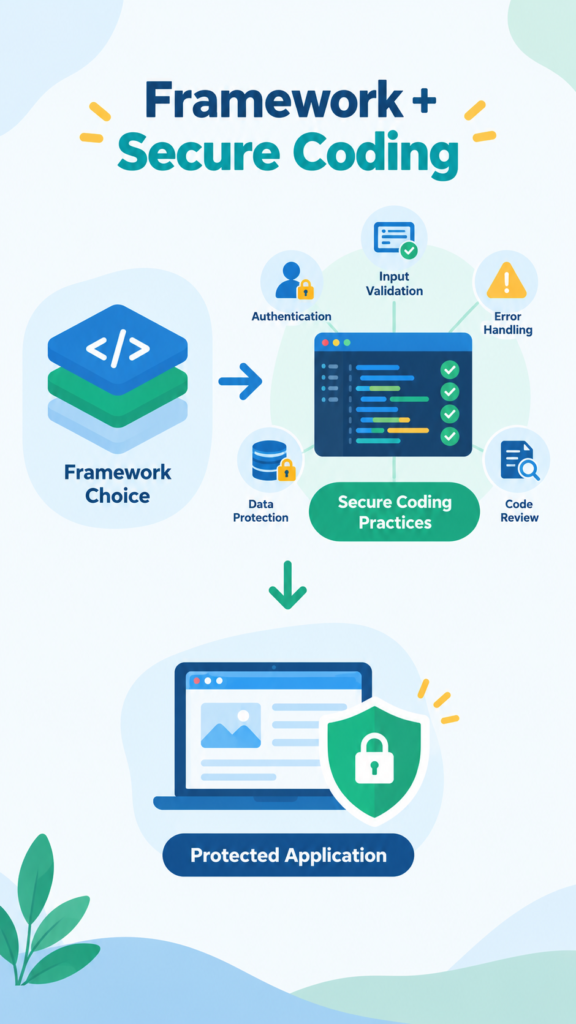
Security headers are a quieter but vital feature. Frameworks that make it easy to set headers such as Content-Security-Policy (CSP), X-Frame-Options, and HSTS provide an extra layer of protection. These headers can help reduce risks such as clickjacking and certain injection attacks.
“Full-stack frameworks (Django, Spring Boot) provide significantly broader automatic protections than client-side and minimalist frameworks (React, Express.js).” – IEEE
Finally, look at the framework’s cryptography offerings. Are there easy-to-use, well-documented libraries for password hashing, such as bcrypt or Argon2, and data encryption? Using established and well-reviewed methods is generally safer than creating your own cryptographic solution.
Ultimately, security comes from the combination of these features. A framework that provides these tools encourages a secure mindset and makes the safer approach easier to follow. When developers have to fight the framework to implement basic security, they may be more likely to cut corners. In security, those shortcuts can create serious vulnerabilities.
How Do Community and Updates Impact Framework Security?
A framework’s security depends on more than its code. The community behind it and the way maintainers handle updates also matter. Before choosing a framework, check:
- Security response: Is there a dedicated security team or clear process for reporting vulnerabilities?
- Patch history: Do maintainers release security fixes quickly after problems are discovered?
- Release activity: Are updates regular, or has the project been inactive for months or years?
- Version support: Does the team provide security patches for supported versions, or require frequent breaking upgrades?
- Community size: More active users can mean more real-world testing and more developers looking for security problems.
- Security discussions: Do developers regularly discuss vulnerabilities in forums, GitHub issues, or other community spaces?
- Documentation: Does the project clearly explain secure configuration and recommended practices?
An active community can become an important security resource. When developers discover a vulnerability, others can report it, investigate it, and share solutions. Security documentation, plugins, and community discussions can also help developers avoid repeating common mistakes.
An abandoned framework creates a different problem. If maintainers no longer release patches, newly discovered vulnerabilities may remain unresolved. Even vulnerabilities in dependencies can become difficult to address.
We learned this difference early. With a small, inactive community, solving an unusual security bug meant spending days searching through source code. With a popular framework, existing discussions and fixes often provided useful answers much faster.
What Are the Trade-Offs Between Security and Other Factors?
Credits: MetroStar
Choosing a framework often means balancing security, performance, productivity, and ease of use. Strong security does not always make development harder. In many cases, built-in security features can save time by reducing bugs and security problems later.
However, there are some trade-offs:
- More security: Strong rules and validation can make development feel slower.
- Performance: Some security features may add a small amount of processing time.
- Learning curve: Developers may need extra time to understand the framework’s security features.
- Productivity: Secure frameworks can reduce time spent fixing security issues later.
- Maintenance: Built-in security features can make long-term maintenance easier.
- Flexibility: Strict security rules may limit how freely developers can build certain features.
For most web applications, the small performance or development cost of good security is usually easier to manage than the cost of fixing a serious security problem later. A framework may seem fast because it is easy to use, but if it creates security issues, that speed can become a bigger problem over time.
Consider this simple table:
| Factor | Potential Trade-Off with Security | Mitigation |
| Performance | Security checks (validation, encryption) use CPU cycles. | Profile your app. Often, the impact is minimal and worth the cost. Use caching strategically. |
| Development Speed | Secure patterns can require more upfront code and thought. | View it as an investment. The time saved fixing vulnerabilities later outweighs the initial slowdown. |
| Ease of Use | Secure defaults may restrict flexibility, feeling “strict.” | Learn the why behind the restrictions. Flexibility often leads to insecure configurations. |
The goal isn’t to maximize security at all costs. It’s to make informed, conscious decisions. Ask: “Am I trading security for a temporary convenience or a fundamental requirement?” Sometimes a trade-off is valid, but it should never be accidental.
How Can Secure Coding Practices Complement Your Framework Choice?
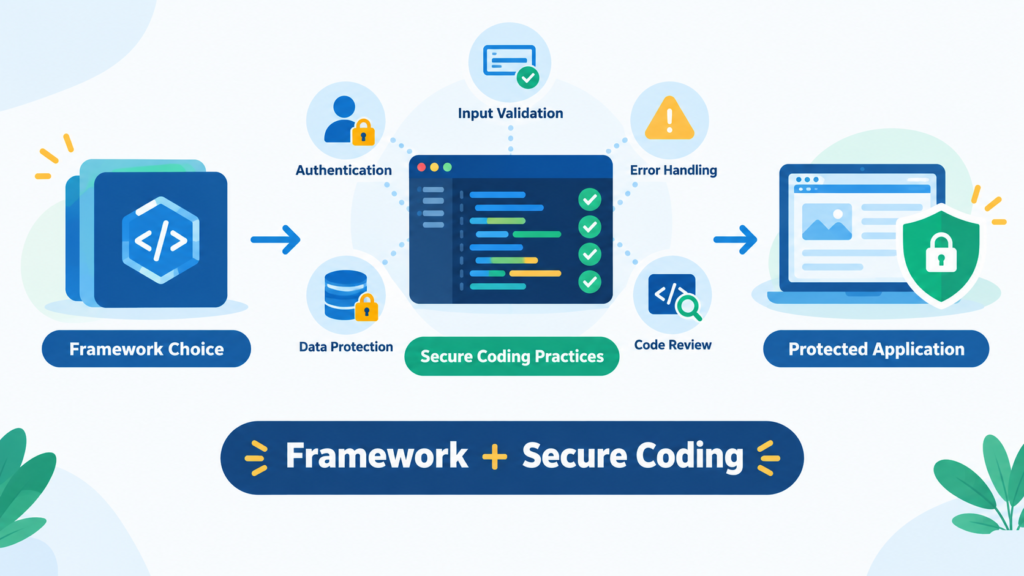
Here’s the heart of it. The framework is your foundation, but you build the house. The strongest foundation won’t save a house with rotten beams and unlocked doors. Secure coding practices are how you build those beams.
This starts with a mindset. Security is a feature, yes, but more than that, it’s a quality of the code. It’s thinking about the adversary with every function you write. “If I pass malicious input here, what happens?” “Who should really have access to this data?” The framework gives you tools, a sturdy lock, but you must remember to install it on the door.
“Select open source software projects that are well-maintained… Routinely monitor for Common Vulnerabilities and Exposures (CVEs) or other security-relevant alerts, such as end-of-life, in all open source software dependencies and update them as necessary.” – CISA.GOV
We make it a rule to validate input at the boundary, as soon as it enters our system, using the framework’s tools. We then validate it again for our specific business logic.
Principle of least privilege. This isn’t a framework feature, it’s a design philosophy. Every component, every database query, every service account should operate with the minimum permissions needed to function.
The framework might provide role-based access control (RBAC), but you define the roles and permissions thoughtfully. We regularly audit our data access patterns, asking if a given process needs all that data. Usually, the answer is no.
FAQ
Does the most popular framework always mean the most secure?
Not necessarily. Popularity brings more scrutiny, which is good, but it also makes it a bigger target. The key is the maintainers’ responsiveness to security issues. A less popular framework with an excellent security response team can be safer than a popular one with slow patches.
Can a “lightweight” framework be secure?
Yes, but the responsibility shifts. A minimalist framework gives you flexibility but provides fewer guardrails. You must provide the security yourself through careful coding and additional libraries. This requires higher expertise. A “batteries-included” framework often makes secure development easier for most teams.
How often should we review our framework choice for security?
Continuously. Monitor the framework’s security announcements and update regularly. Conduct a formal review at least annually, asking: Is it still actively maintained? Have new security features emerged in other frameworks that we lack? Has our application’s risk profile changed?
Is it risky to use a brand-new, cutting-edge framework?
It can be. New frameworks haven’t been battle-tested. Their security models are unproven, and their communities are small. For a high-stakes project, this is a significant risk. For an experimental internal tool, it might be an acceptable gamble. Know what you’re betting.
Final Thoughts on a Secure Foundation
Choosing a secure framework is an important step, but it is not enough on its own. The framework can reduce common risks, while developers still need safe coding practices for application-specific problems.
Look at its security features, community, and update history before making a choice. Then, build on that foundation with practical security skills. For hands-on training in secure coding, OWASP risks, validation, authentication, and encryption, explore the Secure Coding Practices Bootcamp.
References
- https://ieeexplore.ieee.org/document/11648024
- https://www.cisa.gov/sites/default/files/2025-01/joint-guidance-product-security-bad-practices-508c_0.pdf