
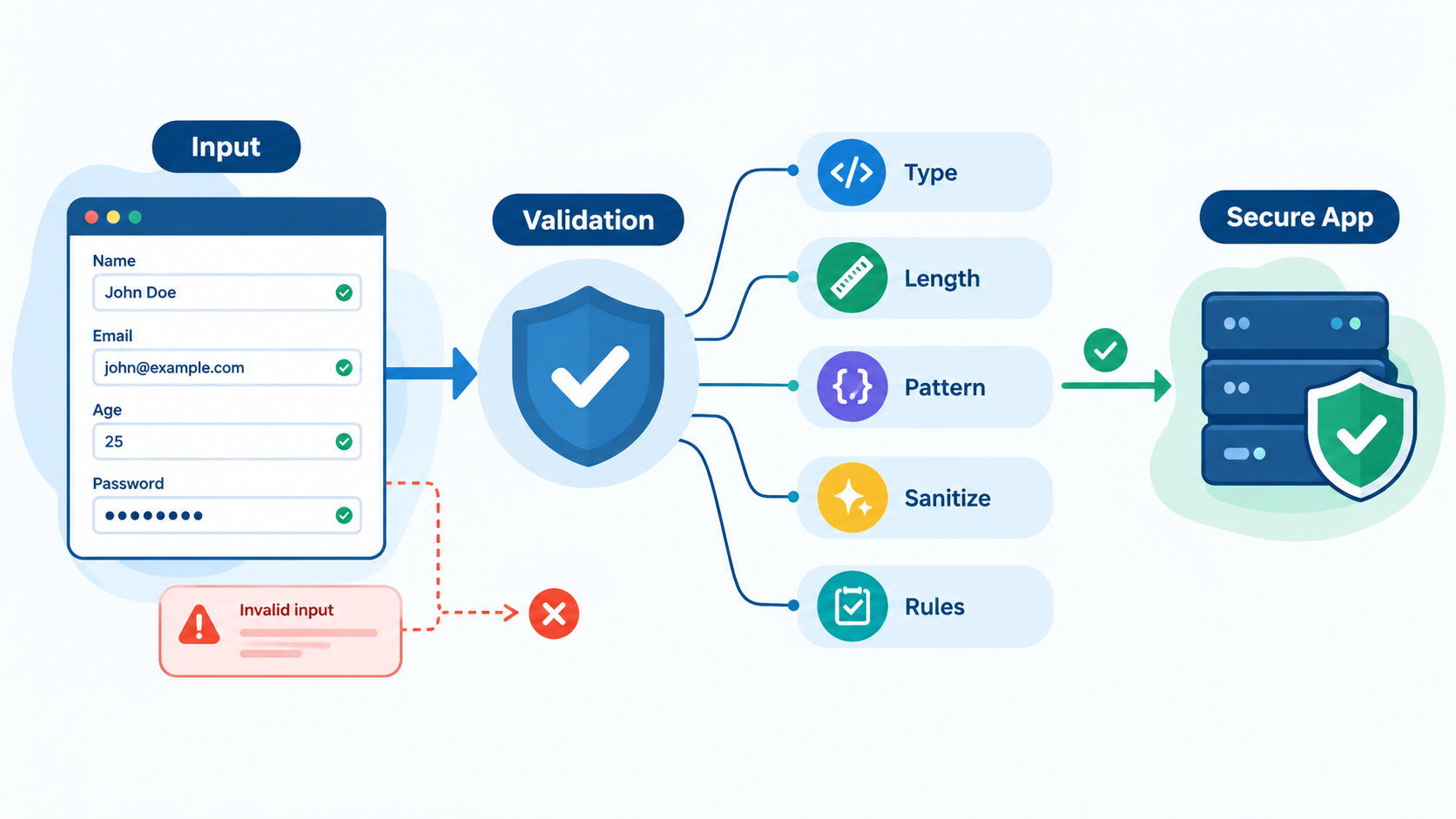

Input validation frameworks help developers control what data enters an application. The common features input validation frameworks provide include type checking, length limits, pattern matching, sanitization, and custom validation rules. These features help reduce invalid or dangerous input before it reaches sensitive parts of your code.
They also make security rules easier to reuse and maintain across an application. At Secure Coding Practices, we focus on practical ways to build safer and more reliable software. Keep reading to see what these features actually do.
Key Insight
Before looking at each feature in detail, here are the main points to remember:
- They standardize security, turning complex checks into reusable rules.
- They separate validation logic from business logic, making code cleaner and easier to test.
- They provide a common defense against top vulnerabilities like injection attacks and XSS.
What Exactly Are We Talking About When We Say Input Validation?
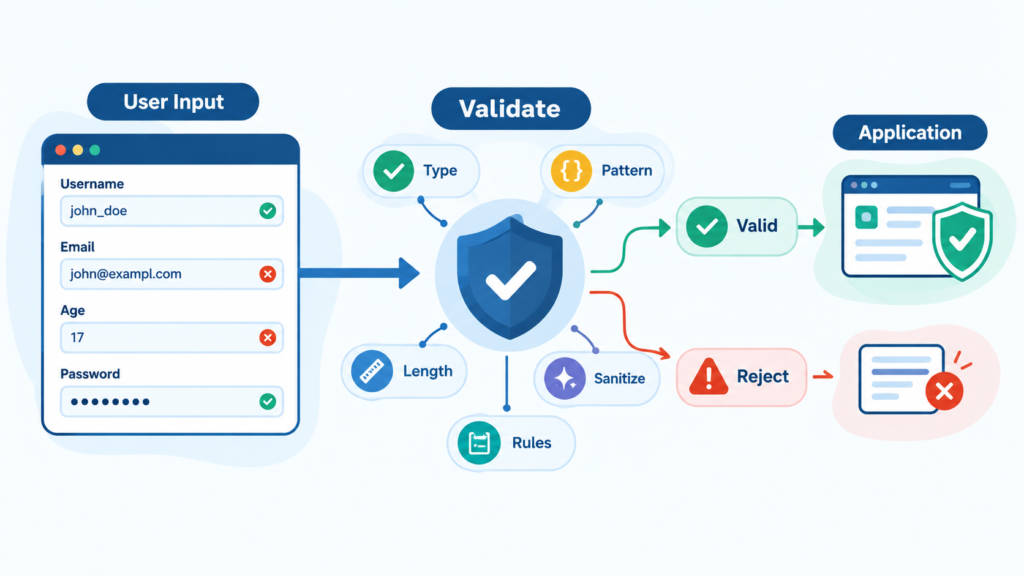
You write a function that asks for a user’s age. A user types in “twenty-five” or maybe “25; DROP TABLE users;”. What does your code do now. Input validation is the process of checking that incoming data meets specific criteria before your application uses it. It’s the first, best line of defense.
A framework for this isn’t just a library, it’s a structured approach, a set of conventions and tools that make this checking consistent across your entire project.
Think of it as the rulebook your application uses to decide if data gets to play or gets shown the door. Input validation frameworks can also help teams apply these rules consistently across different parts of an application.
Without a framework, validation logic gets scattered. One developer checks an email in the controller, another does it in the service layer, a third forgets entirely. It’s a mess. A framework brings order. It says, “Here’s how we define a valid email address for this app, and here’s where that rule lives.”
What Are the Non-Negotiable Features These Frameworks Provide?
Most reliable validation frameworks share a core set of features. The exact syntax may differ, but the main purpose is the same: check incoming data, reject invalid values, and keep application logic consistent.
- Data type and format checking: Makes sure a string is actually a string, a number is a number, and an email follows a basic email format such as user@domain.tld.
- Length and range validation: Prevents values from going beyond reasonable limits. For example, a username should not contain hundreds of characters, while a product quantity should not be negative.
- Pattern matching: Uses rules such as regular expressions to validate structured data. Common examples include phone numbers, postal codes, usernames, and password requirements.
- Sanitization and encoding: Helps make accepted input safer before it reaches other parts of the application. This can include encoding special HTML characters or removing unwanted control characters.
- Custom validation rules: Lets developers add business-specific checks. You might need to confirm that an email is unique, a coupon is still valid, or a requested quantity is available.
The real value comes from combining these features into one consistent process. Instead of scattering validation across controllers, components, and database calls, a framework gives developers a structured place to define and reuse common rules. This can make validation easier to maintain as an application grows.
| Feature | What It Checks | Common Vulnerability It Prevents |
| Data Type/Format | Is it the right kind of data (string, integer, email format)? | Logic errors, some injection flaws. |
| Length & Range | Is it within acceptable size or numerical bounds? | Buffer overflows, integer overflows. |
| Pattern Matching | Does it match a specific pattern (like a phone number)? | Data corruption, application errors. |
| Sanitization | Can I transform it to be inherently safer (encode, strip chars)? | Cross-Site Scripting (XSS), injection. |
| Custom Rules | Does it meet my unique business logic (unique username, valid date range)? | Business logic flaws, data integrity issues. |
How Do These Features Actively Thwart Attacks?
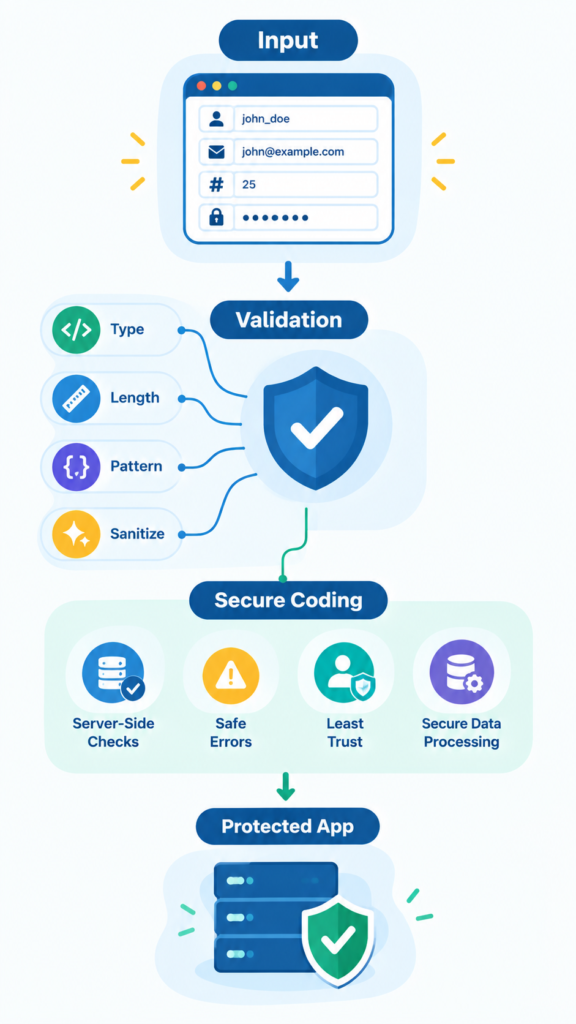
Let’s move from theory to the battlefield. A web form asks for a “description.” An attacker types in <script>malicious_code()</script>. Without validation, that script might get stored and later executed in another user’s browser.
That’s XSS. A framework with proper validation and sanitization stops it cold. The validation might flag the script tags as an invalid pattern for a description field, or the linked sanitization would encode those angle brackets, rendering the script inert.
“This chapter presents some of the most useful controls that are included in ASP.NET: the validation controls. These controls take a potentially time-consuming and complicated task, verifying user input and reporting errors, and automate it. Each validation control, or validator, has its own built-in logic. Some check for missing data, others verify that numbers fall in a predefined range, and so on. In many cases, the validation controls allow you to verify user input without writing a line of code.” – Springer
Consider SQL injection. An attacker puts ‘ OR ‘1’=’1 into a login field. A naïve query might interpret this as a always-true condition, granting access.
Client-side validation can provide an early check that the field contains a well-formed email address, but server-side validation should still reject the odd string before it reaches sensitive application logic. Even if it’s not a format check, a length limit can help control unexpected input.
Where Do Teams Typically Struggle When Implementing This?
Credits: Milan Jovanović
Teams often face a few practical challenges when adding validation to an application. The problem is usually not the validation itself, but deciding how much validation is needed and where it should live.
- Performance concerns: Developers may worry that checking every input will make an application slower. For most business applications, basic validation adds very little overhead. The bigger cost often comes from fixing invalid data, security problems, or database errors later.
- Duplicated validation logic: The same email or password rules may appear in registration, login, contact, and newsletter forms. Copying these rules creates maintenance problems because one rule may be updated while another is forgotten.
- Inconsistent rules: Different parts of an application may handle the same input differently. One form might allow special characters in a name while another rejects them, creating an inconsistent user experience.
- Overly strict validation: Rules that are too restrictive can reject legitimate users. Names, addresses, and other personal information may contain characters that simple validation rules do not expect.
- Unclear business requirements: Teams sometimes struggle to decide what should actually be considered valid. A framework cannot make that business decision for them, but it can provide a consistent structure for implementing the final rules.
The goal is not to validate everything as strictly as possible. Good validation focuses on clear, necessary rules that protect data while allowing legitimate input.
Can Secure Coding Practices Make These Frameworks Work Better?
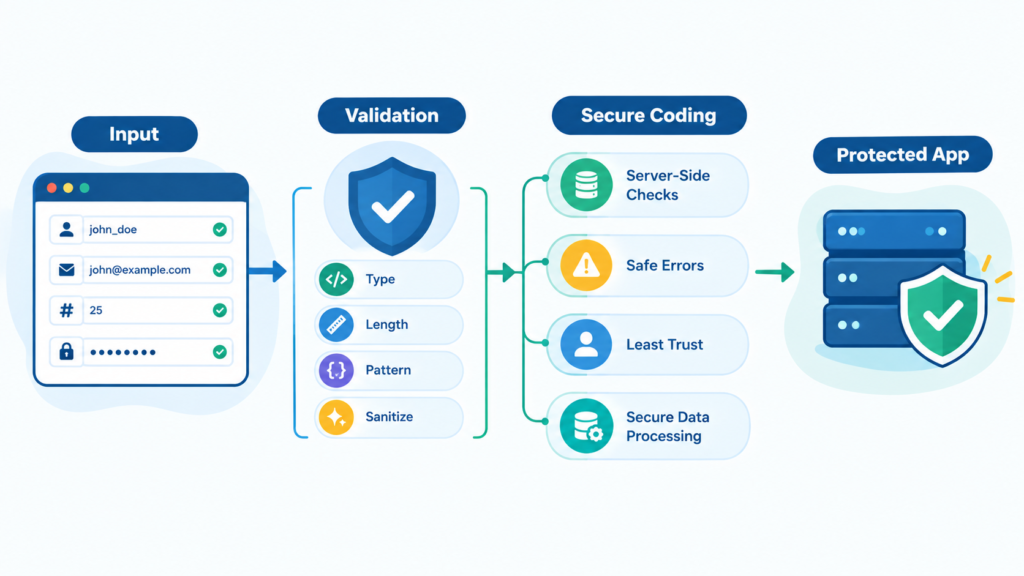
Absolutely, and it’s the best partnership in software security. Think of a framework as a powerful, pre-fabricated fence. Secure coding practices are the knowledge of where to place that fence for maximum effect.
We might use a framework to validate that a file upload has a .jpg extension. Secure coding teaches us to also apply server-side validation by checking the file’s magic number header, renaming it upon storage, and serving it from a separate domain.
Secure coding teaches us to also validate the file’s magic number header on the server-side, rename it upon storage, and serve it from a separate domain. The framework handles the first, standardized check, our practices guide the deeper, layered defense.
The practices inform the rules. A framework lets you say “this field is a number between 1 and 10.”
“Input validation is a valuable tool for securing an application. However, it should be only part of a defense-in-depth strategy, with multiple layers of defense contributing to the application’s overall security.” – ScienceDirect
Secure coding principles ask, “Is that the right range? What’s the business context? Does the user providing this number have the right to set it to 10?” The practices push validation beyond simple syntax (does it look right) into semantics (does it make sense in this context).
We use the framework’s custom rule feature to build these semantic checks, like ensuring a user can only cancel their own order, not any order ID they guess.
FAQ
Don’t these frameworks make my code more complex?
Initially, yes, there’s a learning curve. But they drastically reduce complexity in the long run. They replace scattered, ad-hoc validation code littered across your codebase with centralized, declarative rules. This makes the code easier to read (“this input requires a valid email”) and much easier to maintain and test.
Is client-side validation enough if I use a framework?
Never. Client-side validation is for user experience, to give quick feedback. It can be bypassed in seconds. A server-side validation framework is for security and data integrity. It’s the final, non-negotiable authority that actually protects your application and your data. Always use both, but never trust the client.
What’s the difference between validation and sanitization?
Validation is about judging input. It answers “is this allowed?” with a yes or no. Sanitization is about transformation. It answers “how can I make this safe?” by changing the input, like encoding HTML characters. A good framework lets you do both, but it’s critical to know which you’re doing and when.
How do I handle validation errors without a poor user experience?
The key is clear, actionable error messages from your framework. Don’t just say “invalid input.” Say “Please provide a valid email address (e.g., name@example.com).” Return errors in a structured way (like a JSON object with field-specific messages) so your front-end can display them cleanly next to the relevant form field, guiding the user to fix the issue.
Bringing It All Together for More Resilient Software
Input validation frameworks are practical tools for making applications safer and more reliable. Type checking, length limits, pattern matching, sanitization, and custom rules help teams handle untrusted data more consistently.
The goal is not to add unnecessary complexity, but to build security into everyday development. For hands-on training in input validation, authentication, encryption, and other secure coding practices, explore the Secure Coding Practices Bootcamp.
References
- https://rd.springer.com/chapter/10.1007/978-1-4302-4252-9_9
- https://www.sciencedirect.com/topics/computer-science/malicious-input