
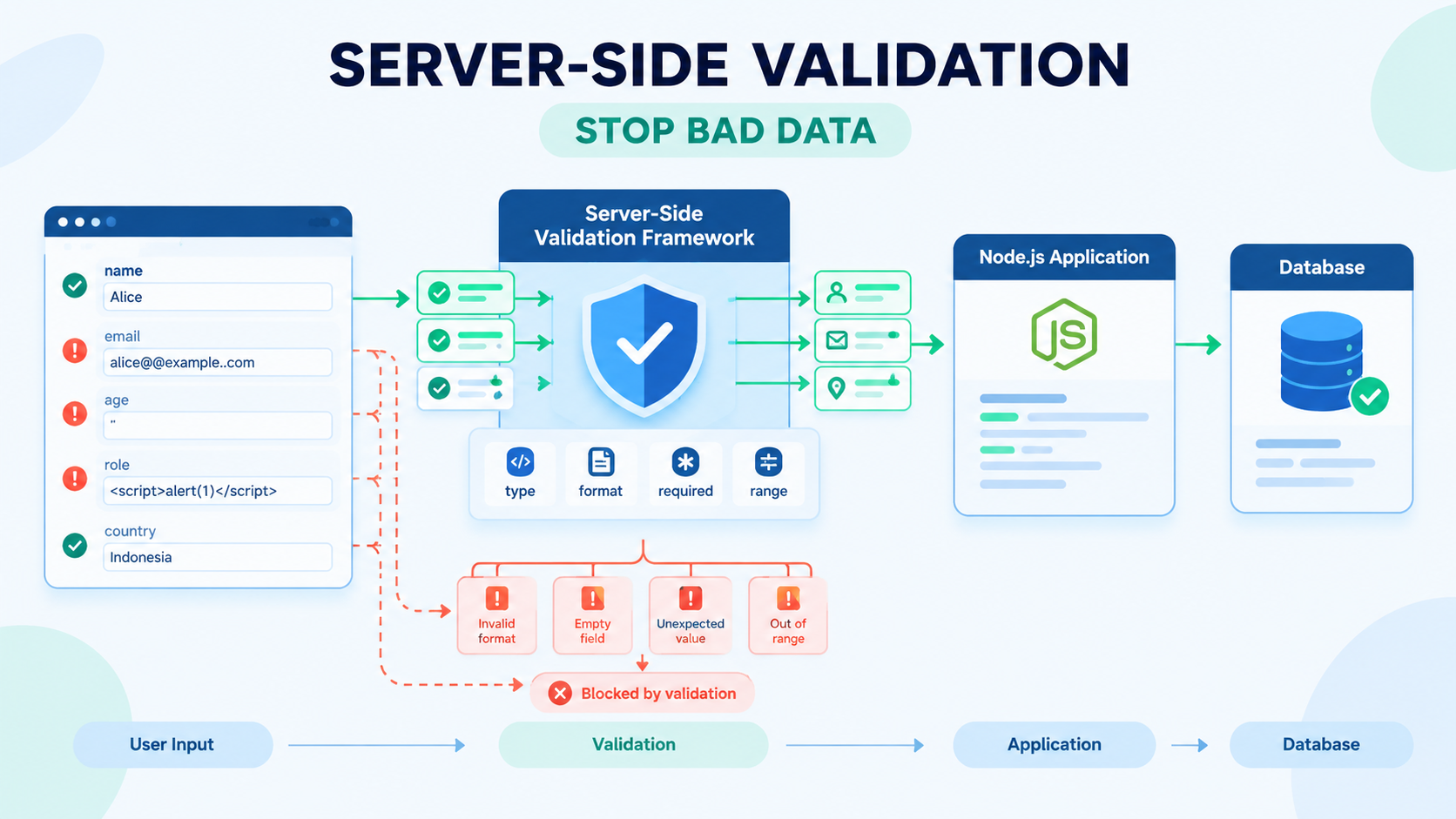

You built your Node.js API, and it works perfectly with test data. But real users can send invalid, unexpected, or even malicious input. A server side validation framework Node js helps check that data before it reaches your application logic.
At Secure Coding Practices, we know that strong validation can make Node.js applications safer, cleaner, and easier to maintain. In this guide, we’ll explain how server-side validation works and what to look for in a framework. Keep reading.
What Good Validation Brings to Your App
Good server-side validation does more than stop incorrect data. It creates a reliable layer between user input and your application logic. Here are three things to keep in mind:
- Server-side validation is a non-negotiable security layer, distinct from and complementary to client-side checks.
- A dedicated framework centralizes rules, making your code cleaner, more consistent, and far easier to maintain.
- The best framework for you balances robust feature sets with a developer experience that fits your team’s workflow.
What is Server-Side Validation and Why Can’t I Skip It?
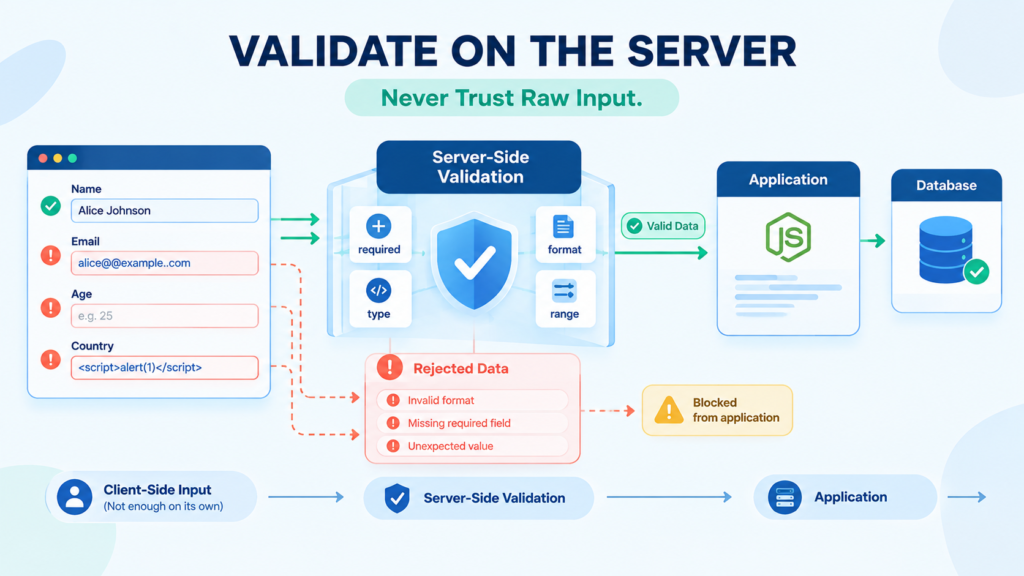
You’ve probably done some form validation before, maybe a quick check in your route handler. If the email field is empty, you send back an error. That’s validation, sure, but doing it ad-hoc, scattered across your codebase, is a recipe for inconsistency and missed vulnerabilities.
You might think, “But I do validation on the client side.” That’s good for user experience, providing instant feedback. But it’s utterly useless for security. A client-side check can be bypassed in seconds with a browser’s dev tools or a simple curl command.
Server-side validation is your last line of defense, the only validation that truly matters for the integrity of your data and the safety of your system. It ensures that no matter what hits your endpoints, the data conforms to your expectations before you store it or act upon it.
We learned this the hard way early on. A simple contact form, validated only with JavaScript, ended up flooding a database table with thousands of junk entries from a script. The server dutifully accepted everything. After that, we made a rule: all data is guilty until proven valid by the server.
- Ensures data integrity before it reaches your business logic.
- Prevents malformed data from causing runtime errors or logic bugs.
- Acts as a critical barrier against injection attacks and other exploits.
What Are My Options for Validating Data in Node.js?
The Node.js ecosystem offers several paths, from writing everything yourself to using comprehensive libraries. It’s a spectrum.
On one end, you have manual validation. It’s straightforward at first, but it quickly becomes a maintenance nightmare. Using input validation frameworks can help move these checks into a more structured and reusable part of the application.
“Input validation must always be done on the server-side for security. While client side validation can be useful for both functional and some security purposes, it can often be easily bypassed. This makes server-side validation even more fundamental to security.” – Wikipedia
Rules are duplicated, error messages are inconsistent, and as the app grows, the validation logic becomes a tangled web that’s hard to reason about.
Then you have the built-in assertion and checking methods. You could use typeof, regular expressions, or Node’s own assert module.
This is a step up from purely manual work, but it still leaves you building the architecture. You’re responsible for collecting errors, formatting responses, and ensuring coverage across all endpoints. It’s a lot of boilerplate you’ll write again and again.
How Do I Choose the Right Validation Framework?
With a few good options available, choosing can feel tricky. It’s not always about which one has the most features. It’s about which one fits your project’s needs and your team’s mindset.
Start by looking at the complexity of your data structures. Are you validating simple flat objects, or deeply nested schemas with conditional logic? Some frameworks handle complex, nested validation more elegantly than others.
Consider the syntax and API style. Some use a fluent, chainable API (like Joi.string().email().required()), while others might be more configuration-based. Your team should find it readable and intuitive.
Performance is another factor, though for most API workloads, the overhead of any major framework is negligible compared to the network and database calls. What matters more is the bundle size if you’re shipping code to the frontend as well.
But before you even evaluate a specific framework, there’s a foundational concept we always prioritize: Secure Coding Practices. This isn’t a competing library; it’s the mindset you bring to the table. It means choosing and using a framework with security as a primary goal.
What Does Integrating a Framework Actually Look Like?
Credits: Weblesson
Let’s get practical. Integration usually starts with installing your chosen package via npm. Then, in your route handler or controller, you import it. The typical flow is simple: you define a validation schema, you pass the incoming request body (or query params) to the validation function, and then you handle the result.
If the validation passes, you get a sanitized, validated data object you can trust. If it fails, you get a detailed error object you can format and send back to the client.
For example, in a POST /api/users endpoint, you wouldn’t start by creating the user in the database. You’d first validate the incoming payload against your user schema. This keeps your controller clean.
The validation logic is separated, testable on its own, and reusable across different endpoints that might accept similar data. The actual business logic, saving to the database, sending a welcome email, only runs once you know the data is sound.
Can You Compare Some Popular Frameworks?
It’s helpful to see them side-by-side. Looking at popular input validation frameworks can also help put the different approaches into context. Remember, this isn’t about declaring a single winner, but highlighting different approaches to suit different tastes.
| Framework | Philosophy | Key Strength | Good For |
| Joi | Robust, feature-complete schema description. | Extensive API with very granular rule control. | Complex enterprise applications where detailed validation is critical. |
| Yup | Concise, client-side first but server-ready. | Lean API, easy to learn, great for isomorphic apps. | Projects that need similar validation on frontend and backend. |
| Validator.js | A collection of single-purpose functions. | Lightweight, offers pure validation functions without schemas. | Simple validations or when you want maximum control without a schema system. |
| Express-validator | Middleware built on Validator.js. | Tight integration with Express, sanitization included. | Express.js apps where you want validation as part of the request pipeline. |
Each has its place. Joi feels thorough, like a comprehensive rulebook. Yup is snappy and gets the job done with less code. Validator.js is the toolbox, you grab just the wrench you need.
Express-validator wraps that toolbox into a convenient Express middleware. Your choice often comes down to the vibe. Do you want a powerful, all-encompassing system, or a set of sharp, simple tools?
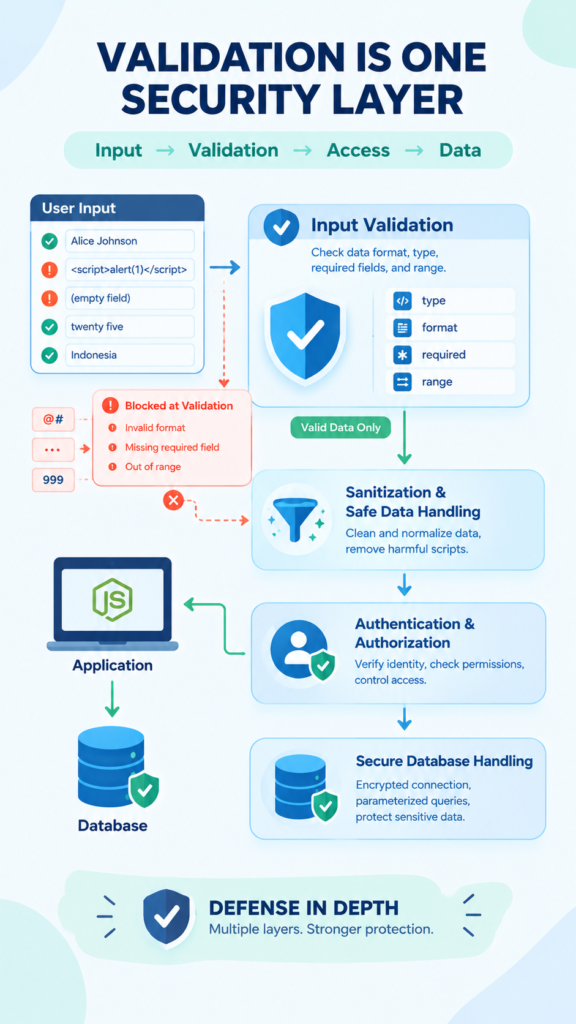
How Does Validation Fit Into the Bigger Security Picture?
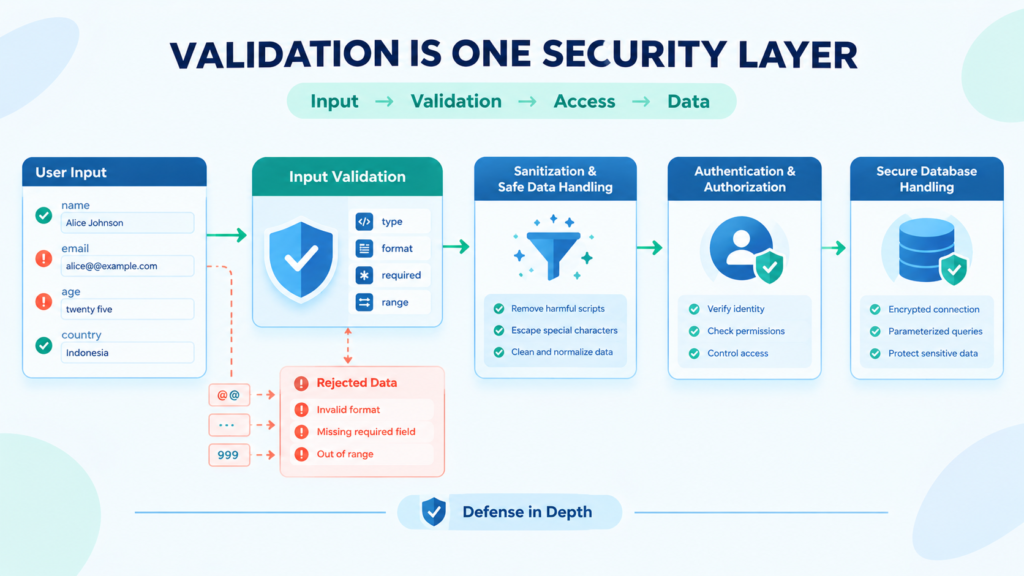
A validation framework is a powerful tool, but it’s just one part of your application’s security posture. Think of it as a filter at the entrance. It stops obviously malformed data, garbage in, garbage out.
The benefits of a validation framework become clearer when validation is combined with other security practices. Validation should work in concert with other practices.
After validation, you still need to use parameterized queries or an ORM to prevent SQL injection. The validation framework might have checked that a field is a string, but it won’t stop a SQL injection if you concatenate that string directly into a query.
“When processing user input in forms and in a more general context, the input data must be validated to ensure that the data is correct and does not cause security issues. This validation can and should be performed both on the client and on the application server. Despite the similarity of the validation rules in both environments, the implementations of these validation phases are almost always separated due to differing technologies used on both sides.” – Medium
You still need proper authentication and authorization to ensure a user can only perform actions on their own data. Validation checks the shape and content of the data, not the permissions of the sender.
We think of it as a partnership. The validation framework ensures the data is clean and conforms to rules. Then, our Secure Coding Practices handle the rest, using prepared statements, hashing passwords with bcrypt, setting appropriate CORS headers, and logging appropriately.
FAQ
Is client-side validation still necessary if I use a server-side framework?
Absolutely, but for different reasons. Client-side validation is about user experience. It gives immediate feedback, like “that’s not a valid email format,” without a round trip to the server. It makes your app feel snappy and helpful. Just never, ever rely on it for security. Always assume the request hitting your server has bypassed all client-side checks.
How do I handle validation errors in my API responses?
Consistency is key. Your framework will give you error details. Format them into a predictable structure, like an errors array containing objects with field and message properties. Use a consistent HTTP status code, usually 400 (Bad Request) or 422 (Unprocessable Entity). This makes life much easier for developers consuming your API.
Can I validate nested objects and arrays?
Yes, all the major frameworks support this extensively. You can define schemas for objects within objects, arrays of specific types, or arrays of other complex objects. This is where they truly outshine manual validation, managing complexity that would be very verbose and error-prone to write by hand.
Does using a framework impact my application’s performance?
In nearly all real-world cases, the impact is negligible. The time spent validating a JSON payload is microscopic compared to database operations or network latency. The benefits in code quality, maintainability, and security far outweigh any trivial performance cost. Premature optimization here is a mistake.
Building Confidence, One Validation at a Time
Adopting a server-side validation framework for Node.js helps turn scattered input checks into a structured part of your application. It can reduce malformed-data bugs, keep validation rules consistent, and make your code easier to maintain. Start with one endpoint and apply clear validation rules before expanding across your app.
For practical training, the Secure Coding Practices Bootcamp gives developers hands-on practice with input validation, OWASP Top 10 risks, authentication, encryption, and safe dependency use. It helps teams build safer Node.js applications with practical skills.
References
- https://en.wikipedia.org/wiki/Nodejs
- https://medium.com/@saudpatel.mscit22/server-side-validation-and-sanitization-using-zod-in-node-js-55e46e126635