
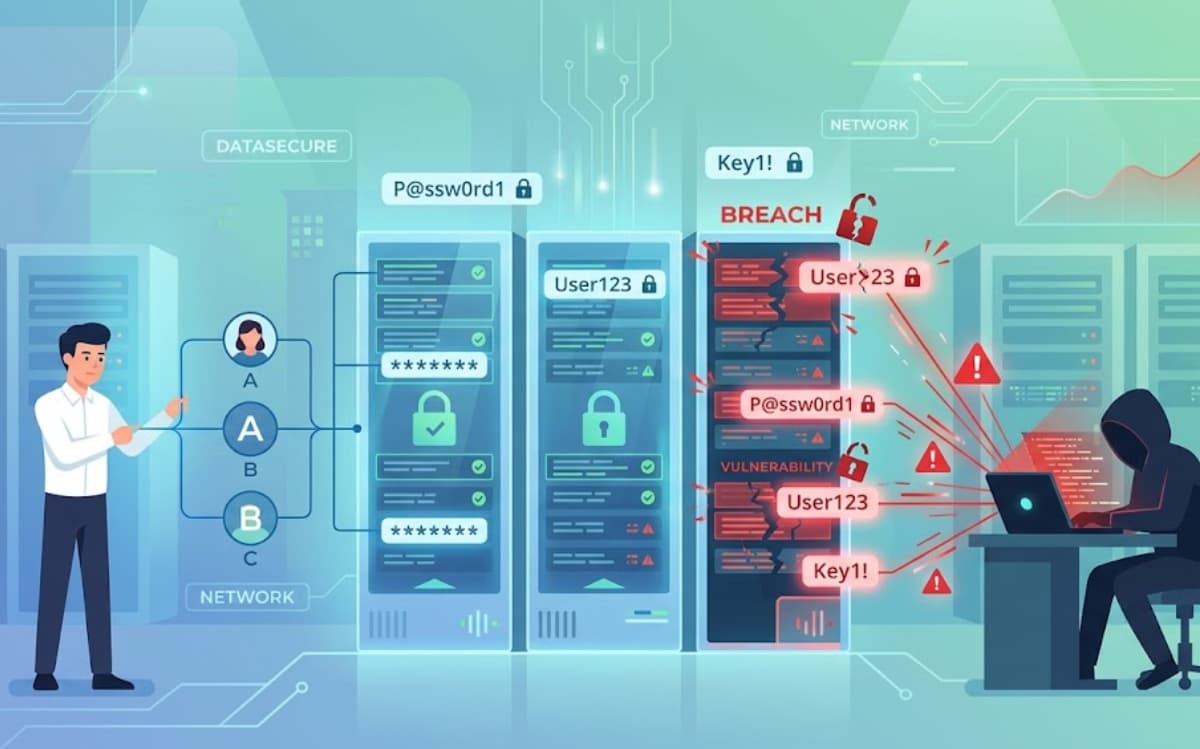

Poor password storage directly exposes user accounts to theft and fraud. When passwords are stored in plaintext, with weak hashes, unsalted hashes, or reversible encryption, a single breach can compromise millions of users.
Attackers focus on databases, not individual passwords, turning small weaknesses into large-scale breaches that trigger identity theft, financial loss, and regulatory action. Organizations must recognize these tangible risks and address them through proper storage techniques and secure coding practices.
This article breaks down how insecure storage occurs, the threats it generates, and actionable defenses. Keep reading to understand the strategies that can protect your data and users.
Quick Lessons from Real Password Breaches
These incidents highlight why insecure password storage is a persistent risk and why modern security practices are essential.
- Facebook 2019: Hundreds of millions of passwords were stored in plaintext, exposing internal accounts.
- Many SHA-1 hashes were quickly cracked due to lack of salting and widespread password reuse.
- Adobe’s 2013 breach exposed approximately 150 million encrypted passwords and password hints, weakening user security.
Why Is Storing Passwords in Plaintext So Risky?
Storing passwords in cleartext is the simplest and most dangerous mistake. There is no technical barrier at all between attackers and user credentials, and in some systems, even minor coding flaws like Cross‑Site Scripting (XSS) can amplify the risk of account takeover.
“Passwords should never be stored in plain text. Instead, they must be protected using strong, slow hashing algorithms such as Argon2id, bcrypt, or PBKDF2 … Fast hashing algorithms such as SHA‑256 are not suitable for password storage because they allow attackers to perform large numbers of guesses quickly.” – OWASP Password Storage Cheat Sheet
In my ten years auditing corporate networks and running defensive engineering boot camps, I consistently find teams who assume their internal employees are perfectly trustworthy.
In reality, even a single mistake, a misconfigured server, or a rogue SQL query can cause massive exposure. A single misconfigured server or a basic database leak can expose hundreds of thousands of active accounts before an IT team even detects the intrusion.
Real-World Example
Facebook 2019: Engineers had the ability to read hundreds of millions of user passwords in plaintext for years. The potential for misuse was enormous. And not theoretical. Reports indicated internal systems allowed access to plaintext passwords, increasing insider risk.
How Do Weak and Unsalted Hashes Create Security Risks?
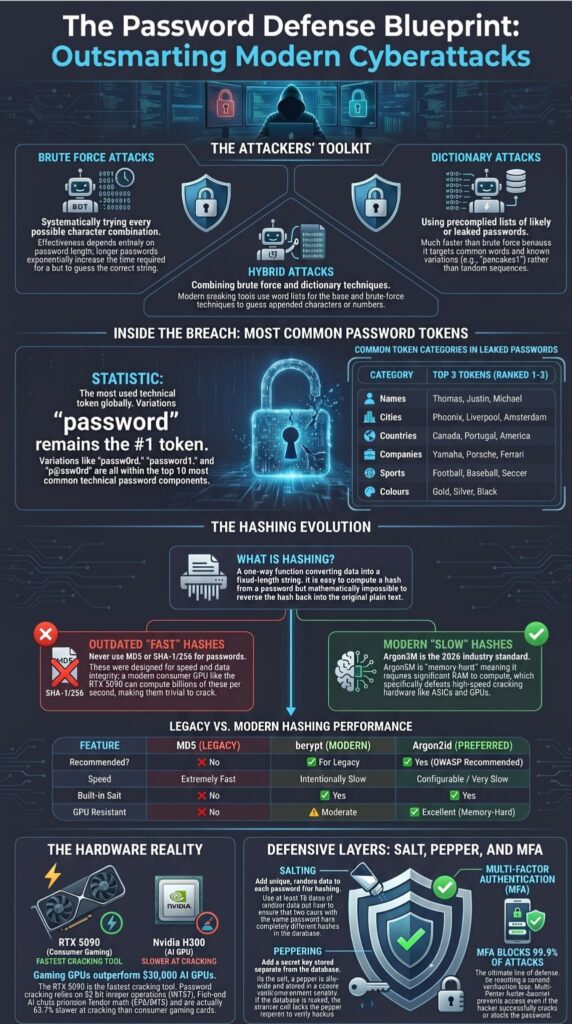
Legacy systems still rely heavily on MD5 and SHA-1 because they are lightweight. Unfortunately, because modern computers can process these formulas so quickly, older databases offer virtually zero protection against a direct attack. These legacy hashing issues are a common example of broken authentication risks.
“Hashing algorithms are commonly used to convert passwords into hashes which theoretically cannot be deciphered. However, simple and outdated algorithms like MD5 present security risks in password storage by being susceptible to attacks such as dictionary and rainbow table attacks unless properly salted and iterated.” – Mary Cindy Ah Kioon, et al.,
That means one cracked hash can expose hundreds or even thousands of accounts. We have trained teams who initially assumed that long passwords alone would protect users. It isn’t enough. Not even close.
Passwords that seem strong on the surface can be dangerously weak in the database. Identical hashes, repeated patterns, legacy code. These factors together make cracking almost effortless.
During our live lab sessions, I have my students run basic cracking tools against default, un-iterated database dumps. Watching a standard graphics card crack thousands of employee passwords in under two minutes completely resets their perspective on internal security.
Case Studies
- LinkedIn 2012: Millions of SHA-1 hashes were cracked in just hours. Weak and reused passwords were exposed immediately.
- Adobe 2013: Unsalted hashes allowed attackers to deduce common passwords across 150 million accounts.
Table of Hash Risks vs. Modern Standards
| Hash Type | Security Risk | Example Breach | Recommended Alternative |
| MD5 | Fast to brute-force | LinkedIn 2012 | Argon2id, Bcrypt |
| SHA-1 | Fast and collision-prone | LinkedIn 2012 | Argon2id, Bcrypt |
| Unsalted | Identical hashes reveal passwords | Adobe 2013 | Salted with adaptive KDF |
| AES (reversible) | Can be decrypted if key exposed | Legacy enterprise apps | One-way hashing with HSM/KMS should protect peppers or keys, not replace hashing |
Why Is Reversible Encryption Dangerous for Passwords?
Encryption is reversible, by design. That is its purpose. But this is also its danger. If the decryption key is exposed, passwords are fully compromised. There is no one-way barrier, no fallback, nothing to slow down an attacker.
We have seen teams who stored passwords in AES thinking that administrative access might be needed for support. It makes sense at first. But if a Local File Inclusion or Remote Code Execution vulnerability occurs, the database and the key are both compromised at the same time. Nothing protects the users. Absolutely nothing.
Example
Administrators retrieving passwords for support inadvertently increase risk if the system is breached. It is counterintuitive but true. One oversight can undo years of work.
How Credential Stuffing Amplifies Data Breaches

When attackers obtain leaked credentials, they reuse them across multiple services in part because this form of reuse is one of the most effective vulnerabilities & attacks against user accounts. Bots automate this process and target high‑value accounts like email, banking, and social media.
We teach our students that strong security in one system is not enough if users reuse passwords elsewhere. One compromised service can create a domino effect. One weak password. And suddenly attackers can compromise multiple accounts belonging to the same person.
Consequences
- Identity theft and financial fraud
- Sale of personally identifiable information on the dark web
- Targeted phishing campaigns using stolen credentials
How Can Modern Password Storage Practices Reduce Large-Scale Breaches?
We’ve spent years teaching development teams how to protect passwords properly. Adaptive hashing, unique salts, and pre hashing are not just buzzwords. They are tools that slow attackers and limit damage when databases are compromised. Using Argon2id or Bcrypt is standard practice now, but implementation matters.
Memory. It’s a factor people overlook. Argon2id requires careful parameter tuning to balance security and performance. Bcrypt truncates long passwords at seventy two bytes. Pre-hashing may be used in specific cases, but must be implemented carefully.
HSMs protect secrets like peppers, reducing risk but not eliminating offline cracking if hashes are exposed.
What Are the Practical Limitations and Edge Cases in Password Security?
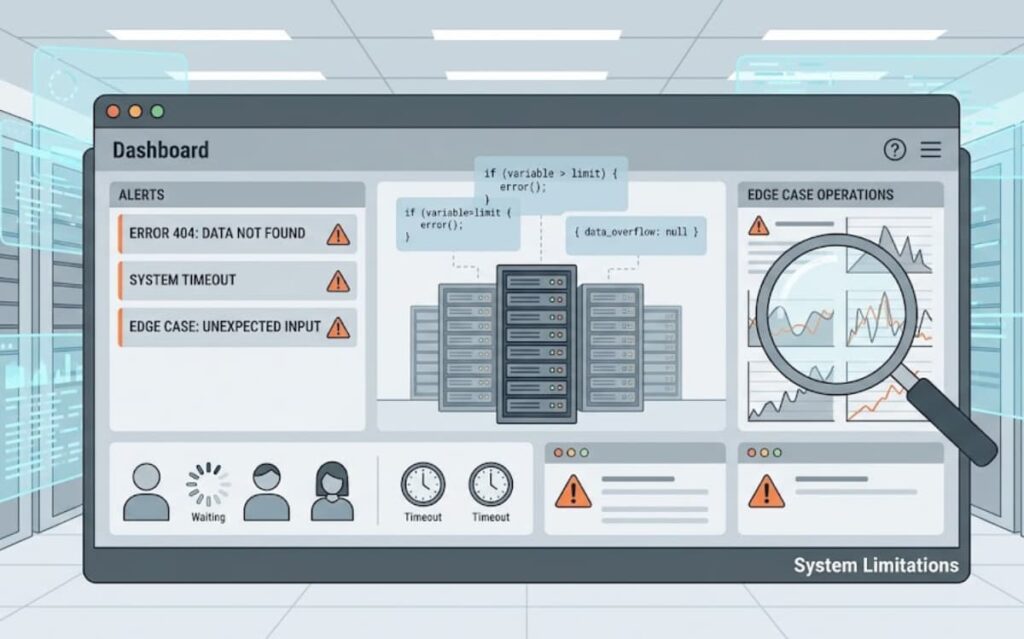
Real life is messy. Sometimes we inherit legacy systems that insist on reversible encryption or older hashes. Integration with Active Directory, mainframes, or third party services complicates everything.
We’ve guided teams who faced pepper exposure risk when servers were compromised. There is no perfect solution. But acknowledging constraints is the first step toward reducing risk.
How Can Organizations Strengthen Password Storage?
If a user creates a long passphrase, standard bcrypt cuts it off completely at 72 bytes. That means any characters typed after that limit are completely ignored by the database.
To fix this safely, our standard engineering pipeline feeds the raw password into a SHA-256 function first. This instantly condenses any long password into a predictable, high-entropy 32-byte string. From there, we feed that string into Argon2id, specifically configured to use at least 15 megabytes of memory and 2 processing iterations.
Finally, we mix in a secret value called a ‘pepper.’ Unlike a standard salt that sits right in the database table, this key is locked away inside a Hardware Security Module (HSM). If an attacker steals the database, they still cannot run an offline attack because they lack the physical hardware key.
What Are the Real-World Consequences of Insecure Password Storage?
Source: IBM Technology
The risks are clear. Account takeover. Credential reuse attacks. Financial fraud. Identity theft. Reputation damage. Regulatory penalties. System compromise. Even ransomware entry points.
We have seen teams underestimate the human impact of insecure password storage. It’s not just about technical risk. Users lose trust. Banks investigate. Regulators fine. And the press notices.
| Risk Consequence | Impact |
| Account Takeover | Attackers access user accounts, impersonate users, steal data |
| Credential Stuffing | Same credentials breach other services |
| Financial Fraud | Unauthorized transactions, bank account access |
| Identity Theft | Personal information stolen and sold |
| Reputational Damage | Loss of trust, lawsuits, regulatory fines |
| Regulatory Penalties | GDPR, HIPAA, PCI DSS violations |
| System Compromise | Attackers gain internal access, escalate privileges |
| Ransomware Entry Point | Stolen credentials enable ransomware deployment |
FAQs
How can insecure password storage lead to credential theft?
Storing passwords in plaintext or using weak hashing algorithms exposes accounts to attackers. Rainbow table attacks, brute force attacks, and dictionary password attacks can compromise credentials quickly when passwords are unsalted or improperly hashed.
Implementing iterative hashing and using strong, adaptive algorithms reduces fast hashing algorithm risks and helps protect against widespread database password exposure.
What risks exist with unsalted or weakly hashed passwords?
When you use old algorithms like MD5 or raw SHA-256, you are using math built for raw speed, not defense. A modern graphics card can guess billions of these combinations every single second.
Without a unique salt attached to every user profile, identical passwords create identical text strings in your database. Attackers use pre-computed cheat sheets called ‘rainbow tables’ to instantly look up and reverse millions of matching values without doing any math at all.
How do password reuse and weak policies amplify breaches?
Password reuse vulnerabilities allow attackers to compromise multiple accounts with a single password. Weak password policies, along with stored password breaches in spreadsheets, text files, or configuration files, make attacks more effective.
Attackers can exploit backup password exposure, log file password leakage, and shared password risks to gain persistent access and potentially escalate privileges across systems.
How can employees accidentally expose passwords externally?
Employees may accidentally expose passwords through email, Slack messages, sticky notes, or source code. Hardcoded password vulnerabilities, .env file password exposure, and GitHub password leaks are common mistakes.
Even unintended sharing can lead to insider threat password abuse, social engineering password theft, and compromise of third-party or contractor accounts, putting organizations at significant risk.
What precautions reduce password interception during transmission?
Passwords transmitted without encryption are vulnerable. API key storage risks, webhook secret exposure, and cloud storage password risks, such as S3 bucket leaks, further increase exposure.
Using proper encryption, avoiding cleartext credential storage, and securing container, server, and database secrets minimizes the risk of man-in-the-middle password intercept and remote credential theft.
Take Control of Password Security Now
Dealing with weak password storage is frustrating, and you know the risks are real. Every breach can cost your team time, trust, and money. You can’t rely on hope or outdated practices, the threat keeps evolving.
Joining the Secure Coding Practices Bootcamp gives you a clear, practical way forward. It’s designed to teach hands-on skills that you can use immediately, from encryption to input validation. Whether you’re upskilling yourself or your team, this program makes secure coding manageable and actionable, so you can stop worrying and start shipping safer code.
References
- https://papers.ssrn.com/sol3/papers.cfm
- https://arxiv.org/abs/2504.17121