


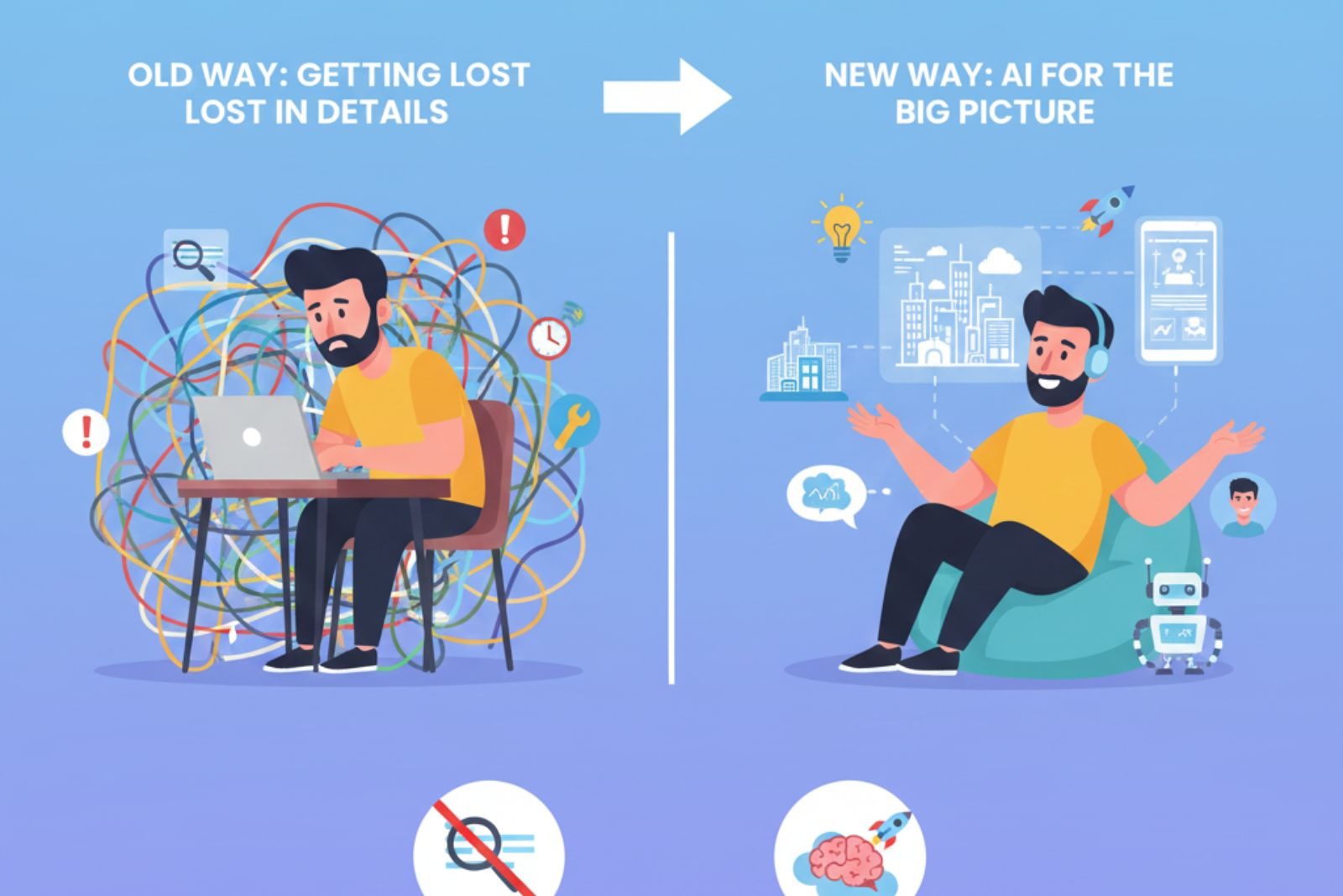
You’re probably spending too much time on the small stuff. The syntax errors, the boilerplate code, the endless debugging. AI is changing that, right now. It’s shifting the entire focus of software development from the microscopic details to the big picture.
Instead of worrying about a missing semicolon, you can think about user experience, system architecture, and business strategy.
This isn’t a future dream. It’s happening today, with 84% of developers already using or planning to use AI tools. The result? A 51% increase in task completion speed and a chance to finally work on what you were hired to do: innovate (1).
Keep reading to see how AI lets you focus to the big picture so you can tackle the bright deas.
Key Takeaways
- AI automates routine coding tasks, freeing up your mental energy.
- Natural language interfaces let you describe intent, not write code.
- Faster prototyping leads to better strategic decision-making.
The Grunt Work Vanishes
You remember the feeling. Staring at a screen for an hour, tracking down a single bug. Or writing the same configuration code for the hundredth time. It’s draining. It’s the kind of work that makes you forget why you started coding in the first place.
AI is taking that weight off your shoulders. Tools like code assistants now handle a huge chunk of this grunt work. They fix errors, write tests, and generate boilerplate. One survey found AI automates about 75% of common development workflows.
That’s three-quarters of the tedious stuff, gone. Suddenly, your brain isn’t clogged with syntax. You have the cognitive bandwidth to actually think. To consider the broader architecture. To ask, “
Does this feature actually solve the user’s problem?” instead of, “Why won’t this compile?” It’s a quiet revolution in daily focus based on fundamental principles of vibe coding.
- Automated error fixing and testing
- Boilerplate code generation
- Optimization suggestions
This change is profound. It’s like having a junior developer who never sleeps, handling all the repetitive tasks. You’re left to do the creative, strategic work. The work that requires a human touch.
Speaking Your Mind, Not a Computer’s Language
The shift goes beyond simple automation. The most exciting change is how we interact with the machine. For decades, we’ve had to learn the computer’s language. Python, Java, C++. Now, the computer is learning ours.
This is the rise of natural language to code process, where conversational intent becomes executable software.
A prompt like “create a function that validates an email address” can generate clean, working code. This is the core of “vibe coding” or “intent-driven development.” You focus on the outcome, the vibe, the intent. The AI handles the implementation details. It’s a higher level of abstraction. You’re thinking about the “what,” not the “how.”
This is incredibly empowering for non-developers, too. So-called citizen developers can now build prototypes and even full applications by describing their needs. It democratizes creation. The hottest programming language is becoming English.
Or whatever language you speak. This conversational workflow is fundamentally changing the developer’s role from a coder to an architect. You are designing with words.
Explosive Gains in Prototyping Speed
The implications are staggering. Prototyping speed has increased five to ten times. What used to take a week can now be sketched out in an afternoon. This acceleration isn’t just about saving time. It’s about enabling a new kind of experimentation.
You can test ideas faster. You can fail cheaply and learn quickly. This rapid iteration cycle is what drives real innovation. Instead of being stuck in a long development cycle, you can get feedback immediately and refine your approach.
The entire process becomes more dynamic and adaptive. It feels less like construction and more like a conversation. You state a goal, the AI presents a solution, you provide feedback, and it refines. This collaborative loop is the core idea in vibe coding fundamentals especially for the future of coding
It’s a partnership between human creativity and machine execution. The key is to provide clear, thoughtful prompts. The quality of your input directly shapes the quality of the output. It’s a new skill to learn, but it’s far more intuitive than memorizing API documentation.
Your New Role: Architect and Strategist
So, if AI is writing the code, what’s left for the developer? This is the most common fear, and it’s based on a misunderstanding. AI isn’t replacing developers. It’s changing their job description for the better. The value of a developer is shifting from the ability to write code to the ability to solve problems.
Your new focus is on the big picture. You are the system architect. You define the requirements. You understand the user’s pain points. You design the overall solution. The AI is your powerful construction crew, building exactly what you design. This is a more rewarding and impactful role.
Senior developers, in particular, are freed from tactical firefighting to focus on strategic direction. They can guide the AI, review its output, and ensure the final product aligns with business goals. This is where human oversight remains critical. AI can generate code, but it can’t understand company culture, long-term vision, or nuanced user needs.
Your role matters more than ever. Companies that use AI are hiring, not cutting.
- 55% of AI-focused firms are adding new jobs.
- 63% created 25 or more new positions.
- These roles include AI ethicists, prompt engineers, and AI workflow managers.
The Tools Making It Happen
This transformation is powered by a new stack of tools that have emerged. They operate at different levels, each contributing to the big-picture shift. The first layer is code generation. These are the tools that most developers encounter first.
They integrate directly into your editor, suggesting code completions, writing functions from comments, and explaining complex code blocks. They are brilliant at handling syntax and common patterns, which is the first step in freeing your mind. The second layer is AI agents. These are more autonomous.
You can give them a broader task, like “add user authentication to this app,” and they can plan and execute the steps needed. They might generate code, run tests, and even deploy changes. They handle full workflows. The third layer is application platforms. ‘
These platforms allow you to describe an entire application in natural language and generate a working prototype almost instantly.
The Three Layers of Intent-Driven Development
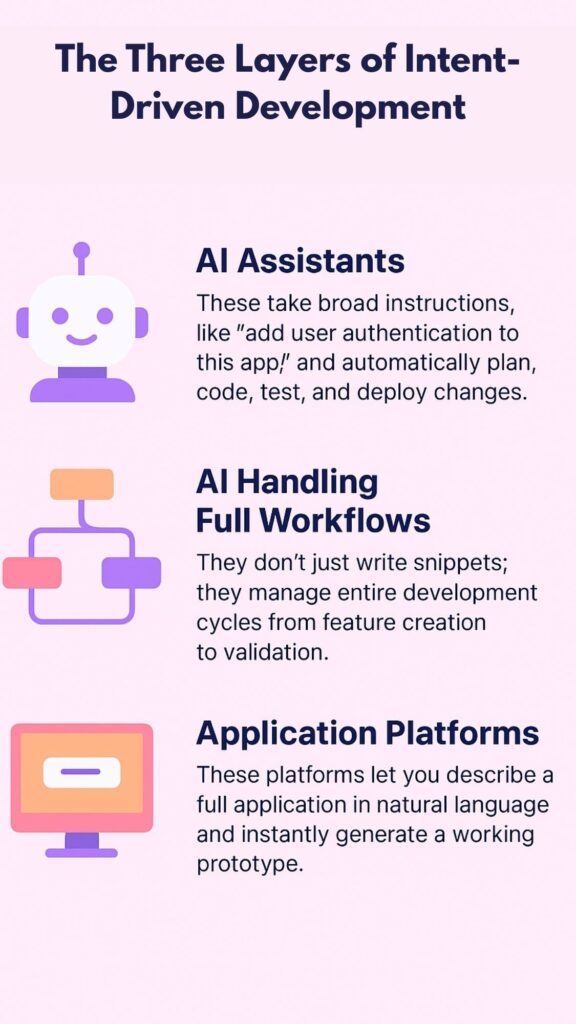
- AI Assistants: These take broad instructions,like “add user authentication to this app”,and automatically plan, code, test, and deploy changes.
- AI Handling Full Workflows: They don’t just write snippets; they manage entire development cycles from feature creation to validation.
- Application Platforms: These platforms let you describe a full application in natural language and instantly generate a working prototype.
A New Collaborative Workflow
Source: Timereaction
These are the new way of collaborative workflow:
- You provide high-level direction and business goals.
- The AI executes the technical work across all layers.
- You evaluate the outcome, give feedback, and refine.
- The cycle becomes adaptive, iterative, and highly collaborative.
Adoption and Market Momentum
Here are the adoption and market momentum that occurred:
- 85% of developers now use AI tools regularly, this is mainstream, not experimental
- Global investment in generative AI is climbing into the billions
- Developer tooling markets are expanding at an unprecedented pace.
- Fortune 500 companies are adopting these systems to maintain a competitive edge (2).
FAQs
How does AI help developers focus on the big picture?
AI takes care of boring tasks like fixing errors and writing basic code. This means developers don’t waste time on small details anymore. They can think about important things like how users will experience the product. AI handles the tedious work, so your brain is free to solve real problems and create new ideas instead of getting stuck on tiny mistakes.
What is natural language programming in AI?
Natural language programming lets you talk to computers in plain English instead of code. You just tell the AI what you want, like “make a login page,” and it writes the code for you. You don’t need to remember complicated syntax anymore.
This makes coding easier for everyone, even people who never learned programming. It’s like having a conversation instead of speaking a foreign language.
Can AI replace human developers completely?
No, AI cannot replace human developers. AI is a helper, not a replacement. Developers are still needed to make big decisions and understand what users really need.
AI writes code, but humans decide what problems to solve and how the final product should work. Companies using AI are actually hiring more people, not fewer. Your job changes to become more creative and strategic instead of just typing code.
How much faster can you build prototypes with AI?
You can build prototypes five to ten times faster with AI tools. Work that used to take a whole week now takes just one afternoon.
This speed lets you test more ideas quickly and learn from mistakes faster. You can try different solutions and get feedback right away. This quick testing helps you find the best answers and make better products without wasting lots of time.
What percentage of developers use AI coding tools?
About 85% of developers now use AI tools regularly. This isn’t just a test anymore,it’s how most people work today.
Another stat shows 84% are either using AI or planning to start soon. These tools help finish tasks 51% faster than before. AI coding assistants have become normal in everyday work, not something rare or experimental that only a few people try.
What is vibe coding or intent-driven development?
Vibe coding means you focus on what you want to happen, not how to make it happen. You describe your goal or the “vibe” of what you need, and AI figures out the technical details.
Instead of writing every line of code yourself, you explain your idea in simple words. The AI then builds it for you. This lets you think like an architect who designs buildings, not a construction worker.
What grunt work does AI automate for developers?
AI handles about 75% of boring daily tasks. It fixes common errors, writes test code, and creates repetitive boilerplate code automatically. AI also gives suggestions to make your code run better.
This removes the frustrating work that drains your energy, like hunting for bugs for hours. You get to skip the tedious stuff and jump straight to creative problem-solving and building cool features.
How does AI change a developer’s role?
Developers become architects and strategists instead of just code writers. Your new job is understanding user problems and designing complete solutions.
You make the big decisions about how systems should work together. AI acts like your construction crew that builds what you design. You guide the AI, check its work, and make sure everything matches business goals. This role is more rewarding and creative than before.
What are the three layers of AI development tools?
The first layer is code assistants that complete your code and explain tricky parts. The second layer is AI agents that handle whole tasks like adding user login systems automatically.
The third layer is application platforms where you describe an entire app in normal language and get a working version instantly. Each layer helps you work at a higher level, focusing less on details and more on the overall vision.
Are companies hiring more people because of AI?
Yes, companies using AI are creating new jobs, not cutting them. About 55% of AI-focused companies are hiring more workers.
Another 63% created 25 or more new positions recently. These new jobs include AI ethicists, prompt engineers, and workflow managers.
AI helps companies grow faster, which means they need more people. The technology creates opportunities for different types of work, making teams bigger and stronger.
Embracing How AI Lets You Focus to The Big Picture
The shift is clear and undeniable. AI is moving the developer’s focus from the “how” to the “what.” It’s lifting us out of the weeds of syntax and into the clear air of strategy and architecture.
This transition amplifies human creativity. It makes software development more accessible, more iterative, and ultimately, more impactful.
The big picture is no longer a luxury for which we never have time. It is becoming the central focus of our work. By embracing AI as a collaborative partner, we can build better software, faster, and focus on the problems that truly matter.
The future of coding is less about code and more about conversation. It’s about defining the problem clearly and guiding the solution intelligently such as in Secure Coding Practices Bootcamp can help you strengthen the engineering side with practical, hands-on skills that fit perfectly alongside Vibe Coding. That’s a future worth building.
References
- https://pmc.ncbi.nlm.nih.gov/articles/PMC9355324/
- https://www.forbes.com/councils/forbesbusinesscouncil/2024/02/08/fortune-500-in-the-ai-era-navigating-disruption-and-seizing-opportunities/
Related Articles
