

Conformity assessment cyber resilience act is becoming a critical requirement as the Cyber Resilience Act (CRA) reshapes how organizations prove product security. Many teams still find this process complex and time-consuming.
From our experience, the real challenge is aligning security, development, and documentation effectively. When approached correctly, conformity assessment becomes a strategic advantage rather than a burden. In this guide, we break it down into practical steps you can apply directly. Keep reading.
Conformity Assessment Cyber Resilience Act Essentials
Conformity assessment is not just an audit, it’s a structured way to prove your product is secure and compliant.
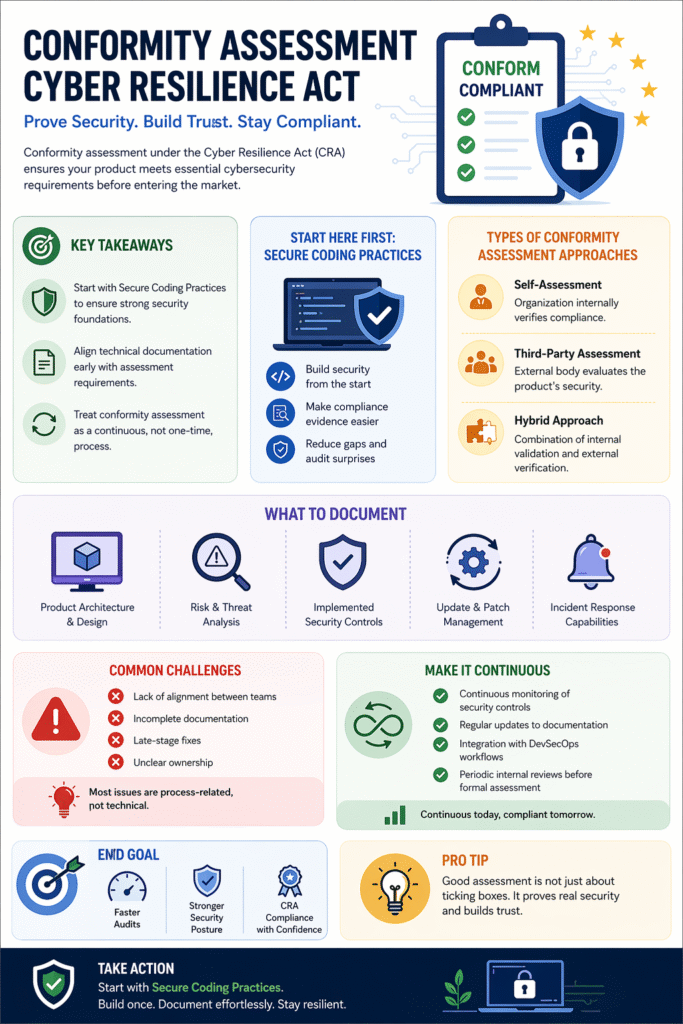
- Start with Secure Coding Practices to ensure strong security foundations
- Align technical documentation early with assessment requirements
- Treat conformity assessment as a continuous, not one-time, process
Understanding Conformity Assessment in the Cyber Resilience Act
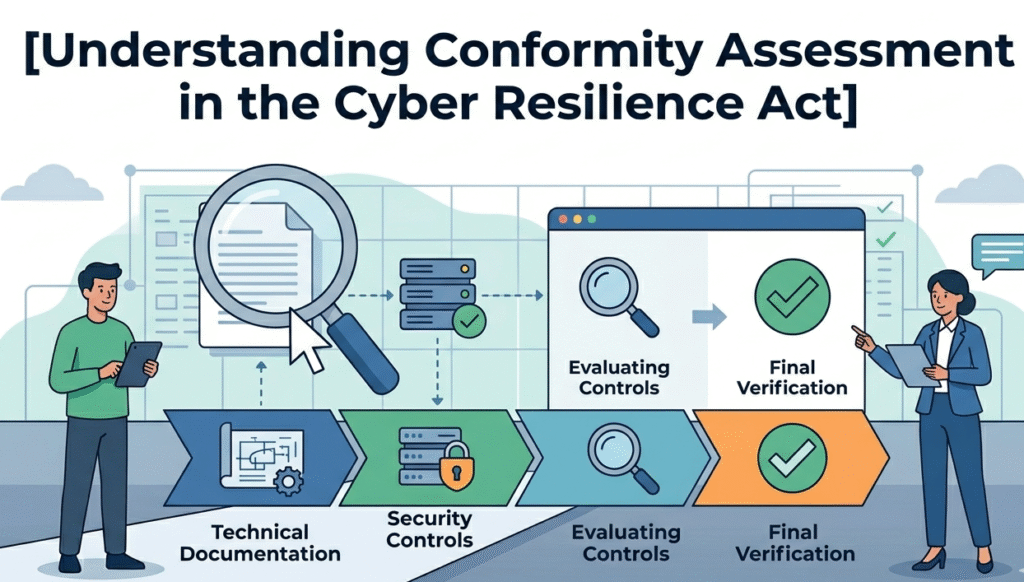
Conformity assessment under the CRA ensures that products meet essential cybersecurity requirements before entering the market.
It typically involves:
- Evaluating security controls
- Reviewing cyber resilience act technical documentation to ensure all architecture details are present
- Verifying risk management processes
- Ensuring lifecycle security practices
From our experience, organizations often underestimate the level of detail required, especially when documentation and implementation are not aligned.
“A conformity assessment is a demonstration that specified requirements relating to a product, process, system, or person have been fulfilled.” – Wikipedia
Start with Secure Coding Practices as Your Foundation
We always begin with Secure Coding Practices because conformity assessment reflects the actual security posture of a product.
When we build securely from the start:
- Evidence for compliance is easier to produce, especially regarding open source obligations Cyber Resilience Act mandates
- Security controls are consistent and traceable
- Fewer gaps appear during audits
Instead of fixing issues late, we ensure that security is embedded into every stage of development. This approach significantly reduces assessment friction.
Types of Conformity Assessment Approaches
Credits: hopelabs
The Cyber Resilience Act allows different assessment pathways depending on product risk and classification.
Common approaches include:
Self-Assessment
Organizations internally verify compliance based on defined requirements.
Third-Party Assessment
An external body evaluates the product’s security and documentation.
Hybrid Approach
A combination of internal validation and external verification.
From what we’ve seen, choosing the right approach early helps avoid delays and unnecessary rework later.
Aligning Technical Documentation with Assessment Requirements
Technical documentation is central to conformity assessment. Maintaining a secure open source and supply chain is a core part of this record.
It should clearly demonstrate:
- Product architecture and design
- Identified risks and mitigations
- Implemented security controls
- Update and patch management processes
- Incident response capabilities
“Technical documentation is used to describe the functionality, architecture, and operation of a product or system.” – Wikipedia
We’ve learned that documentation should mirror reality. Any mismatch between documentation and implementation is quickly exposed during assessment.
Common Challenges and How to Overcome Them
Many teams face similar obstacles during conformity assessment:
- Lack of alignment between teams. Integrate security, development, and compliance
- Incomplete documentation. Build documentation alongside development
- Late-stage fixes. Start early with secure foundations
- Unclear ownership. Assign clear responsibilities
From our experience, most issues are not technical. They are process-related.
Making Conformity Assessment Continuous
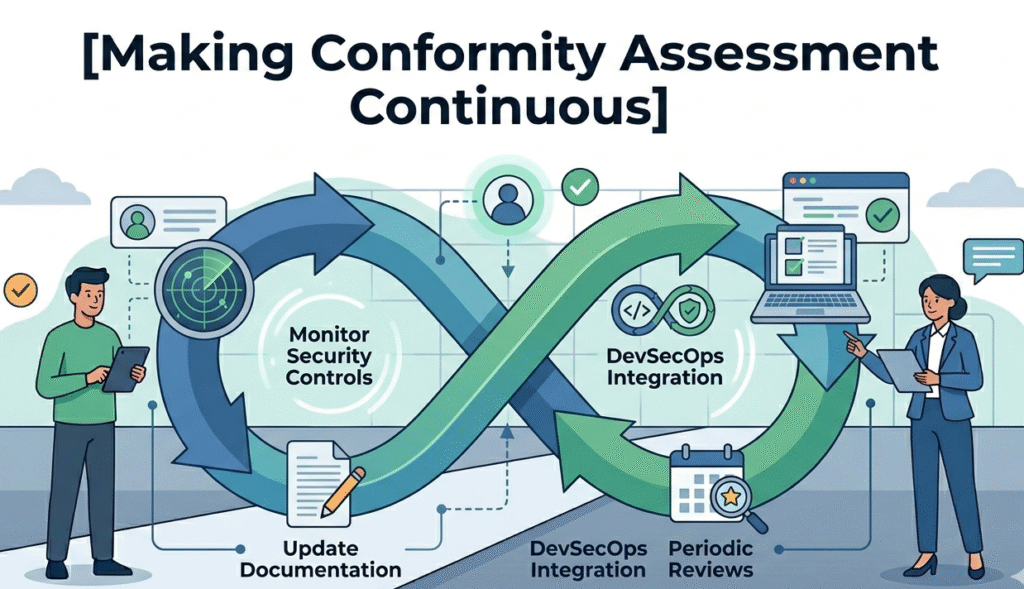
The most effective organizations treat conformity assessment as an ongoing process rather than a final checkpoint.
Best practices include:
- Continuous monitoring of security controls
- Regular updates to documentation
- Integration with DevSecOps workflows
- Periodic internal reviews before formal assessment
We’ve seen that this approach not only ensures compliance but also improves overall resilience and readiness.
FAQ
What is conformity assessment in the Cyber Resilience Act?
It is the process of verifying that a product meets the cybersecurity requirements defined by the CRA before it is placed on the market.
Is third-party assessment always required?
Not always. It depends on the product’s risk level, some products can undergo self-assessment, while others require external evaluation.
How does documentation impact conformity assessment?
Documentation provides the evidence needed to prove compliance, making it a critical part of the assessment process.
How do Secure Coding Practices support conformity assessment?
They ensure that security is built into the product from the beginning, making compliance easier to demonstrate and validate.
Strengthening Conformity Assessment Cyber Resilience Act Compliance
Conformity assessment Cyber Resilience Act requirements may seem complex, but they become manageable with a strategic approach. Starting with Secure Coding Practices simplifies everything from technical documentation to final validation. By treating assessment as a continuous process, teams reduce risk and stay audit-ready.
If you want smoother compliance and stronger security, strengthen your development strategy today. Join the Secure Coding Practices Bootcamp to master hands-on skills and ship safer code from day one.
References
- https://en.wikipedia.org/wiki/Conformity_assessment
- https://en.wikipedia.org/wiki/Technical_documentation