


Understanding the Benefits Robust Server Side Validation provides is essential for modern web development. At Secure Coding Practices, cybersecurity experts emphasize that relying solely on client-side checks leaves applications vulnerable to malicious data tampering.
Implementing rigorous server-side verification ensures that all incoming user input is thoroughly sanitized and validated before it ever reaches the backend database. This critical defense layer protects enterprise architectures from sophisticated injection attacks, data corruption, and unauthorized access attempts across all distributed web services.
Core Advantages of Implementing Server-Side Input Verification
Adopting stringent backend validation safeguards application stability by ensuring untrusted data never bypasses critical security gates.
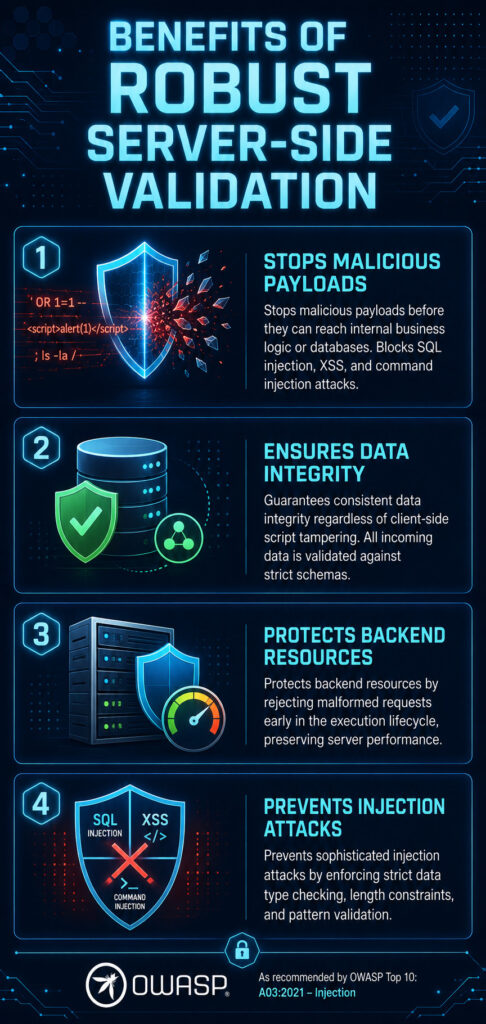
- Stops malicious payloads before they can reach internal business logic or databases.
- Guarantees consistent data integrity regardless of client-side script tampering.
- Protects backend resources by rejecting malformed requests early in the execution lifecycle.
How Do the Benefits Robust Server Side Validation Safeguard Enterprise Web Applications?
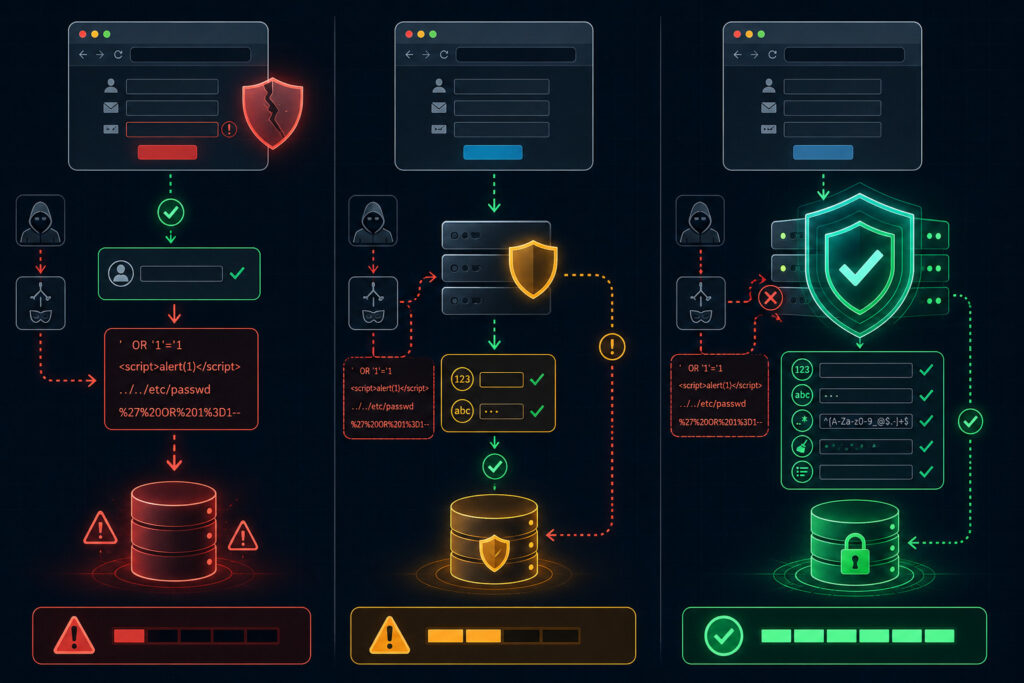
Modern web development requires looking beyond superficial client-side checks to establish a truly secure perimeter. When development teams fully recognize the Benefits Robust Server Side Validation provides, they can architect systems that intercept malicious data before it ever interacts with core business logic or sensitive data stores.
Relying exclusively on browser-side validation leaves APIs and backend endpoints exposed to direct manipulation via automated tools or crafted HTTP requests.
Enforcing strict data type checking, length constraints, and semantic validation directly on the server ensures that incoming payloads adhere strictly to expected application schemas. This proactive filtering eliminates entire classes of web application vulnerabilities.
Why Is Evaluating the Benefits Robust Server Side Validation Crucial for Architecture Design?
Comparing validation layers reveals why client-side scripts alone cannot secure modern backend systems. For a detailed exploration of architectural necessities, read our guide on the importance of server side validation to understand how structural data defense complements the core Benefits Robust Server Side Validation across enterprise environments.
| Validation Layer | Security Efficacy | Bypass Vulnerability | Resource Impact |
| Client-Side Only | Low (Easily Disabled) | Critical | Minimal (Browser-executed) |
| Basic Server-Side | Moderate | Low | Low (Basic type checking) |
| Robust Server-Side Validation | Comprehensive | Zero | Optimized (Pre-filter execution) |
What Do Security Engineering Guidelines Recommend for the Benefits Robust Server Side Validation?
Implementing strict input checks ensures that systems properly handle untrusted data streams before any execution takes place. Exploring the core Benefits Robust Server Side Validation brings to enterprise architectures requires examining standardized vulnerability frameworks and mitigation protocols.
Industry security standards explicitly mandate rigorous structural checking for all incoming parameters:
“Inputs should be decoded and checked against a rigorous specification of what is allowed, before any processing or database interaction occurs.” – MITRE CWE-20 Mitigation Guidance
How Do the Benefits Robust Server Side Validation Compare to Frontend Checks?
Understanding the critical differences between frontend user experience features and true backend security is vital for modern developers. To dive deeper into how these two mechanisms interact and why backend verification is non-negotiable, explore our comparative analysis on client side vs server side validation.
Relying solely on browser-based constraints leaves systems exposed, which is why engineering teams prioritize the structural Benefits Robust Server Side Validation to guarantee data integrity before processing any user requests.
- Backend validation prevents malicious actors from bypassing browser controls using specialized intercepting proxies.
- Centralized server checks ensure data consistency across diverse client interfaces, including mobile apps and third-party APIs.
- Strict backend enforcement shields underlying databases from malformed payloads and structural data corruption.
How Do Modern Frameworks Maximize the Benefits Robust Server Side Validation?
Credits: Chuck Severance
Leading web development frameworks build their entire security architecture around strict backend data handling, proving that server-side enforcement is non-negotiable. When engineering teams leverage built-in tools to rigorously verify all incoming data streams, they can fully realize the Benefits Robust Server Side Validation to maintain system integrity against malicious payloads.
Enterprise-grade frameworks emphasize the absolute necessity of cleaning and verifying untrusted data directly on the server before processing:
“Validation is run automatically when data is cleaned on a form, ensuring that all incoming parameters are strictly evaluated and sanitized on the server before any database interaction or application logic executes.” – Django Form Validation Documentation
How Does Testing Prove the Benefits Robust Server Side Validation?
Validating backend security configurations requires rigorous testing protocols to ensure continuous system resilience. Automated verification frameworks help engineering teams confirm the Benefits Robust Server Side Validation under various operational stress conditions.
Continuous integration pipelines systematically catch potential structural bypass flaws before any code reaches production deployment. This proactive evaluation guarantees that malformed payloads never compromise active enterprise environments.
- Simulating payload bypass attacks verifies backend constraints successfully block malicious input manipulation.
- Analyzing server execution logs confirms unvalidated data drops before reaching core business logic.
- Executing strict unit test coverage ensures no legacy endpoints lack mandatory validation rules.
How Do Practical Implementations Reveal the Benefits Robust Server Side Validation?
Implementing concrete backend checks demonstrates the core power of defensive programming patterns. To explore functional code models that enforce strict data constraints, review our technical guide detailing server side input validation php examples. Studying these implementations highlights the Benefits Robust Server Side Validation across varied enterprise architectures.
Relying on native language features ensures incoming requests meet exact structural requirements consistently. Developers must define strict validation rulesets evaluating data types, length boundaries, and permitted character sets. This rigorous filtering process guarantees backend components process only clean, predictable data payloads.
Systematic backend enforcement neutralizes complex payload injection vectors entirely.
- Utilizing built-in server filters ensures exact type matching before data reaches database tiers.
- Defining explicit boundary constraints prevents unexpected memory exhaustion during data processing operations.
- Sanitizing input parameters systematically neutralizes malicious payloads embedded within complex HTTP requests.
FAQ
Why is client-side validation insufficient for web security?
Client-side checks execute within the user browser, allowing malicious actors to easily bypass or disable them using intercepting proxies or developer tools.
What core Benefits Robust Server Side Validation provide modern applications?
It guarantees data integrity, prevents complex injection attacks, and ensures malformed payloads never interact with sensitive backend business logic.
How does backend verification protect enterprise database architectures?
By strictly enforcing data types, structural formats, and length constraints on the server, it blocks unauthorized inputs from executing destructive database commands.
Should development teams implement both frontend and backend validation?
Yes, frontend validation improves user experience through immediate visual feedback, while backend validation acts as the definitive security perimeter against external manipulation.
How do engineering teams implement server-side validation effectively?
Teams must utilize standardized framework validation libraries, enforce strict architectural allowlists, and sanitize all incoming HTTP parameters before execution.
Secure Your Backend Infrastructure
Maximizing the Benefits Robust Server Side Validation is mandatory for enterprise web security. Developers must eliminate vulnerable client-side reliance immediately. Strict backend data verification prevents catastrophic system breaches.
Automated filtering neutralizes sophisticated payload injections efficiently. Securing data architectures demands continuous technical discipline and advanced engineering expertise. Teams must enforce uncompromising structural constraints across all API endpoints.
Upgrade your development protocols and defensive engineering skills. To master advanced validation architecture, join our secure coding bootcamp today. Build resilient backend systems that systematically withstand hostile data manipulation.
References
- https://cwe.mitre.org/data/definitions/20.html#Potential_Mitigations
- https://securecodingpractices.com/bypassing-client-side-validation-easily/
Related Articles
- https://securecodingpractices.com/server-side-input-validation-php-examples/
- https://securecodingpractices.com/client-side-vs-server-side-validation/
- https://securecodingpractices.com/importance-of-server-side-validation/