


Challenges implementing SCA effectively usually come from limited dependency visibility, alert fatigue, outdated libraries, and inconsistent security processes rather than the scanning tool itself. Modern Software Composition Analysis (SCA) helps identify security, licensing, and compliance risks in open-source dependencies, but it requires continuous management as software evolves.
At Secure Coding Practices, we’ve seen that combining developer education with automated SCA produces stronger, more sustainable results than relying on tooling alone. Keep reading to explore the biggest implementation challenges and practical ways to strengthen your software supply chain.
Quick Reads: SCA Implementation Essentials
Successful SCA is built on continuous visibility, developer adoption, and consistent governance, not scanning alone. These key points highlight the practices that help teams reduce software supply chain risk over time.
- Effective SCA depends on continuous visibility rather than occasional scans.
- We have found that Secure Coding Practices combined with automated SCA creates stronger software supply chain security from the start.
- Long-term success requires governance, developer adoption, and ongoing improvement instead of relying on tooling alone.
Why Is Implementing Software Composition Analysis Harder Today?

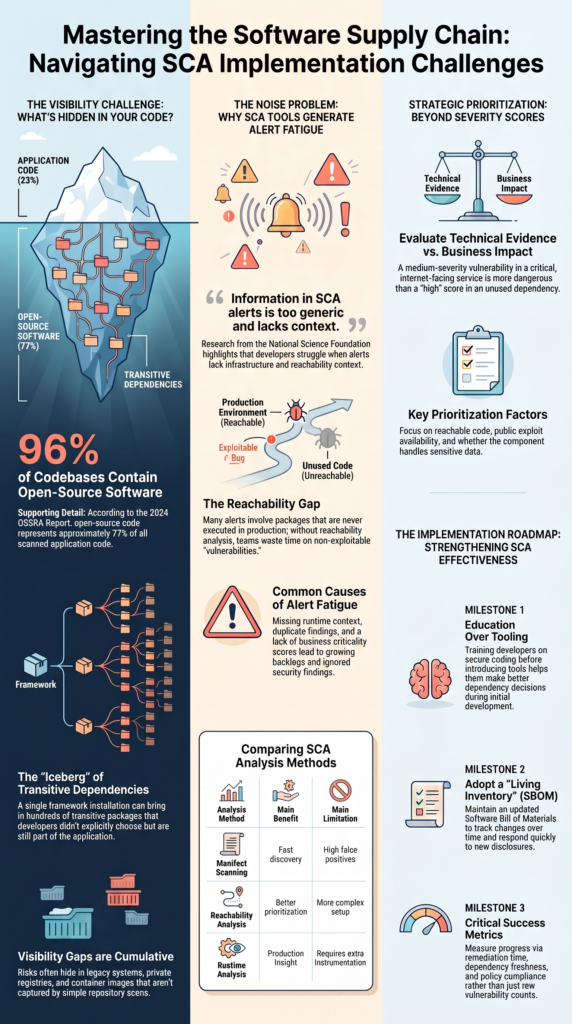
Modern software depends on far more open-source code than many teams realize. According to the 2024 OSSRA Report, 96% of assessed codebases include open-source software, representing about 77% of scanned application code.
As projects grow, a single dependency often introduces dozens of transitive packages, making software supply chains increasingly difficult to manage.
We’ve seen this during secure development training. Teams often understand the libraries they install directly but have limited visibility into automatically added packages. As applications expand, manual tracking quickly becomes impractical while security and development teams struggle to balance rapid releases with risk reduction.
Several factors increase implementation complexity:
- Large dependency trees
- Frequent package updates
- Multiple programming languages
- Distributed development teams
- Fast release cycles
Automation helps discover and monitor dependencies, but tools alone cannot solve the problem. Understanding the importance of SCA dependency management helps organizations establish clear ownership, consistent policies, and regular reviews that strengthen long-term software supply chain security.
From our experience, teaching Secure Coding Practices before introducing SCA tools helps developers make better dependency decisions early, reducing technical debt while making software supply chain security a natural part of daily development.
Why Is Dependency Visibility Still Incomplete?
Maintaining complete dependency visibility becomes increasingly difficult as software spreads across repositories, cloud platforms, containers, and CI/CD pipelines. Hidden components often accumulate through legacy systems, inherited frameworks, automated build processes, or private package registries, creating risks that teams may not realize exist.
We’ve reviewed projects that appeared well documented until automated discovery revealed forgotten services and outdated dependencies still present in production. These gaps rarely happen intentionally, they develop gradually as applications evolve.
Common causes of incomplete visibility include:
- Transitive dependencies
- Legacy applications
- Private package registries
- Multiple package managers
- Container images
- Distributed build environments
Each environment provides only part of the overall picture, making a single repository insufficient for understanding production software. Organizations supporting web applications, APIs, mobile apps, and cloud-native services often face additional complexity because every platform follows different dependency management processes.
Our experience shows that maintaining a living software inventory is far more effective than performing occasional cleanup projects. Regular dependency reviews help security and development teams maintain accurate visibility while reducing unexpected risks as software continues to grow.
Why Do Transitive Dependencies Matter?
Developers usually trust the packages they install. The bigger challenge comes from everything those packages bring with them.
A single framework may depend on several other libraries. Those libraries can depend on even more. Before long, one installation becomes hundreds of software components working together.
We’ve seen teams surprised by vulnerabilities buried several layers deep. Nobody chose those packages directly, but they still became part of the application. That’s why transitive dependencies deserve attention.
Modern Software Composition Analysis (SCA) solutions map those relationships automatically, giving developers a clearer picture of what exists beneath the surface. Pairing that visibility with a Software Bill of Materials (SBOM) makes tracking changes much easier over time.
Our instructors often remind developers that secure software isn’t only about the code they write. It’s also about understanding the code they inherit. That mindset helps teams catch problems earlier, reduce hidden risk, and build stronger software supply chains from the beginning.
Why Do SCA Tools Generate So Many Alerts?
Software Composition Analysis tools quickly identify known vulnerabilities, but large reports do not always reflect actual risk. Many findings involve packages that are never executed in production, while others duplicate existing issues or lack meaningful remediation guidance.
We’ve seen teams attempt to resolve every reported issue, only to become overwhelmed by growing backlogs and slower development cycles. Effective remediation depends on understanding whether vulnerable code is actually reachable instead of relying solely on severity ratings.
Different analysis methods provide different levels of detail. Some focus on discovering packages, while others also evaluate whether vulnerable code can realistically be reached.
| Analysis Method | Main Benefit | Main Limitation |
| Manifest scanning | Fast discovery | More false positives |
| Reachability analysis | Better prioritization | More setup required |
| Runtime analysis | Production insight | Extra instrumentation |
Our recommendation isn’t to rely on one technique alone. Combining automated analysis with secure development habits gives developers better information and more confidence when deciding what should be fixed first.
Common causes of alert fatigue include:
- Missing runtime context
- Generic severity scores
- Duplicate findings
- False positives
- Limited remediation guidance
- No business context
From our experience, combining automated analysis with Secure Coding Practices helps developers focus on meaningful risks instead of raw alert volume. Better context leads to faster remediation, fewer ignored findings, and stronger long-term adoption of Software Composition Analysis.
Research from National Science Foundation shows
“Developers are flooded with vulnerability alerts and often struggle to quickly remediate critical issues with external components. We find that SCA tools are most often integrated into build pipelines and that users report that information in SCA alerts is too generic and lack context, specifically context on infrastructure, network configurations, reachability, and exploitability.” – National Science Foundation / USENIX Security Symposium
Why Is Vulnerability Prioritization So Difficult?
Finding vulnerabilities is no longer the greatest challenge for most organizations. The real difficulty lies in deciding which issues require immediate attention as new disclosures, dependency updates, and software releases continue to appear every week.
We’ve worked with organizations where thousands of findings accumulated within months because clear prioritization policies were missing. Successful teams evaluate technical evidence alongside business impact rather than relying only on vulnerability severity.
As noted by BSides Luxembourg 2026 Conference
“Most organizations run Software Composition Analysis, yet very few actually use the results effectively. Alerts pile up, developers ignore findings, and security teams drown in noise.” – BSides Luxembourg 2026 (Application Security Engineer Talk)
Important prioritization factors include:
- Reachable vulnerable code
- Internet-facing exposure
- Public exploit availability
- Business criticality
- Sensitive data exposure
- Operational impact
A medium-severity vulnerability affecting a critical production service may deserve faster remediation than a higher-severity issue in an unused dependency. Looking beyond severity scores helps organizations allocate resources more effectively.
From what we’ve seen, the strongest security programs regularly review prioritization policies as applications and business requirements evolve. Consistent, risk-based decision-making allows developers to reduce meaningful software supply chain risk without slowing product delivery.
Why Do Outdated Dependencies Persist?
Keeping dependencies current sounds simple. In practice, upgrades often affect much more than one package.
We’ve worked with organizations that wanted to update vulnerable libraries right away. After testing began, they discovered newer versions required framework upgrades, API changes, or updates across several connected systems. What looked like a small task quickly turned into a larger project.
Many organizations delay updates because stability matters too. Breaking production systems to remove one vulnerability rarely helps anyone. The challenge is finding a balance between reducing security risk and protecting business operations.
Common reasons updates get postponed include:
- Breaking API changes
- Older frameworks
- Compatibility concerns
- Regression testing
- Limited engineering time
Our advice is to avoid waiting years between dependency updates. Smaller, regular maintenance cycles are usually much easier to manage. Developers also become more familiar with changes, making future upgrades less disruptive.
Teaching Secure Coding Practices reinforces that mindset. When developers review dependencies throughout the software lifecycle instead of only during audits, technical debt grows much more slowly and applications stay healthier over time.
How Do Licensing Challenges Complicate SCA?
Credits: Techstrong TV
Security is usually the first thing people think about when discussing Software Composition Analysis. But licensing deserves just as much attention. Every open-source component comes with rules, and those rules don’t disappear because a package is free to use.
We’ve seen development teams focus heavily on fixing vulnerabilities while overlooking license obligations until an audit or customer review raises questions. By then, sorting everything out took far more time than it should have. Planning ahead helps.
Some licenses require attribution. Others have conditions that may affect how software is distributed. If developers add packages without understanding those requirements, legal and compliance teams may need to step in later.
Common licensing concerns include:
- License compatibility
- Attribution requirements
- Distribution obligations
- Intellectual property risks
Our instructors encourage teams to review new dependencies before they become part of production. It doesn’t slow development as much as people expect. Instead, it reduces future surprises and gives everyone a clearer picture of what is being introduced into the software supply chain.
Good governance starts early. When security, legal, and development teams share the same process, managing open-source software becomes much less stressful.
Why Is Tool Selection More Difficult Than Expected?
Choosing an SCA platform isn’t as easy as comparing feature lists. Many tools scan for known vulnerabilities, but they don’t all provide the same level of detail or fit into existing development workflows.
We’ve helped organizations evaluate different solutions during secure development programs. On paper, several options looked similar. Once developers started using them in real projects, the differences became much clearer. Workflow matters.
A platform that interrupts every build with unclear alerts often creates frustration instead of improving security. Understanding how SCA tools work makes it easier to evaluate platforms that fit naturally into existing CI/CD pipelines and support efficient developer workflows.
Before making a decision, organizations should compare practical factors instead of marketing claims.
| Evaluation Area | What to Check |
| Vulnerability data | Timely updates |
| Language support | Fits tech stack |
| CI/CD integration | Smooth workflow |
| Policy controls | Easy automation |
| Reporting | Clear remediation guidance |
We also recommend involving developers during evaluations. Security teams may focus on governance, while engineers care about speed and usability. Listening to both groups usually leads to a better long-term decision. A tool should support development, not become another obstacle.
How Can Organizations Improve SCA Effectiveness?

Effective Software Composition Analysis depends on more than automated scanning. Strong programs combine developer education, governance, continuous monitoring, and secure development practices to reduce software supply chain risk throughout the SDLC.
We’ve consistently found that developers make better security decisions when they understand why dependency management matters instead of viewing SCA as another compliance requirement. Education helps teams evaluate libraries before adoption and respond more effectively when vulnerabilities appear.
Recommended practices include:
- Scan during CI/CD
- Maintain an updated SBOM
- Prioritize reachable vulnerabilities
- Automate dependency updates
- Monitor license compliance
- Set remediation targets
- Review security policies regularly
- Strengthen Secure Coding Practices
- Train developers on dependency management
Organizations should also measure progress using meaningful operational metrics such as remediation time, dependency freshness, policy compliance, and false-positive rates rather than focusing only on vulnerability counts.
From our experience, combining continuous SCA with secure coding education creates lasting improvements. Developers become more selective when introducing new libraries, security teams receive higher-quality remediation efforts, and organizations build software that remains secure as dependency ecosystems continue evolving.
FAQ
Can authentication challenges affect software dependency security?
Authentication challenges can indirectly affect software dependency security when applications rely on outdated libraries for access control, customer verification, or identity verification.
If those components contain known vulnerabilities, attackers may exploit them before authentication occurs. Regular dependency reviews, timely updates, and stronger security controls help reduce risk and improve the overall security of the application.
How does legacy system integration make dependency management more difficult?
Legacy system integration often depends on older frameworks and unsupported libraries that are difficult to upgrade. This implementation complexity increases the risk of compatibility issues because updating one dependency can affect several connected systems.
Maintaining an accurate software inventory, testing updates thoroughly, and following a regular maintenance schedule help reduce technical debt and strengthen long-term security.
Can API integration increase software supply chain risks?
Yes. API integration often introduces third-party libraries, SDKs, and open-source dependencies that require continuous monitoring. Every component should be evaluated for vulnerabilities, licensing requirements, and compatibility before deployment.
Ongoing Software Composition Analysis helps organizations identify new risks early, maintain secure integrations, and reduce the likelihood of vulnerabilities reaching production.
Why should organizations review security controls after dependency updates?
Dependency updates can introduce new libraries, modify application behavior, or affect existing functionality. Reviewing security controls, authentication methods, transaction monitoring, and access control after each update helps verify that new dependencies do not create unexpected vulnerabilities.
Regular validation also improves application stability, supports compliance efforts, and reduces operational risk.
How do compliance reporting and regulatory requirements improve dependency management?
Compliance reporting and regulatory requirements encourage organizations to document software components, dependency updates, and remediation activities throughout the software lifecycle.
Maintaining accurate records improves visibility, supports regulatory audits, and demonstrates that security processes are consistently followed. These practices also help teams respond more quickly to newly disclosed vulnerabilities and maintain stronger software supply chain governance.
Make SCA a Lasting Engineering Practice
Software Composition Analysis delivers better results when it’s part of everyday development. Combining automation with secure coding habits helps teams reduce software supply chain risk, improve compliance, and keep dependencies under control as applications evolve.
Take the next step with Secure Coding Practices. Learn practical secure coding and DevSecOps skills that help you strengthen SCA implementation and build more secure software.
References
- https://par.nsf.gov/biblio/10609315-context-matters-qualitative-insights-developers-approaches-challenges-software-composition-analysis
- https://pretalx.com/bsidesluxembourg-2026/talk/ZQWC7Y/