
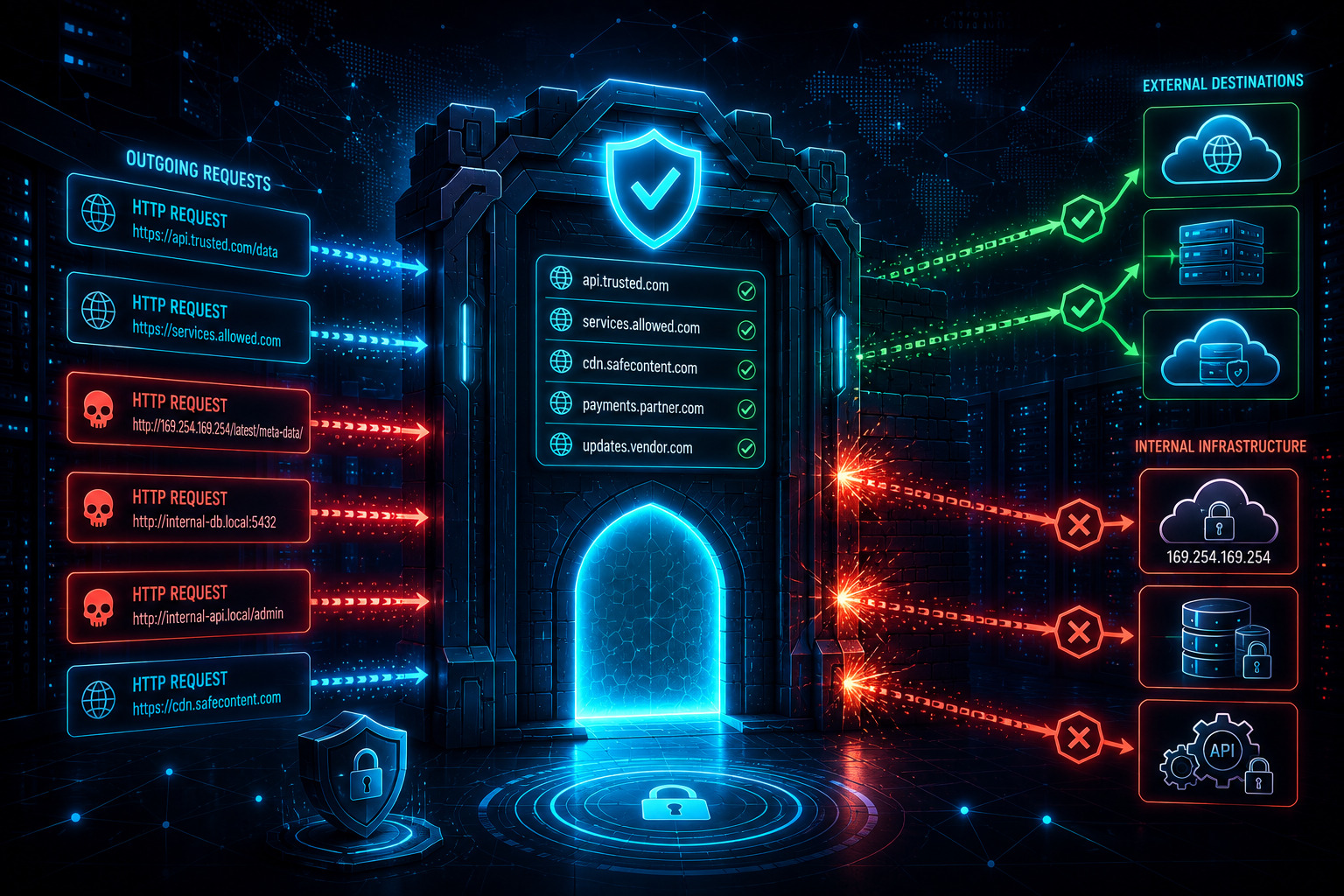

Modern web architectures frequently interface with external APIs and microservices, creating expansive attack surfaces vulnerable to server-side request forgery. When engineering teams secure their network perimeters, implementing robust ssrf mitigation techniques allowlist strategies becomes essential for preventing unauthorized internal resource access.
Without strict URL validation, malicious actors can easily manipulate backend parameters to target internal metadata services. At Secure Coding Practices, experts emphasize that deploying precise domain allowlists helps organizations intercept dangerous payloads, isolate backend endpoints, and maintain airtight security compliance across all active cloud deployment environments.
Enforcing Strict Allowlists Secures Enterprise Infrastructure
Implementing structured governance around outbound requests drastically reduces systemic security risks and unauthorized data access.
- Establish explicit domain allowlists to ensure backend applications communicate exclusively with pre-approved external endpoints.
- Eliminate vulnerable protocol handlers like file and gopher to prevent local file reading and internal port probing.
- Deploy rigorous input validation checks to inspect all user-supplied URL parameters before network execution.
Why Are Domain Allowlists Crucial for Network Security?
When developers build secure cloud services, relying solely on blocklists often leaves critical security gaps because attackers can easily bypass IP restrictions using alternative encodings and DNS rebinding tactics.
Implementing effective ssrf mitigation techniques allowlist solutions ensures that outgoing application requests are tightly controlled, verifying every destination against an explicitly approved list before any network socket is opened.
This proactive architectural boundary prevents malicious actors from leveraging backend applications as proxies to access internal corporate APIs and sensitive cloud metadata endpoints.
How Do Filtering Approaches Differ in Effectiveness?
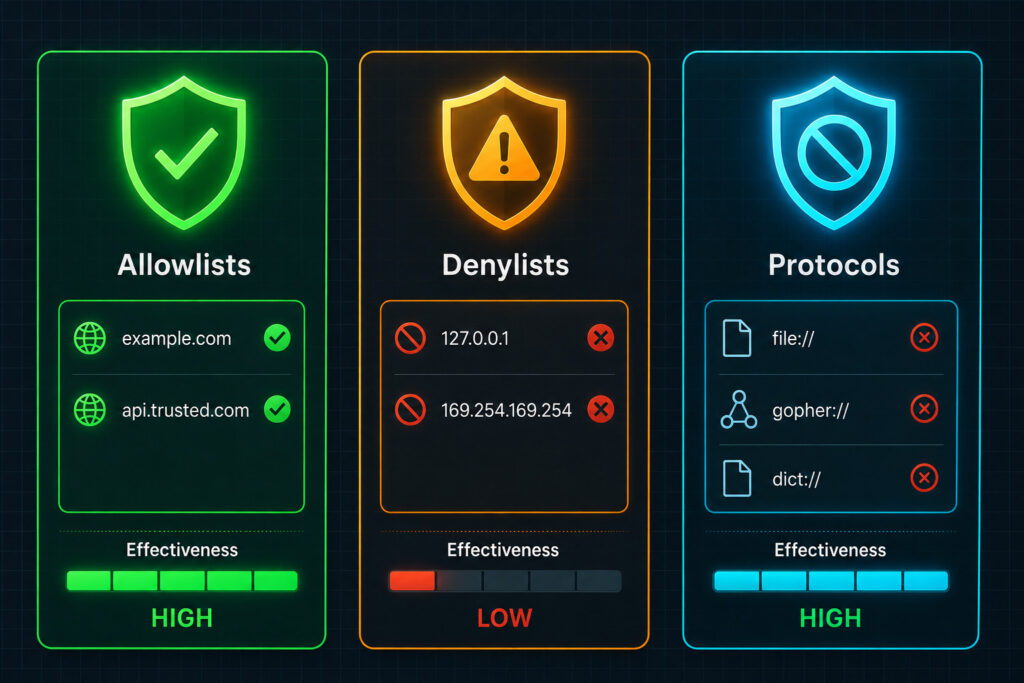
When evaluating how various protocols behave, understanding server-side request forgery mechanics helps architects choose the right approach when applying ssrf mitigation techniques allowlist protocols to production codebases.
| Filtering Method | Implementation Approach | Security Effectiveness |
| Domain Allowlists | Explicitly trusting approved hostnames | High (Blocks arbitrary external routing) |
| IP Denylists | Blocking known internal loopbacks | Low (Easily bypassed via encoding) |
| Protocol Restrictions | Disabling file and gopher schemes | High (Prevents local file reads) |
What Do Industry Standards Recommend for Outbound Filtering?
When establishing formal compliance benchmarks, security architects turn to established vulnerability references to understand how unvalidated backend requests introduce severe operational risks across distributed environments.
Furthermore, integrating these structured governance guidelines into routine deployment cycles helps organizations maintain absolute visibility over all outbound socket connections, effectively neutralizing automated exploitation vectors.
“The inclusion of strict URL allowlists and rigorous protocol validation ensures that applications cannot be manipulated into querying internal components or unauthorized external services.” – OWASP Foundation
How Can Security Teams Verify Outbound Request Safety?
Credits: BePractical
Validating the operational readiness of cloud applications requires continuous assessment to ensure that deployed controls remain resilient against sophisticated bypass techniques. By systematically testing for ssrf potential vectors during code reviews and continuous integration pipelines, engineering teams can uncover hidden routing flaws before malicious actors weaponize them.
- Simulate DNS rebinding scenarios to verify domain resolution security boundaries.
- Attempt local loopback IP injections against external-facing API parameters.
- Audit application response headers to prevent internal network topology leakage.
How Do JavaScript Applications Handle Vulnerable Outbound Requests?
Modern JavaScript environments, such as Node.js, frequently process dynamic URLs provided by users, making them prime targets for server-side exploitation if proper validation layers are omitted.
Ensuring that applications enforce strict ssrf mitigation techniques allowlist policies prevents backend runtimes from executing unauthorized requests against local network ports.
“Understanding how Node.js and other JavaScript runtimes handle HTTP requests is critical for identifying and patching server-side request forgery vectors before they impact production environments.” – Snyk Learn
How Do You Implement Effective Filtering?

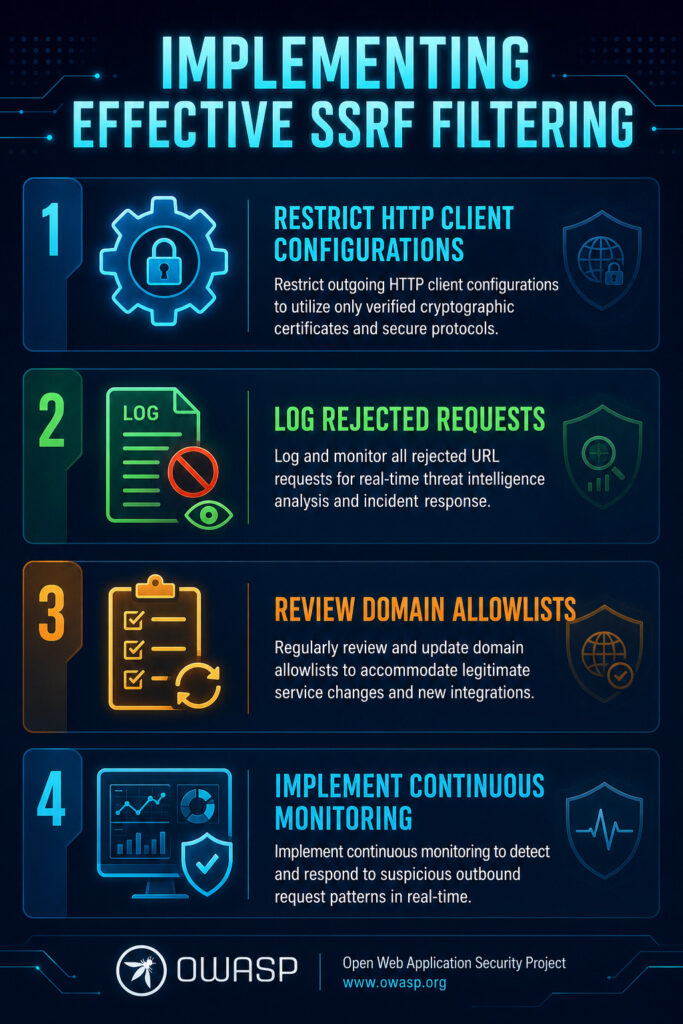
Deploying reliable ssrf mitigation techniques allowlist frameworks requires careful coordination between development and security operations teams to safeguard backend infrastructure.
- Restrict outgoing HTTP client configurations to utilize only verified cryptographic certificates.
- Log and monitor all rejected URL requests for real-time threat intelligence analysis.
- Regularly review and update domain allowlists to accommodate legitimate service changes.
What Are the Consequences of Inadequate Filtering?
Failing to deploy comprehensive defense mechanisms often leaves backend infrastructure dangerously exposed to sophisticated request forgery attacks. When organizations neglect proper boundary enforcement, they frequently underestimate the severe impact successful ssrf exploitation introduces to modern cloud architectures.
Attackers can quickly weaponize unvalidated endpoints to bypass perimeter firewalls, probe internal network ports, and extract confidential configuration data. Establishing rigid architectural safeguards is therefore vital to neutralizing these multi-stage threats before structural compromise occurs across production systems.
- Block attackers from stealing temporary cloud metadata credentials and administrative secrets.
- Stop unauthorized lateral movement across internal microservices and backend databases.
- Prevent malicious actors from turning your web application into an internal network proxy.
FAQ
What is the core purpose of an allowlist in preventing request forgery?
It ensures that backend application servers only communicate with a pre-approved, strictly verified list of external domains and trusted IP addresses.
Why are IP denylists insufficient compared to strict allowlist strategies?
Attackers can easily bypass denylists using alternative IP encodings, decimal representations, and DNS rebinding techniques, whereas allowlists explicitly block everything else.
Can automated tools verify proper allowlist implementation?
Automated scanners can test basic endpoint filtering, but manual code reviews are still necessary to uncover complex routing logic flaws and asynchronous pathways.
Which URI schemes should be blocked alongside domain allowlisting?
Dangerous protocols like file, dict, and gopher must be disabled entirely to prevent attackers from executing local file reads and internal port scans.
How do cloud metadata services interact with unsecured outbound requests?
Unvalidated requests can reach local cloud instance IP addresses, allowing malicious actors to steal temporary IAM credentials and compromise cloud environments.
Securing Enterprise Systems Against Advanced Request Forgery
Mastering effective ssrf mitigation techniques allowlist implementations requires a disciplined and comprehensive defense strategy combining strict domain verification, dangerous protocol disuse, and robust egress filtering across all active microservices.
When development teams actively sanitize untrusted inputs and secure backend network boundaries, they effectively neutralize complex server side request forgery vectors before exploitation occurs.
Ready to elevate your software security standards and protect enterprise systems? Join the Secure Coding Practices Bootcamp to master practical remediation techniques, build advanced defensive coding architectures, and safeguard critical infrastructure from sophisticated threats safely today ensuring absolute digital resilience across all modern production deployment environments now.
References
- https://securecodingpractices.com/testing-for-ssrf-potential-vectors/
- https://learn.snyk.io/lesson/ssrf-server-side-request-forgery/?ecosystem=javascript