


Modern web applications frequently integrate external services and media import engines, expanding their attack surface across interconnected microservices. When security teams evaluate application risks, understanding the impact successful ssrf exploitation brings to enterprise infrastructure is critical.
Server-side request forgery occurs when unvalidated parameters allow malicious actors to force backend servers into initiating unauthorized network requests.
This bypasses traditional perimeter defenses and exposes core infrastructure components, making proactive vulnerability assessment essential for protecting sensitive cloud environments and internal data assets.
Strategic Takeaways Highlight Critical Defense Mechanisms
Understanding the full consequences of server-side vulnerabilities helps security teams design robust architectural safeguards.
- Enforce rigorous input validation and strict URL allowlists to prevent unauthorized outbound connections from backend servers.
- Monitor cloud metadata endpoints closely to block unauthorized credential extraction and lateral movement.
- Disable dangerous URI schemes like file, gopher, and dict to eliminate local file read risks.
What Are the Operational Consequences of Compromised Infrastructure?
When evaluating security posture, organizations often underestimate the cascading failures triggered by server-side vulnerabilities. The impact successful ssrf exploitation extends far beyond simple data leakage, frequently resulting in total infrastructure compromise.
Because backend servers operate inside trusted internal network zones, attackers leverage them as secure pivots to bypass perimeter firewalls and interact with internal APIs that are entirely inaccessible from the public internet.
Furthermore, this weaponization enables threat actors to execute internal port scanning, discover hidden administration panels, and extract sensitive environment configurations or database credentials.
Without rigorous egress filtering and strict URL verification, modern web applications inadvertently act as malicious proxies, turning routine feature requests into severe architectural security breaches.
What Infrastructure Components Face the Greatest Threat?
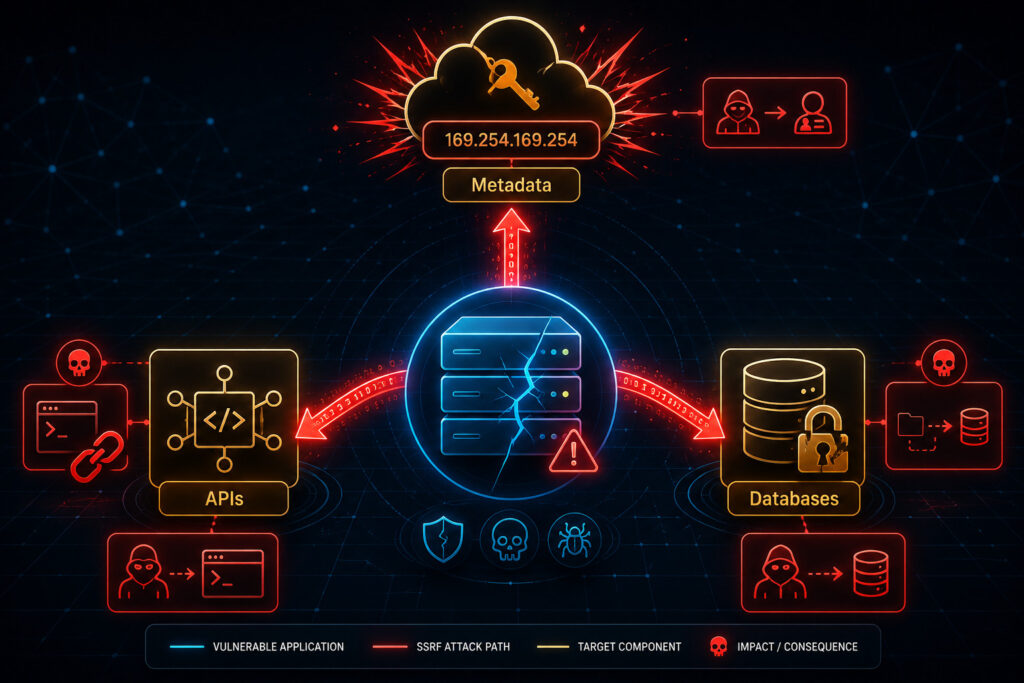
When studying the impact successful ssrf exploitation has on an enterprise, understanding the core mechanics of server-side request forgery across different network layers is crucial for security engineers. Attackers systematically map target surfaces to maximize operational disruption and pivot through internal perimeters.
| Target Component | Vulnerability Mechanism | Exploitation Consequence |
|---|---|---|
| Cloud Metadata Services | Unfiltered Instance IP Access | Temporary credential extraction and account takeover |
| Internal APIs | Local Loopback Redirection | Unauthorized backend service command execution |
| Databases | Direct Socket Communication | Internal data exfiltration and query abuse |
How Do Governance Frameworks Evaluate Server-Side Threats?
When organizations formalize their threat models, understanding the impact successful ssrf exploitation has on risk management requires referencing established security controls.
Industry guidelines, such as those detailed in the OWASP SSRF Prevention Cheat Sheet, outline specific defensive architectures necessary to neutralize outbound request vulnerabilities before they compromise core systems.
“Preventing server side request forgery requires strict validation of all user supplied input, enforcing network segmentation, and disabling unnecessary URI schemes that can expose internal components to external manipulation.” – OWASP Foundation
How Can Security Teams Mitigate Advanced Request Forgery Risks?
Credits: codewithKrish
To counter the severe impact successful ssrf exploitation poses to enterprise architectures, engineering teams must implement proactive diagnostic routines.
By systematically testing for ssrf potential vectors during code reviews and continuous integration pipelines, organizations can uncover hidden vulnerabilities before malicious actors weaponize them.
- Implement strict validation schemas to filter out malicious or malformed URL parameters.
- Establish robust egress filtering rules on all internal backend services to restrict unauthorized outbound traffic.
- Monitor asynchronous connections and audit logs closely for unusual outbound routing patterns.
What Official Classifications Define Server-Side Risks?
When evaluating the true impact successful ssrf exploitation poses to enterprise architectures, security researchers rely on standardized vulnerability definitions.
Detailed technical breakdowns, such as those found in the MITRE CWE-918 Documentation, explain how unvalidated server-side requests expose sensitive internal resources to external manipulation.
“Server-Side Request Forgery (SSRF) weaknesses can allow an attacker to read or write to resources on the application server, connect to internal services, or force the application to make requests to arbitrary destinations.” – MITRE Corporation
How Do You Mitigate Infrastructure Exposure?

Assessing the full impact successful ssrf exploitation has on production systems requires continuous verification of network boundaries and egress filters. Security teams must ensure that deployed defenses cannot be bypassed through protocol obfuscation or routing anomalies.
- Enforce strict IP address allowlists to prevent connections to reserved loopback spaces.
- Validate all DNS resolution logic to block domain name rebinding exploits.
- Audit service error handling routines to prevent internal network topology leakage.
What Preventive Measures Stop Exploitation?
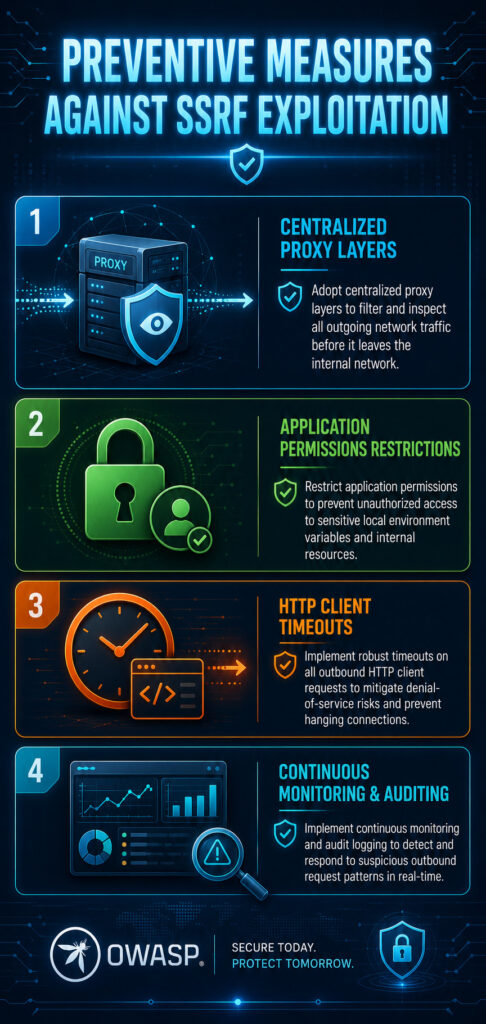
To permanently reduce the destructive impact successful ssrf exploitation brings to software systems, development teams can explore detailed guidelines on owasp ssrf prevention measures to implement systematic architectural safeguards across all active production environments.
- Adopt centralized proxy layers to filter and inspect all outgoing network traffic.
- Restrict application permissions to prevent unauthorized access to sensitive local environment variables.
- Implement robust timeouts on all outbound HTTP client requests to mitigate denial-of-service risks.
FAQ
What is the primary impact successful ssrf exploitation has on cloud environments?
It allows unauthorized actors to extract temporary instance metadata credentials, which frequently results in full cloud resource takeover and lateral network movement.
Why are traditional perimeter firewalls ineffective against the impact successful ssrf exploitation?
Because malicious requests originate from trusted internal application servers rather than external sources, standard perimeter security controls remain entirely blind to the internal traffic.
Can automated security scanners fully uncover the impact successful ssrf exploitation risks?
Automated tools often miss complex asynchronous logic flaws and hidden application routing paths, meaning comprehensive manual code reviews are still vital.
Which URI schemes worsen the impact successful ssrf exploitation during an attack?
Dangerous protocols like file, dict, and gopher severely amplify the risk because they enable arbitrary local file reading and internal network port scanning.
How can developers minimize the impact successful ssrf exploitation on backend systems?
Developers can mitigate these risks by enforcing strict URL allowlists, disabling dangerous protocol schemes, and deploying robust egress network packet filters.
Securing Enterprise Systems Against Advanced Request Forgery
Mitigating the destructive impact successful ssrf exploitation brings to modern software architectures requires a disciplined, multi-layered defense strategy combining strict URL allowlists, dangerous protocol disuse, and robust egress filtering across all active microservices.
When development teams actively sanitize untrusted inputs and secure backend network boundaries, they effectively neutralize complex server side request forgery vectors before exploitation occurs.
Ready to elevate your software security standards and protect enterprise systems? Join the Secure Coding Practices Bootcamp to master hands on remediation techniques, build advanced defensive coding architectures, and safeguard critical infrastructure from sophisticated threats safely ensuring long-term resilience across all deployment environments right now.
References
- https://cheatsheetseries.owasp.org/cheatsheets/Server_Side_Request_Forgery_Prevention_Cheat_Sheet.html
- https://cwe.mitre.org/data/definitions/918.html