


Modern applications frequently handle remote resources, creating complex security challenges across interconnected architectures. Identifying server-side request forgery vulnerabilities before malicious actors discover them requires a combination of automated scanning and rigorous manual code review.
When evaluating applications that handle remote URLs, security testers must systematically inspect every entry point such as webhooks, file import features, and API connectors to determine if backend requests can be redirected toward internal networks.
Effective testing for ssrf potential vectors allows organizations to uncover hidden vulnerabilities and secure backend infrastructure against sophisticated exploitation attempts.
Strategic Takeaways for Effective Security Assessments
Systematic evaluation of unvalidated remote URLs is vital for securing modern enterprise architectures.
- Inject local loopback addresses and alternative IP representations into user supplied URL parameters to check for unexpected internal communication.
- Evaluate cloud metadata endpoints thoroughly to prevent unauthorized extraction of temporary instance credentials and sensitive data.
- Utilize out of band interaction tools and automated scanners to monitor asynchronous backend connection attempts triggered by background processing jobs.
Why Is Source Code Review Essential for Identifying Flaws?
Automated scanners often struggle to uncover complex logic flaws that allow server-side request forgery. Comprehensive testing for ssrf potential vectors requires developers and security engineers to conduct deep source code reviews.
By examining how HTTP clients, URL parsers, and outbound request handlers are implemented within the codebase, teams can spot subtle flaws that dynamic testing tools frequently miss. Furthermore, understanding architectural data flows helps pinpoint where user input intersects with network operations.
When developers trace the lifecycle of an incoming URL from the initial parameter intake to the final socket connection, they gain absolute clarity on potential blind spots, ensuring robust mitigation strategies are embedded directly into the application logic.
What Are the Primary Targets and Exploitation Risks Associated with Request Forgery?
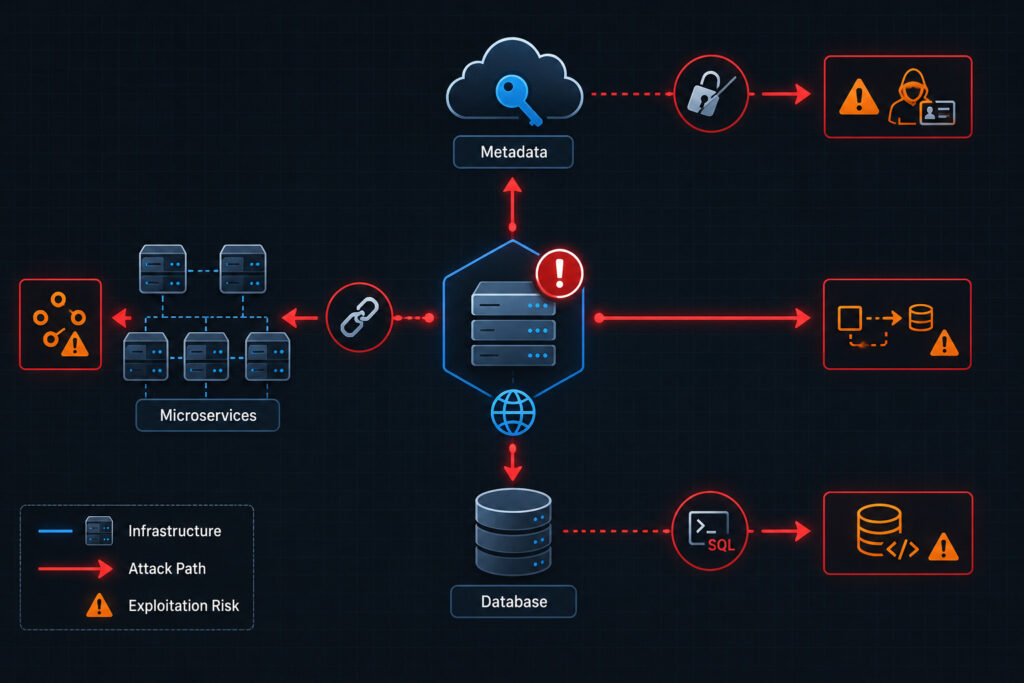
When performing security assessments, understanding the underlying mechanics of server-side request forgery helps engineers anticipate how attackers leverage unvalidated parameters during testing for ssrf potential vectors.
Attackers frequently exploit these architectural gaps to pivot deep into internal network perimeters.
| Target Surface | Vulnerability Vector | Potential Impact |
| Cloud Metadata Services | Unfiltered Instance IP Access | Credential theft and account takeover |
| Internal Microservices | Local Loopback Redirection | Lateral network movement and data exfiltration |
| Database Endpoints | Direct Socket Connection | Unauthorized internal query execution |
How Do Weakness Classifications Guide SSRF Identification?
When assessing software risk profiles, security analysts rely on formal vulnerability taxonomies to classify code flaws correctly during testing for ssrf potential vectors. Recognizing how input validation breakdowns allow arbitrary outbound requests is essential for comprehensive security assessments and remediation tracking.
“A server-side request forgery vulnerability occurs when a web server receives a URL or similar request from a user, processes it, and sends a backend request to an arbitrary external or internal destination without sufficient validation.” – Common Weakness Enumeration
What Core Remediation Strategies Stop Request Forgery Exploits?
Credits: PortSwigger
Integrating robust defensive engineering principles is essential when testing for ssrf potential vectors reveals systemic input validation flaws. Teams can explore comprehensive guidelines on preventing ssrf vulnerabilities application code to establish permanent safeguards across all active microservices.
- Enforce strict URL schema checks to ensure only HTTP and HTTPS protocols are processed by backend handlers.
- Deploy centralized allowlists to govern all outbound connections and restrict traffic to trusted external partners.
- Disable dangerous URI schemes like file, gopher, and dict to completely block local file reads and port scanning.
What Standards Govern Web Application Security and Input Validation?
Establishing rigorous security baselines is essential when testing for ssrf potential vectors across complex enterprise systems. Regulatory frameworks and federal security guidelines emphasize that securing application boundaries requires comprehensive validation of all inbound and outbound data streams to prevent unauthorized internal resource access.
“Secure web services require strict input validation, proper authentication mechanisms, and robust boundary protections to ensure that backend components cannot be leveraged as proxies for internal network scanning.” – NIST Special Publication
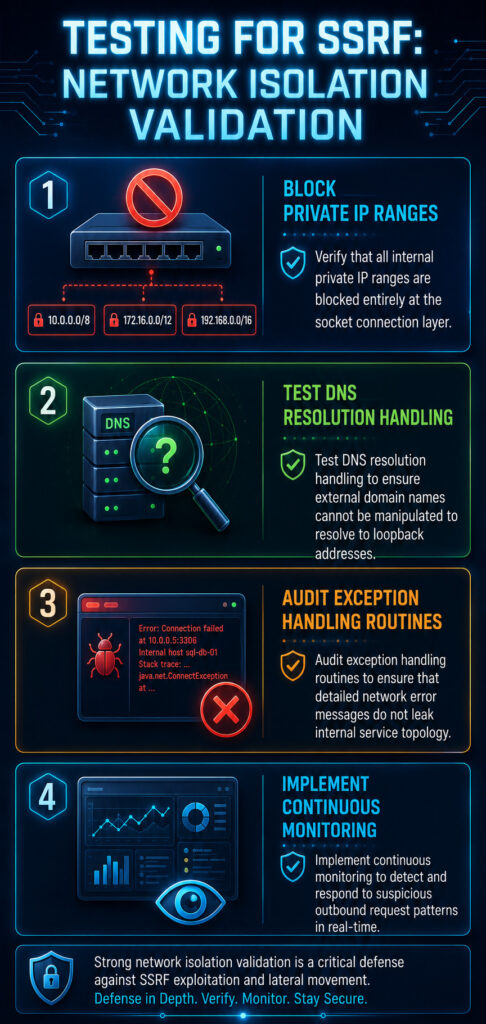
How Do You Validate Network Isolation?

Continuous monitoring and validation are critical elements when testing for ssrf potential vectors in production environments. Security teams must ensure that deployed defenses cannot be bypassed through network obfuscation, alternative IP representations, or indirect request routing.
- Verify that all internal private IP ranges are blocked entirely at the socket connection layer.
- Test DNS resolution handling to ensure external domain names cannot be manipulated to resolve to loopback addresses.
- Audit exception handling routines to ensure that detailed network error messages do not leak internal service topology.
How Do Cloud Environments Amplify Server-Side Threats?
Analyzing real-world attack scenarios is vital during testing for ssrf potential vectors because modern elastic infrastructures introduce unique security risks. By reviewing concrete case studies of ssrf attack examples cloud environments, engineering teams can better anticipate how threat actors exploit automated APIs and metadata services.
- Examine how unvalidated webhook integrations allow attackers to target internal microservices.
- Review past incidents where instance metadata endpoints leaked temporary cloud provider credentials.
- Analyze how DNS rebinding bypasses naive IP blocklists during active exploitation.
FAQ
What is testing for ssrf potential vectors?
It is the systematic process of evaluating application input parameters and URL handlers to identify pathways where malicious actors can force backend servers to execute unauthorized internal or external requests.
Why do standard blacklists fail during testing for ssrf potential vectors?
Attackers can easily bypass simple denylists using alternative IP encodings, DNS rebinding, and uncommon URI schemes, which makes comprehensive testing for ssrf potential vectors necessary to uncover hidden flaws.
How do cloud metadata services impact testing for ssrf potential vectors?
Cloud environments feature predictable local IP endpoints that can leak temporary credentials if unvalidated requests reach them, making metadata evaluation a crucial part of testing for ssrf potential vectors.
Can automated tools fully replace manual testing for ssrf potential vectors?
Automated scanners often miss complex logic flaws and asynchronous pathways, meaning thorough testing for ssrf potential vectors requires a combination of automated tools and manual code review.
Which URI schemes are most important to examine when testing for ssrf potential vectors?
Testers must closely examine dangerous protocols like file, gopher, and dict because they allow arbitrary file reading and internal port scanning during testing for ssrf potential vectors.
Securing Modern Cloud Architectures Against Request Forgery
Mastering the core principles of testing for ssrf potential vectors requires a disciplined, multi-layered approach combining strict URL allowlists, dangerous protocol disuse, and robust egress filtering across all active microservices.
When development teams actively sanitize untrusted inputs and secure backend network boundaries, they effectively neutralize complex server-side request forgery vectors before exploitation occurs.
Ready to elevate your software security standards and protect enterprise systems? Join the Secure Coding Practices Bootcamp to master hands-on remediation techniques, build advanced defensive coding architectures, and safeguard critical infrastructure from sophisticated threats safely today ensuring long-term digital resilience across all modern deployment environments right now.
References
- https://cwe.mitre.org/data/definitions/918.html
- https://nvlpubs.nist.gov/nistpubs/Legacy/SP/nistspecialpublication800-95.pdf