


Effective preventing ssrf vulnerabilities application code requires deep integration of security checks across the software lifecycle. Modern applications frequently process untrusted URLs. Without strict defenses, these requests expose backend systems to severe risks.
This weaponization converts a standard web application into an internal proxy, exposing architectural vulnerabilities that traditional perimeter firewalls fail to detect. At Secure Coding Practices, we help teams identify high-risk pathways before exploitation.
By understanding how attackers transition from parameter tampering to full exploitation, organizations can implement robust architectural controls, secure configuration defaults, and comprehensive input verification across every microservice.
Preventing SSRF Vulnerabilities in Application Code
- Deploy Strict Allowlists: Always use explicit allowlists instead of denylists, as attackers easily bypass denylists using IP obfuscation and DNS rebinding techniques.
- Disable Dangerous Protocol Handlers: Immediately disable unused or risky URI handlers like
file://,gopher://, anddict://to stop arbitrary file reading and internal port scans. - Implement Egress Filtering: Reinforce application code security with robust network-level egress filtering and firewalls to drop unexpected internal IP connections.
Why Standard Error Handling Fails in Preventing Ssrf Vulnerabilities Application Code
Developers often rely on standard try-catch blocks and basic exception handling when building web services, assuming runtime errors will catch malformed network requests. However, asynchronous remote fetching operations frequently fail to flag internal IP loops or unexpected redirects, leaving systems exposed.
When developers focus on preventing ssrf vulnerabilities application code, they must realize that standard exception handling does not validate the semantic safety of a URL destination. Furthermore, legacy libraries and outdated HTTP client implementations often follow HTTP redirects automatically by default.
If an application permits a user-supplied URL that redirects to a local loopback address or metadata endpoint, the client library will blindly execute the chained request, completely bypassing initial input filters. Addressing these risks requires disabling automatic redirects and inspecting intermediate headers.
What Are the Primary Targets and Impacts of Request Forgery Exploits?
When assessing potential security flaws, understanding server-side request forgery mechanics helps developers identify why preventing ssrf vulnerabilities application code requires strict destination validation.
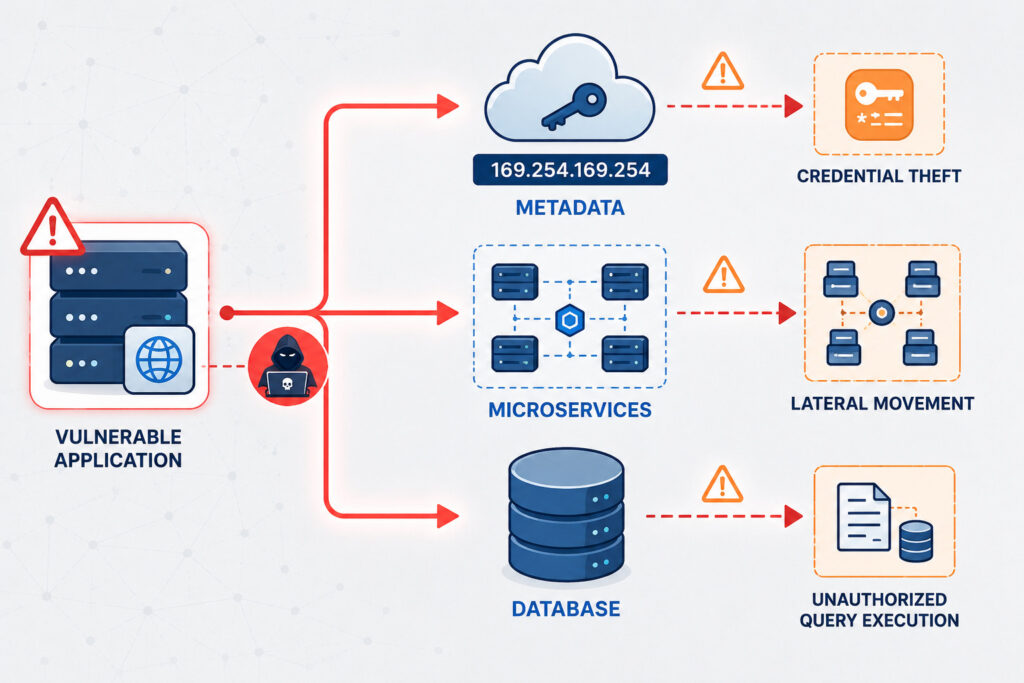
Attackers frequently leverage unvalidated endpoints to target internal services, configuration metadata, and private network infrastructure.
| Target Resource | Attack Vector | Security Impact |
| Instance Metadata | Unfiltered URL parameter | Credential theft and account takeover |
| Internal Microservices | Local loopback access | Lateral movement and data exfiltration |
| Database Endpoints | Direct socket connection | Unauthorized query execution |
How Do DNS Rebinding and Redirects Compromise Application Security?
Even when teams implement initial validation routines, subtle edge cases can entirely bypass backend safeguards. Attackers frequently deploy custom DNS servers or open redirect loops to outsmart basic URL filters, transforming a seemingly safe outbound call into a malicious payload delivery.
When focusing on preventing ssrf vulnerabilities application code, developers must account for runtime DNS resolution changes and follow-up HTTP redirection targets.
“Beware of redirects. One common technique is to host a script that redirects to a host that should be forbidden. For example, the server may request hacker.example.com, but this URL redirects to 169.254.169.254, so the server then ends up requesting the AWS metadata endpoint.” – Snyk Learn
How Do Core Code Fixes Stop Request Forgery?
Credits: Loi Liang Yang
When implementing effective preventing ssrf vulnerabilities application code, developers must look closely at how requests are structured and handled in the backend. Reviewing an ssrf vulnerability explained simple terms guide helps development teams recognize why standard input checks often fail under complex, obfuscated payloads.
- Sanitize and parse user-provided URLs using secure native language libraries to ensure proper schema validation before execution.
- Enforce absolute restrictions on non-standard port numbers to prevent malicious internal service scanning loops.
- Programmatically reject any outbound connection attempts containing loopback IP addresses or private subnet ranges before dispatching requests.
What Best Practices Ensure Robust Application-Level Defenses?
When focusing on preventing ssrf vulnerabilities application code, developers must integrate defensive coding patterns directly into the request dispatching lifecycle. Relying solely on network firewalls leaves internal APIs vulnerable if an application accepts raw, unverified URLs from untrusted sources.
Establishing centralized parsing functions and strict schema enforcement ensures that every outgoing request complies with predetermined security policies before execution occurs.
“The application should validate the user-supplied input data, enforce a safe allowlist of protocols and destinations, and disable unnecessary URI schemas to prevent server-side request forgery.” – OWASP Cheat Sheet Series
How Do You Test Applications for SSRF?

Rigorous security testing is an indispensable component of preventing ssrf vulnerabilities application code. Because server-side request forgery exploits often hide deep within asynchronous workflows such as webhooks, PDF generation engines, or media import features security teams must systematically evaluate every data entry point that handles remote URLs.
Combining automated scanning tools with meticulous manual verification ensures that hidden internal pathways are uncovered and remediated before malicious actors can exploit them in production environments.
- Inject local loopback addresses (such as
127.0.0.1orlocalhost) into URL parameters to check if the server improperly attempts internal communication. - Test cloud metadata endpoints (like
169.254.169.254) to verify whether access restrictions properly block unauthorized credential retrieval. - Monitor out-of-band (OOB) DNS and HTTP interactions using specialized scanners to detect asynchronous requests triggered by hidden background processes.
How Do You Apply OWASP SSRF Prevention Measures?
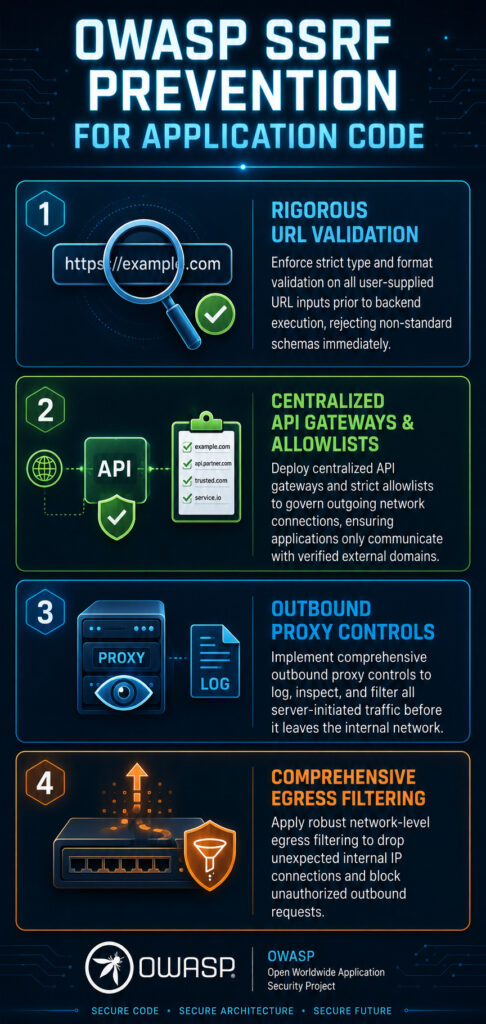
When securing modern software architectures against request forgery, development teams can leverage structured frameworks such as owasp ssrf prevention measures to establish robust defenses while preventing ssrf vulnerabilities application code.
Translating these industry-standard guidelines into concrete coding practices ensures that security controls are embedded directly into the software development lifecycle from day one, rather than treated as an afterthought.
- Enforce rigorous type and format validation on all user-supplied URL inputs prior to backend execution, rejecting non-standard schemas immediately.
- Deploy centralized API gateways and strict allowlists to govern outgoing network connections, ensuring applications only communicate with verified external domains.
- Implement comprehensive outbound proxy controls and egress filtering to log, inspect, and filter all server-initiated traffic before it leaves the internal network.
FAQ
What is preventing ssrf vulnerabilities application code?
It involves writing secure code that strictly validates and sanitizes user-supplied URLs to prevent malicious servers from executing unauthorized internal requests.
Why do standard try-catch blocks fail against SSRF?
Standard exception handling catches runtime errors, but it does not evaluate the semantic safety or destination of remote URL parameters.
How do URL allowlists stop request forgery?
Allowlists explicitly restrict outgoing server requests to a pre-approved set of trusted domains, blocking arbitrary internal network targets.
What URI protocols should developers disable?
Developers should immediately disable dangerous protocols like file, gopher, and dict to prevent arbitrary file reading and internal port scanning.
Can network firewalls replace application code fixes?
Network firewalls offer helpful defense-in-depth, but fixing input validation directly within the application code remains mandatory to stop internal proxy attacks.
Securing Modern Software Architecture Against Server-Side Request Forgery
Mastering the core principles of preventing ssrf vulnerabilities application code requires a disciplined, multi-layered approach combining strict URL allowlists, dangerous protocol disuse, and robust egress filtering across all active microservices.
When development teams actively sanitize untrusted inputs and secure backend network boundaries, they effectively neutralize complex server-side request forgery vectors before exploitation occurs.
Ready to elevate your software security standards and protect enterprise systems? Join the Secure Coding Practices Bootcamp to master hands-on remediation techniques, build advanced defensive coding architectures, and safeguard critical infrastructure from sophisticated threats safely today ensuring long-term digital resilience across all deployment environments moving forward.
References
- https://learn.snyk.io/lesson/ssrf-server-side-request-forgery
- https://cheatsheetseries.owasp.org/cheatsheets/Server_Side_Request_Forgery_Prevention_Cheat_Sheet.html