


Unvalidated network requests in elastic cloud architectures create severe SSRF risks when handling unverified inputs. When servers accept user-supplied URLs without strict validation, malicious actors manipulate them to fetch hidden internal resources or external payloads.
This weaponization transforms standard web applications into internal proxies, easily bypassing traditional perimeter firewalls.
By understanding how threat actors transition from parameter tampering to full cloud metadata extraction, organizations can implement robust architectural controls, secure configuration defaults, and comprehensive input verification across every microservice. Secure Coding Practices helps teams identify these high-risk pathways before exploitation occurs.
Essential Understanding of SSRF Vulnerability
Reviewing core insights into cloud-based server-side request forgery mechanics and risk mitigation:
- Studying an ssrf attack examples cloud environments guide helps teams understand how unvalidated URL inputs typically exploit local instance metadata endpoints.
- Attackers leverage trusted server positioning to bypass perimeter firewalls and probe internal microservices or databases.
- Effective defense requires strict URL allowlists, disabling unnecessary protocol handlers, and enforcing cloud metadata version security.
Why Can You Not Simply Trust User-Supplied URLs?
Developers frequently assume that data originating from user inputs can be safely processed if it conforms to basic string formats. However, modern web applications often require features that fetch remote assets, such as profile picture downloaders, PDF generators, or webhook dispatchers.
When analyzing an ssrf attack examples cloud environments guide, this exact functionality represents the primary entry point for malicious actors seeking to compromise backend infrastructure. If the underlying application logic does not restrict destination addresses, an attacker can input internal IP addresses, private subnet blocks, or local loopback interfaces.
This ability to redirect server-side requests forms the bedrock of server-side request forgery. Without strict validation, your infrastructure inadvertently exposes hidden internal APIs and sensitive backend services to untrusted external control.
What Is the Cloud Metadata Trap?
Cloud platforms like AWS, Azure, and Google Cloud rely heavily on Instance Metadata Services (IMDS) to provide running instances with temporary credentials, dynamic configurations, and network settings. These services are hosted on predictable, non-routable link-local IP addresses, such as 169.254.169.254.
When reviewing an ssrf attack examples cloud environments guide, understanding the core mechanics of server-side request forgery reveals why this metadata endpoint is almost always the primary objective for malicious actors. An attacker injects the metadata IP into an unvalidated URL parameter, causing the application server to fetch and leak sensitive security tokens directly back to the public-facing interface.
| Cloud Platform | Metadata Endpoint | Target Resource | Security Impact |
| AWS EC2 | 169.254.169.254/latest/meta-data/ | IAM Security Credentials | Full Cloud Account Takeover |
| Azure VM | 169.254.169.254/metadata/identity | Managed Identity Tokens | Internal Subscription Access |
| Google Cloud | metadata.google.internal | Service Account Tokens | Project-Wide Data Exfiltration |
How Can Security Teams Proactively Validate Against SSRF?
Proactive validation requires shifting security controls into the design and coding phases to effectively utilize an ssrf attack examples cloud environments guide. Applications should never rely on denylists, as malicious actors frequently bypass them using IP obfuscation, alternate encodings, or complex DNS rebinding techniques.
Instead, engineering teams must implement strict URL allowlists that explicitly permit only trusted external domains and service endpoints. Additionally, disabling dangerous protocol handlers prevents attackers from turning standard HTTP request features into arbitrary file reads or internal port scans.
“To prevent SSRF effectively, you should sanitize and validate user input, enforce strict allowlists for outbound URLs, and disable unnecessary URL schemas.” – PortSwigger Web Security
What Are the Specific Risks of SSRF in Cloud-Native Architectures?
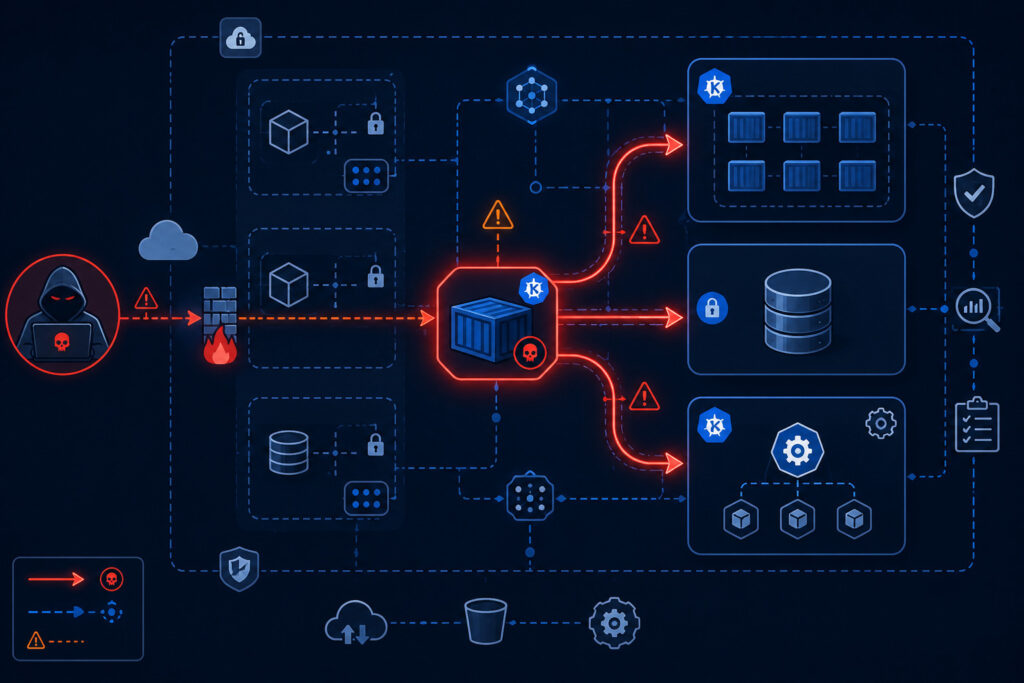
The severity of request forgery in cloud architectures stems from flat internal networking and automated service discovery mechanisms.
When analyzing various insights from an ssrf attack examples cloud environments guide, reviewing an ssrf vulnerability explained simple terms clarifies these core mechanisms to help security professionals recognize hidden attack vectors before they cause severe damage.
- Threat actors frequently exploit these internal pathways to interact with management APIs, unauthenticated backend services, and orchestration control planes that were never intended to be exposed to untrusted input streams.
- When an application server is compromised via server-side request forgery, the blast radius rarely stops at that single instance.
- Attackers can quickly transition from exploiting a minor input flaw to full lateral movement across internal container clusters and database endpoints.
Is Network Segmentation Enough to Stop SSRF?
Credits: Rana Khalil
Network segmentation is frequently deployed as a core defense against lateral movement, yet it often fails to completely mitigate risks outlined in an ssrf attack examples cloud environments guide.
While internal firewalls successfully restrict unauthorized inbound connections from the outside world, they routinely permit standard outbound traffic so that application servers can fetch software updates, connect to databases, or communicate with external APIs.
Because server-side request forgery leverages legitimate outbound request mechanisms initiated directly by the trusted host, traditional network boundaries cannot easily differentiate between a valid operational query and an illicit probe targeting internal services.
This limitation highlights why organizations examining security blueprints must combine network zoning with rigorous egress filtering and strict application-layer validation.
How Do You Test for SSRF?
Identifying server-side request forgery vulnerabilities before malicious actors discover them requires a combination of automated scanning and rigorous manual code review.
When evaluating applications that handle remote URLs, security testers must systematically inspect every entry point such as webhooks, file import features, and API connectors—to determine if backend requests can be redirected toward internal networks.
During security assessments based on an ssrf attack examples cloud environments guide, testers frequently utilize out-of-band interaction tools to detect asynchronous requests triggered by the server. If an application responds to untrusted input by querying external log collectors or internal loopback addresses, it confirms that request forgery vectors exist within the data processing pipeline.
“Key API risks include unrestricted resource consumption, server-side request forgery (SSRF), and poor API inventory management, all of which can lead to data exposure.” – Cloudflare Learning Center
What Are the Best OWASP SSRF Prevention Measures?
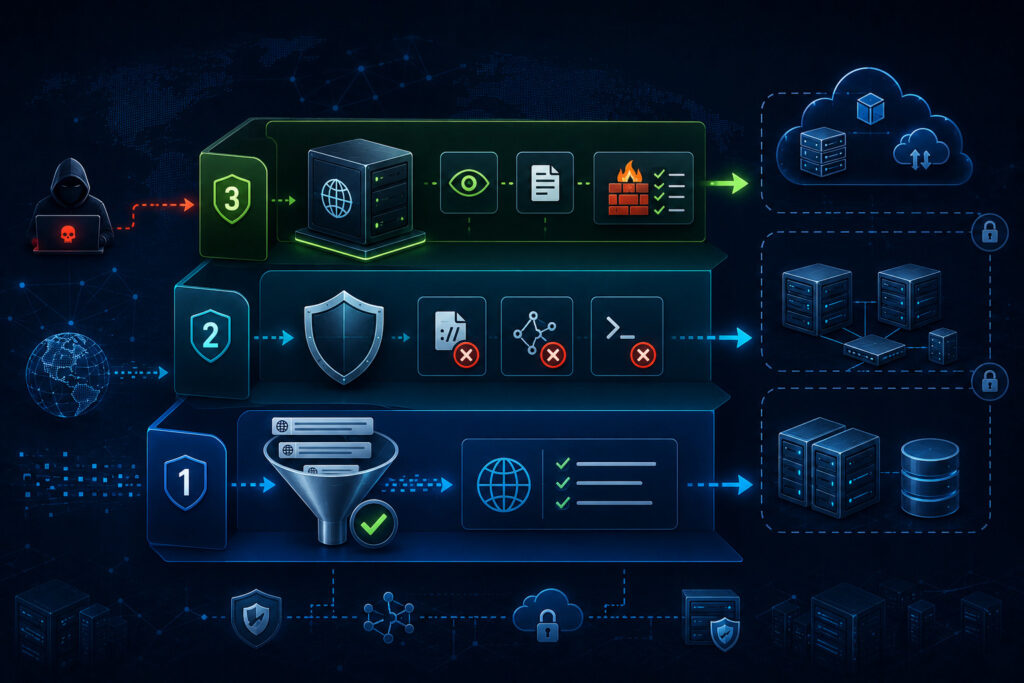
Mitigating the impact of server-side request forgery requires adopting standardized security frameworks across the entire software development lifecycle.
When examining an ssrf attack examples cloud environments guide, organizations frequently discover that adhering to established baseline controls prevents the vast majority of injection vectors.
Implementing a comprehensive defense strategy ensures that application components remain resilient even under active exploitation attempts.
- Enforce strict input validation schemas to reject unexpected URL formats and non-standard domain structures immediately.
- Disable unused or dangerous URI protocol handlers such as
file://,gopher://, anddict://to prevent arbitrary file reading. - Implement centralized outbound proxy controls and egress filtering to inspect, log, and filter all server-initiated network traffic.
How Do You Implement OWASP SSRF Prevention Measures?
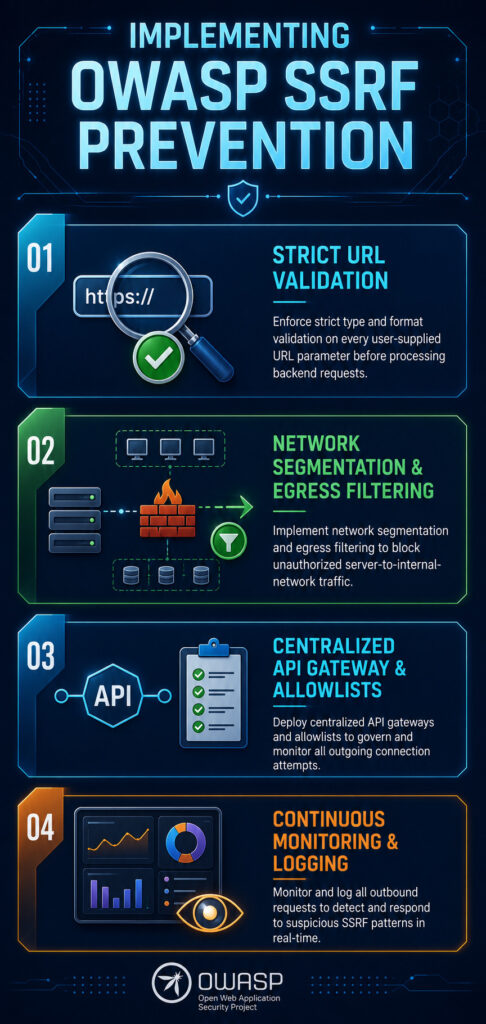
Protecting modern cloud infrastructure against sophisticated server-side request forgery requires adhering to industry-standard guidelines.
When applying data from an ssrf attack examples cloud environments guide, security teams can leverage structured frameworks such as owasp ssrf prevention measures to establish robust defenses across all application layers.
- Enforce strict type and format validation on every user-supplied URL parameter before processing backend requests.
- Implement network segmentation and egress filtering to block unauthorized server-to-internal-network traffic.
- Deploy centralized API gateways and allowlists to govern and monitor all outgoing connection attempts.
FAQ
What is server-side request forgery?
Server-side request forgery is a vulnerability where an attacker manipulates an application into making unauthorized HTTP requests to internal or external systems.
Why are cloud environments targeted by SSRF?
Cloud instances rely on predictable local metadata services that expose sensitive configuration data and temporary security credentials.
Does HTTPS prevent SSRF attacks?
HTTPS does not prevent SSRF because it only encrypts data in transit rather than validating the destination endpoint or restricting server requests.
How do URL allowlists stop request forgery?
Allowlists restrict outgoing server connections to explicitly trusted external domains and endpoints, blocking unauthorized internal targets.
Can network segmentation stop SSRF completely?
Network segmentation is vital, but it cannot stop SSRF alone because malicious requests originate directly from trusted application servers.
Securing Cloud Infrastructure Against SSRF Attacks
Following an ssrf attack examples cloud environments guide enables developers to recognize how malicious actors exploit unvalidated requests to target metadata services and internal networks.
Armed with this awareness, teams can enforce strict URL allowlists, disable dangerous protocol handlers, and implement comprehensive egress filtering.
Ready to strengthen your cloud infrastructure? Join the Secure Coding Practices Bootcamp to master hands-on remediation techniques, stop server-side request forgery, and build highly resilient web applications safely from day one.
References
- https://portswigger.net/web-security/ssrf
- https://www.cloudflare.com/learning/security/api/owasp-api-security-top-10