


Having SSRF Vulnerability Explained Simple Terms is crucial for developers navigating modern web security. Server-Side Request Forgery acts as a silent gateway for attackers, allowing them to manipulate servers and interact with restricted internal resources.
By coercing applications to fetch untrusted data, malicious actors bypass firewalls and exfiltrate cloud metadata. Secure Coding Practices helps engineering teams neutralize these flaws during development through rigorous validation and granular network controls, providing the practical knowledge needed to harden endpoints and build robust software.
Essential Understanding of SSRF Vulnerability
Mastering the fundamental dynamics of SSRF is essential for maintaining a secure and resilient web application architecture.
- SSRF allows unauthorized actors to manipulate server-side processes to send malicious requests to restricted internal resources.
- These vulnerabilities exploit the trust placed in the server’s IP address, effectively bypassing traditional perimeter security controls.
- Effective mitigation requires a defense-in-depth approach involving strict input validation and granular network-level controls.
Why can you not simply trust user-supplied URLs?
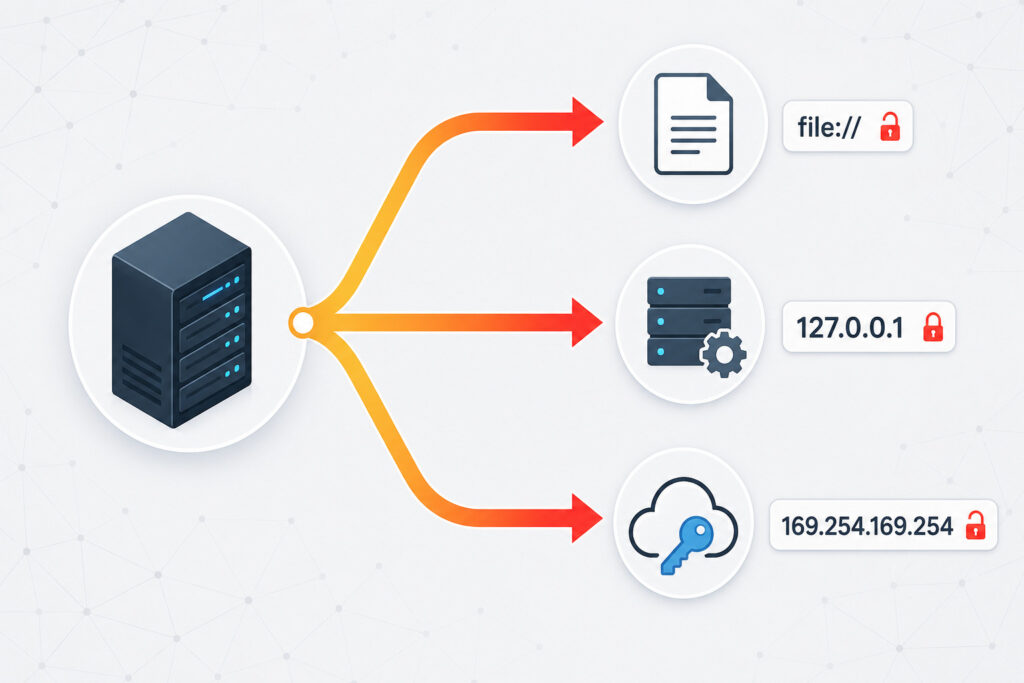
The common belief follows a simple logic: a URL is merely a harmless string—a map pointing to a public web resource. If the input format resembles a standard web address, surely the application logic remains safe, right? That is where thinking gets dangerous. The URL text itself is inert.
The vulnerability resides in the server-side machinery that executes the request. When your application accepts a URL as input, the underlying library becomes an unchecked proxy for an attacker.
In our field experience, we have seen application defenses fail under surprisingly simple input manipulation:
- Protocol Smuggling: Attackers can inject schemes such as
file://,gopher://, ordict://to bypass HTTP filters, allowing them to read sensitive local system files or interact with internal non-HTTP services. - Internal Network Probing: Malicious input can force the server to interact with private network ranges or loopback addresses (e.g.,
127.0.0.1), effectively bypassing perimeter firewalls. - Cloud Metadata Exfiltration: Accessing specific non-routable endpoints, such as
169.254.169.254, can lead to the unauthorized retrieval of temporary security credentials and instance identity tokens.
The URL input is merely the trigger. The real failure occurs when your application logic assumes every outbound request it initiates is destined for the public internet.
This is the core of the SSRF vulnerability, a concept we prioritize in our comprehensive resources to ensure you have the SSRF vulnerability explained simple terms. The threat lives in the trust you place in the request-handling machinery.
What Is the Cloud Metadata Trap?
Credits : Snyk
This is the closest SSRF gets to the classic “infrastructure compromise” nightmare. The Cloud Metadata Trap is a major security hole in distributed environments. It stems from a developer’s need for flexibility, such as an application instance requiring temporary credentials to talk to other cloud services.
To manage this, cloud providers expose a non-routable IP (typically 169.254.169.254) that serves identity tokens and configuration data. The application requests this endpoint, and the cloud fabric returns the secrets associated with that specific instance.
If the application blindly fetches attacker-chosen URLs, the result can be full cloud environment compromise. Unsafe URL handling has been the root cause of multiple high-profile cloud data breaches where attackers escalated from a simple server request to full administrative control.
The chain looks like this:
- Subject: Application Request Library
- Predicate: Fetches/Queries
- Object: Sensitive metadata endpoint
The vulnerability isn’t in the cloud provider itself. It is the application logic that permits unauthorized, outbound requests. We recommend isolating the application environment by default.
If you need external connectivity, you must define a strict, explicit allowlist of domains the application is permitted to reach. To master these defense techniques and have the SSRF vulnerability explained simple terms, implement these controls without exception.
How can security teams proactively validate against SSRF?
Proactive testing is the only way to confirm whether your application’s defensive layer can withstand sophisticated SSRF attempts. Static analysis alone often misses dynamic execution paths, so security teams must simulate attacker behavior by targeting any endpoint that consumes user-provided URLs.
“Effective SSRF mitigation requires a layered defense approach, integrating rigorous input validation with deep network-level inspection to prevent unauthorized internal resource access.” – Veracode
By probing these inputs, you can identify whether your application exposes internal network infrastructure or sensitive configuration endpoints.
- Redirect Handling: Test how the application processes HTTP redirects. Malicious actors often use redirect chains to bypass initial domain-based allowlists.
- Header Inspection: Analyze whether the application improperly trusts headers such as
X-Forwarded-FororRefererwhen making internal requests. - Internal Service Probing: Attempt to access restricted services, loopback addresses (e.g.,
127.0.0.1), and cloud metadata endpoints from the server-side perspective.
What are the specific risks of SSRF in cloud-native architectures?

Cloud-native environments significantly change the stakes for SSRF vulnerabilities. Having the ssrf vulnerability explained simple terms makes it evident that cloud platforms provide a specialized, high-value target: the Instance Metadata Service (IMDS).
This service is typically located at a non-routable, link-local address, such as 169.254.169.254, and is accessible from any instance without traditional authentication. If your application server is compromised via SSRF, an attacker can query this metadata endpoint to retrieve temporary security credentials, instance identity tokens, and sensitive configuration secrets.
These tokens often hold high-level permissions within the cloud provider’s API, potentially leading to full account takeover or lateral movement across your entire infrastructure. For a clear breakdown of how these threats materialize in real-world scenarios, refer to our guide on SSRF attack examples in cloud environments.
By understanding these specific vectors, you can implement stricter egress filtering and identity-based security policies that prevent your cloud instances from becoming the weak link in your security chain.
Is network segmentation enough to stop SSRF?
While network segmentation is a fundamental requirement for infrastructure security, it is rarely sufficient to halt all SSRF attacks. Segmentation effectively limits the blast radius by preventing the server from accessing sensitive internal networks.
However, attackers can often leverage allowed outbound traffic or local services still reachable by the server, such as local databases or internal APIs that are explicitly permitted to talk to the application tier. Relying solely on network controls leaves the application logic blind to the content of the requests it initiates.
| Defense Layer | Purpose | Limitation |
| Network Segmentation | Restricts lateral movement | Does not inspect application payloads |
| Application Allowlist | Validates destination domains | Can be bypassed via open redirects |
| Egress Filtering | Blocks unauthorized outbound | Complex to manage for dynamic services |
To truly secure your environment, you must combine infrastructure controls with rigorous, application-level checks. When you have the ssrf vulnerability explained simple terms, it becomes clear that relying solely on the network layer leaves application logic blind to the content of the requests it initiates.
“A robust security posture relies on the assumption that the network perimeter has already been breached; therefore, you must secure the application logic itself by validating every outbound request.” – Acunetix
How do you test for SSRF?
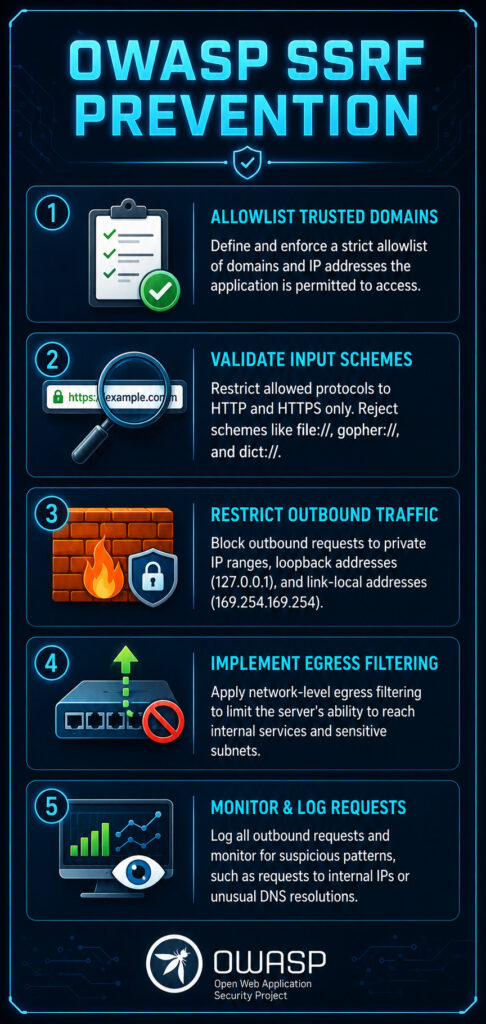
Identifying SSRF vulnerabilities requires a rigorous approach to input analysis. You must locate every application entry point that accepts URL-based input and systematically probe for potential exploitation. Our comprehensive methodology on testing for SSRF potential vectors provides the specific steps to identify where your application might leak internal connectivity.
- Map Input Points: Locate all form fields, API parameters, and HTTP headers that process remote resource locations.
- Probe Internal Hosts: Attempt to access restricted internal IP addresses, loopback addresses (e.g.,
127.0.0.1), and cloud metadata endpoints from the server’s perspective. - Validate Schemes: Test various protocol schemes (e.g.,
file://,ftp://,gopher://) to verify if the request library correctly restricts execution to safe, expected protocols.
FAQ
For those who require the ssrf vulnerability explained simple terms, we have compiled the most critical inquiries regarding mitigation and identification below
What is SSRF?
It is a vulnerability where an attacker forces a server to make unintended network requests to unauthorized destinations, such as internal databases or restricted admin panels.
Why is SSRF critical?
It allows attackers to bypass perimeter security, enabling them to access sensitive internal data, probe internal network infrastructure, or exfiltrate cloud secrets.
Does HTTPS prevent SSRF?
No, HTTPS only encrypts the transport layer between the server and the destination; it does not validate the security or safety of the resource being requested.
How can I prevent SSRF?
Implement strict allowlisting for domains, restrict allowed protocols to HTTP/HTTPS only, and utilize network segmentation to limit the server’s outbound access.
Are cloud environments at risk?
Yes, attackers frequently target cloud metadata services (typically at 169.254.169.254) to steal sensitive instance credentials and configuration secrets.
Making SSRF Easier to Understand and Prevent
ssrf vulnerability explained simple terms helps developers understand how attackers can abuse server-side requests to reach internal systems and sensitive resources. With this knowledge, teams can implement practical defenses such as input validation, allowlisting trusted destinations, restricting outbound connections, and monitoring suspicious requests.
These security practices reduce SSRF risks and strengthen application resilience. Ready to improve your secure coding skills? Join the Secure Coding Practices Bootcamp and learn hands-on techniques for preventing SSRF vulnerabilities and building more secure applications.
References
- https://info.veracode.com/rs/790-ZKW-291/images/ssrf-prevention-guide-en.pdf
- https://www.acunetix.com/blog/articles/server-side-request-forgery-vulnerability