


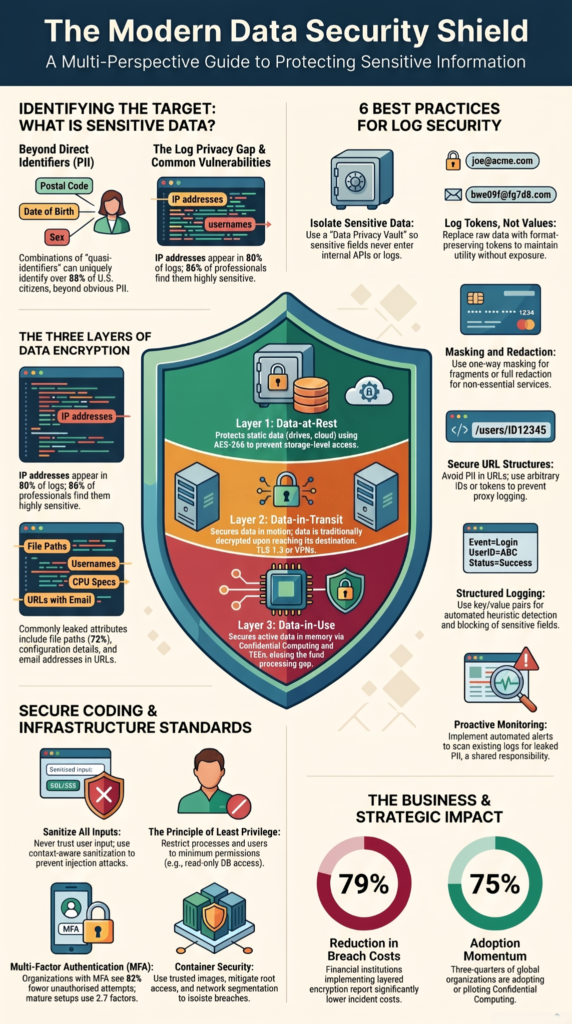
Data encryption best practices developers follow go far beyond simply choosing AES-256. Effective protection depends on everything surrounding the algorithm, including secure key management, thoughtful database architecture, and avoiding common mistakes such as querying encrypted fields or storing keys in environment variables. Even strong encryption can fail when these details are overlooked.
Building security into applications requires consistent attention to Secure Coding Practices that reduce risk across the entire development lifecycle. Want to understand which practices matter most and why they work? Keep reading.
Encryption Essentials at a Glance
Strong encryption depends as much on key management and implementation choices as it does on the algorithm itself.
- Never store encryption keys with your code. Move them to a dedicated key management service immediately.
- Use authenticated encryption (AES-GCM) for data at rest. It protects both confidentiality and integrity in one operation.
- Plan for database queries before you encrypt a field. Use blind indexes for exact matches, or you’ll face massive performance penalties.
Where Do Most Encryption Systems Fail First?
We learned this firsthand when our team discovered a live master key in an old git commit. It was a clear reminder that even strong encryption like AES-256-GCM cannot protect data if the key is exposed. This is exactly how sensitive data gets exposed.
That’s why secure coding practices must include strong key management. Never hardcode secrets or store them in source repositories. Instead, use a dedicated secrets manager and a layered encryption strategy.
Our approach uses envelope encryption:
- The application retrieves a master key (KEK) from a secure vault.
- A unique data encryption key (DEK) is generated.
- The DEK encrypts the sensitive data.
- The KEK encrypts the DEK, which is stored alongside the encrypted data.
When data needs to be decrypted, the process is reversed. The master key stays protected in the vault, reducing risk and preventing a single key compromise from exposing all your data.
Is Your Data Truly Protected in Transit?
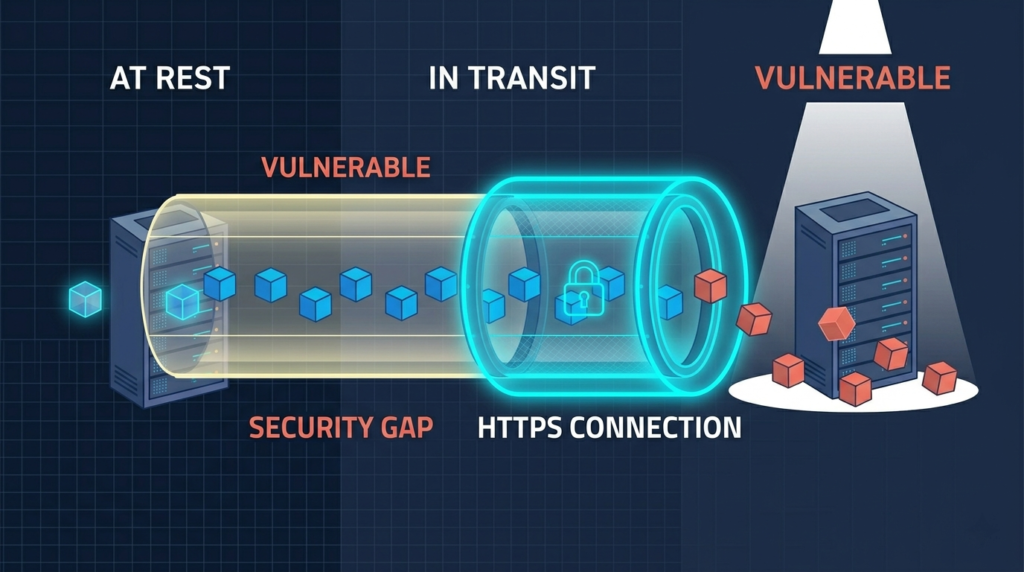
Securing data in motion is mandatory. It’s also more than just flipping on HTTPS. TLS 1.3 is the standard. Disable everything older SSL, TLS 1.0, TLS 1.1. They have known vulnerabilities.
But developers often miss this: TLS protects the wire to your load balancer. What about inside your network? Traffic between your microservices or to your database is often plaintext. In a cloud VPC, a compromised service can sniff all that internal chatter, creating serious data exposure risks. You must encrypt this east-west traffic too. Use TLS between services.
You also need Perfect Forward Secrecy. With modern cipher suites like ECDHE, each session uses a unique key. This extra layer helps protect data in transit even if long-term credentials are later compromised. This means if an attacker records traffic today and steals your private key tomorrow, they still can’t decrypt old sessions.
Finally, implement HTTP Strict Transport Security headers. This simple header forces browsers to use HTTPS, preventing downgrade attacks.
What’s the Right Way to Encrypt Data at Rest?
Research from OWASP.org shows
“AES-GCM is the recommended authenticated encryption mode per OWASP and NIST guidelines, combining AES-CTR encryption with authentication in one operation” – OWASP.org
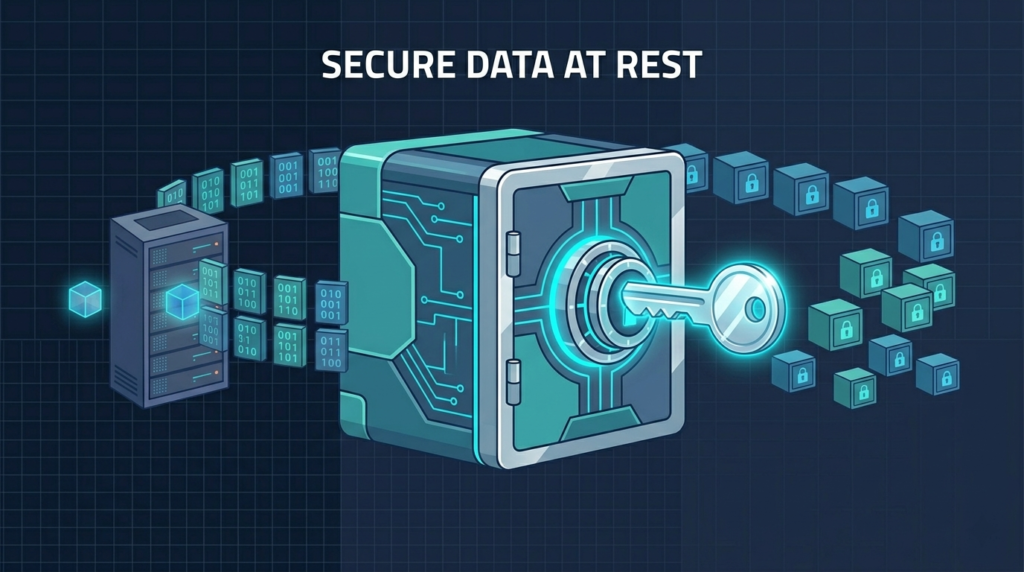
For new systems, the default should be AES-256 in Galois/Counter Mode. This is authenticated encryption, guaranteeing both confidentiality and integrity. Older modes like CBC only provide secrecy, requiring a separate, easy-to-forget integrity check. Never use Electronic Codebook mode. It’s deterministic and leaks patterns; you can see repeating structures in the encrypted output.
The nonce is critical with GCM. It must be unique for every single encryption operation under the same key. Reusing a nonce breaks security. Generate it with a cryptographically secure random number generator.
Think of it like a unique salt for a password hash. Store the nonce alongside the ciphertext, often as a prefix. It doesn’t need to be secret, just unique, because decryption needs it. This is exactly why we teach our students to use high-level libraries instead of building their own crypto.
How Do You Search an Encrypted Database Field?
You’ve encrypted an email field. Now you can’t query it. A WHERE email = ‘…’ clause won’t work on an encrypted blob. Decrypting every row to search is impossibly slow.
The fix for exact matches is a blind index. Create a separate column. When saving a user, you store HMAC-SHA256(email, secret_pepper). To find them, compute the same HMAC on your search term and match it. It’s fast and indexed. The pepper is a separate secret key.
Partial searches, like finding “John” in “Johnathan”, are much harder. You’d need to hash overlapping text fragments. Storage and complexity explode. Often, the better choice is to ask if you really need to search that encrypted data at all. Encryption changes your data model. You must design for it upfront.
As highlighted by stackoverflow.com
“Blind indexing enables secure queries without decryption, using HMAC with a secret pepper key.” – stackoverflow.com
Application-Level or Database Encryption: Which Threat Are You Solving?
Transparent Data Encryption, offered by most cloud databases, encrypts the entire file on disk. It protects against stolen hard drives with almost no performance cost. But if an attacker gets SQL injection access, TDE does nothing.
Application-level encryption protects against that. You encrypt specific fields in your code before sending data to the database. Even a full database compromise leaves attackers with ciphertext. That distinction can significantly reduce the consequences of a data exposure breach.
| Approach | Protects Against | Main Limitation |
| Transparent Data Encryption (TDE) | Stolen disks and database files | Does not protect against SQL-level access |
| Application-Level Encryption | Database compromise and unauthorized queries | Higher complexity and performance overhead |
For the highest-sensitivity data, like social security numbers, application-level encryption is the stronger choice. For other cases, TDE plus good access controls works. You have to know which threat you’re actually solving. You have to know which threat you’re actually solving.
Why Should You Never Write Your Own Crypto?
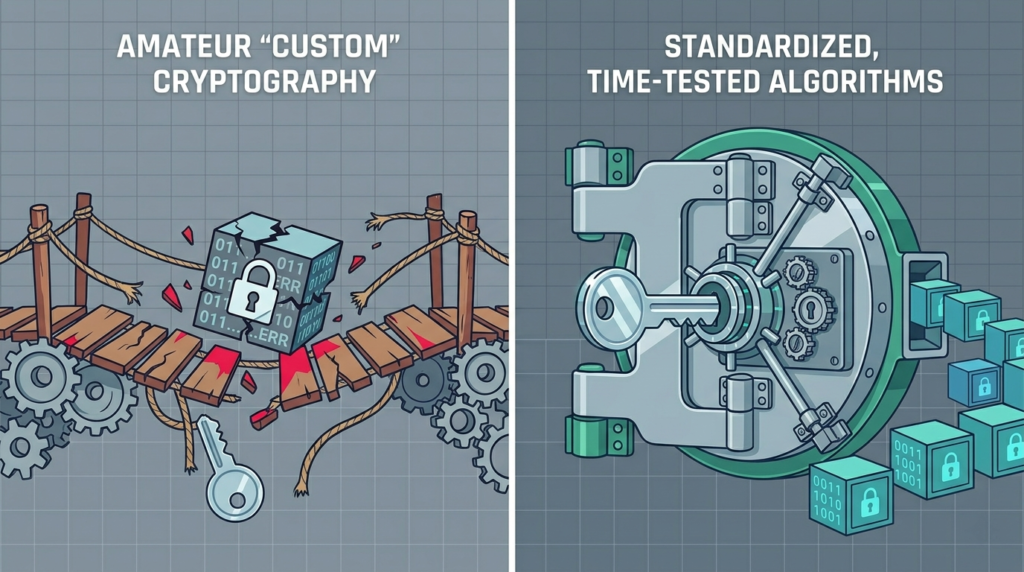
We don’t write our own sorting algorithms for production, and we shouldn’t write our own crypto either. Cryptography is a minefield of side-channel attacks and subtle, catastrophic mistakes. You should always use a vetted library.
For a high-level, multi-language API, Google Tink is excellent. It provides safe, simple interfaces for common tasks. For many projects, libsodium is a great choice with a clean API and solid defaults. In Python, the cryptography library is the standard. In Node.js, it’s wise to avoid the built-in crypto module for complex operations if possible. Instead, lean on framework features, like encryption built into a trusted ORM, that have been reviewed by experts.
Your goal is to reduce the attack surface. Let the library maintainers worry about timing attacks and memory leaks. We teach our students that the most secure line of code is the one you don’t have to write.
When and How Should You Rotate Encryption Keys?
Credits: KirkpetrickPrice
Key rotation isn’t just a compliance task; it’s a critical recovery control. If a key is compromised or an employee leaves, you must be able to retire it without losing old data. The standard method is key versioning.
Your encrypted data stores a reference to the key version used. Old keys are kept in your KMS, marked inactive but not deleted. New data is encrypted with a new active key. Your code reads the version from the data and uses the correct key to decrypt. Automate this rotation annually. Manual processes are error-prone and forgotten.
Finally, audit and test. Encryption can fail silently. Use static analysis tools to spot weak crypto calls. Run pen tests that try to downgrade TLS or steal keys. Check logs for key vault access. Encryption needs maintenance, monitoring, and verification.
FAQs
How can API keys be protected from unauthorized access?
Organizations should store secure API keys outside application code, limit permissions, enforce API key rotation, and monitor access logs to detect suspicious activity.
When should mutual TLS authentication be required?
Mutual TLS authentication should be required when systems exchange sensitive information. This mTLS REST security method verifies both parties through certificate-based authentication.
Why are encrypted backups necessary for sensitive data?
Encrypted data backups protect information if backup files are stolen or accessed improperly. Backup encryption at rest prevents unauthorized users from reading stored data.
How do secure REST endpoints improve application security?
Secure REST endpoints use API authentication methods, input validation REST controls, and secure headers REST API configurations to block unauthorized requests and attacks.
How do we secure application file uploads?
We encrypt files in memory using Google Tink stream-encryption before storing them, keeping data secure even if cloud storage buckets leak.
Why Should Encryption Become a Lasting Security Habit?
Strong encryption depends on consistent implementation, not just choosing the right tools. Start by improving one area, such as key management or internal traffic encryption, and expand from there. Small security improvements create lasting results over time.
Learn practical encryption, authentication, input validation, and secure coding techniques through the Secure Coding Practices Bootcamp. Learn more and join here: Secure Coding Practices Bootcamp.
Which Sources Support These Encryption Best Practices?
- https://stackoverflow.com/questions/4961603/whats-the-best-way-to-store-and-yet-still-index-encrypted-customer-data
- https://owasp.org/Top10/2021/A02_2021-Cryptographic_Failures/