


Traditional coding remains the preferred approach for many developers because it offers full control, deep understanding, and dependable outcomes in complex systems. We have seen this firsthand, project after project, especially when performance, security, and long-term maintenance actually matter.
While AI-assisted and low-code tools have their place, many experienced developers still reach for the keyboard first. Keep reading, because the reasons go deeper than nostalgia.
Key Takeaway
- Traditional coding gives developers full control over logic, architecture, and long-term outcomes
- Manual coding builds deeper understanding, sharper debugging skills, and better judgment
- Secure Coding Practices work best when developers fully own and understand every line
Full Control Over Code and Architecture
Traditional programming starts with a blank file and a clear problem. No hidden assumptions, no auto-generated layers. Manual coding gives you direct control over structure, flow, and behavior, which matters a lot once systems grow and small mistakes start to echo.
Some key spots where that control really shows up:
- Complex conditional logic with many edge cases
- Domain workflows that don’t fit any template
- Legacy systems where behavior must stay predictable
Precision Without Platform Constraints
When you write code by hand, you’re not forced into predefined workflows that almost fit. You can design logic, data flows, and APIs that match the business exactly, including raw SQL, custom authentication, and odd corner paths the platform designer never imagined.
Tailored Performance and Optimization
Real performance rarely comes from defaults. It comes from knowing how the code runs under the hood. Low-level work, C++ modules, plain Java services, pointer math, manual memory strategies, tight async code, lets you cut overhead in places where latency and resources actually decide whether the system holds or breaks, like real-time, embedded, or graphics-heavy workloads [1].
Deeper Understanding of Systems

We’ve seen this during onboarding. People with a manual coding background tend to:
- Ask deeper “why does it do that?” questions
- Push for clarity on data flow and state
- Notice unseen failure paths in existing code
That kind of understanding grows slowly, but it sticks.
Stronger Debugging and Problem-Solving Skills
With manual coding, you can’t blame the platform when something breaks. You trace the logic, step through the debugger, inspect memory, and follow state changes until the bug finally shows itself. Long hours chasing a race condition are rough, but you come away with better instincts.
Some skills that sharpen naturally:
- Reading stack traces with real precision
- Spotting code smells before they spread
- Designing tests that mirror real behavior
Long-Term Skill Growth
Traditional coding builds skills that survive tool churn. Clean code principles, SOLID patterns, and modular design carry across languages and frameworks. Tool ecosystems come and go; strong problem-solving and system understanding keep paying off, which lines up with what surveys like the Stack Overflow Developer Survey keep showing.
Reliability in Complex Projects
When systems get bigger, speed stops being the main concern. What matters more is whether they behave the same way, every time. Traditional coding helps there because the code is clear, and it runs exactly what you wrote.
Fewer Hidden Errors and Hallucinations
AI-generated code can look clean and still fail in one strange scenario you didn’t test. With manual code, the logic is right in front of you, so you can review it, reason about it, and argue over it in a code review, which is where vibe coding faster often becomes questionable once hidden assumptions and edge cases surface.
A few real risks that show up with generated or poorly understood code:
- Logic that passes happy-path tests but fails under load
- Subtle security gaps, especially around auth and input handling
- Misused libraries that behave differently in production
OWASP has pointed out that many common vulnerabilities come from misunderstood or misapplied logic, and that risk grows when developers don’t fully grasp the code they ship.
Easier Maintenance and Refactoring
Readable, intentional code is easier to change later. With traditional coding, teams can refactor, pay down technical debt, or extend old systems without first decoding layers of opaque abstractions, which matters a lot for long-lived, regulated, or legacy-heavy environments.
Security and Trust Considerations
Credits : SiliconANGLE theCUBE
Over time, we’ve seen that security isn’t just a checklist, it’s how you think about code from the first line. At our secure development bootcamp, we push a simple rule: if you can’t explain what your code does, you shouldn’t trust it.
Transparent Logic and Auditing
When logic is written by hand, you can review it, test it, and argue about it with a straight face. In our workshops, we focus on:
- Peer reviews that follow real logic paths
- Unit tests that cover attack cases, not just success paths
- Integration tests wired to real-world risks
That kind of transparency is crucial in aerospace, automotive embedded systems, and manually written smart contracts, where a single bug can be catastrophic. NIST keeps stressing traceability for a reason: security depends on being able to follow the chain.
Reduced Dependency Risks
We’ve watched teams scramble when a platform changed terms, behavior, or APIs. Heavy dependence on outside models or tools can turn into a security and stability problem fast. By owning core security code, hardening steps, encryption paths, and custom authn/authz, teams keep control instead of being pushed into rushed, risky changes [2].
Limitations of AI and Low-Code Alternatives

We see the same pattern again and again in our secure development bootcamp: AI and low-code feel fast at the start, then slow everyone down once the system gets real users, real data, and real security needs, which reflects how vibe coding can trade early momentum for later complexity when ownership and clarity are not maintained.
Context Loss in Larger Codebases
As projects grow, architecture and intent matter more than syntax. AI tools often miss that context. We’ve seen generated code that:
- Crosses domain boundaries the team agreed to keep separate
- Skips or repeats validation and security checks
- Breaks naming and layering rules that keep the system clear
Developers then spend time fixing those breaks instead of moving the system forward.
Time Cost of Corrections
More than once, we’ve thrown away AI-generated modules and rewritten them by hand. Fixing tiny wrong assumptions in:
- Custom APIs
- Microservices layouts
- Real-time WebSocket flows
ended up taking longer than careful manual coding.
Scalability Challenges
Low-code and no-code often start strong, then turn brittle as rules and edge cases pile up. Custom code scales more predictably because the team owns the architecture, the modules, and the integration boundaries, which makes change and security work far easier over time.
| Aspect | Traditional Coding | Low-Code / AI Approaches |
| Logic control | Full developer control | Abstracted and limited |
| Debugging | Transparent and traceable | Often opaque |
| Security | Strong with Secure Coding Practices | Depends on platform |
| Scalability | Predictable with planning | Can degrade with complexity |
| Code ownership | Complete | Shared or restricted |
Traditional Coding as a Complement, Not Opposition
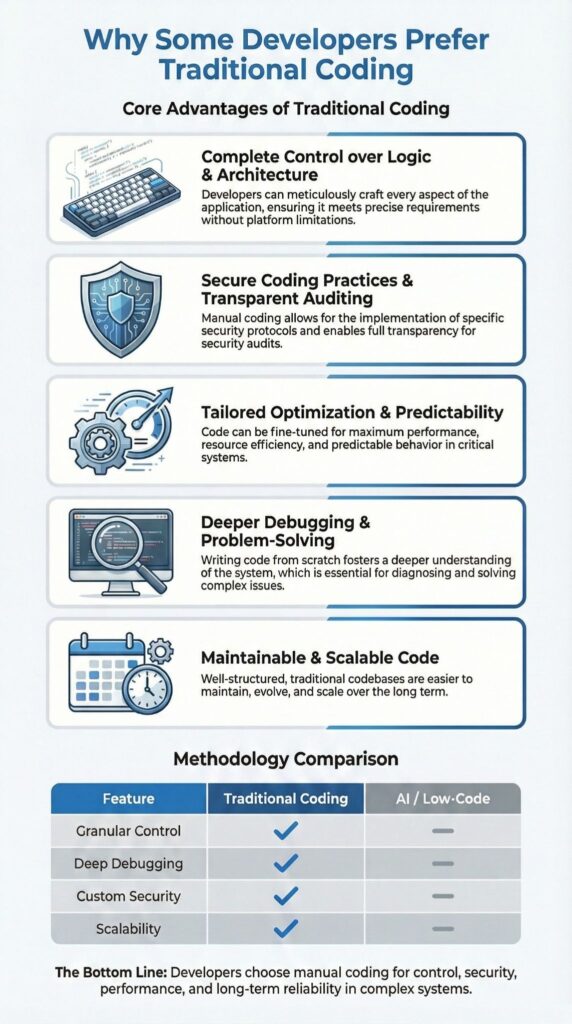
In our secure development bootcamp, we see it all the time: people are happy to use AI, linters, and generators, as long as they stay in charge of the important parts, which highlights how vibe coding differs from pair programming in responsibility sharing, feedback loops, and decision ownership.
Using AI as an Assistive Tool
In real projects, our learners use AI for light work:
- Exploring new libraries or patterns
- Generating simple boilerplate
- Checking syntax in an unfamiliar language
But when it comes to core logic, security rules, and architecture, they write it themselves. We’ve run exercises where AI drafts a helper function, and the class still walks through every line to confirm it’s safe. That way, AI saves time on low-risk work, while humans stay responsible for decisions that affect security and behavior.
Preserving Developer Judgment
Across our training, one idea keeps coming back: tools can suggest, but developers decide. Traditional coding helps make that mindset real, because you can’t hide behind a platform when the code is clearly yours. In CI/CD pipelines, infrastructure as code, and cloud-native setups.
FAQ
Why do developers prefer manual coding over automated solutions?
Many developers prefer manual coding because it provides full control coding over every part of the software. Hand coding ensures precise logic, strict syntax precision, and clear semantic accuracy. Developers maintain code ownership and code transparency, which makes debugging easier. There are no hidden processes, so behavior is predictable and easier to verify, fix, and improve.
How does traditional programming improve code quality and reliability?
Traditional programming improves quality by allowing direct code quality control. Developers write custom code using algorithmic thinking and structured problem-solving code. This approach supports clean code principles, reduces technical debt, and improves maintainable code. Manual reviews and testing help produce reliable code that performs consistently and remains stable as requirements change.
Why is developer control important for complex or critical systems?
Developer control is essential for systems with complex logic or strict safety requirements. Low-level coding and from-scratch coding allow complete visibility into execution flow, memory management, and performance optimization. This level of control supports secure coding practices, reduces vulnerabilities, and ensures predictable behavior in environments where failure is not acceptable.
How does hand coding support long-term maintainability and scalability?
Hand coding supports scalability by enforcing clear code architecture design and modular programming. Developers can refactor manually, manage legacy code maintenance, and reduce technical debt over time. Scalable custom code is easier to extend because developers understand every component, dependency, and decision made during development.
Why do many developers value the learning process of traditional coding?
Traditional coding strengthens deep understanding by requiring developers to solve problems without shortcuts. The learning curve coding builds strong debugging skills, algorithmic thinking, and code mastery. This process improves decision-making, encourages disciplined coding habits, and develops software craftsmanship that applies across different systems and programming environments.
Why Some Developers Prefer Traditional Coding Today
Why some developers prefer traditional coding comes down to trust, control, and experience. They’ve seen what happens when abstraction hides too much and when ownership is diluted. Manual coding supports deep understanding, reliable systems, and Secure Coding Practices that hold up under real pressure. The keyboard stays a tool of clarity, not resistance. The preference isn’t about rejecting progress. It’s about choosing responsibility.
Join the Secure Coding Bootcamp to turn that responsibility into real, hands-on secure development skills.
References
- https://www.itpro.com/software/development/developers-arent-quite-ready-to-place-their-trust-in-ai-nearly-half-say-they-dont-trust-the-accuracy-of-outputs-and-end-up-wasting-time-debugging-code
- https://www.techradar.com/pro/security/ai-generated-code-contains-more-bugs-and-errors-than-human-output