

Vibe coding and pair programming both push you to ship faster, but they do it in very different ways that shape your code and your team. Vibe coding leans on flow, quick decisions, and a strong individual voice in the code. Pair programming slows you down just enough to force shared understanding, better naming, and clearer logic.
We’ve used both on the same codebase, sometimes in the same week, and the tradeoffs become obvious once the shine wears off. If you care about speed, safety, and real ownership, it’s worth looking closer at where each one breaks, keep reading.
Key Takeaway
- Vibe coding pairs you with an AI assistant and prioritizes speed, experimentation, and flow.
- Pair programming pairs two humans and prioritizes correctness, shared ownership, and long-term maintainability.
- Most effective teams blend both, using Secure Coding Practices as the stabilizing foundation we rely on.
Core Definitions and Mental Models
Vibe coding and pair programming both change how you share thinking while writing code, but they load responsibility in very different places.
- Vibe coding: you talk to an LLM, it writes most of the code, you steer with prompts and review.
- Pair programming: two humans work the same problem, one types, one questions, both hold the design in their heads.
What Vibe Coding Means in Practice
In vibe coding, the AI assistant handles most of the typing, reflecting how vibe coding shifts effort away from syntax and toward intent, prompts, and outcome evaluation rather than line-by-line construction. You describe goals, constraints, and acceptance criteria, then iterate on prompts. Early on, it feels smooth and fast: you ask for a feature, code appears, maybe tests too, and progress looks great.
The risk is quiet. Deep logic, edge cases, and architecture can live in the AI’s output instead of your own understanding unless you pull them back through review, testing, and consistent Secure Coding Practices.
What Pair Programming Means in Practice
Pair programming is slower at the keyboard but faster in shared understanding. The driver focuses on mechanics, the navigator scans for design issues, concurrency bugs, and style. Review is real-time, design talk is constant, and knowledge transfer happens as you solve problems together.
Who You Collaborate With

The biggest difference between vibe coding and pair programming is not tooling. It is accountability. Who challenges decisions, who owns mistakes, and who truly understands the code.
Collaborating With an AI Model
In vibe coding, your “pair” is an AI model that only knows what you feed it in the prompt. It cannot weigh business tradeoffs or team norms, it just completes patterns.
- AI is strong at fast, plausible code for common frameworks and internal tools.
- It is weak when requirements are fuzzy or edge cases matter.
- It never says, “Are you sure this is safe?”
So typing drops, but evaluation goes up. You still bring the domain knowledge, you still apply Secure Coding Practices, and all accountability sits.
Collaborating With Another Developer
With another developer, you get more than extra eyes, you get memory and judgment. A good navigator questions assumptions, surfaces past incidents, and ties code back to real users.
They might notice a subtle race condition or a risky auth shortcut that no prompt would highlight. That kind of back-and-forth builds trust and spreads ownership. The code ages better because more than one person truly understands why it looks the way it does [1].
Workflow and Structure Differences
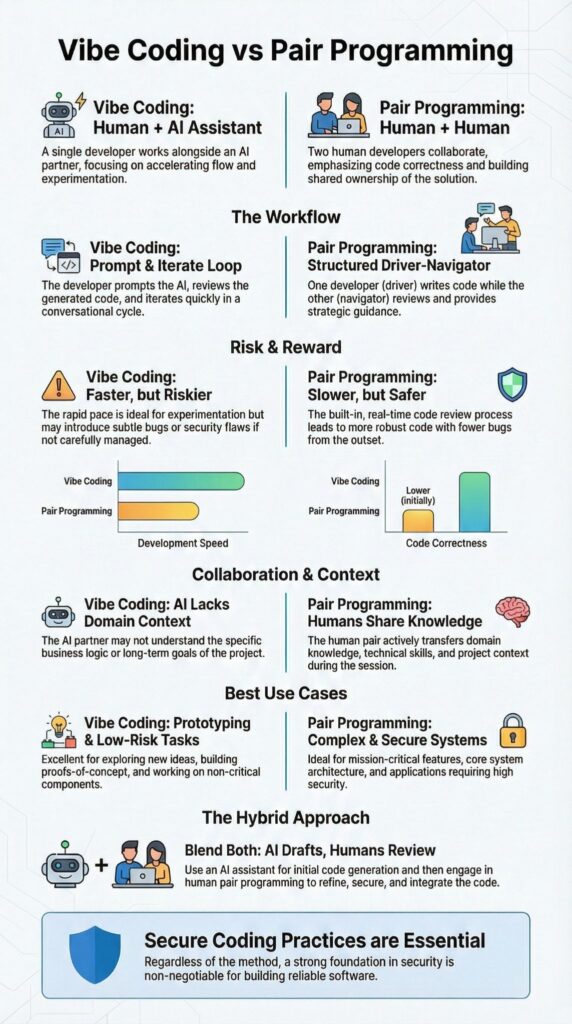
How work unfolds hour by hour looks very different between vibe coding and pair programming, especially when comparing vibe coding vs traditional development patterns around planning, validation, and when understanding is expected to emerge.Structure, or the lack of it, shapes outcomes.
Prompt-and-Iterate Workflow in Vibe Coding
Vibe coding runs on a loose prompt loop: you describe what you want, the AI generates code, you run it, then tweak the prompt based on what breaks or feels off.
It works well for:
- Rapid prototyping
- Exploratory coding
- Trying ideas without heavy planning
The risk is drift. Without clear acceptance criteria or tests, you can end up optimizing for “seems to work” instead of correctness. Free-form prompts stand in for structured sessions, micro reviews are easy to skip, and documentation or tests often slide unless you enforce them with the same Secure Coding Practices you’d use anywhere else.
Structured Driver–Navigator Workflow in Pair Programming
Pair programming leans on structure. Tasks are scoped, roles are explicit, feedback is constant. The driver focuses on typing and local details, the navigator holds the bigger picture, edge cases, and architecture.
Test-driven development fits naturally here, with tests clarifying behavior before code appears. Continuous micro review, explicit acceptance criteria, and visible code standards make the pace feel slower.
Code Quality, Safety, and Risk

Quality and risk are where the two approaches diverge most sharply, especially for long-lived systems.
Quality and Risk Profile of Vibe Coding
Vibe coding produces working code fast. For low-risk work, that can be enough. We’ve used it for internal dashboards, prototypes, and disposable experiments where speed clearly wins over accuracy.
The risk appears when code shifts from experimental to foundational. Hidden bugs, uneven style, and security gaps can slip through.
- Bug detection depends on human discipline.
- Security sensitive paths need extra scrutiny.
- Mystery code accumulates easily.
According to the OWASP Foundation, many vulnerabilities come from misunderstood code paths and missing validation, a risk that increases when review stays shallow.
Quality and Risk Profile of Pair Programming
Pair programming reduces defects by catching them early. Two sets of eyes see more than one, especially when the pressure is high. High-stakes code benefits most: core business rules, authentication flows, concurrency paths [2].
Research summarized by IEEE Software links collaborative coding and real-time review to improved code quality.
- Design flaws surface early.
- Security discussions happen naturally.
- Long-term maintenance improves.
The tradeoff is cost and intensity, so not every task deserves pairing.
Cognitive Load and Skill Requirements
Both approaches demand skill, but the skills differ in subtle ways.
Skills Needed to Vibe Code Effectively
Vibe coding shifts effort from syntax to conceptual clarity. You must express intent precisely and evaluate output critically.
We have learned that weak prompts produce misleading code. Strong prompt engineering requires clear mental models and domain knowledge.
It feels easy until it is not. When the AI code output is wrong, recognizing it requires deep understanding.
- Prompt optimization matters.
- Code evaluation replaces code typing.
- Discipline in testing is essential.
Without that discipline, speed becomes an illusion.
Skills Needed for Effective Pair Programming
Pair programming demands communication. Thinking out loud, listening, and adjusting in real time are core skills.
We have seen junior developers grow quickly through learning by doing, guided by a more experienced navigator.
The cognitive load is shared. One person holds the big picture while the other handles details.
- Empathy improves team dynamics.
- Conceptual skills develop through dialogue.
- Feedback is immediate.
It is demanding, but it builds durable capability.
Blending Vibe Coding and Pair Programming
Credits : Matt Palmer
Most teams that care about secure, long-lived systems do not marry a single style forever. Our own classes and internal projects move back and forth between vibe coding and pairing, depending on risk, deadlines, and who needs to grow from the work.
Using AI for Drafting and Humans for Hardening
On real bootcamp projects, we keep seeing the same pattern pay off:
- We start with vibe coding to get a working draft on screen fast.
- Then two developers sit down to pair, rewrite weak parts, and clean up the design.
- Along the way, they add tests, challenge edge cases, and apply the Secure Coding Practices we drill into every cohort.
In our secure development labs, that rhythm gives learners both speed and depth: they see how quickly AI can draft, then feel how much human judgment it still needs.
You can frame the workflow in simple phases:
| Phase | Primary Approach | Focus |
| Exploration | Vibe coding | Speed, experimentation |
| Refinement | Pair programming | Design, correctness |
| Stabilization | Pair + review | Security, maintainability |
By the time code reaches the “stabilization” phase, everyone involved understands it well enough to defend it in a security review, not just run it and hope.
FAQ
How is vibe coding different from traditional pair programming sessions?
Vibe coding relies on AI collaboration, where developers use natural language prompts to guide code generation and refinement. Pair programming depends on human pairing, using a driver navigator model for continuous discussion and real-time review. The core difference is AI delegation versus shared human control, which changes accountability, cognitive load, decision making, and how mental models develop during the software development workflow.
Does vibe coding replace the driver and navigator roles used in pair programming?
Vibe coding does not follow fixed driver role and navigator role patterns. An AI assistant generates code, while the human manages prompt engineering, evaluates results, and applies human oversight. Pair programming requires both people to stay actively involved through structured sessions, shared ownership, constant communication, and immediate responsibility for every design and implementation choice.
How do code quality and bug detection compare between vibe coding and pair programming?
Pair programming improves code quality through continuous human code critique, micro reviews, and early bug detection during collaborative coding. Vibe coding depends on AI code output and iterative feedback, which may overlook edge cases or concurrency issues. Clear acceptance criteria, disciplined code review, testing rigor, and correctness priority are necessary to reduce long-term risks.
Which approach is better for learning, onboarding, and knowledge transfer?
Pair programming supports learning by doing, onboarding teammates, and direct knowledge transfer through design discussion and shared problem solving. Vibe coding accelerates exploratory coding and prototype building, but it can create mystery code or knowledge silos. Teams must reinforce domain knowledge through prompt iteration, documentation, and deliberate explanation to support skill development.
When should teams choose vibe coding over pair programming, or combine both?
Vibe coding fits low-risk code, internal tools, rapid prototyping, and creative coding where experimentation focus and speed matter more than accuracy. Pair programming suits high-stakes code, security sensitive logic, and long-term maintenance. Hybrid approaches blend AI delegation with human oversight, improving developer productivity while protecting code ownership, quality, and system reliability.
How Is Vibe Coding Different From Pair Programming in the Long Run
The real difference between vibe coding and pair programming shows up months later, when you have to touch the same code again. One style pushes for immediate momentum, the other keeps nudging you toward shared understanding and long-term safety.
So the real move is not picking a winner. It is matching the style to the context: use speed when you are learning or exploring, bring in structure when the code will live for years, and anchor both in disciplined secure coding habits.
If you want structured, hands-on practice applying those habits, join our Secure Coding Bootcamp and train your team to ship safer code on purpose, not by luck.
References
- https://en.wikipedia.org/wiki/Pair_programming
- https://www.coursera.org/articles/pair-programming