



What is the future of conversational programming? It lies in hybrid human-AI workflows where developers guide AI through intent-driven dialogue, allowing code to be generated, refined, and deployed iteratively.
In our experience, this approach speeds up development while keeping humans responsible for architecture, security, and quality. By 2023, GitHub reported over 1.3 million paid Copilot users, highlighting the mainstream adoption of AI-assisted workflows.
Large language models now power everything from rapid prototypes to enterprise pull requests. Understanding how human-AI collaboration works is crucial for modern software teams. Keep reading to explore what this evolution means for your workflow.
Quick Reads, Conversational Coding Wins
Conversational programming is shaping how software is developed, blending human judgment with AI assistance to increase efficiency without sacrificing quality. Key points to remember:
- Augmentation, not replacement: AI supports developers in complex domains rather than fully taking over coding tasks.
- Hybrid human-AI workflows: These will lead SaaS, enterprise, and DevOps pipelines, enabling faster, safer, and more consistent development.
- Secure coding and verification: Embedding Secure Coding Practices and automated checks ensures AI-generated code meets production standards.
How Is Conversational Programming Redefining Software Development?
Conversational programming is shifting software development away from syntax-heavy tasks toward AI-driven dialogue.
Developers now describe intent in natural language, and tools like GitHub Copilot generate code iteratively, accelerating workflows and lowering the barrier to entry. In our experience, this approach allows teams to focus on architecture and security rather than boilerplate coding.
As highlighted by NIST
“Conversational interaction with generative artificial intelligence models has become a popular method for interacting with collections of information; a user sends a prompt to the model, and the model provides a response.” – NIST
During early product sprints, our team used conversational coding to scaffold backend services in hours rather than days. Our role shifted from typing every line to reviewing, refining, and validating AI outputs.
This approach enables:
- Rapid prototyping: Turn abstract ideas or vibe coding concepts into working features
- Iterative debugging: Engage in code debugging through AI-assisted dialogue
- Refactoring sessions: Replace manual rewrites with guided AI prompts
- Architecture suggestions: Receive AI guidance on design before implementation
Developers now focus on system prompt design, iterative refinement, and secure coding oversight, shifting cognitive load toward governance and higher-level architecture, creating opportunities for more strategic contribution.
Will Conversational Coding Replace Traditional Programming?

Conversational programming is positioned to augment rather than replace traditional coding. Complex domains like PLC systems, embedded software, and safety-critical environments still require deep human oversight.
In our Secure Coding Practices bootcamps, we emphasize that AI excels at routine tasks but cannot replace human judgment in deterministic or regulated systems.
Conversational tools perform well in web applications, SaaS backends, and frontend AI scaffolding but face limitations in industrial or embedded contexts where hardware constraints and deterministic logic dominate.
Comparing the two approaches highlights the differences:
| Area | Conversational Programming | Traditional Programming |
| Speed | High for prototyping | Moderate |
| Precision control | Medium | High |
| Edge cases | Needs human review | Manual handling |
| Safety-critical domains | Risky without oversight | Standard practice |
For regulated or complex systems, teams must apply:
- Embedded systems dialog precision
- Low-level verification prompts
- Industrial AI safeguards
- Formal verification layers
We’ve seen autonomous coding deliver impressive speed in SaaS environments, yet it always requires structured review in regulated industries. Our experience shows that developers now act as AI pair programming supervisors, guiding outputs while retaining responsibility, rather than being replaced.
How Will AI-Human Dialogs Enable Scalable SaaS Creation?

Conversational AI allows founders to turn product ideas into deployable SaaS systems without needing full-stack expertise. In our experience, iterative AI-human dialogue accelerates MVP creation while keeping security and maintainability intact. The global SaaS market is projected to exceed $300 billion by 2026, highlighting the scale opportunity for conversational coding workflows.
We’ve seen early-stage teams build AI-driven prototypes in weeks by following a simple pattern:
- Describe the product concept in plain language
- Generate backend API services via AI
- Refine database schemas through dialogue
- Deploy using serverless pipelines with AI guidance
This approach reduces reliance on rigid no-code platforms. Instead of assembling templates, developers describe intent, and the system outputs React components, chat interfaces, CI/CD scripts, and AI-powered DevOps agents automatically.
Security remains critical. We embed Secure Coding Practices at every stage, running automated vulnerability fixes and compliance checks before code goes live.
The result is dialog-driven SaaS creation that balances speed with reliability. By structuring iterative workflows and maintaining oversight, teams can scale safely while leveraging AI to handle routine coding and deployment tasks.
Is Conversational Programming Killing No-Code Platforms?
Conversational programming is changing the role of no-code platforms. By letting developers describe intent in natural language, it removes visual-builder constraints and allows dynamic logic generation that templates cannot match. In our experience, teams can prototype faster and implement more complex workflows without relying solely on visual tools.
The structural differences are clear:
| Feature | No-Code Tools | Conversational Programming |
| Flexibility | Template-bound | Idea-bound |
| Custom logic | Limited | Dynamic |
| Learning style | Visual builder | Low-code conversation |
| Scalability | Platform limits | Architecture dependent |
Key points from our experience include:
- No-code tools still provide guardrails for clarity and onboarding.
- Conversational coding requires structured prompts to prevent hallucinated dependencies.
- Secure Coding Practices must be enforced to avoid insecure defaults in production.
We’ve observed convergence rather than replacement. Modern no-code platforms are evolving into hybrid SaaS-AI systems, where visual layers sit above multi-agent workflows and autonomous coding agents.
Teams benefit most when human oversight combines with AI guidance. In practice, the barrier has shifted: it’s no longer syntax knowledge, it’s understanding system design, architecture, and secure implementation. This hybrid approach lets teams scale safely while leveraging the speed and flexibility of conversational coding.
What Emerging Trends Will Shape the Next Decade?
Credits : Conversation Design Institute
The next decade of conversational programming will be defined by multimodal coding, proactive AI suggestions, multi-agent collaboration, and verification layers integrated directly into development pipelines. These trends are already reshaping how we think about software creation.
Multimodal coding is gaining traction. Developers can now upload screenshots to request UI adjustments, or use voice assistants for hands-free iteration in IoT and embedded systems. We’ve experimented with these approaches in internal projects, and they dramatically reduce context switching while accelerating feature delivery.
Key emerging patterns we’ve observed include:
- Proactive code suggestions generated before explicit prompts.
- AI managing concurrency and data-flow challenges in real time.
- Self-improving code agents that learn from preference feedback loops.
- Benchmarks showing improvement in HumanEval and SWE-bench metrics.
Multi-agent systems are coordinating planning, test automation flows, and DevOps orchestration. In practice, this feels less like chat and more like collaborative workflow management.
Ethical coding, bias detection, and quantum-safe cryptography become standard safeguards. Ultimately, programming output may shift from typed code to structured intent expressed through dialogue, with code serving as a validated artifact of human-AI collaboration.
What Skills Will Developers Need in a Conversational Future?
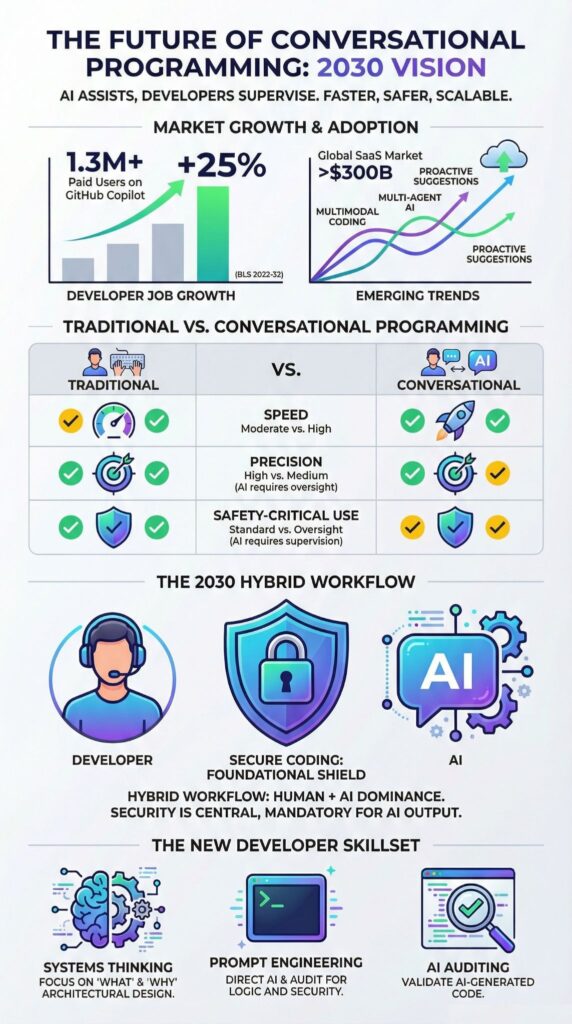
In a conversational coding world, developers need more than syntax mastery. Systems thinking, prompt engineering, AI auditing, and Secure Coding Practices take priority.
We’ve noticed in our bootcamp sessions that the developers who succeed aren’t the fastest typists, they are the ones who validate AI outputs, refine prompts, and enforce security checks before code reaches production.
Trust in AI outputs remains limited. In practice, we pair every AI suggestion with structured verification to prevent errors and security gaps.
Insights from appinventor.mit.edu indicate
“Our results show that future conversational programming tools should be tailored to users’ programming experience and allow users to choose their preferred input mode.” – appinventor.mit.edu
High-value skills we emphasize include:
- Architecture design and AI supervision
- Iterative code refinement through structured prompts
- Security vulnerability AI fix verification
- Compliance code review interpretation
- Scalability evaluation for AI-generated code
Less critical are memorizing boilerplate or generating repetitive patterns manually.
Developers who thrive in this era focus on the human-AI coding loop. They manage code agents, oversee concurrent AI tasks, and design governance frameworks.
FAQ
What will conversational coding change for everyday software developers?
Conversational coding will change how developers start and refine software. Instead of writing syntax first, developers describe goals using natural language programming.
Through chat-based development and dialog-driven software, AI code generation produces drafts that developers review and adjust. This approach reduces repetitive work and allows developers to focus on logic, system behavior, and long-term maintainability.
How does conversational programming affect learning to code in the future?
Conversational programming makes learning more accessible by turning coding into an interactive discussion.
Beginners can use text-to-code AI to see how ideas become working programs. With code debugging chat and error fixing conversation, learners understand mistakes step by step. This supports a human-AI coding loop where concepts improve through clear explanations and iterative code refinement.
Will conversational programming replace traditional coding skills?
Conversational programming will not replace traditional coding skills. Developers must still understand algorithms, data structures, and architecture decisions.
Autonomous coding and agentic programming can generate solutions, but humans remain responsible for correctness, performance, and security. Strong fundamentals are needed to guide prompts, review results, and ensure production code aligns with real technical and business requirements.
How will conversational programming impact large and enterprise software systems?
In enterprise environments, conversational programming helps manage complexity across teams.
Developers can explore architecture design AI suggestions, handle refactoring dialog for legacy code migration, and coordinate multi-agent systems for testing and deployment. This improves communication, speeds decision-making, and supports scalable development while keeping humans responsible for approvals, audits, and compliance requirements.
What new risks come with conversational and autonomous coding systems?
Conversational and autonomous coding introduces risks related to trust and accountability. Generated code may contain hidden flaws, security issues, or biased logic.
Without explainable AI development and traceable code generation, teams may miss critical problems. Strong review processes, preference feedback code, and formal verification AI are required to ensure safe, reliable, and ethical software outcomes.
Prepare for Hybrid, Secure, Intent-Driven Conversational Programming
Conversational programming can amplify developers, but only when humans guide architecture, ethics, and security. AI-driven dialogue tools are powerful, yet without Secure Coding Practices first, speed creates risk instead of value. Ask yourself, do you want rapid output, or software that scales safely, reliably, and responsibly?
Take action now. Join the Secure Coding Practices Bootcamp to master secure, hybrid conversational workflows, embed compliance and traceability, and equip your team to ship maintainable, trusted software from day one.
References
- https://www.nist.gov/ctl/ctl-2026-surf-program
- https://appinventor.mit.edu/papers/JessVBPublications/VLHCC_2020_conv_ai_voice-text_arXiv.pdf
Related Articles
