


Your career as an AI-assisted coder is managing more complexity, not writing less code. You’ll move from making quick prototypes to using AI within a strict engineering workflow. Your real value becomes human review, system design, and oversight, things AI can’t do.
This leads to roles like AI Specialist or AI Architect, where your judgment is the product. Build a lasting career by being the pilot, with AI as your copilot. See what is the career path for an ai-assisted coder
What Actually Moves an AI-Assisted Coder Forward
- Your career security lies in system design and review, not in the ability to generate the most code the fastest.
- Advancement is measured by the scale of context you manage, moving from single files to entire codebases and business objectives.
- Sustainable paths pivot on ethics and security, making Secure Coding Practices and responsible AI governance non-negotiable skills.
Is This Even a Real Career Path?
Is this even a real career path? It’s a fair question, given all the headlines. The short answer is yes, but the job has changed. It’s less about writing every line yourself and more about directing the whole project.
“AI handles repetitive coding tasks such as boilerplate generation, debugging, and regression testing. […] As a result, career paths are shifting from execution-focused roles to strategy-focused roles. Developers are becoming: System Designers (Focusing on architecture and scalability), Problem Framers (Defining what problems AI should solve), and Ethical Leaders (Ensuring fairness, privacy, and compliance).” – Logiciel.io
We see this shift firsthand in our training. People start in a creative mode, but many wonder if vibe coding will replace software developers or if it is just a starting point for prototypes.
Teams that adopt this structured method tell us they see speed improvements between 30 and 60 percent. But that boost only happens when AI augments a solid, disciplined process; it can’t create one from scratch. So the career becomes about mastering that process above all else.
The Five Levels of an AI Coder’s Journey
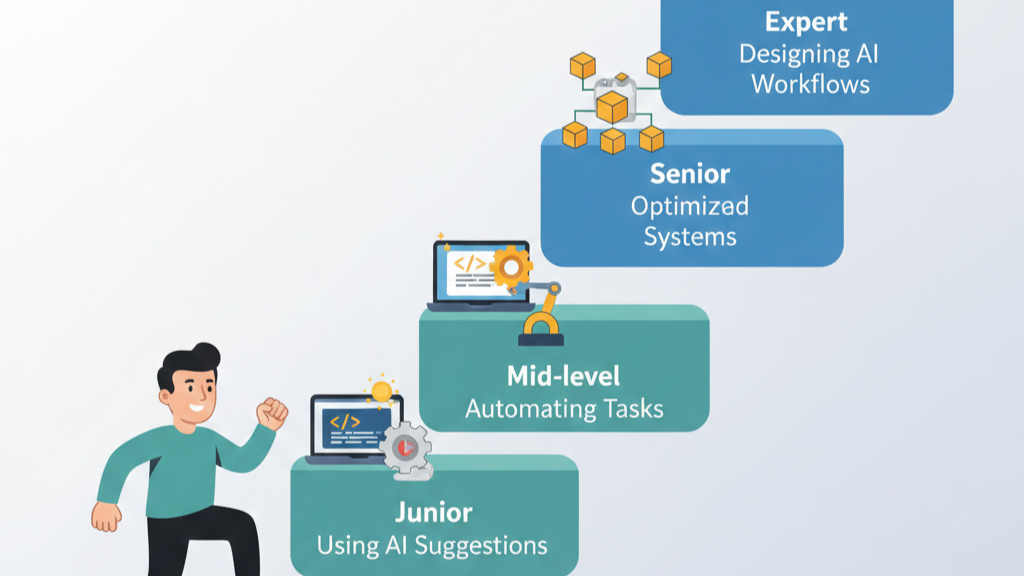
Progress isn’t just about titles; it’s about understanding the long-term impact on developer skills and careers as the expanding scope of your responsibility grows.
| Career Level | Primary Focus | Your Key Tools & Mindset |
| Level 1: The Apprentice | Basic prompting, boilerplate, bug fixes. | Starter LLMs, learning to ask the right questions. |
| Level 2: The Integrator | Feature building, unit testing, basic model tweaks. | Python libraries, Test-Driven Prompting, version control. |
| Level 3: The Architect | System design, deployment, pipeline creation. | Cloud platforms (like Google Cloud), containerization. |
| Level 4: The Innovator | Custom AI workflows, optimization, multi-agent systems. | Advanced frameworks, neural network tuning, RAG. |
| Level 5: The Visionary | Strategic AI direction, ethical governance, team leadership. | Policy design, cross-functional strategy, ROI analysis. |
The path from Level 1 to Level 5 is a journey from tactical execution to strategic ownership. At the start, you’re focused on the “what” of the code. By the end, you’re defining the “why” for the entire business. Each step demands a deeper layer of foundational knowledge.
The Technical Core: Building Your Foundation
You can’t oversee what you don’t understand. This is the hard truth that prevents ‘junior stagnation’ and defines how this changes the future of programming jobs by requiring a shift from syntax to high-level oversight.
“In an ‘agentic’ development environment, engineers become ‘composers,’ orchestrating ensembles of AI agents and software services. They won’t write every note themselves, but they define the melody: architecture, interfaces, how agents interact. This role is interdisciplinary and creative: part software engineer, part system architect, part product strategist.” – Addy Osmani
We start with Secure Coding Practices. It’s the first and most critical filter for any AI-generated block. The model doesn’t care about SQL injection or exposed secrets, you have to. This means:
- Automating security scanners into your review pipeline.
- Manually auditing code for input validation and authentication flows.
- Treating every AI suggestion as a potential vulnerability until proven otherwise.
From there, your learning accelerates. You use AI to explore new libraries, to generate examples of reinforcement learning, or to explain the math behind a new paper. But you validate everything.
You move from using AI to write a function, to using it to design the entire data flow for a recommendation system, and then you critique its proposal. Your portfolio shifts from “apps I built” to “complex systems I designed and reliably shipped, with AI’s help.”
The Non-Coding Pivot: Your Skills Are Transferable
What if your passion isn’t deep in the technical stack? The skills you hone have immense value elsewhere. An AI-assisted coder becomes fluent in translating between human intent and machine capability. This is a superpower in adjacent roles.
- AI Product Manager: You bridge the gap. You understand what’s possible technically, can prototype an MVP shockingly fast to test a hypothesis, and can manage a roadmap where AI handles the heavy lifting.
- Solutions Architect: You design the high-level structure that multiple AI agents might populate with code. You define the contracts between services.
- Ethical AI Advocate: Having seen the “slop” and the biases, you are equipped to build the guardrails and review processes that make technology responsible.
These paths leverage your unique position. You are not just a business person, and not just a technologist. You are a hybrid who can speak both languages, and in an AI-driven market, that is the currency.
Navigating the Market: Salary and Demand
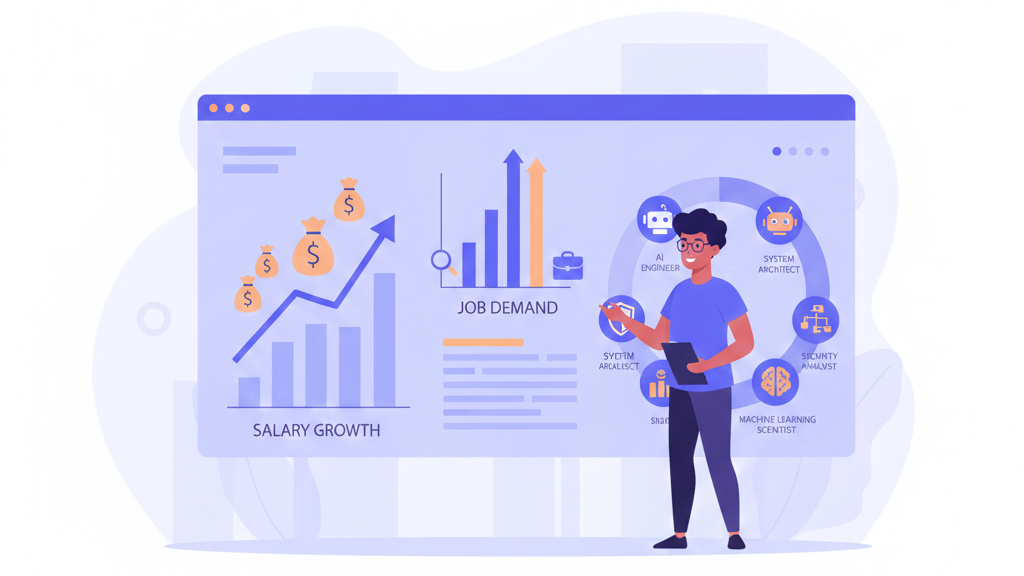
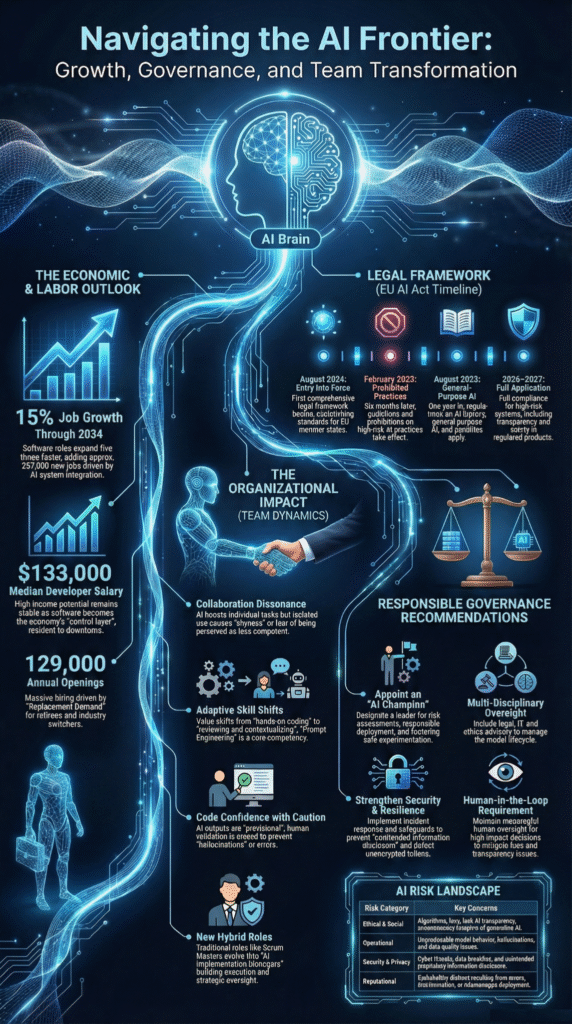
Let’s talk practicalities. The financial incentive is there. In the United States, AI developers and engineers command a significant premium. The median salary sits around $148,000, with senior architects and specialists going far higher. Demand is projected to grow at an above-average rate of about 15% through 2034.
The market isn’t just hiring for the title “AI-Assisted Coder.” It’s hiring for the augmented skills you bring to established roles: the software engineer who ships features 40% faster with robust tests, the data scientist who prototypes models in days, the robotics engineer who uses AI to simulate and debug firmware logic.
Your proof is in your workflow and your portfolio. While 63% of AI professionals hold a Bachelor’s degree, specialized certifications in tools and platforms are becoming powerful signals of your applied, hands-on competency.
FAQ
How does Artificial Intelligence reshape the career path for an AI-assisted coder today?
Artificial Intelligence changes the role from writing every line to guiding smarter systems. Many coders move toward AI engineering, machine learning engineering, or data-focused roles.
Skills in software engineering, version control, and AI-powered workflows become essential. Understanding neural networks, automation, and algorithmic decision-making helps developers grow into higher-impact AI jobs across many industries.
What skills should an AI-assisted coder build for long-term career growth?
Strong foundations in software engineering, Machine Learning, and data handling matter most. Learning code review practices, reproducible workflows, and machine learning pipelines improves reliability.
Experience with generative AI, AI agents, and automation strategies increases productivity. A solid machine learning portfolio showing real ML applications often matters more than certificates when pursuing advanced AI jobs.
Can an AI-assisted coder transition into data science or AI research roles?
Yes, many move into Data Science, AI research, or ML engineer positions over time. Skills in supervised learning, unsupervised learning, reinforcement learning, and data transformations transfer well.
Working with customer datasets, recommendation systems, and neural networks builds practical experience. These roles focus more on experimentation, modeling, and insights rather than daily software delivery.
What career options exist beyond coding for AI-assisted developers?
Beyond coding, many shift into AI product management, data engineering, or AI ethics roles. Others specialize in NLP engineer work, computer vision, robotics engineering, or speech recognition.
Understanding business process automation and how AI impacts users allows developers to guide real-world systems. These paths blend technical knowledge with strategy, safety, and decision-making.
Your Next Step on the Path
The career path for an AI-assisted coder is built on intentional oversight, not endless prompting. As AI handles output, your value shifts to secure design, smart reviews, and system-level decisions.
This is what keeps your role relevant and resilient. To build that foundation with real-world skills, from preventing common vulnerabilities to safely guiding AI-written code, join the Secure Coding Practices Bootcamp: Strong security habits turn AI from a shortcut into a long-term career advantage.
References
- https://logiciel.io/blog/ai-software-development-developer-career-paths-2025
- https://addyosmani.com/blog/next-two-years/
Related Articles
