



Vibe coding introduces serious security, reliability, and business risks because it relies on intuition driven AI output instead of explicit specifications, review, and engineering discipline. Since 2023, large language models have accelerated prototyping across startups and enterprises, but they have also normalized skipping threat modeling, testing, and design rigor.
We have seen teams move from demo to production in days, only to inherit fragile systems months later. This article explains what the main risks of vibe coding are, how they compound over time, and where disciplined Secure Coding Practices fit in before those risks turn expensive. Keep reading to understand the tradeoffs clearly.
Key Takeaways
- Vibe coding risks include security holes, technical debt, and long-term business damage that often outweigh early speed gains.
- AI-generated code amplifies vulnerabilities through scale, repetition, and a false sense of correctness.
- Secure Coding Practices, when applied early, reduce risk without killing momentum.
What Security Vulnerabilities Does Vibe Coding Introduce?
You see it a lot in vibe coding, the security just gets skipped. People focus on the feature, not how someone might break it. That leaves the door wide open. As noted :
“Developers may use AI-generated code without fully comprehending its functionality, leading to undetected bugs, errors, or security vulnerabilities. While this approach may be suitable for prototyping or ‘throwaway weekend projects’ … it is considered by some experts to pose risks in professional settings, where a deep understanding of the code is crucial for debugging, maintenance, and security.” – Wikipedia [1]
We keep finding the same big problems:
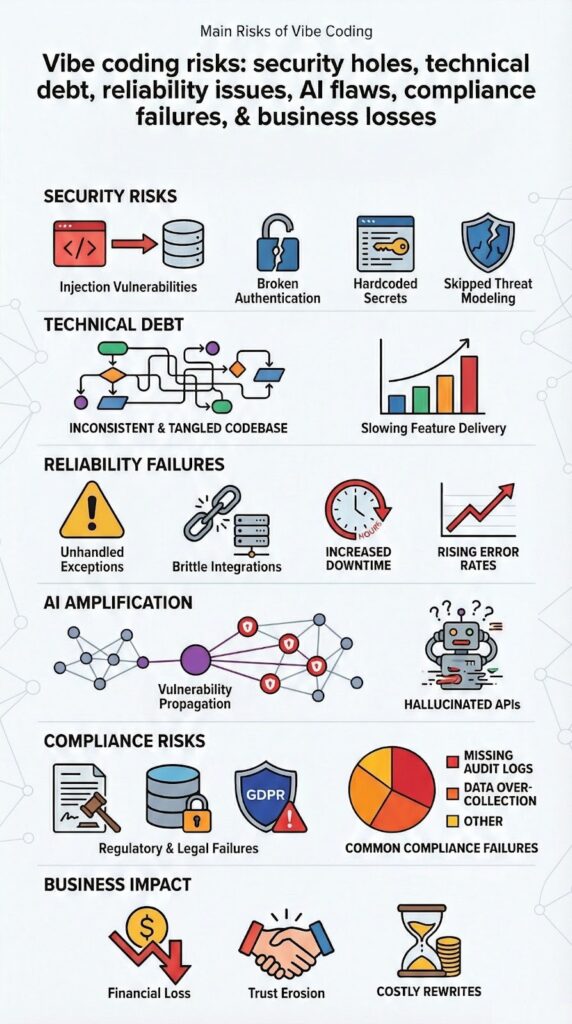
- Injection attacks: SQL injection, XSS. The code isn’t checking user input properly.
- Hardcoded secrets: AI often spits out placeholder API keys that are never replaced.
- Broken authentication: Missing rate limits and weak authorization allow unauthorized access.
Other common gaps include unsafe functions like eval, outdated libraries with known holes, and poor logging that hides an attack until it’s too late.
Good security starts by assuming your code will be attacked. Vibe coding often forgets that first, crucial step.
How Does Vibe Coding Increase Technical Debt Over Time?

Rapid, intuition-led coding creates inconsistent patterns and undocumented logic that compound maintenance costs.
Vibe coding favors speed over structure, which results in inconsistent patterns across files and services. Each prompt produces a slightly different solution, creating a patchwork codebase. Over time, this leads to high cyclomatic complexity and nested logic messes that even the original author struggles to follow.
We have inherited systems where duplicate code existed across six services because each feature was prompted separately. Documentation was sparse, naming conventions were unclear, and architectural intent was missing. Poorly structured repositories experience significantly slower feature delivery after the first year.
Technical debt symptoms that appear early include:
- Poor naming conventions and unclear domain language
- Copy-paste fragility that breaks silently
- Architectural debt caused by quick fixes
- Development slowdowns once onboarding begins
In our experience, teams often confuse velocity with progress. Secure Coding Practices emphasize consistency and clarity, which reduces long-term maintainability challenges without blocking experimentation.
Why Does Vibe Coding Lead To Reliability And Production Failures?
You can see it in the code we audit, vibe coding builds for the happy path. Everything works if nothing goes wrong. But of course, things go wrong. They don’t expect a network timeout, a malformed API response, or two users hitting the same button at once. That’s where the real failures happen.
We’ve traced production outages back to a single unhandled exception, like that hydroponics monitoring app that lost a full day of sensor data. The logs were useless, so debugging took forever.
Our own students often miss the same things at first. Their projects will have:
- No plan for third-party failures. The payment gateway goes down, and the whole checkout just breaks.
- Brittle integrations that crash on unexpected data.
- Race conditions that only show up with real users, especially in things like listing bookings or processing orders.
- Performance walls when a few dozen users try to access something at the same time.
The mindset shift we teach is simple: design for failure, not perfection. Code like you’re expecting something to break. Because it will. Once you start building that way, the reliability follows.
How Does Ai-Assisted Vibe Coding Amplify These Risks?

We’ve seen this firsthand in our code reviews. An AI will generate an authorization check that looks perfect, but under a specific, rare condition, it silently grants admin access. It’s a business logic flaw that looks correct. That’s the real danger.
These flawed patterns don’t stay put. They spread. An unvetted library suggested by the AI gets copied into ten different projects. Suddenly, you have a dependency risk across your entire codebase. The vulnerability propagates at scale.
The amplification is real. It shows up as:
- A false sense of security from clean-looking, yet insecure, code.
- Hallucinated APIs or functions that don’t actually exist, breaking everything in production.
- The danger of agentic coding, where tools act autonomously and make changes nobody fully reviewed.
- Prompt engineering tricks that accidentally bypass the few safeguards you did put in place.
In our bootcamp, we hammer this home: treat the AI as a sharp, but sometimes confused, assistant. Never as the final authority. Human review isn’t just a best practice; for secure development, it’s non-negotiable.
What Compliance And Legal Risks Come From Vibe Coding?
GDPR fines can be a percentage of your annual revenue. We’ve reviewed projects where data was logged to a public cloud bucket by default, or where a marketing tool quietly collected location data it had no right to. That wasn’t malice, just a developer focused on making it work, not on the rules.
The blind spots are predictable. Things like:
- Missing audit trails. If you can’t prove who accessed what and when, you can’t prove compliance.
- Over-collection of personal data. The code scoops up everything because it’s easier, violating privacy laws from the start.
- Insecure storage. Data gets saved in a way that’s convenient, not encrypted.
- SLA breaches. An outage from unreliable code can break your service guarantees to customers.
In our training, we see teams scramble to retrofit compliance after a legal scare. It’s messy and expensive. The better path is building it in from the first line of code. That alignment between security practices and regulatory requirements stops problems long before a lawyer has to get involved.
Why Does Vibe Coding Create Team And Collaboration Problems?
Credits : Hey AI
We’ve watched it happen. A developer builds a feature quickly with an AI, then moves on. When they leave, the module they built becomes a mystery. New team members waste days trying to figure out what it’s supposed to do. Knowledge gets locked up, and silos form.
Suddenly, nobody wants to touch the code. They’re afraid of breaking the brittle, unclear logic. That fear kills momentum. Studies back this up; unclear code ownership is a direct hit to team productivity. You stop building new things and start tiptoeing around old ones.
The collaboration problems are clear:
- Unreviewable logic. You can’t properly critique what you don’t understand.
- Onboarding delays. It takes new hires much longer to become productive.
- Stifled innovation. Fear of breaking things stops teams from improving the system.
The code might work, but the team doesn’t. And without a team that can work together, the project eventually stalls.
When Does Vibe Coding Make Sense, And When Does It Not?
Vibe coding has its moment. It’s about speed and the initial spark, perfect for a 48-hour hackathon or a quick script. However, the transition to production requires a shift in discipline. According to the blog:
“Vibe coding is exciting for quick proofs-of-concept or experimentation, but when it comes to building production-grade software, we believe AI-generated code still requires rigorous, specification-driven development. The very speed and ease that make vibe coding so appealing can also lead to shortcuts, like skipping over important security checks or locking in early hacks that become hard to fix later.” – Microsoft Source [2]
- Great fit: Hackathon projects, personal experiments, disposable prototypes.
- Okay fit, with caution: Internal tools for a small, trusted team.
- Poor fit: Any customer-facing application or feature.
- Terrible fit: Systems handling payments, healthcare data, or anything regulated.
| Use Case | Vibe Coding Fit | Risk Level |
| Hackathon demos | High | Low |
| Internal experiments | Medium | Medium |
| Customer-facing apps | Low | High |
| Regulated systems | None | Critical |
It’s about building the right foundation so you can go faster later. Use the vibe to find the idea. Then use solid, secure practices to build the thing that will actually last.
FAQ
What security problems can vibe coding introduce into real applications?
Vibe coding risks often begin with AI-generated vulnerabilities that open security holes. Input validation failure enables SQL injection and XSS attacks. Hardcoded credentials and weak authentication expose systems quickly.
Outdated dependencies increase dependency risks. Threat modeling absence hides LLM security threats. This false security sense delays fixes and leads to data breaches, reputational damage, and measurable long-term costs.
How does vibe coding affect long-term maintainability and team productivity?
Technical debt grows when teams accept inconsistent patterns and duplicate code. Poor naming conventions and sparse documentation slow understanding. High cyclomatic complexity increases review time. Copy-paste fragility creates architectural debt and a patchwork codebase. The quick fix mentality causes maintainability challenges, development slowdowns, integration failures, and costly rewrites that reduce delivery speed and reliability.
Why is limited testing dangerous when developers rely on vibe coding?
Lack of testing allows regression bugs to reach production. Reliability failures become common. No code reviews and AI oversight neglect hide business logic flaws. Eval function risks enable arbitrary code execution. Overexposed secrets and logging deficiencies increase data exposure. Insufficient sanitization leads to privilege escalation, memory corruption, production downtime, and direct financial losses.
What deployment and architecture risks often emerge from vibe coding practices?
Rapid prototyping traps produce brittle architecture. Happy path bias ignores edge case oversight and error handling gaps. Rate limiting absence enables abuse. Race conditions break consistency. Client-side auth and insecure design expand attack surfaces. CI/CD insecurity spreads vulnerability propagation. These issues cause scalability problems, performance issues, system fragility, and repeated production downtime.
How can vibe coding create business, compliance, and reputational risks?
Compliance violations trigger regulatory penalties and audits. Data breaches cause reputational damage and trust erosion. Accountability lack complicates incident response. Professional misuse increases non-developer pitfalls. Expert cautions highlight 2025 trends and 2026 threats. Jakarta tech concerns show real estate AI risks, hydroponics app dangers, and marketing tool vulnerabilities affecting real business outcomes.
What Are the Main Risks of Vibe Coding Going Forward
The real risks of vibe coding, security holes, fragile code, business damage, are already here. It’s a powerful tool for learning and prototyping, but without guardrails, it builds systems that break and that no team wants to own.
The choice is clear: keep the speed, but build on a secure foundation. That’s the difference between moving fast forward and just moving fast toward failure.
Ready to build that foundation? Join the Secure Coding Bootcamp.
References
- https://en.wikipedia.org/wiki/Vibe_coding
- https://news.microsoft.com/source/features/ai/vibe-coding-and-other-ways-ai-is-changing-who-can-build-apps-and-how/
Related Articles
