


You should choose the model that matches how you actually build, not what sounds fancy on paper. If your work leans toward hard design questions, unclear specs, or tricky debugging across services, Claude Opus 4.5 is the one that keeps its grip on the problem.
It stays stable over long reasoning chains and big code contexts. If your day is mostly quick edits, feature work, and a lot of trial‑and‑error, Claude Sonnet 4.5 is the better default, fast, cheaper, and steady. Most developers will live in Sonnet, then pull in Opus for the knots. Keep reading to see this play out on real workflows.
Key Takeaways
- Opus 4.5 excels in complex, multi-step coding tasks and advanced agentic workflows where precision is non-negotiable.
- Sonnet 4.5 delivers the best balance of speed, intelligence, and cost for the vast majority of daily development work.
- The right choice depends heavily on your project’s specific demands for reasoning depth, latency, and budget.
Understanding the Developer’s Dilemma

Most developers don’t choose an AI model once; they choose it over and over as the project shifts. Early on, a rough prototype needs speed and low friction. This echoes the principles behind essential tools and editors that support fluid transitions between rapid ideas and complex workflows.
Later, a gnarly refactor needs slow, careful understanding. An agent that will touch real data needs dependable, step‑by‑step reasoning and a builtin respect for risk.
In our secure development bootcamps, we see this every week. One group is racing to stand up a safe login flow; another is cleaning up an inherited codebase full of quiet security debt. Both use AI, but not in the same way. The Claude 4 family, especially Opus 4.5 and Sonnet 4.5 meets these different phases head-on.
They feel less like “bigger models” and more like tools shaped for real engineering work. When teams think in terms of task complexity and security impact, instead of staring at model specs, they save time, avoid waste, and catch more vulnerabilities.[1]
Claude Opus 4.5: The Strategic Powerhouse
Some problems in our labs push past simple autocomplete and into “please, do not drop this thread.” That’s where Opus 4.5 has proven itself. Opus can sit with a sprawling, half-documented codebase and still propose refactors that actually make structural sense.
We watched this clearly during a secure auth module exercise. Our cohort inherited a legacy authentication system with scattered checks, weak session handling, and old dependencies. Opus didn’t just flag the obvious security flaws; it walked through a migration path that respected dependency chains several of us had overlooked, including how changes would ripple through permission checks and logging.
This type of comprehensive workflow is reminiscent of a complete review of the windsurf editor, where context-aware suggestions guide complex development flows.
That long-horizon thinking is why we treat it like a senior partner. For agentic workflows, plan → implement → test → harden → debug, Opus keeps context across files and edits without losing sight of security.[2]
Best Use Cases for Opus 4.5:
- Refactoring large, complex, security-sensitive codebases.
- Building multi-step AI agents that read, write, and test real code.
- Tackling scientific or mathematically heavy logic in production paths.
- Work where precision, correctness, and security risks are highest.
Claude Sonnet 4.5: The Daily Driver
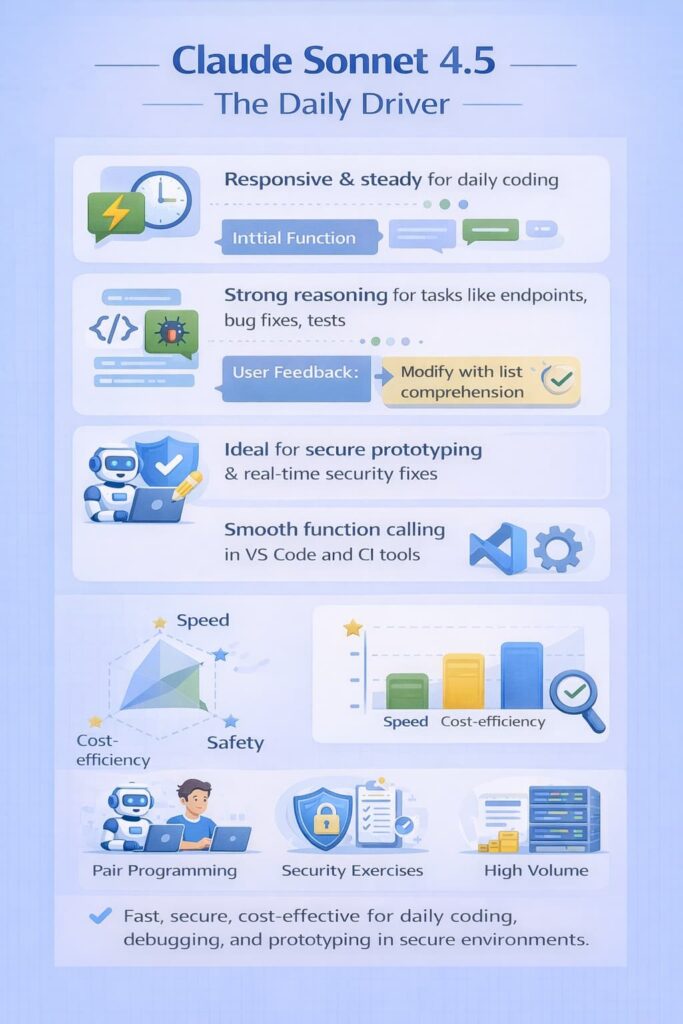
Most days in our bootcamps, learners need an assistant that’s quick and steady, not a marathon thinker. For that, Sonnet 4.5 has become the model we rely on. It feels responsive enough that pair programming doesn’t break flow, and the reasoning is strong for the everyday work: writing endpoints, cleaning up handlers, adding tests, or stepping through a confusing bug in a secure flow.
We use Sonnet heavily for secure prototypes. A student might ask it to sketch a safer input validation layer or generate a first pass at role-based access control. Sonnet is fast enough that they can iterate security fixes in near real time, while we coach them on why a suggestion is safe or not.
When tied into tools, Sonnet 4.5 handles function calling cleanly, which makes it practical inside VS Code, CI helpers, and our internal training apps. It’s the model we leave “always on” for scanning lab code, suggesting safer patterns, and handling lots of small, security-aware requests without exhausting our budget.
When Sonnet 4.5 Shines:
- Daily coding and debugging in security-focused exercises.
- Rapid prototyping and tightening features with tests and checks.
- Real-time pair programming during secure development practice.
- High-volume use cases where cost, speed, and reasonable safety all matter.
Making the Choice: Opus 4.5 vs. Sonnet 4.5
| Decision Factor | Claude Opus 4.5 | Claude Sonnet 4.5 |
| Primary Role | Strategic problem solver | Daily coding companion |
| Reasoning Style | Deep, deliberate, long-context | Fast, practical, focused |
| Best For | Complex refactors, agents, security reviews | Feature work, debugging, prototyping |
| Latency | Slower | Faster |
| Cost Efficiency | Higher cost per task | More budget-friendly |
| IDE / CI Usage | On-demand, targeted | Always-on assistant |
| Risk Tolerance | High-stakes, high-precision tasks | Low-to-medium risk workflows |
| Typical Usage Pattern | Final passes, hard problems | Default model for most work |
Getting Started with Anthropic Models

Getting these models wired into a secure workflow matters more than just “getting a response.” In our own environment, we usually start learners on the Anthropic API via platform.claude.com, then show how the same models appear on AWS Bedrock or Google Vertex AI when a company is already in that stack.
The Python and Node.js SDKs are straightforward, so students can move quickly from theory to live calls.
Our security angle shows up right away: API keys live in environment variables, not in code; payloads avoid secrets; logs are treated as sensitive. We walk cohorts through that setup repeatedly until it feels automatic. Inside editors, the Claude extensions for VS Code and JetBrains have changed how people practice.
This seamless switch between models fits perfectly with workflows that embrace what is the best editor for vibe coding, where fluidity and uninterrupted focus are key. Learners keep Sonnet 4.5 as the default in their IDE, cranking through secure coding drills, then flip a setting to Opus 4.5 when they hit a stubborn, high-risk problem and want a deeper read of the code.
FAQ
How do developers choose between different Anthropic Claude models?
Model selection depends on workload, not hype. Some Anthropic Claude models excel at long-horizon coding and multi-step reasoning AI, while others focus on latency low inference and throughput high volume. Developers should compare Opus vs Sonnet choice based on coding benchmarks SWE-bench, reliability pressure tasks, and whether the work involves precise code edits or fast prototype generation.
Which Anthropic models work best for daily developer AI coding?
For everyday developer AI coding, teams usually want intelligence balance dev rather than maximum depth. Models in the Claude 4 family handle software engineering tasks, real-time coding assistance, and pair programming Claude well. They support JSON structured outputs, tool use Claude, and multilingual programming support without slowing feedback loops during active development.
How do Anthropic models support large refactoring and complex workflows?
Anthropic Claude models are built for agentic workflows developers use in real projects. They manage conversation history refinement, extended thinking mode, and function calling agents. This makes them suitable for refactoring codebases large, long-horizon coding, and enterprise app development where context retention, consistency, and structured planning matter more than quick one-off answers.
What performance factors matter when comparing Anthropic models?
Developers should look beyond raw intelligence. Important factors include latency low inference, throughput high volume, pricing tiers Anthropic, and benchmark leader coding results like Terminal-bench scores. Cost-effective models matter for background tasks IDE usage, while higher-end models suit scientific discovery code and reliability pressure tasks that demand deeper reasoning.
How do developers test and control Anthropic model outputs?
Good testing starts with prompt engineering dev and playground testing prompts. Developers tune temperature control code, top_p sampling, max_tokens limit code, and stop sequences prompts. Features like streaming responses code, response parsing choices, finish reason handling, and seed reproducibility tests help ensure predictable behavior and safer deployment in production systems.
A Developer’s Model Strategy
Think of Anthropic models less as “pick one” and more as a playbook. Most days, Claude Sonnet 4.5 handles the bulk of your work feature code, debugging, quick security checks, without slowing you down.
When the problem turns heavy, like a fragile auth refactor or a multi-step security review, that’s when Claude Opus 4.5 earns its place. Live in Sonnet, reach for Opus on the hard 10%. Your future codebase, and security team, will feel the difference.
If you want to pair that model strategy with strong, human-level security judgment, the Secure Coding Practices Bootcamp is a smart next move. It’s a hands-on, developer-first program covering the OWASP Top 10, input validation, secure authentication, encryption, and safe dependency use, taught through real code, not theory. Whether you’re leveling up individually or training a team, it helps you ship safer code from day one.
References
- https://www.schneier.com/blog/archives/2008/03/security_is_a_1.html
- https://owasp.org/www-project-top-ten/
Related Articles
