



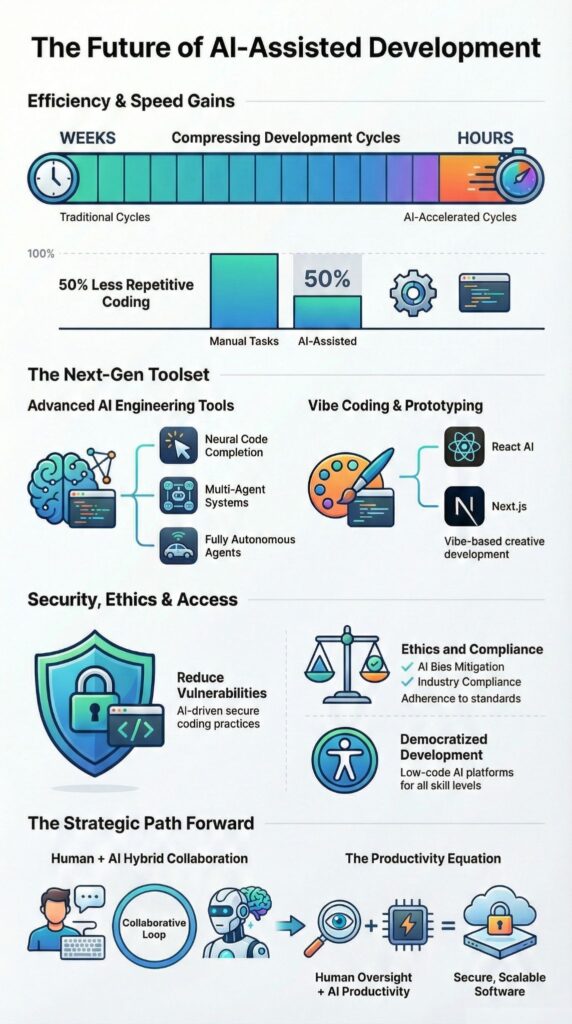
The Future of AI-Assisted Development lies in blending automation with human expertise to make software engineering faster, safer, and more innovative. By embedding secure coding practices from the start, teams ensure AI-generated code remains reliable while reducing routine workloads.
Hybrid human-AI workflows now speed up prototyping, debugging, and testing, letting developers focus on architecture, integration, and ethical considerations.
Tools such as neural code completion, multi-agent systems, and autonomous coding assistants enhance productivity without replacing human judgment. Keep reading to explore the evolution of conversational programming, next-generation AI coding tools, and practical strategies for effective human-AI collaboration.
AI-Assisted Development at a Glance, Core Insights
These points summarize the main lessons from exploring the future of AI-assisted development, highlighting how teams can combine automation with human expertise effectively.
- Secure coding first: Combining secure practices with AI-assisted workflows reduces vulnerabilities and accelerates development cycles.
- Next-generation tools: Modern AI coding assistants streamline full-stack development, testing, and prototyping while making workflows more accessible to diverse teams.
- Ethics and oversight: Human judgment, reliability checks, and ethical considerations remain essential for effective AI-human collaboration.
What Is the Future of Conversational Programming
Conversational programming is evolving toward AI-assisted dialogue with code. In our Secure Coding Practices bootcamps, we teach developers to guide AI through prompts, producing scaffolds, testing scripts, and architecture proposals while maintaining strict security standards.
We’ve seen tools like the Cursor AI editor and autonomous coding agents enable hands-on collaboration. These tools scaffold code efficiently and integrate automated testing and debugging, reducing iteration time and catching errors earlier.
Key capabilities we emphasize in practice include:
- Secure scaffolding: AI generates code while enforcing secure coding practices from the outset
- Automated testing and debugging: Reduces cycles spent on manual verification
- Context-aware outputs: Retrieval-augmented generation (RAG) pipelines keep AI suggestions aligned with project-specific architecture and dependencies
From our experience, hybrid systems that combine natural language instructions, structured prompts, and AI-generated code make development more interactive and productive.
As highlighted by Forbes
“As AI becomes deeply integrated with how software engineers write code, it’s essential to understand how developers can take advantage of AI and thrive in the new technology era.” – Forbes
Developers retain control while AI handles repetitive or boilerplate tasks, freeing teams to focus on architecture, integration, and security considerations.
How Will AI Change Software Development Workflows
AI-assisted development is reshaping software workflows by handling repetitive coding tasks and letting teams focus on higher-value work.
In our Secure Coding Practices bootcamps, we’ve guided developers to use AI for tasks like CI/CD optimization, deployment pipeline management, and automated debugging, all while keeping security and maintainability front and center.
From our experience, the biggest gains come from combining AI with structured human oversight supported by advanced workflows that keep automation predictable and secure. We’ve seen development cycles shrink from weeks to hours, while code quality and consistency improve. Key benefits we emphasize include:
- Faster iteration: Automated debugging and pipeline optimizations reduce manual work and accelerate release cycles
- Enhanced reliability: Code review bots and AI-driven refactoring catch errors early and maintain standards
- Security-first integration: Embedding secure coding practices prevents AI-generated vulnerabilities from entering production
We also focus on practical controls, like managing hallucination mitigation, context window limits, and precise prompts to ensure outputs remain accurate.
By treating AI as a guided collaborator rather than an autonomous agent, teams achieve faster delivery, cleaner code, and stronger confidence in software quality. Structured hybrid workflows let AI amplify productivity without compromising maintainability or security.
Where Is the Vibe Coding Trend Heading
Vibe coding focuses on rapid prototyping powered by AI, especially in environments shaped by vibe coding practices that emphasize speed over structure.
In our Secure Coding Practices bootcamps, we guide teams to use AI tools for React components, Next.js code generation, and frontend prototyping, letting both developers and non-developers iterate quickly while maintaining security and maintainability.
From our experience, several AI-driven capabilities define the trend:
- Neural code completion: Predicts context-aware UI elements, reducing repetitive work and speeding development
- Automated documentation: Generates changelogs, commit messages, and code notes to improve team collaboration
- Multimodal AI: Interprets visual, audio, and textual inputs for interface design, making prototyping more intuitive
We’ve seen firsthand that integrating these tools with structured workflows and human oversight ensures AI contributions remain reliable and auditable. Vibe coding also makes development more inclusive, allowing smaller teams or cross-functional collaborators to contribute effectively without slowing delivery.
By combining rapid iteration, collaboration support, and security-first practices, vibe coding helps teams prototype faster, maintain quality, and keep projects scalable. This approach reflects how modern development increasingly blends AI assistance with human judgment to achieve efficiency and maintain control over complex interfaces.
Will All Code Be AI-Generated in the Future

Full AI-only development remains unlikely. In our Secure Coding Practices bootcamps, we’ve seen that AI excels at repetitive or boilerplate tasks, but struggles with architecture decisions, ethical compliance, and edge-case handling. Human oversight is still essential to ensure reliability and maintainability.
We’ve identified several areas where human involvement is critical:
- Reviewing AI outputs: Ensures accuracy and prevents hidden errors in complex systems
- Ethical and regulatory compliance: Detects bias, enforces accessibility, and maintains GDPR or other legal standards
- Architectural decisions: Guides long-term design choices that AI cannot fully anticipate
From our hands-on experience, AI works best as a productivity augmentation tool rather than a replacement, which is why a hybrid coding approach continues to outperform fully automated models. Combining AI assistance with human judgment makes workflows faster, safer, and more consistent.
Teams that integrate structured AI support with deliberate human review achieve reliable, secure software delivery. AI handles scaffolding, automated testing, or refactoring, but humans remain responsible for critical decisions. This collaborative approach defines the future of software development: efficient, inclusive, and secure.
What Are the Next-Generation AI Coding Tools
Next-generation AI coding tools combine neural code completion, multi-agent systems, and autonomous coding agents to streamline development. In our Secure Coding Practices bootcamps, we guide teams to use these tools strategically, balancing automation with human oversight to maintain secure, reliable code.
From our experience, core capabilities include:
- Context-aware coding: Neural code completion suggests relevant snippets, cutting repetitive coding by nearly half
- Automated scaffolding: Multi-agent systems coordinate tasks for full-stack development, reducing manual orchestration
- Security and testing: Test-driven AI and vulnerability scanning ensure outputs remain reliable and compliant
| Tool Category | Function | Benefit |
| Neural Code Completion | Suggests context-aware code snippets | Reduces repetitive coding by 50% |
| Multi-Agent Systems | Coordinates multiple AI agents for complex tasks | Automates full-stack scaffolding |
| Test-Driven Dev AI | Generates unit & integration tests | Improves reliability & reduces regression bugs |
| RAG Pipelines & Vector DBs | Provides retrieval-based code suggestions | Enhances context-specific solutions |
| AI Vulnerability Scanning | Detects security gaps | Enforces secure coding practices |
We’ve applied platforms like Devin AI Coder and Windsurf AI IDE in hands-on projects. Low-code AI tools also let non-developers contribute safely. By combining these tools with structured workflows and secure coding practices, teams can accelerate development while keeping outputs maintainable and trustworthy.
How Will AI Impact Open-Source Contributions
AI-assisted development is transforming open-source collaboration. In our Secure Coding Practices bootcamps, we guide teams to use AI for generating pull requests, creating tests, and writing documentation while maintaining secure and maintainable code. This approach accelerates contributions without replacing human oversight.
From our experience, key areas where AI adds value include:
- Automated commits and merges: AI handles routine branch operations, reducing manual errors
- Refactoring support: Suggests structural improvements without breaking existing functionality
- Security-first code scaffolds: Embeds secure coding practices directly into AI-generated outputs
Repository activity often increases while human effort focuses on design, architecture, and review. Junior contributors also benefit, AI guidance gives them confidence to participate in complex projects safely, learning best practices as they go.
We’ve seen firsthand that combining AI assistance with human validation improves code quality, iteration speed, and overall reliability. By structuring AI workflows and keeping humans in the loop, open-source teams can scale contributions efficiently, maintain security, and foster inclusive collaboration, ensuring AI complements human effort rather than replacing it.
The Ethical Implications of AI Code Generation
AI code generation brings both opportunities and responsibilities. In our Secure Coding Practices bootcamps, we emphasize that development speed must never compromise security, fairness, or compliance.
Autonomous coding agents require careful human oversight, particularly in regulated or safety-critical environments where errors can have serious consequences.
From our experience, three ethical considerations are most critical:
- Bias detection: AI outputs should be reviewed to prevent unintended patterns or inequities, ensuring all code remains fair and inclusive.
- Compliance frameworks: Following standards like ISO 26262 for safety-critical systems or GDPR for data handling keeps AI-assisted code within regulatory boundaries.
- Transparency and logging: Maintaining clear, traceable records of AI-generated changes ensures accountability and makes audits straightforward.
We integrate these practices into every AI-assisted workflow. Structured monitoring and review prevent ethical lapses while allowing AI to handle repetitive tasks safely. Teams that adopt this approach see faster iteration without sacrificing reliability or security.
By combining human oversight with secure coding practices, AI functions as a guided collaborator rather than an autonomous executor.
This balance ensures faster development while upholding ethical standards, maintaining compliance, and protecting users and stakeholders, demonstrating that productivity and responsibility can coexist in AI-assisted software development.
What Is the End Goal for Human-AI Collaboration
The ultimate goal of human-AI collaboration is a hybrid workflow where AI handles routine and repetitive tasks, while humans retain control over architecture, security, and ethical compliance. In our Secure Coding Practices bootcamps, we’ve seen firsthand that this balance allows teams to accelerate development without compromising reliability or maintainability.
We emphasize that humans remain responsible for creative and design decisions. AI can draft code, generate tests, and assist with deployments, but critical decisions around system architecture, security controls, and feature design must stay in human hands. This ensures accountability and prevents AI-generated errors from propagating into production.
Core practices we apply in hybrid workflows include:
- Task delegation: Assign repetitive coding, formatting, and testing to AI
- Human oversight: Validate architecture, logic, and ethical compliance
- Secure coding enforcement: Integrate policies and automated checks from the start
- Iterative improvement: Refine AI guidance based on team feedback and project context
When structured this way, AI acts as a disciplined collaborator rather than a wildcard. Teams achieve faster delivery, improved code quality, and stronger confidence in secure, maintainable software.
How Will This Make Development More Accessible
Credits : IBM Technology
AI-assisted tools are making software development more accessible to non-developers and cross-functional teams.
In our Secure Coding Practices bootcamps, we’ve observed that designers, analysts, and product managers can participate safely in coding workflows when AI handles routine tasks and provides guided scaffolds. This expands collaboration beyond traditional engineering roles without compromising security or quality.
We rely on low-code AI platforms to enable rapid prototyping. Teams can iterate on features quickly, test ideas, and validate designs while following structured workflows. Automated testing and documentation simplify complex tasks, ensuring contributions remain consistent, auditable, and aligned with secure coding principles.
We have found that guiding every AI-generated contribution with secure coding standards prevents vulnerabilities, even when contributors have limited programming experience. This allows junior developers or cross-functional team members to work confidently without introducing risk.
Key accessibility benefits we’ve seen in practice include:
- Rapid prototyping: Accelerates experimentation and early-stage development
- Simplified testing and documentation: Reduces complexity for non-developers
- Security-first guidance: Ensures safe contributions across all skill levels
By combining AI assistance with human oversight and structured secure coding practices, teams become more inclusive, innovative, and efficient while maintaining reliable, maintainable, and secure software outputs.
Predicting the Evolution of Developer Environments

Developer environments are moving toward AI-native setups, where CI/CD optimization, microservices orchestration, and serverless deployment are tightly integrated with intelligent tooling. In our Secure Coding Practices bootcamps, we’ve guided teams to experiment with AI-assisted workflows while maintaining security and reliability as non-negotiable priorities.
Insights from IBM indicate
“AI will become more integrated into personal and professional realms… enabling solutions without requiring deep technical expertise.” – IBM
We’ve seen tools like Replit Agent v0 embed RAG pipelines, vector database support, and performance profiling AI, allowing developers to collaborate with agents on testing, refactoring, and documentation..
Edge computing and WebAssembly AI further expand deployment flexibility, enabling teams to push features across devices and environments with minimal friction. From our hands-on experience, autonomous coding agents accelerate development while still requiring oversight to prevent security gaps and maintain code quality.
Key principles we implement include:
- Human-AI collaboration: Developers guide AI while retaining control over architecture and security
- Secure coding first: Every AI-assisted change passes structured validation and testing
- Iterative monitoring: Continuous review ensures AI outputs align with project standards
By embedding these practices, next-generation environments become more productive, flexible, and secure without compromising maintainability or ethical standards.
FAQ
What is AI-assisted development and how does it improve coding workflows?
AI-assisted development uses machine learning integration and neural code completion to simplify and accelerate coding tasks.
By leveraging AI coding tools and AI pair programming, developers can automate repetitive code generation, optimize CI/CD pipelines, and perform refactoring AI and legacy code modernization efficiently. This approach enhances developer productivity metrics, reduces errors, and allows engineers to focus on high-level architecture and design.
How can automated debugging and test-driven development AI help catch errors early?
Automated debugging combined with unit test generation, integration testing AI, and mutation testing bots enables developers to detect errors quickly.
These AI software testing methods, including AI vulnerability scanning and code review bots, identify potential issues before deployment. Using performance profiling AI and predictive error tools ensures higher code quality, more reliable software, and stronger software engineering AI practices.
What role do multi-agent systems and agentic workflows play in AI coding?
Multi-agent systems and agentic workflows allow autonomous coding agents to collaborate effectively on complex tasks. They manage RAG pipelines, retrieval augmented generation code, refactoring AI, and microservices AI orchestration.
By reducing manual coordination, these workflows support prompt engineering dev, LangChain development, and Llama Index apps, enabling developers to handle large-scale projects efficiently while maintaining high-quality, structured code.
How do low-code AI platforms and no-code AI builders accelerate development?
Low-code AI platforms and no-code AI builders enable rapid software prototyping and frontend AI development without extensive manual coding.
They support backend AI scaffolding, database migration AI, SQL query optimization, and NoSQL AI indexing. Developers can integrate AI architecture design and neural code completion to build functional software quickly, allowing faster iteration and experimentation while maintaining secure, ethical AI coding practices.
How does AI architecture design integrate with DevOps and cloud-native tools?
AI architecture design combines serverless AI deployment, edge computing code, Kubernetes AI operators, and Terraform AI plans to optimize infrastructure.
It enhances CI/CD pipelines, deployment pipeline AI, and observability AI stacks, including logging analysis bots and anomaly detection code. This integration ensures scalable, secure, and high-performance software while embedding DevOps automation AI into real-world production systems reliably.
Human-Centered AI Development: Lead, Don’t Follow
AI can speed coding, testing, and documentation, but without human oversight it risks creating fragile or unsafe systems.
When structured hybrid workflows put humans in charge, security comes first, and accessibility is prioritized, AI becomes a tool for innovation rather than a source of errors. Ask yourself, do you want faster outputs, or software that is trustworthy, maintainable, and ethical?
Take control of your AI-assisted development. Join the Secure Coding Practices Bootcamp to embed secure, human-led AI workflows, reduce errors, and empower every team member to contribute confidently.
References
- https://www.forbes.com/councils/forbestechcouncil/2025/04/04/the-future-of-code-how-ai-is-transforming-software-development/
- https://www.ibm.com/think/insights/artificial-intelligence-future
Related Articles
