
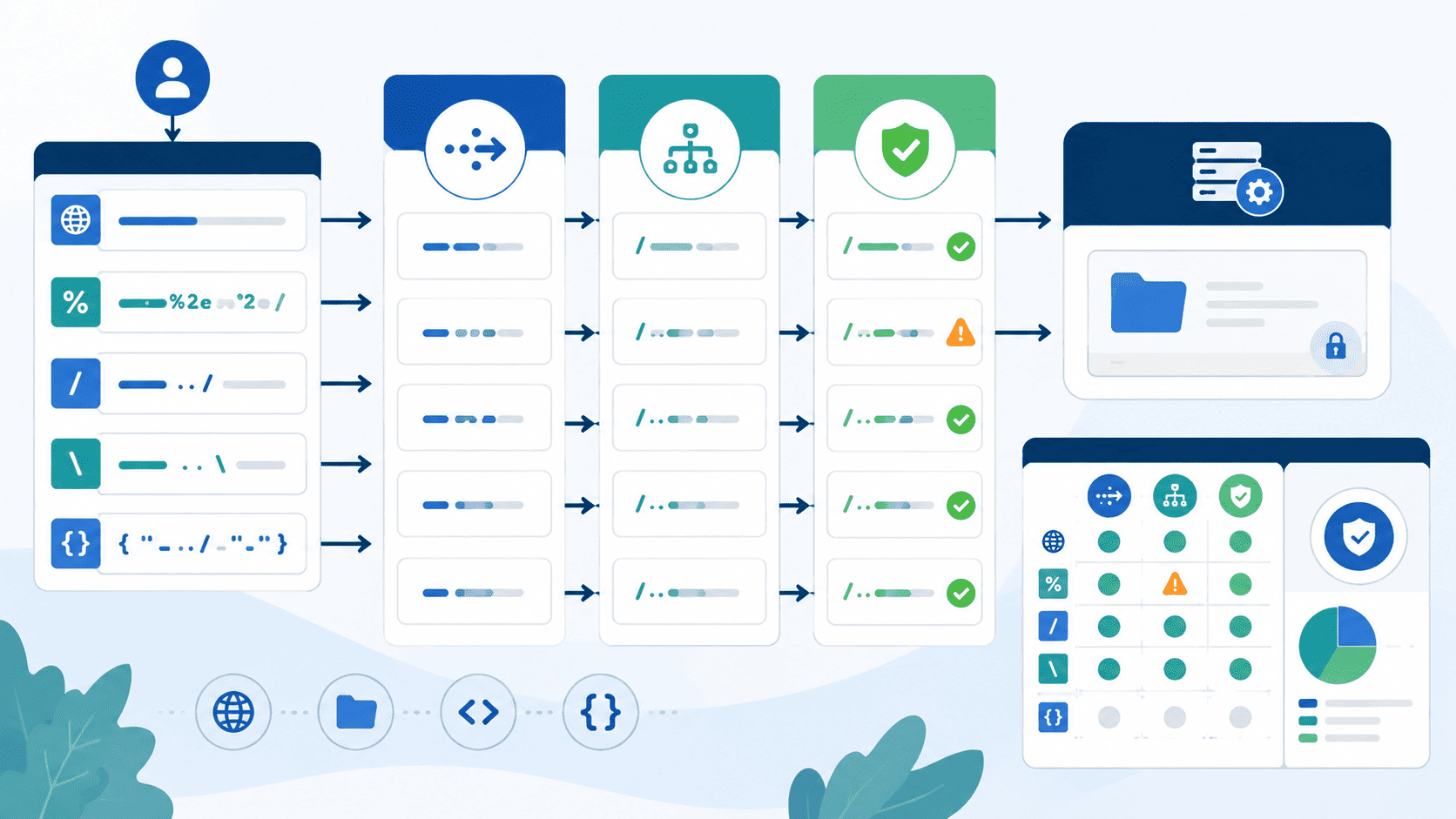

Canonicalization testing checks whether each layer reads the same input in the same way. That matters because security checks can fail when one layer decodes, normalizes, or rewrites data before another layer uses it. MITRE CWE-180 points to validation before canonicalization as a core weakness. We’ve seen the problem appear between parsers, routers, filters, and application code, not inside one obvious function.
Test by tracing each transformation, sending equivalent input forms, and checking what reaches the final sink. Path traversal and URL parsing are common examples. Secure Coding Practices uses this method to find mismatches before attackers do. Keep reading for a repeatable testing approach.
Canonicalization Testing: The Key Security Checks
- Secure Coding Practices should begin with one principle: validate and authorize the final canonical representation, not the raw string.
- Test equivalent inputs across encoding, Unicode, path resolution, proxies, routers, archives, and structured-data parsers.
- Prove findings with transformation evidence, controlled canaries, and security regression testing rather than a payload screenshot alone.
Why Is Canonicalization Testing a Cross-Layer Security Problem?
That edge-proxy split you’re seeing between Nginx and Go is classic: Nginx sees a single-encoded route like /admin%252Fconfig as a non-matching, benign string and passes it upstream, while Go decodes %25 into %, sees %2F, decodes it to /, and grants access to /admin/config without Nginx’s security policies ever firing.
When parsing layers don’t agree on a single source of truth, security logic collapses.
How Can You Identify Cross-Layer Discrepancies?
Mapping where input transforms occur requires looking for moments where structural representation shifts. The vulnerability almost never lies in a single broken library; it lives in the space between two parsers that process state differently.
Common Canonicalization Edge Cases
- Double URL Encoding (%252e%252e%252f): Edge filters check for literal ../, pass the payload, and an upstream backend decodes it twice into a valid path traversal.
- Unicode Homoglyphs & Case Normalization: Filtering mechanisms validate UTF-8 strings before converting them to lower case or mapping visual equivalents (e.g., K to k), bypassing blacklists.
- Path Traversal Stripping: Scrubbing ../ sequentially instead of recursively allows inputs like ….// to collapse into a functional traversal path post-validation.
- Null Byte Injections (%00): Higher-level framework routing ignores trailing null bytes, while lower-level filesystem calls treat them as string terminators, truncating expected file extensions.
- HTTP Parameter Pollution (HPP): Passing duplicate parameters (?user=1&user=2) causes edge systems to validate the first instance while origin systems process the second.
How Can You Fix the Canonicalization Ordering Sequence?
To solve CWE-180 and cross-layer drift, applications must enforce Canonicalize-Then-Validate across the entire routing stack.
- Decode at the Outer Edge: Ensure your outermost reverse proxy or gateway fully decodes and normalizes incoming URI paths before evaluating access controls or routing rules.
- Pass Strict, Standardized Inputs Upstream: Do not rely on downstream microservices to re-parse raw URL encoding differently. Force origin engines to operate strictly on the normalized path passed from the edge.
- Validate Right Before the Sink: If a downstream service must perform its own canonicalization (e.g., calling filepath.Clean() or realpath()), run path containment checks after that final resolve step, never before.
Why Should You Map Every Transformation Before Sending Test Cases?
Mapping transformations before sending test cases is the single most effective way to eliminate blind spots in canonicalization and encoding reviews. When validators and sinks read two different versions of the exact same input, security logic collapses regardless of how strong your underlying rules are.
As noted by arXiv
“Cryptographic systems operate on bytes but mean semantic objects. The translation between the two is rarely unique. Where this uniqueness is not enforced, an attack surface opens up.” – arXiv
Here is how to structure this process across your pipeline, integrating structured checklists alongside your mapping phase:
How Should You Map Inputs and Scope Boundaries?
Before crafting payloads, trace every input vector from its initial entry point to its ultimate sink. Treat internal microservice hops with the same scrutiny as public-facing endpoints.
Primary Attack Surface Checklist
- HTTP Surface: URL paths, query parameters, request bodies (JSON, XML, form-data), headers, cookies, and multipart filenames.
- Archive & System Inputs: File paths inside ZIP/TAR archives, metadata fields, and environment variable overrides.
- Internal Boundaries: Microservice-to-microservice REST/gRPC calls, message queue payloads (Kafka, RabbitMQ), and cached objects re-hydrated from Redis or Memcached.
- Target Sinks: Filesystem APIs (fopen, FileStream), HTTP outbound clients, database drivers, template engines, and authorization check functions.
How Can You Track Transformations and Align the Test Matrix?
For every input target, document every layer that touches, rewrites, or evaluates the payload.
+——————+ +——————+ +——————+ +——————-+
| Original Input | –> | Decoding/Parsing | –> | Security Check | –> | Application Sink |
| (e.g., %2e%2e%2f)| | (URL Decode) | | (Path Validation)| | (File Read/Write) |
+——————+ +——————+ +——————+ +——————-+
Transformation Map & Execution Phases
| Phase | Core Question | Evidence to Collect |
| Map | Where does the input change representation? | Transformation diagram |
| Baseline | What should normal behavior do? | Control response |
| Mutate | Which equivalent forms behave differently? | Test matrix |
| Trace | Which layer changed the input’s meaning? | Layered logs |
| Prove | Did the final behavior violate a security policy? | Controlled evidence |
| Retest | Does the fix protect every equivalent representation? | Regression suite |
How Can You Identify Canonicalization Divergence?
The primary failure mode in complex pipelines occurs when a security control validates an input before a lower-level framework layer transforms it.
Critical Divergence Checks
- Double Decoding: Does a web firewall or API gateway decode %252e%252e%252f once (seeing %2e%2e%2f as safe text), while the backend application decodes it a second time into ../../?
- Unicode Normalization: Does the validator evaluate Unicode characters (like \u002e) as harmless text, while the runtime normalizes them into ASCII control characters before touching the filesystem or database?
- Path Resolution: Does an authorization middleware validate /api/v1/user/../admin as an unprivileged path, while the routing engine resolves it directly to /api/v1/admin?
- Parameter Pollution: Does the security proxy inspect only the first occurrence of a duplicate query parameter (?id=1&id=2), while the backend application processes only the last?
When penetration testing or conducting code reviews, target these exact mismatch points. Once you locate the layer where canonicalization drifts from execution, testing stops being a guessing game and becomes a precise verification of security enforcement.
How Can You Test Equivalent Representations, Not Just Obvious Payloads?
Here’s the big idea: take one value and write it in different ways. Then check if every part of the system agrees on what it means. That’s really what this kind of testing is about. OWASP’s testing guide talks about this too, it says to change encoding and input formats in a careful, step-by-step way. We’ve learned the hard way that changing one thing at a time teaches you more than mixing five tricks together at once.
Think about a file path. It can be written as plain text, as percent-encoded text, as double-encoded text, or with the dots and slashes arranged differently. All these versions can point to the exact same file. A secure system needs to treat them the same way no matter how they’re written.
| Test family | Variations | What to observe |
| Encoding | Literal, encoded, repeatedly encoded | Decode order |
| Paths | Separators, dot segments, absolute forms | Final resolved target |
| Unicode | NFC, NFD, compatibility forms | Identity matching |
| Case | Lowercase, uppercase, mixed case | Routing and authorization |
| Whitespace | Leading, trailing, control handling | Parser differences |
| Structured data | Escapes, duplicate keys | Validator and parser agreement |
Some of the best tricks to test are double URL encoding, decoding done wrong, mixed-up slashes, and Unicode tricks. But we’re not just collecting weird strings to show off. We’re checking if the system stays consistent no matter how the input looks.
Every test we run starts with the same four things:
- A normal value that should be allowed
- A value that should clearly be blocked
- A value right on the edge
- A different-looking version of the same value
Getting the same error message every time doesn’t mean you’re safe, though. We dig deeper and compare the handler, the access decision, the cleaned-up value, which file or page actually got picked, and the logs, whenever we’re allowed to look.
How Can You Test Path Traversal Beyond Basic Dot Dot Slash Payloads?

Good path traversal testing isn’t just about whether a filter catches ../ in a string. It comes down to where the application actually resolves the path after all normalization and decoding layers (WAF, reverse proxy, application server) finish processing it.
Why Simple String Blocking Fails?
Both OWASP and MITRE (CWE-22, CWE-23) emphasize that basic string filtering fails because resolution happens downstream. If a security check executes before path canonicalization, the application can approve an input that resolves to an unintended location.
Key Attack Vectors & Payload Variations
To thoroughly test path handling, move beyond basic relative paths and evaluate how the stack handles edge cases:
- Dot-Dot-Slash & Repeat Segments: Variations like ….//, …/./, or deeply nested sequences designed to bypass single-pass recursive stripping.
- Encoding & Double Decoding: URL encoding (%2e%2e%2f), double encoding (%252e%252e%252f), unicode variants, and NUL byte injections (%00).
- Slash & Separator Tricks: Alternate separators such as backslashes (..\..\) on Windows or encoded slashes (%2f, %5c).
- Absolute Paths: Passing fully qualified paths (e.g., /etc/passwd or C:\Windows\System32) to bypass relative path logic.
- OS-Specific Behaviors: Case sensitivity differences (Linux vs. Windows/macOS) and short filename aliases (such as 8.3 filenames on NTFS).
- Symbolic Links: Soft links pointing outside the web root or sandbox directories.
What Is the Defensive Remediation and Processing Flow?
To securely handle file access, resolve absolute locations using native APIs (such as realpath() in C/PHP or Path.of().toRealPath() in Java) and confirm the canonical path stays bounded within the intended root directory. Checking string prefixes alone is vulnerable to partial-name matching (e.g., /var/www/app-data matching /var/www/app).
Secure Path Processing Sequence
- Receive Input: Capture the raw request parameter.
- Canonicalize: Resolve the absolute path using native platform APIs.
- Scope Validation: Verify that the canonical path strictly starts with the designated base directory path followed by a path separator.
- Authorization: Check user read/write permissions for the resolved target resource.
- Execute: Perform the requested filesystem operation.
How Can You Test Archive Extraction and Zip Slip?
Testing shouldn’t be limited to direct parameter inputs. Archives, templates, and file imports process paths through separate code paths:
- Header Parsing: Zip, Tar, and War extractors often trust relative file paths embedded directly inside archive headers.
- Multi-Entry Execution: Test archive entries individually, as extraction libraries may normalize paths differently than main application endpoints.
How Can URL Normalization Flaws Bypass Security Decisions?
A URL normalization flaw occurs when a security checker evaluates a URL differently than the underlying system executing the request. Research from security platforms like SonarSource highlights that this parser mismatch spans multiple programming languages, creating critical vulnerabilities such as Server-Side Request Forgery (SSRF), open redirect abuse, and authentication bypasses.
Parser Mismatches & Verification
The core vulnerability isn’t whether a URL appears malformed on input. It comes down to whether the approved URL resolves to the exact same destination as the backend client or application framework. Effective validation requires testing the checking tool against the execution tool to verify identical handling across several vectors:
- Redirect Handling: Testing whether the validator follows redirects in the same manner as the HTTP client, including open redirect chains.
- Hostname Anomalies: Evaluating trailing dots (example.com.), mixed casing (ExAmPlE.cOm), and alternate IP representations (decimal, hex, octal).
- Encoding Schemes: Checking single vs. double URL encoding, Percent-encoding (%2f), Unicode normalization, and multi-byte characters.
- Special Characters & Delimiters: Injecting matrix parameters (;), fragments (#), backslashes (\), or NUL bytes (%00) to observe path truncation or parsing drift.
How Can Proxy and Gateway Misconfigurations Affect Canonicalization?
Intermediate reverse proxies like Nginx, Apache HTTP Server, and IIS each perform path canonicalization, URL decoding, and routing adjustments using distinct rules. When proxy configuration rules differ from backend application routing, security controls break down.
Path Transformation Lifecycle
- Edge Ingestion: The perimeter server receives URL Version A directly from the client.
- Proxy Normalization: The proxy layer rewrites or decodes the request, producing Version B.
- Access Evaluation: The security policy or WAF inspects one specific version against access control rules.
- Backend Execution: The backend application decodes or handles routing differently, servicing Version C.
Tracing Impact Beyond Mismatches
Identifying a parser discrepancy between layers is only the initial phase. A normalization mismatch only yields a security vulnerability if the resulting transformed path leads to sensitive functionality, such as an unauthenticated administrative endpoint, a restricted internal resource, or a state-changing application route.
How Can You Test Unicode and Structured Data at Parser Boundaries?
Canonicalization bugs don’t just happen with file paths. In lab environments, the exact same vulnerability patterns surface in usernames, tenant IDs, API tokens, and log entries. Anywhere a system normalizes text to derive identity or structure, mismatches create security boundaries.
OWASP & The Core Canonicalization Rule
OWASP’s baseline guidance for handling user-supplied identifiers is straightforward: Always decode and normalize text into a single standard representation before executing any validation or access control checks.
This requirement is critical whenever systems process free-text input across multiple microservices or boundaries:
- Registration & Auth: Mismatches between identity checks and database lookup logic allow account takeover or duplicate registrations.
- Access Control: Middleware might validate an un-normalized route (e.g., %2fadmin), while the router executes a normalized path (/admin). Learn more about validating input after canonicalization.
- Storage & Buckets: Object stores might decode characters differently than the application logic layer, creating path traversals or target overwrites.
- Security Monitoring: SIEMs and loggers that ingest raw strings can obscure malicious payloads that the backend application executes after normalization.
If one service reads a normalized string and another evaluates the raw input, the mismatch bypasses validation logic, even if every component appears secure in isolation.
How Can You Test Unicode Normalization Boundaries?
Unicode is one of the most reliable places to test for canonicalization flaws. System behavior changes significantly depending on how characters are decomposed, folded, or matched:
- NFC vs. NFD Forms: NFC combines characters into single codepoints (e.g., é as U+00E9), whereas NFD decomposes them into base characters and diacritics (e + U+0301). If a system hashes or compares string representations without normalizing to a single form first, user in NFC and user in NFD will fail equality checks while rendering identically to humans.
- Case Folding & Mapping: Standardizing uppercase to lowercase isn’t always 1:1 across languages. For instance, the Turkish dotted İ (U+0130) lowers to i, but in simple ASCII lowercasing logic, it may break or bypass string-matching rules.
- Compatibility Mappings (NFKC / NFKD): Visual variants like full-width characters (e.g., ASCII vs. ASCII) or superscript digits might be converted to standard characters after security checks pass.
- Homoglyph Evaluation: Testing characters from different scripts that look identical (e.g., Cyrillic а U+0430 vs. Latin a U+0061). If authentication systems allow mixed-script homoglyphs, spoofing attacks become trivial.
Testing these edge cases ensures that two values that look or mean the same thing to a user are treated strictly and consistently by the backend.
What Are the Structured Data Traps Across Parsing Layers?
Structured formats introduce canonicalization errors through encoding, nested definitions, and boundary handling across different parsers:
- JSON Inconsistencies: Parsers handle duplicate keys differently (first key vs. last key wins) or evaluate escaped Unicode sequences (\u002f) after authorization checks have already been executed.
- XML Entity & Namespace Expansion: Differences in how XML parsers expand entities, resolve external references, or handle default namespaces can alter the parsed DOM tree unexpectedly.
- Multipart File Boundary Anomalies: Web frameworks frequently split multipart metadata. The filename in the Content-Disposition header might differ from the name processed by downstream storage drivers.
- Archive Traversal on Extraction: Path variables encoded inside .zip or .tar headers (e.g., ../) can bypass filename UI checks and extract files into arbitrary directory paths.
CWE-180 and CWE-178 continuously reinforce the requirement: decode first, normalize second, validate third. Always audit and test the finalized value at the execution point, rather than trusting raw parameters captured at the edge.
How Can You Use Differential, Property-Based, and Transformation-Aware Tests?

Differential testing compares how different versions or parsers handle the same input. Property-based testing adds another layer by checking whether a security invariant holds true regardless of the input generated.
Research from Dartmouth Computer Science demonstrates
“The more recent Reghizzi et al monograph goes even further and observes: parenthesized CFGs are deterministic. Together, this suggests a decision procedure for parser differentials of the same format.” – Dartmouth Computer Science
One rule we test constantly is idempotence:
$$C(C(x)) = C(x)$$
If running a canonicalizer twice produces a different result than running it once, that’s a red flag. It usually means two components are repeating a cleanup step, creating space for double-decoding vulnerabilities.
For restricted folders, the path resolution rule must hold true: the final canonical file path must remain inside the allowed base directory. Simple string matching isn’t enough—it misses real structural path issues quietly.
Transformation-Aware Fuzzing Process
Transformation-aware fuzzing isolates changes one at a time. Research confirms path traversal bugs are hard to catch because no static tool perfectly understands every parser variant. A clean process looks like:
- Start with a clean baseline: Begin with a fully valid, minimal input.
- Apply a single mutation: Introduce only one specific alteration at a time.
- Observe parser behavior: Track exactly how the target decodes and interprets the change.
- Document anomalies: Record state shifts, differential outputs, or unhandled errors.
- Combine systematically: Only pair mutations after each variation is fully understood individually.
This structured approach lets us test overlong UTF-8 encodings, separator swaps, nested encodings, duplicate key collisions, and URL structural drift without turning the test suite into an unmaintainable pile of random fuzz vectors.
Still, automation doesn’t replace manual code review. A clean automated scan can easily miss edge-case framework quirks or hidden library behaviors.
How Can You Combine Runtime Testing With Secure Coding Practices?
Secure coding relies on runtime testing, code review, and regression checks following identical rules. Discrepancies between these layers create blind spots attackers actively exploit.
Standard guidelines from MITRE, OWASP, and NIST align on a clear sequence:
- Define canonical representations: Standardize the expected internal input format upfront.
- Reject malformed variants early: Drop ambiguous or structurally invalid inputs immediately.
- Validate post-canonicalization: Run security assertions only after decoding is complete.
- Authorize resolved targets: Perform access control checks on the final, fully resolved resource.
What Are the Key Code Review Checkpoints?
During code reviews, we focus on identifying systemic parsing and validation flaws:
- Validation running before input decoding
- Multiple, redundant decoding passes
- Manual string-replace operations used instead of real path/URL parsers
- Parser discrepancies between API gateways and backend services
- Unsafe path concatenation operations
- Authorization checks evaluated prior to final file path resolution
What Should Be Included in the Additional Validation Scope?
We apply the same rigorous check to secondary target areas:
- Archive extraction mechanics (mitigating Zip Slip vectors)
- Symlink resolution race conditions and filesystem canonicalization
- HTTP header formatting and proxy forwarding header manipulation
- Cache key construction to prevent cache poisoning attacks
- Parameter parsing anomalies within query strings
- REST endpoint formatting differences across API gateway routes
Fixing a vulnerability shouldn’t end with a single patch. Every related variant needs immediate retesting, a step that gets skipped far too often.
Build the habit: document every transformation bug found, write property tests for all related variations, and enforce uniform handling across the entire input surface. That is how a single fix turns into long-term defensive security.
How Testing for Canonicalization Vulnerabilities Strengthens Secure Coding?
When testing for canonicalization bugs, the focus stays on what an input finally turns into rather than how it looks the moment it arrives.
MITRE’s CWE list and OWASP agree on the core principles for handling input boundaries safely:
- Normalize first: Clean up, decode, and resolve the input before applying any access control checks.
- Rely on real parsers: Use battle-tested, built-in framework parsers rather than writing manual string-replacement routines.
- Validate actual targets: Approve access only after resolving the exact final resource or path the system landed on.
In bootcamp labs, this is taught as a seven-step process. Most insights come from tracking the exact spot where the meaning of an input shifts, then checking what actually got used at the end.
Consistency is what gets pushed hardest in secure coding practices. If every part of an app reads paths, URLs, IDs, and data the same way, you avoid the small cracks that pop up when each layer does its own thing.
Modern application stacks benefit from continuous differential testing at every interface boundary. By embedding automated property-based fuzzers directly into CI/CD pipelines, proxy rewrites, API gateway routes, and archive unpackers automatically reject non-canonical representations before deployment.
Why Do Reverse Proxies, WAFs, and Routers Need Differential Testing?
Credits: Computer & Info Sciences at University of Delaware
A lot of these bugs happen because the proxy, the WAF, and the app don’t clean up the same request in the same way before it hits a protected page.
Guidance from OWASP’s Web Security Testing Guide highlights path confusion specifically because most apps today pass a request through several layers before anything actually happens with it. Proxy behavior deserves just as much attention as input checks inside the backend app.
The first move is simple: look at what each layer actually sees. The WAF might read one version of the path. The proxy might rewrite or transform it. Then the app reads it again and normalizes it its own way before deciding who gets in.
Core Surface Boundaries to Test
- Slash variations: How the web server handles duplicate, trailing, or mixed slashes (//, \, /./).
- Encoding bypasses: Encoded slashes (%2F, %5C) and double-encoded characters slipping past initial filters.
- Rewrite transformations: How path rewrite rules alter routes and strip or add path segments.
- Case and suffix mismatches: Uppercase/lowercase differences, trailing dots, or null bytes altering extension checks.
- Route resolution confusion: Discrepancies in which backend handler or route a request actually hits versus what the security layer checked.
For every test run, save what the edge saw, what the proxy saw, the final resolved route, whether access was approved, and which backend handler picked it up. If something doesn’t line up, those logs make the problem easy to isolate and fix.
WAF evasion tricks shouldn’t be treated as the end goal. They serve as a tool to compare layers, the primary objective is confirming whether one layer lets something through that a downstream layer treats as off-limits.
How Can You Test Rewrite and Normalization Boundaries?
Change one thing at a time, then see if every layer still agrees on the same decision. Building off OWASP’s guidance and proxy pathing research, start with a request known to be fine, followed by one known to be blocked. From there, make single structural adjustments incrementally.
Step-by-Step Boundary Execution
- Send baseline: Submit the standard, expected request to establish normal response logs.
- Capture layer state: Save the exact request log captured at the edge, the proxy, and the app.
- Introduce single mutation: Apply one minor path change (e.g., dot segment, percent-encoded slash, or casing tweak).
- Verify final handler: Check the final route reached, the status code returned, and whether access was granted.
- Document and repeat: Record the layer differential before moving on to the next isolated modification.
Not every weird routing behavior is a bug. Some frameworks are built to smooth over small differences on purpose, which is normal. It only becomes a real security finding when the changed version reaches a page or resource that the original version couldn’t reach. Keeping that line clear stops teams from flagging every small parser quirk as a vulnerability when it’s really just a difference in architectural design.
Why Do Unicode and Identity Normalization Need the Same Discipline?
Unicode problems show up when signup, login, permissions, storage, and logs don’t all agree on which text counts as the same value.
OWASP says to pick one standard encoding before you validate anything, and Unicode itself has more than one way to represent text that looks almost identical. We’ve seen why normalizing user input securely consistently is worth testing across the whole life of an account, not just at one signup form.
Picture a username that passes a uniqueness check in one form, then gets read differently by another part of the system later. The same thing can happen with tenant IDs, file names, API resource names, or any rule that ignores letter cases.
To catch these gaps before they reach production, we focus our test suites on specific edge cases:
- NFC and NFD forms: Ensuring composed and decomposed character representations resolve identically across all services.
- Compatibility mappings: Verifying how NFKC/NFKD transformations handle full-width, subscript, or formatted characters.
- Lookalike characters: Testing homoglyphs safely in controlled setups to prevent identity spoofing.
- Case conversions: Validating uppercase, lowercase, and mixed-case handling across different locale settings.
- System alignment: Checking whether the database’s uniqueness check strictly matches the app’s permission check.
Good proof shows whether each version of a value points to the same account, file, or decision. Two strings just looking alike doesn’t mean there’s a bug.
Even so, testing UTF-8 normalization can turn up real problems that a plain ASCII test suite would completely miss. The goal isn’t to treat every non-English character as dangerous, it’s to make sure every system reads meaning the same way.
How Can Structured Data Hide Canonicalization Mismatches?
JSON, XML, multipart data, archives, and signed messages all share one weak spot. The data that gets checked isn’t always the same data that gets used later. A validator looks at one version of an object, while the real parser might read a completely different version downstream. That gap is where security issues sneak in.
MITRE’s CWE list covers this idea in general terms: checking an object before it’s fully turned into its final shape is risky. Structured formats make the problem worse because two distinct parsers can read the same source payload two different ways.
During our bootcamp labs, we break down how these mismatches manifest across formats:
- JSON payload risks: Handling duplicate property names or unescaping hidden Unicode characters before schema evaluation.
- XML structure twists: Resolving entity expansions and namespace shifts that alter object meaning after validation.
- Multipart header variations: Exposing differences between the visual filename shown on screen and the actual path saved to disk.
- Archive path resolution: Uncovering path traversal risks when entry listings diverge from actual extraction paths.
- Signed payload drift: Preventing situations where verified signature bytes differ from the executed payload.
| Boundary | Test Focus | Security Question |
| JSON | Duplicate keys and escaped values | Which value does the final sink actually use? |
| XML | Entities and namespaces | Is the validated object the same one that gets processed? |
| Multipart | Filename representations | Which filename actually reaches storage? |
| Archives | Entry paths and symbolic links | Does extraction remain inside the intended directory? |
| Signed Data | Canonical bytes | Is the verified value identical to the value that gets used? |
When we test archive extraction for path traversal, we split the file name shown in a listing from the actual path used when the file gets extracted. A file can look totally fine in the list. Then, once the path gets normalized, it lands somewhere it should never go.
Zip Slip testing works the same way. Before writing anything to disk, the extraction code has to show that every destination path still lands inside the intended directory.
This same problem shows up in JSON pointer injection and XML entity path injection too, especially when a structured identifier picks which resource gets loaded. We trace the payload representation the exact same way, and we only run these tests on systems we own or have clear permission to test.
How Do Differential and Property-Based Tests Improve Repeatability?

Differential testing means comparing two versions of data that are supposed to mean the same thing. Property-based testing checks whether canonicalization keeps the app’s security rules solid, no matter how the input is shaped.
There’s good ACM research on path traversal detection, and it shows how hard full automated coverage really is across messy, real-world code. We’ve seen the same thing ourselves. Automation helps us repeat tests, but we never assume a scanner or fuzzer fully understands every framework, path function, or parser it’s touching.
One rule we use a lot is called idempotence:
C(C(x)) = C(x)
If running canonicalization a second time changes the value again, something in the pipeline is transforming the data more than once. That doesn’t automatically mean there’s a bug. But it’s a good reason to go check the production pipeline closer.
We also check something called containment:
resolvedResource(base, x) stays within the allowed policy boundary
This check has to look at the real, resolved path, not just compare text strings. A plain string check can easily let a sibling folder through by mistake, or completely miss what a symlink is doing.
For automated testing, we start with one valid value and change it step by step:
- Apply percent encoding to one character.
- Flip the encoding case.
- Add one more layer of encoding.
- Swap the path separators.
- Normalize or change the Unicode form.
- Add extra path segments or duplicate fields.
We only mix these changes together after testing each one by itself first. This gives us cleaner proof than random fuzzing, because every test case still has a clear, known link back to the original baseline.
Why Should Fuzzing Track Meaning, Not Just Crashes?
Fuzzing gets a lot more useful for canonicalization bugs when the test harness pays attention to meaning, not just crashes.
A crash tells you a bug exists. But canonicalization bugs usually don’t crash anything. Instead, the app quietly serves a different file, hits a different route, or makes a different access decision than the original input suggested.
That’s why our test harnesses check more than crashes. We compare status codes, response signatures, which handler ran, access decisions, which resource got picked, and normalized logs. A harmless test file can prove something resolved the wrong way, without ever touching real production data.
Our Harness Workflow
- Build a valid baseline: Establish expected, standard behavior first.
- Create a labeled variant: Generate an equivalent or modified test input.
- Send both through the test path: Run both payloads under identical conditions.
- Collect multi-layer behavior: Record response codes, handlers, and normalized logs.
- Flag mismatches: Identify any behavioral drift between the baseline and the variant.
- Minimize the case: Shrink the payload down to the smallest reproduction snippet.
This helps us cover things like absolute path injection, null byte injection at old legacy spots, 8.3 filename bypass tricks, Windows reserved filenames, and NTFS path quirks, wherever they actually apply.
That said, we don’t copy platform-specific test cases blindly into every environment. Windows path traversal and Linux path traversal aren’t the same problem. Different operating systems, filesystems, and frameworks all read separators and paths differently.
In the end, our test matrix has to match the real system we’re testing, not just a generic checklist.
How Can Code Review Find Dangerous Transformation Order?
When our team reviews code, we’re hunting for things that testing alone won’t catch. The order steps happen. Decoding that runs more than once. Parsers that quietly disagree with each other. Catching these early, before someone actually proves the exploit works, saves a lot of pain down the road.
There’s a rule from MITRE, CWE 180, that says you should clean input into one standard format before you check whether it’s valid. Not after. OWASP backs this up too, pushing for consistent encoding, server side checks, and allowlists instead of blocklists. We’ve found the best way to use these rules is to turn them into simple checks our engineers can actually run when they hit a risky part of the code.
High-Risk Review Patterns
- Validation before canonical path resolution: Checking input prior to normalizing path strings.
- Multiple URL decodings: Running decode functions repeatedly across middleware layers.
- String prefix containment checks: Relying on basic prefix matches instead of strict bounds.
- Library mismatch: Using different libraries for validation and final URL consumption.
- Early authorization: Evaluating auth before route or resource normalization occurs.
- Unsafe archive extraction: Unpacking archives without strict path resolution checks.
- Header & cookie confusion: Inconsistent header canonicalization, cookie path handling, or cache keys.
Swapping out a few bad characters isn’t a real fix. Not even close. We see this constantly, someone strips “../” a couple times, calls it done, moves on. That’s not a policy. That’s a patch job.
And even when a scanner comes back clean, that doesn’t mean the code is safe. People on SonarSource’s forums have talked about cases where a scanner missed a path problem because it just didn’t understand how a library joins paths at runtime. Good reminder. No single tool sees everything. Static analysis, manual review, fuzzing, live testing, they each catch something the others miss. You need all of them, honestly.
How Does Evidence Make a Canonicalization Finding Defensible?
A finding only means something if we can show the whole chain and prove the final result actually broke a security rule.
OWASP recommends keeping three things separate:
- Finding weird inputs: Spotting unusual or encoded payloads entering the application pipeline.
- Testing them: Pushing those inputs through the system to observe behavior.
- Proving real harm: Verifying that the payload caused an actual security breach, not just an anomaly.
We stick to that pretty closely. We won’t call something a confirmed vulnerability just because we stumbled on a strange encoded string. We need proof it caused an actual problem, not just a hunch.
For a report to hold up, it needs:
- Endpoint and target parameter
- Intended purpose of the security rule
- Baseline (normal) working example
- Modified payload input
- Full transformation sequence (every shape the input took)
- System component responsible for each state change
What Evidence Should Be Collected for a Canonicalization Finding?
When assembling defensible reports, we consistently capture:
- Raw representation and canonical representation
- Edge, proxy, and application observations
- Final route, resource, or outbound destination
- Authorization result
- Controlled canary evidence
- Relevant audit logs
- Preconditions and impact boundaries
What Are the Impact Boundaries and Honest Limits?
It matters that we stay clear about what kind of problem we actually found. Local file inclusion, route confusion, a changed URL destination, and real unauthorized access can look almost identical on the surface, but they carry vastly different risks.
We also clearly state what we didn’t prove:
- Landing on an unexpected handler doesn’t mean data was exposed.
- Finding a parser mismatch doesn’t prove remote file inclusion unless an actual remote-loading function exists.
Being honest about these limits is what builds trust with engineering teams when it’s time to fix things.
Why Should You Retest the Full Equivalence Matrix After Remediation?

A fix isn’t finished until every version of that input follows the same rule. Every single one.
Both MITRE and OWASP point to the same core remediation pattern:
- Pick one standard format: Establish a clear canonical standard across all services.
- Reject invalid input: Strict validation upfront rather than trying to clean up malformed payload variants.
- Use real parsers: Rely on native, battle-tested path or URL parsers instead of fragile custom string tricks.
Once we confirm a problem, we turn it into a permanent test that runs automatically on every code change. The original bad input becomes one item in a broader family of automated regression tests.
What Should Be Included in the Post-Remediation Verification Checklist?
After a fix ships, we verify these key controls:
- Canonicalization occurs at a defined point.
- Repeated decoding cannot change the approved meaning.
- Validation applies to the canonical value.
- Authorization occurs after final resource resolution.
- Filesystem access control uses resolved, path-aware containment.
- URL allowlists and HTTP clients agree on parsed destinations.
- Proxies, routers, and backend services apply consistent route policy.
- Logs safely preserve both the relevant raw and canonical forms.
- Regression tests cover every discovered representation family.
What Specialized Boundary and Architecture Checks Are Needed?
Some risks require specialized validation before closing out a finding:
- Symbolic link attacks: Ensuring filesystem resolution cannot jump directory boundaries via symlinks.
- Container volume traversal: Verifying mount point constraints hold true across container runtimes.
- Cloud storage path traversal: Validating object keys across bucket boundaries and virtual prefixes.
A path can look completely clean on the surface while landing somewhere unauthorized inside an isolated storage tier.
Finally, fixing this shouldn’t mean building a fragile, monolithic parser that everyone is afraid to edit. Small, modular shared libraries, each handling one job cleanly, are far easier to test and far safer for the next engineer to maintain without breaking security assumptions.
FAQ
What should testers check first when performing canonicalization vulnerability testing?
Start by tracing how input changes between the request, validation layer, parser, and final data sink. Test for percent encoding bypass, double URL encoding, URL decoding inconsistencies, and path separator confusion. During web application security testing, compare the representation inspected by security controls with the representation processed by the filesystem or router. This approach helps identify input validation bypasses that basic payload testing can miss.
How can path traversal testing reveal weaknesses that standard security checks miss?
Use several representations of the same path instead of relying on a single payload. Test dot dot slash payloads, encoded slash bypasses, backslash traversal payloads, and mixed slash payloads. Compare Linux path traversal and Windows path traversal behavior, then verify canonical path resolution before allowing filesystem access. These tests can reveal file path manipulation that basic input sanitization testing may not detect.
Which URL tests can help identify normalization flaws in modern applications?
Test malformed URL cases alongside percent-encoded characters, double decoding vulnerability scenarios, and different path separators. Compare how the reverse proxy, web server, application, and router normalize the same request. URL parser differentials can occur when different components decode or normalize input in different ways. These tests can expose URL normalization flaws, URL decoding inconsistencies, and weaknesses in redirect validation testing.
How should teams test whether a WAF or gateway handles canonicalization safely?
Send equivalent requests that use different encodings, path formats, and separators, then compare how the gateway and backend process them. Include application firewall bypass cases, encoded slash bypasses, mixed slash payloads, and double URL encoding. Verify that the gateway and application produce the same normalized path before making security decisions. This process can expose API gateway bypasses caused by inconsistent request normalization.
What should developers verify after finding a canonicalization issue during security testing?
Identify exactly where the application interprets the same input differently and correct the validation and normalization order. Verify that canonical path resolution occurs before security decisions and that filesystem access control applies to the final resolved path. After vulnerability remediation, repeat the original tests and add related cases to security regression testing. Strong secure coding practices can help prevent the same canonicalization flaw from appearing elsewhere.
Testing Canonicalization Vulnerabilities Should Focus on Final Meaning
When you test for canonicalization vulnerabilities, the real challenge is understanding what happens to the input before it reaches its final destination. A validator may approve one representation while another layer interprets it differently. That’s where security gaps can appear. Payload volume isn’t the answer.
The better approach is to trace how each input changes across the stack, then confirm what the final component actually consumes. Secure Coding Practices can help teams turn this approach into a repeatable security practice, so canonicalization issues are easier to test, fix, and retest as architectures change.
References
- https://arxiv.org/abs/2608.06508?context=cs#1
- https://ieeexplore.ieee.org/abstract/document/10188627/metrics#metrics#2