
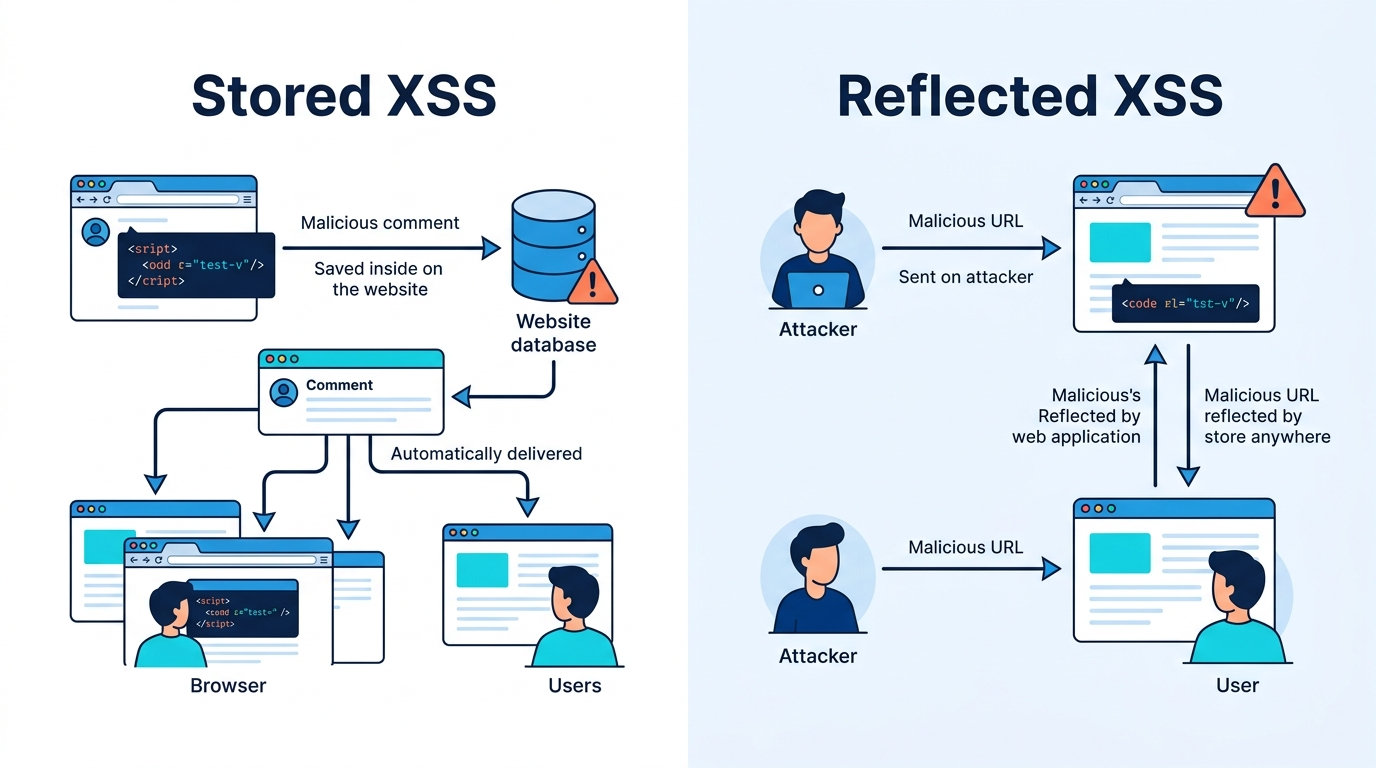

Learn the stored vs reflected XSS difference, how persistence changes attack impact, and why stored XSS creates greater security risks than reflected XSS.
Stored XSS is an attack where the code is permanently saved on a server. Anyone who visits a certain page will trigger it. Reflected XSS, on the other hand, is embedded in a single link and only runs when someone clicks that specific, malicious URL. That’s the core difference.
The impact is huge. A stored flaw can hit every user of a page automatically. A reflected one needs active trickery. This is why bug bounties pay more for stored XSS, often over $1,000, while a basic reflected flaw might be rated lower. Curious about the real-world tactics hackers use? Keep reading.
XSS Risk Snapshot
- Persistence dictates impact: Stored XSS alters the server’s state, creating a permanent attack vector. Reflected XSS is transient, living and dying within one request cycle.
- Exploitation friction defines severity: Stored XSS is “fire and forget,” automatically affecting visitors. Reflected XSS requires social engineering, making it harder to weaponize at scale.
- Modern defenses have shifted the landscape: Browser protections like HttpOnly cookies and default SameSite policies have significantly reduced the practical damage of Reflected XSS, while Stored XSS remains a critical, high-severity find.
Understanding Stored XSS and Why It’s More Dangerous
Stored XSS is when an attacker’s script gets saved on your server. It’s written into a database field, a user profile, a comment, a product review. That malicious code is now a permanent part of your application’s data.
Then, it waits. Whenever any user loads that page, the server sends the poisoned content and the victim’s browser executes the script. We’ve cleaned up these messes in comment systems that failed to escape HTML, and in rich text editors that trusted user input too much. Even with frameworks like React, a single misstep with dangerously Set Inner HTML can let it in. Teams handling user-generated content often rely on proper JavaScript XSS prevention patterns to reduce unsafe rendering paths before attackers can abuse them.
The real threat is its automatic reach. One injection can hit every user who visits that page. That’s why it gets a higher severity rating in bug bounty programs. Its blast radius is massive. It doesn’t need a phishing campaign; it just sits there, infecting people.
Understanding Reflected XSS and Why It’s Often Underestimated
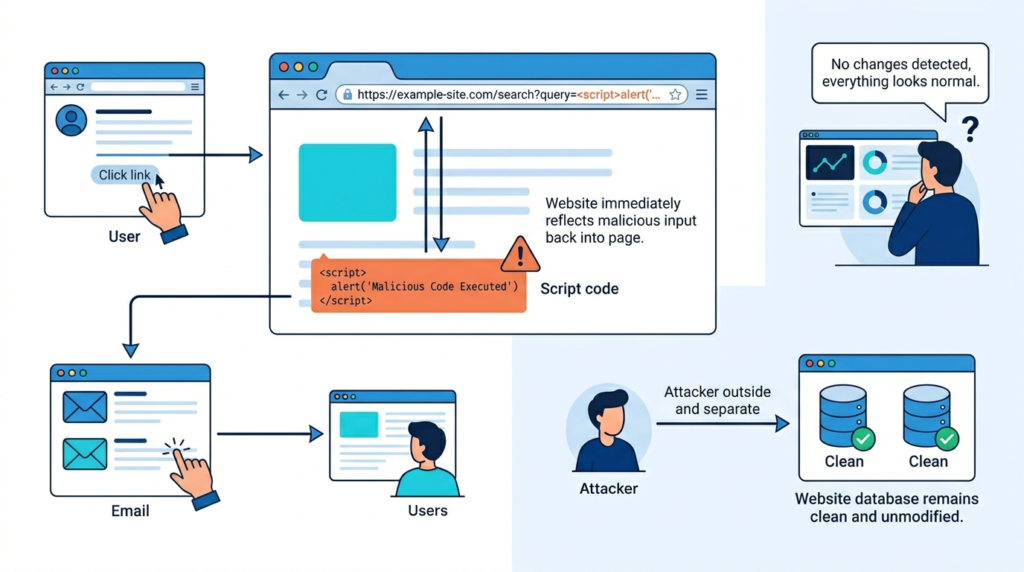
Reflected XSS is a one-shot attack. The malicious script isn’t stored; it’s embedded in a URL parameter or form input. When the victim clicks that link, the server reflects the script back un-sanitized in its response, and the browser runs it. A search page echoing your query is the classic example: search?q=<script>alert(1)</script>.
We often see it underestimated. Modern defenses have raised the bar: HttpOnly cookies, SameSite=Lax policies, and Content Security Policies (CSP) make stealing data harder. Frameworks do better output encoding now. So while the vulnerability might exist, exploiting it alone often yields little. Attackers usually need to chain it with another flaw, like CSRF, for real impact.
As noted by acunetix.com
“According to OWASP, XSS is the second most prevalent issue in the OWASP Top 10 and is found in around two-thirds of all applications” – acunetix.com
That’s why in bug bounties, a pure Reflected XSS with no clear path to data theft frequently gets marked as “Informative” or low severity. The friction is high, and the payoff is often limited.
Stored vs Reflected XSS: The Data-Flow Difference
The core difference is in the data flow. Stored XSS alters the application’s state. The attacker’s script travels from them, to your server or database, and then out to every victim’s browser. It becomes stored content, a permanent part of your backend. Every time that page loads, it pulls from that poisoned source.
Reflected XSS is stateless. The flow is simpler: a malicious link, a victim’s request, the server reflecting the script back in its response, and then execution. The payload is just a passenger in a single HTTP exchange. When that request ends, the attack is over. It doesn’t touch your disk or change a database row; it’s a fleeting reflection.
| Aspect | Stored XSS | Reflected XSS |
| Payload Location | Saved in database or server-side storage | Sent through URL or request |
| Persistence | Remains active until removed | Exists for one request only |
| Victim Interaction | Automatic when page loads | Requires victim to click or submit |
| Impact Scope | Can affect many users at scale | Usually limited to targeted victims |
This transient nature is why its impact is often lower. The attacker must guide each victim to the trap. A stored attack is different: you set the trap once, and your own application springs it on everyone who comes after.
Why Traditional <script> Payloads Rarely Work Today
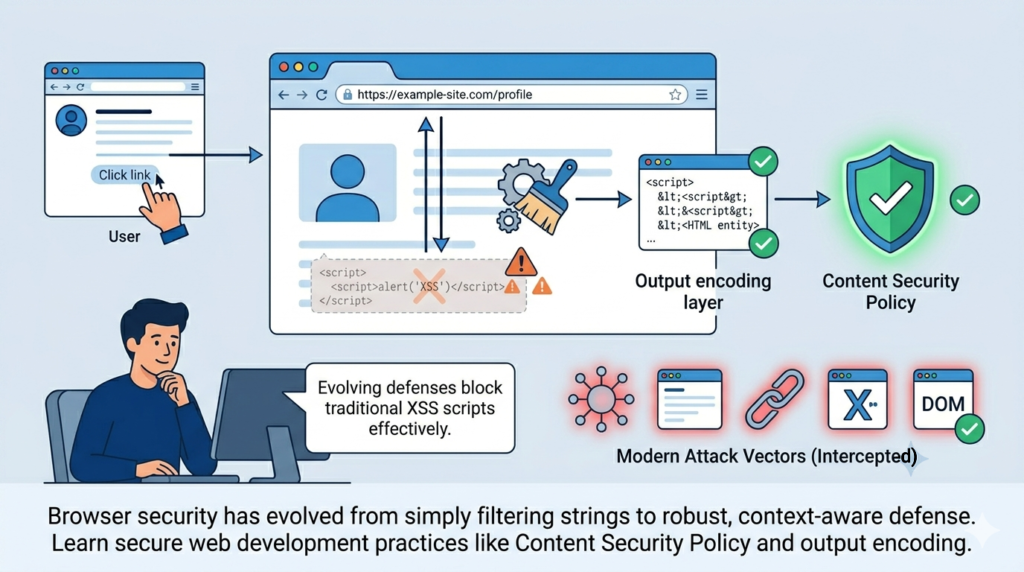
The classic <script>alert(1)</script> payload is mostly useless now. Modern defenses block it. A strict Content Security Policy (CSP) that prohibits unsafe-inline will stop it. Libraries like DOMPurify sanitize it on input. Web Application Firewalls (WAFs) have entire signature databases for these basic tags.
Research from USENIX Security 25 shows
“31,432 distinct clobbering markups across five different techniques, showing that attackers have moved far beyond simple </script> tags to exploit complex client-side behaviors” – USENIX Security 25
The real game is about context and bypass. Attackers now use vectors that match the specific injection point. We see them use an onerror handler inside a broken <img> tag, or an onload attribute within an <svg> element. They break out of HTML attributes with payloads like “><svg onload=…>.
It’s all about tailoring. Is the injection inside an HTML attribute, a JavaScript string, or a URL parameter? Each context needs a different escape sequence, a different trick to fool the parser into executing code where it should only see data. The payloads are smaller, smarter, and designed to slip through the exact cracks of a specific application.
How Security Researchers Actually Hunt XSS Vulnerabilities
Credits: NahamSec
Finding XSS vulnerabilities is a methodical process, not random guessing. Professional testers start by mapping the attack surface. We use tools like Burp Suite to catalog every parameter, header, and field where the application accepts user input.
Next, we test for reflection. Does our input get echoed back in the HTML, inside a JavaScript string, or even in an HTTP header? We analyze the Content Security Policy (CSP) for weak directives or whitelisted domains we can abuse. We experiment with WAF bypasses using encoded payloads and alternative syntax.
Out-of-band tools like Burp Collaborator are essential. They prove blind XSS, where a payload executes but you can’t see the alert directly. The craft has its own language: a “polyglot” payload works in multiple contexts, “DOM clobbering” manipulates client-side execution, and “Self-XSS” is a term for an injection that only works in your own browser. It’s about reverse-engineering how the application parses data, not just finding a single bug.
Building a Real Defense: Secure Coding Practices
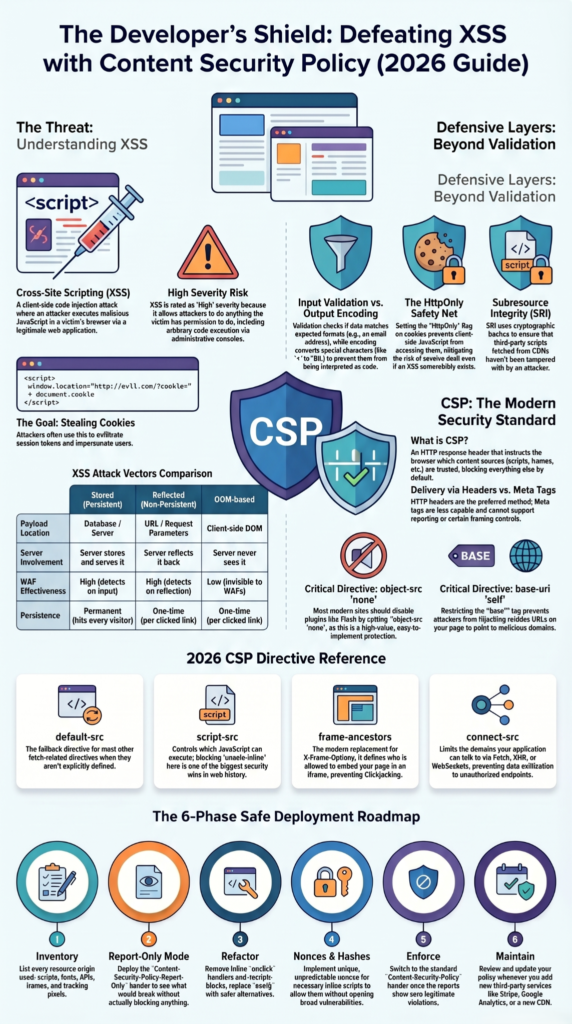
Defense starts with secure coding, woven into the development lifecycle from the beginning. It’s a fundamental shift in how we build.
Our first and strongest line is context-aware output encoding. Don’t just escape HTML. You need to encode for the specific context where the data will be used. Putting user input into an HTML element? Use HTML entity encoding. Into a JavaScript string? Apply Unicode escapes. Into a URL? Use percent-encoding. This treats the data as plain text every time, never as executable code.
We pair that with strict input validation. Use allow-lists, not block-lists. Define the exact characters permitted for a username, an email, a search field. In legacy applications, consistent PHP XSS prevention measures around output encoding and sanitization still play a major role in limiting injection opportunities.
The architecture matters too. Implement a strict Content Security Policy (CSP). A good CSP can stop attacks even if a bug slips past your other checks. Modern enterprise stacks using ASP.NET Core XSS prevention techniques also combine CSP enforcement with automatic output encoding to reduce exploitable rendering behavior.
These practices form a layered defense:
- Encode on output, validate on input.
- Use a strict CSP and proper cookie flags.
- Sanitize rich HTML with trusted libraries.
They aren’t revolutionary. They’re the essential habits that build resilient applications.
FAQs
How does persistent XSS spread across multiple users?
Persistent XSS stores malicious script injection inside server databases, automatically affecting visitors through comment fields, profile pages, and shared content.
Why does reflected XSS depend on crafted links?
Reflected XSS uses crafted links and URL-reflected XSS techniques, requiring victim interaction before JavaScript execution triggers inside browsers.
Can DOM-based XSS bypass server-side security checks?
DOM-based XSS manipulates client-side scripts directly, reducing XSS server involvement and sometimes bypassing traditional input sanitization defenses completely.
What makes XSS payload fuzzing useful during security testing?
XSS payload fuzzing helps penetration testing teams discover hidden XSS attack vectors, weak output encoding, and overlooked application behaviors faster.
How do secure cookies reduce XSS session hijacking risks?
HttpOnly and secure cookie settings block browser access to session tokens, reducing credential theft, cookie theft, and phishing attack exposure.
XSS Attacks Start With Unsafe Input
Stored XSS creates bigger problems because attacks spread across users and sessions without extra interaction. Reflected XSS is still risky, but usually depends on a single action. The reality is simple: weak data handling creates openings attackers will use.
Protecting applications requires layered defenses, not a single fix. Teams that want to strengthen secure development practices, improve application visibility, and reduce exploitable risks can explore the Secure Coding Practices Bootcamp.
References
- https://www.acunetix.com/blog/articles/persistent-xss/
- https://jackfromeast.github.io/assets/DOMinoEffect_Slides.pdf