


Secure coding training teaches developers how to write safe code. They learn to find, prevent, and fix software bugs early. The best programs offer hands-on practice and focus on specific coding languages. They also include code reviews and security testing. Teams can follow proven standards by using materials from OWASP, Oracle, and the PCI Security Standards Council.
Secure Coding Practices helps companies build developer skills and address common code risks. This guide shows you how to pick the right training, build useful skills, and track progress. Read on to learn how to create an effective program.
Secure Coding Training: Building Safer Code, One Skill at a Time
Secure coding training teaches developers how to spot security flaws. It shows them how to follow best practices and build safer apps at every stage of development. Key takeaways include:
- Good secure coding training has three key parts. It teaches basic security rules. It includes hands-on practice. It also tests learners using real flaws.
- Resources from OWASP, Java courses, and PCI DSS rules give developers a solid base.
- Organizations should not just track completion rates. Instead, they should measure actual skills, fewer security bugs, and better code quality.
Why Does Secure Coding Training Matter?
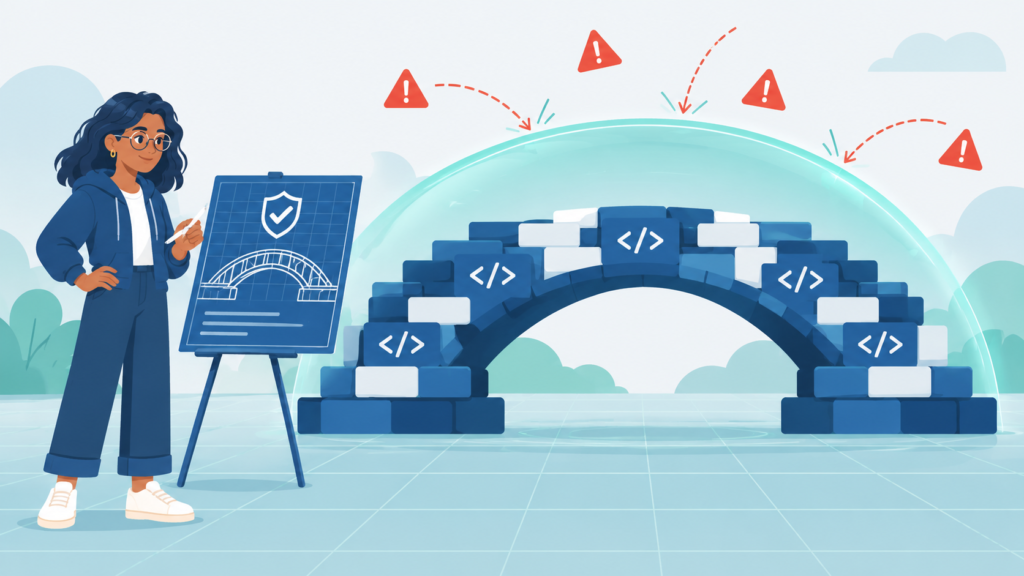
Secure coding training teaches developers how to spot security flaws. It also helps them fix these issues before releasing their software. Our bootcamp focuses on hands-on skills. Developers learn how to spot unsafe code and protect private data.
These facts show why developers need security skills at every stage of building software. Training also helps teams follow standards like PCI DSS Requirement 6.2.2. Under this rule, relevant staff must complete security training at least once every 12 months.
Research from ACM indicates
“Only 39.6% of respondents stated that they had been offered training relevant to software security or privacy in their coding environment.” –ACM Digital Library
Our training covers common risks such as:
- SQL injection and XSS.
- Weak authentication and authorization.
- Insecure session management.
- Exposed credentials and sensitive data.
- Unsafe third-party dependencies.
- Poor error handling and configuration.
Training cannot prevent every breach. We treat it as one part of a broader security program that includes patching and regular testing.
What Should Secure Coding Training Programs Include?
Effective secure coding training programs combine technical lessons with exercises based on real development tasks. We help developers understand security flaws. We also help them fix unsafe code and test their solutions. Organizations should also incorporate secure coding practices and practical techniques into their training to help developers apply security principles consistently.
OWASP provides useful guidance for building course content.
| Program component | Learning objective | Example activity |
| Security foundations | Recognize common risks | Trace untrusted input |
| Secure implementation | Apply defensive coding | Fix unsafe SQL queries |
| Language-specific training | Understand coding risks | Review Java deserialization |
| Secure code review | Identify weaknesses | Examine vulnerable code |
| Security testing | Verify fixes | Write regression tests |
| Continuous learning | Reinforce skills | Complete follow-up labs |
Training should match each person’s job. Developers need skills to build software. Architects and technical leads need to understand secure design and threat modeling.
In our bootcamp, we use a practical learning sequence:
- Cover application security fundamentals.
- Teach secure coding techniques.
- Practice with relevant programming languages.
- Review vulnerable code.
- Assess practical skills.
- Schedule follow-up exercises.
This approach helps teams apply security knowledge throughout the development lifecycle.
Secure Coding Practices and Techniques
Secure coding practices help developers protect applications from attacks. These attacks often target user input, access controls, and sensitive data. In our hands-on training sessions, we refer to the OWASP Cheat Sheet Series.
| Security area | What developers should learn | Practical exercise |
| Input validation | Check data formats and lengths | Reject malformed input |
| SQL injection | Use parameterized queries | Fix dynamic SQL |
| XSS prevention | Encode output correctly | Test untrusted content |
| Authentication | Protect login processes | Review authentication flows |
| Authorization | Enforce access permissions | Test unauthorized access |
| Session management | Secure session IDs and cookies | Test session expiration |
| Cryptography | Apply established methods | Review data storage |
| Secrets management | Protect passwords and API keys | Find exposed credentials |
Each technique targets a different risk. In our bootcamp, developers track unsafe data. They find weak security controls and explain how an attack could happen. Next, they fix the problem and test the solution. This hands-on practice shows us whether learners can write secure code in real projects.
What Do OWASP Secure Coding Courses Teach?
OWASP offers practical resources that help developers understand application vulnerabilities and learn how to prevent them. Its materials range from introductory lessons to hands-on security challenges. OWASP secure coding courses help developers strengthen their application security knowledge through structured learning and practical exercises.
Several resources work well in secure coding training:
| OWASP resource | Main purpose | Best application |
| Application Security Curriculum | Structured security education | Foundational learning |
| Secure Coding Dojo | Vulnerability recognition | Team exercises |
| WebGoat | Vulnerable Java application | Java security labs |
| Juice Shop | Web security challenges | Practical exercises |
| Cheat Sheet Series | Defensive coding guidance | Daily development |
| ASVS | Security requirements and verification | Application assessment |
| Code Review Guide | Finding source code weaknesses | Reviewer education |
In our bootcamp, we encourage learners to combine these resources. They can study core concepts, practise with WebGoat or Juice Shop, then apply the Cheat Sheet Series to their own code.
For a deeper assessment framework, OWASP ASVS 5.0.0, released in May 2025, provides technical security requirements for applications and web services. We can use these requirements to shape learning objectives and measure progress.
Which Java Secure Coding Courses Should Developers Choose?
Java developers need to understand how APIs, frameworks, and libraries can introduce security risks. Our Java secure coding courses focus on practical skills for technologies such as Spring Boot, JDBC, Hibernate, and JPA. Developers should also understand secure implementation through established Java security practices.
A useful course should cover:
| Module | Learning objective |
| SQL injection prevention | Write parameterized JDBC and ORM queries |
| Spring Boot security | Configure authentication and authorization |
| Java deserialization | Handle untrusted objects safely |
| Input validation | Check data before processing |
| Web application security | Protect sessions and endpoints |
| Cryptography | Use established security libraries |
| Secure code review | Spot vulnerable Java patterns |
| Security testing | Verify fixes with automated and manual tests |
One common misconception we address is that Hibernate or JPA automatically prevents SQL injection. Unsafe JPQL or HQL queries can still expose applications to attacks. Untrusted Java deserialization also needs careful handling.
For practical learning, consider Pluralsight, OWASP WebGoat, SecureFlag, and Veracode. We advise checking each current syllabus against your team’s Java versions, frameworks, and libraries before choosing.
What Are the Essential Java Secure Coding Guidelines?
Credits: Java
Java secure coding guidelines help developers make safer choices during development, testing, and code reviews. We use Oracle’s Java SE guidelines and OWASP resources as technical references.
Our training emphasizes six practical habits:
- Use parameterized queries. Avoid building SQL with untrusted input. Use prepared statements and parameter binding.
- Avoid untrusted deserialization. Treat serialized input as a security boundary and prefer safer data formats.
- Apply serialization filters. Restrict which classes Java applications can deserialize.
- Protect sensitive information. Keep passwords, tokens, and personal data out of logs and unnecessary serialized content.
- Check authorization. Verify access to each protected resource, even for authenticated users.
- Make guidelines testable. Include requirements in code reviews and security tests.
We encourage developers to check current Java and framework documentation before applying older recommendations. Secure coding practices should match the runtime and technologies a team actually uses.
What Do PCI DSS Secure Coding Courses Cover?
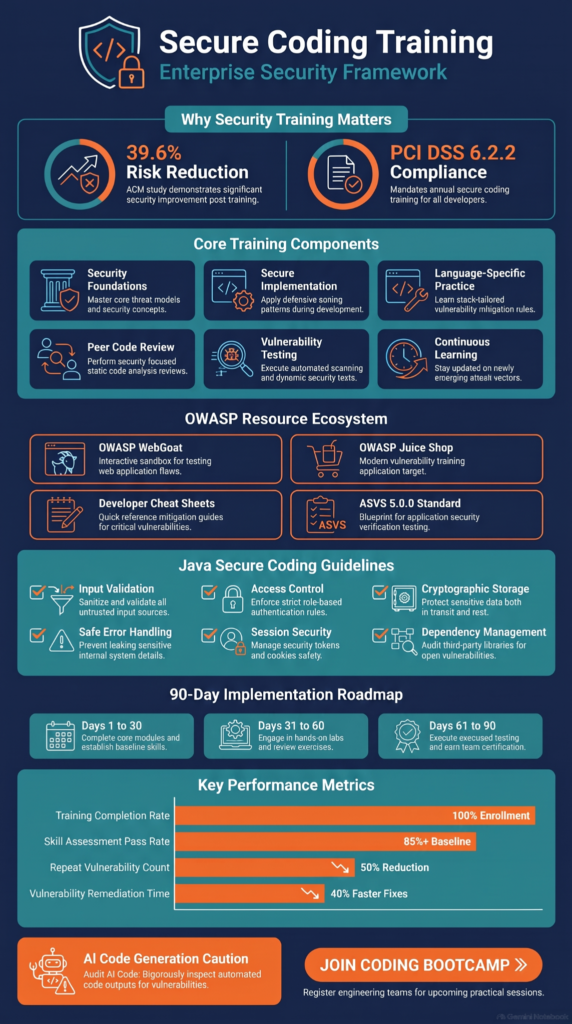
PCI DSS secure coding courses help developers protect payment applications and cardholder data. Under Requirement 6.2.2, personnel developing or maintaining bespoke and custom software must receive role-relevant security training at least once every 12 months.
Training should cover:
- Security risks related to employees’ roles and programming languages.
- Secure software design and coding techniques.
- Security testing tools, where applicable.
As noted by IEEE Xplore
“Annual, or even less frequent, training suggests a compliance approach that does not add value.” –IEEE Xplore
In our bootcamp, we emphasize that general cybersecurity awareness isn’t enough for developers building payment systems. Java developers, for example, need training that addresses risks in their own technology stack.
PCI DSS developer training and code reviews
Requirement 6.2.2 covers training, while Requirement 6.2.3 addresses security reviews before software release. Organizations should retain evidence of both.
We recommend courses with practical exercises in payment security, access controls, injection prevention, and vulnerability remediation. A certificate alone does not prove compliance. Teams must meet all applicable requirements.
What Should Secure Code Review Courses Teach?
Secure code review courses teach developers to spot weaknesses before release. The OWASP Code Review Guide offers a useful starting point for examining application security.
A structured review should cover:
| Review stage | Required activity |
| Understand functionality | Identify sensitive operations |
| Find entry points | Locate user input and API requests |
| Trace data flow | Follow information through the code |
| Examine controls | Check validation and permissions |
| Assess impact | Consider what an attacker could do |
| Recommend fixes | Address the underlying weakness |
| Verify corrections | Review changes and regression tests |
Manual and automated code review training
Manual reviews help developers understand application logic, while automated tools add another layer of testing:
- SAST: Examines source code without running it.
- DAST: Tests a running application.
- SCA: Checks dependencies for known vulnerabilities.
In our training, learners practise finding issues such as SQL injection, XSS, hardcoded credentials, and broken access controls. They explain the risks, recommend fixes, and test their changes. This helps us assess practical skills beyond multiple-choice answers.
Which Secure Coding Learning Platforms Are Worth Considering?
Secure coding learning platforms offer courses, hands-on labs, and assessments to support developer training. The best fit depends on your team’s technologies, goals, and reporting needs.
| Platform | Learning approach | Suitable application |
| Secure Code Warrior | Interactive challenges | Enterprise training |
| SecureFlag | Vulnerability remediation exercises | Technical learning |
| Veracode | Security courses and exercises | Application security |
| OWASP Secure Coding Dojo | Vulnerability recognition | Code review practice |
| OWASP WebGoat | Guided Java exercises | Java security |
| OWASP Juice Shop | Web security challenges | Practical learning |
| Pluralsight | Structured technical courses | Individual education |
How to choose a secure coding learning platform
When evaluating providers, we look for:
- Technology coverage: Support for the team’s languages and frameworks.
- Practical exercises: Opportunities to find, fix, and test vulnerabilities.
- Role-based learning: Paths for developers, architects, and reviewers.
- Assessment and reporting: Useful evidence of skills and progress.
- Updated content: Coverage of current frameworks and risks.
We recommend piloting a platform with a small developer group first. Their results can show whether the exercises transfer to real coding tasks. Training should fit into the development lifecycle, not sit apart from it.
How Can Organizations Implement and Measure Secure Coding Training?
A 90-day plan gives organizations a practical way to introduce secure coding training. We use three phases to build skills and track progress.
First 30 days: Establish the baseline
Review team skills, technology stacks, and recurring vulnerabilities. Assess existing knowledge and record initial results.
Days 31-60: Build practical skills
Introduce exercises based on identified weaknesses. Developers can practise secure coding, review code, and use pull request checklists. Java teams might focus on Spring Boot security, JDBC queries, and deserialization.
Days 61-90: Measure and reinforce learning
Use follow-up assessments, code reviews, and vulnerability trends to identify areas needing more practice.
Which training metrics should organizations track?
| Metric | What it measures |
| Course completion | Participation |
| Assessment improvement | Knowledge gained |
| Repeat vulnerability rate | Recurring weaknesses |
| Remediation time | Speed of fixes |
| Security regression coverage | Fix verification |
| Training currency | Required training intervals |
No single metric tells the whole story. We recommend combining assessment results, code review findings, remediation data, and production security trends. More reported vulnerabilities may reflect better detection, not poorer code quality.
How Should Organizations Address AI-Generated Code Security?
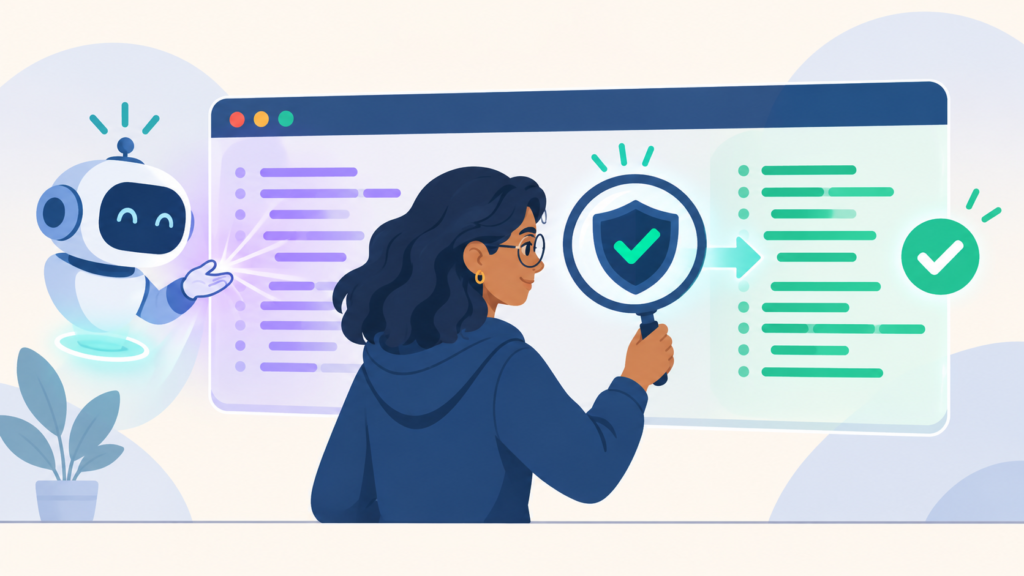
More engineering teams now use coding assistants. Because of this, teaching developers about the security of AI-generated code is becoming vital.
Generated code can have many flaws. It might include unsafe dependencies or wrong authorization checks. It can also handle inputs poorly and use outdated patterns. Developers need to review AI code with the same strict security standards they use for code written by hand.
A practical training module should cover:
- Reviewing AI-generated code before accepting suggestions.
- Checking third-party dependencies.
- Identifying unsafe database queries.
- Verifying authentication and authorization logic.
- Keeping secrets out of AI prompts.
- Testing generated code for security weaknesses.
- Applying normal code review procedures to AI-assisted changes.
Organizations should also establish clear rules about approved AI tools and the source code or sensitive information employees may submit.
We recommend treating AI coding assistants as development tools, not security reviewers. Their output still needs human inspection, testing, and verification before it enters production.
FAQs
What should developers look for in secure coding training programs?
Developers should look for secure coding training that offers hands-on practice. Good programs teach lessons for specific coding languages. They also include practical code reviews and exercises based on real security threats.
Are secure coding courses suitable for beginners?
Yes. Beginner secure coding courses cover several key topics. Students learn about common vulnerabilities, input validation, and user authentication. They also cover best practices for writing safe code. Students learn these skills through practical examples and step-by-step exercises.
Which secure coding certification should developers pursue?
Developers should earn a secure coding certification. This credential should test their skills in application security and threat modeling. It should also cover how to prevent vulnerabilities and build secure software.
Should development teams choose online courses or secure coding workshops?
Online courses let developers learn at their own speed. In contrast, secure coding workshops offer exercises guided by an instructor, group learning, and useful feedback.
How can organizations measure the effectiveness of secure coding training?
Organizations can measure how well training works by tracking a few key results. They can watch vulnerability rates and look at code review findings. They can also check assessment scores, fix times, and gains in application security.
Build Secure Coding Skills Your Developers Can Use Every Day
When you build software under real deadlines, security advice is hard to use if it does not match your code. That gap matters.
The Secure Coding Practices Bootcamp helps close this gap. It is a two-day, hands-on course. You will learn about the OWASP Top 10, input validation, secure authentication, encryption, and safe dependency use. You can join live online or in person. You will practice in real coding labs. You also get session replays, cheatsheets, and a certificate. Explore the Secure Coding Practices Bootcamp and join here to help your developers build practical security skills they can apply to everyday development work.
References
- “IEEE Xplore Document 10649741.” IEEE Xplore. Accessed November 12, 2026.
- “Proceedings of the 2024 ACM/IEEE 4th International Workshop on Engineering and Cybersecurity of Critical Systems (EnCyCriS) and 2024 IEEE/ACM Second International Workshop on Software Vulnerability.” ACM Digital Library, August 26, 2024. Accessed November 12, 2026.
Related articles
- https://securecodingpractices.com/secure-coding-training-programs/
- https://securecodingpractices.com/secure-coding-practices-and-techniques/
- https://securecodingpractices.com/owasp-secure-coding-courses/
- https://securecodingpractices.com/java-secure-coding-courses/
- https://securecodingpractices.com/java-secure-coding-guidelines/
- https://securecodingpractices.com/pci-dss-secure-coding-courses/
- https://securecodingpractices.com/secure-code-review-courses/
- https://securecodingpractices.com/secure-coding-learning-platforms/