
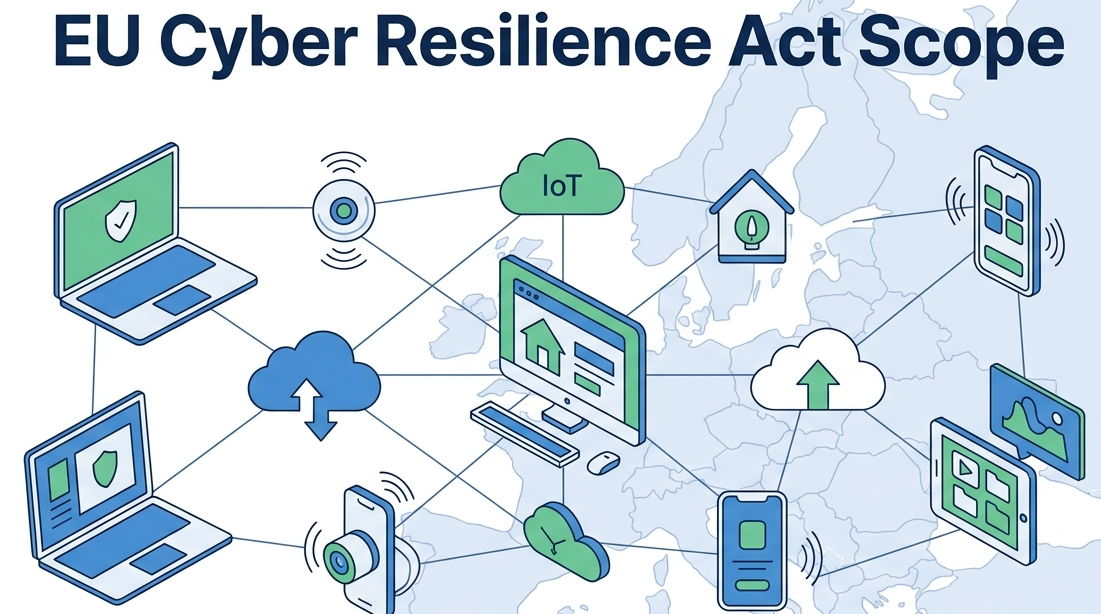

If you sell any connected hardware or software in Europe, the scope of EU Cyber Resilience Act (CRA) applies to you. It’s a sweeping new law that mandates cybersecurity for virtually every product with digital elements placed on the EU market. This isn’t just for tech giants, it covers everything from smart lightbulbs to mobile apps.
The clock is ticking, with key requirements kicking in September 2026. Understanding the scope is your first, non-negotiable step toward compliance. Keep reading to decode what this regulation truly means for your business and your products.
What the EU Cyber Resilience Act Covers
Before diving into the details, here’s what you need to know about the EU Cyber Resilience Act at a glance:
- The CRA’s scope is intentionally broad, covering nearly all connected products not already under specific sector laws.
- Products are split into four risk tiers, which dictate the rigor of the required compliance process.
- The law imposes strict, tiered reporting deadlines for vulnerabilities, starting with a 24-hour alert to authorities.
What Products Fall Under The Scope Of EU Cyber Resilience Act
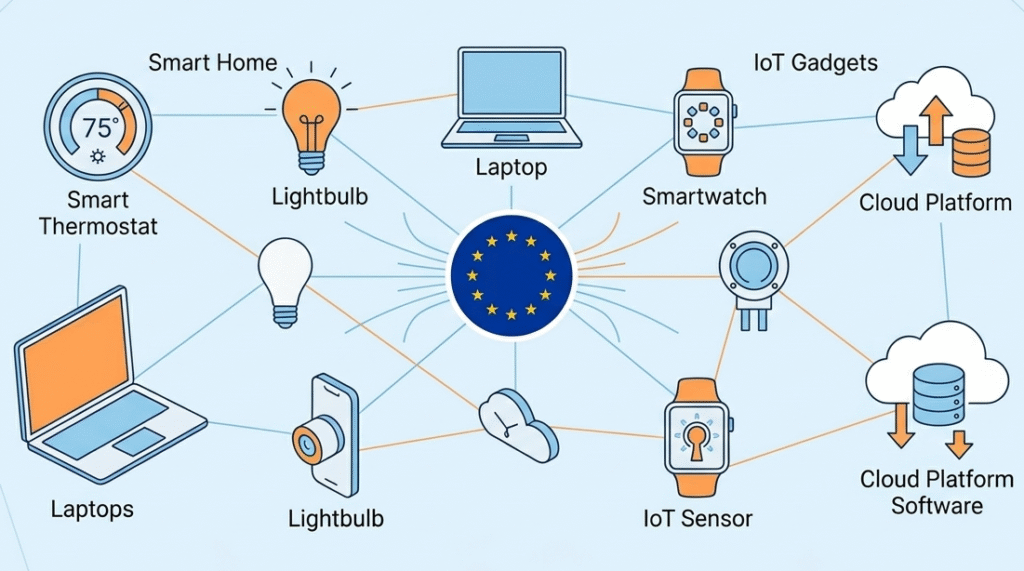
Look around your office or home. The laptop you’re using, the router blinking in the corner, the app on your phone. If it can connect to a network, directly or indirectly, it’s likely a “product with digital elements” (PDE) under the CRA. The European Commission cast a wide net, aiming to cover the entire digital ecosystem.
This includes both hardware with embedded software and stand-alone software, even “remote data processing solutions,” which is essentially a formal term for many cloud services.
The goal is horizontal regulation, a baseline of security across all sectors. They estimate it covers nearly 100% of connected digital products not already governed by stricter, vertical rules. Think of it as a new floor for cybersecurity, one that every market participant must build upon.
- Connected consumer devices (IoT gadgets, smart home gear).
- Commercial software and applications.
- Network-connectable hardware components.
Which Sectors and Product Categories Are Exempt from the CRA?
Credits: Hogan Lovells
The CRA isn’t universal. It leaves specific sectors alone where EU law already sets cybersecurity rules, which avoids a regulatory mess for companies. We see this as practical, but it means you need a checklist.
“The Cyber Resilience Act (CRA) is an EU regulation that sets mandatory cybersecurity requirements for hardware and software with digital elements throughout their lifecycle, from design to end-of-life. […] it is a product-centric law that makes secure‑by‑design and secure‑by‑default engineering a legal duty for manufacturers and publishers placing products on the EU market.” – Cycode
For example, medical devices stay under the MDR. Your car’s software has its own automotive rules. Non-commercial open-source projects get a pass, though commercial involvement can change that. These aren’t loopholes; they’re clear carve-outs.
- Medical devices (EU MDR)
- Motor vehicles and aviation
- Defense and national security products
- Non-commercial open-source software
How Are Products Classified Under the CRA Risk Tiers?
Risk determines the rules. The CRA uses four tiers: Default, Important Class I & II, and Critical. This classification is crucial, it sets your entire compliance path. In our training, we stress that most products (think smart toys or basic apps) will be “Default,” allowing for internal self-assessment.
But as risk climbs, so does scrutiny. Important Class II items, like firewalls, need a third-party check. Critical products, including hardware security modules, face the toughest certification. Getting the tier wrong means wasted effort or dangerous shortcuts.
Manufacturers must think about how the product connects to the internet, what data it uses, and what could happen if it gets hacked. The correct risk tier helps companies know what testing, security checks, and documents they need before selling the product in the EU.
Here’s a simple overview of the CRA risk tiers:
| CRA Risk Tier | Example Products | Conformity Assessment Path |
| Default | Smart toys, photo editing apps, most consumer IoT. | Internal self-assessment. |
| Important Class I | Password managers, identity management systems. | Internal self-assessment. |
| Important Class II | Firewalls, industrial routers, hypervisors. | Third-party assessment by a notified body. |
| Critical | Smart meter gateways, hardware security modules. | Most rigorous third-party certification. |
What Are the Mandatory Reporting Timelines for Vulnerabilities?
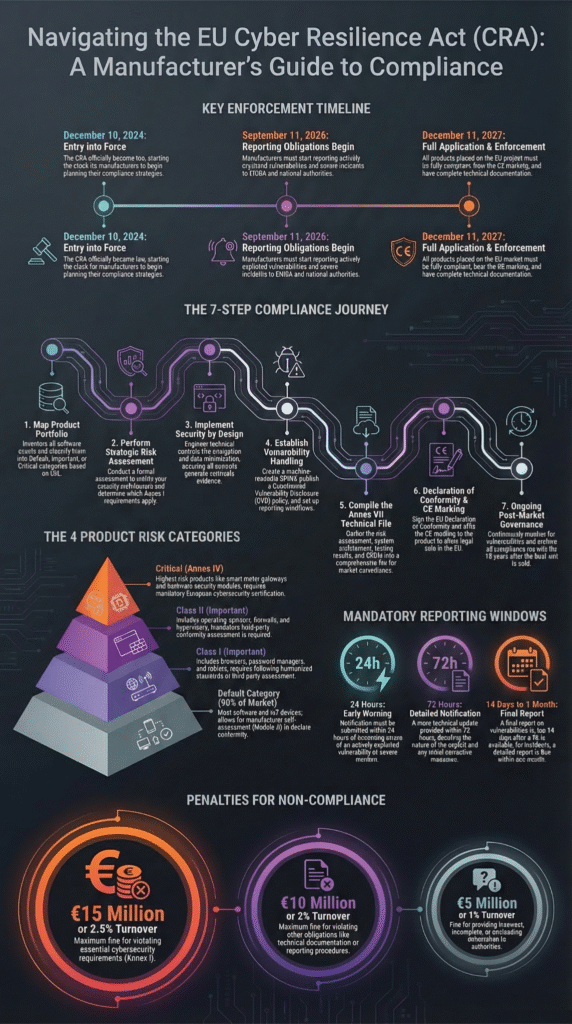
An infographic detailing the scope of the EU Cyber Resilience Act and key enforcement timelines for compliance.
This is where the “resilience” part gets real. The CRA mandates a strict, multi-stage reporting cascade when a severe incident or actively exploited vulnerability is discovered. It’s not a suggestion, it’s a countdown.
“The CRA proposal covers all products with digital elements put on the market which can be connected to a device or a network, including their building blocks (i.e., hardware and software), and encompassing also solutions provided in a Software as a Service (SaaS) fashion if they qualify as remote [data processing].” – European-Cyber-Resilience-Act
The moment you become aware, a 24-hour timer starts for an early warning to ENISA and your national CSIRT team. It’s a heads-up, a flare shot into the night.
Then you have 72 hours to submit a detailed initial report. Fourteen days after that, a final analysis is due, complete with root cause and remediation steps. This timeline transforms vulnerability management from an internal IT task into a regulatory obligation with legal weight. For teams used to quieter fixes, this transparency will feel jarring.
The reporting obligation itself goes live on September 11, 2026, making your incident response plan a cornerstone of compliance.
What Are the Penalties for Non-Compliance with the CRA?
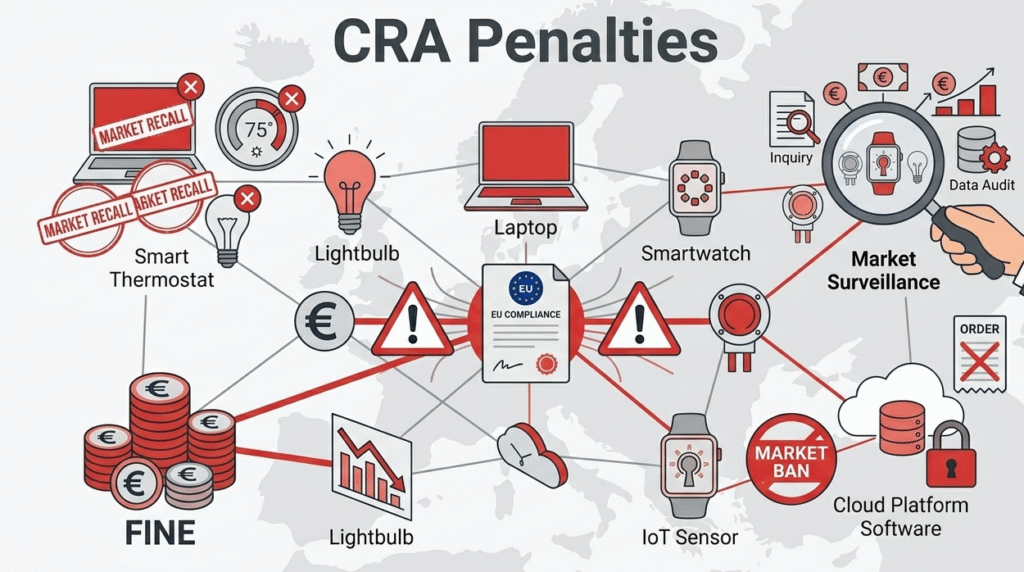
The EU is serious. Non-compliance isn’t a slap on the wrist, it’s a existential business threat. Financial penalties can reach up to €15 million or 2.5% of your total global annual turnover, whichever is higher. For failing to report a severe incident, fines can hit €10 million or 2% of turnover. The numbers are designed to get the attention of any C-suite.
Beyond fines, market surveillance authorities have powerful tools. They can order a product recall, demand its withdrawal from the EU market, or impose a complete sales ban. Imagine the logistics, the reputational damage, the shareholder questions.
The law entered force in December 2024, with a long runway for a reason. The full weight of enforcement arrives in December 2027, but the core requirements start in 2026. Preparing now isn’t early, it’s essential.
FAQ
Which digital products are covered by the Cyber Resilience Act?
The Cyber Resilience Act (CRA) covers products with digital features sold in the European Union. This includes connected hardware and software, IoT devices, smart home products, apps, cloud-based services, and remote data processing systems.
Products with embedded software, such as smart vehicles or connected industrial devices, may also fall under the CRA. The goal is to improve cybersecurity standards across digital products used in the EU.
How are products classified under the EU Cyber Resilience Act risk tiers?
The CRA places products into four risk tiers: Default, Important Class I, Important Class II, and Critical. The tier depends on the product’s purpose, cybersecurity risk, and possible impact if attacked.
Most low-risk products can go through self-assessment. Higher-risk products, such as firewalls or industrial IoT systems, need stricter testing and third-party checks before they can enter the EU market.
What are the main reporting rules for serious security incidents?
Companies must report serious cybersecurity incidents affecting products with digital features. They must notify the proper EU cybersecurity authorities quickly after discovering the issue.
The first alert is usually required within 24 hours. A more detailed report follows within 72 hours, along with updates on fixes and recovery steps. These rules help reduce cyber risks and protect users from data breaches or attacks.
Are any products or sectors exempt from the EU Cyber Resilience Act?
Yes. Some products are excluded because they already follow other EU laws. This includes certain medical devices, defense products, and some automotive systems.
Non-commercial open-source software may also be exempt in some cases. These exemptions help avoid overlap with existing cybersecurity regulations while still protecting most digital products sold in the EU.
Navigating the New Digital Landscape
The Cyber Resilience Act fundamentally changes manufacturing in Europe. It’s not about a checkmark; it’s about embedding security into your product’s entire life. Exemptions are narrow, risk tiers are strict, and reporting clocks are ticking. Your first move is an honest audit to see where your products fit.
The real work begins now. Every connected product you sell is a direct statement of your security posture.
Building that resilient foundation requires skilled developers. Our hands-on Secure Coding Bootcamp trains teams in practical, essential security practices. Equip your team to build securely from the start.