


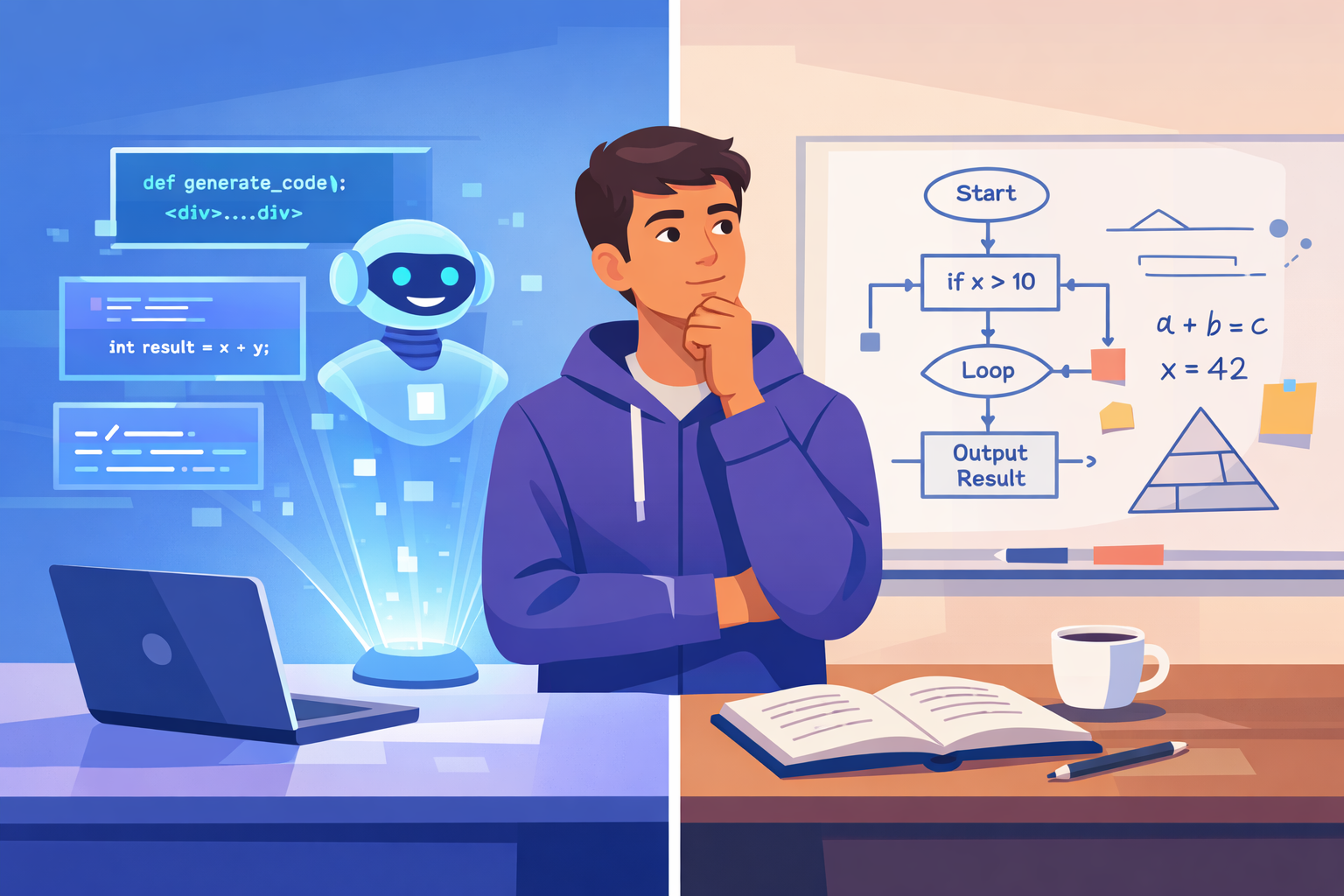
Is learning to code from scratch still necessary? Yes. AI tools move fast, but they don’t reason, debug with context, or take responsibility when things fail. The U.S. Bureau of Labor Statistics still projects strong growth for software developers, and that demand favors people who understand how systems actually work.
We use AI daily in our own projects, and the pattern is clear: stronger fundamentals lead to better outcomes and fewer surprises. AI works best as a helper, not a substitute for judgment. If you’re unsure whether starting from zero is worth it, keep reading.
Why Learning to Code From Scratch Still Matters
- The core concepts of programming are still valuable. AI makes a skilled developer faster; it doesn’t replace the need for understanding.
- Learn secure coding practices early. It’s the best defense against the subtle, costly vulnerabilities AI can sometimes generate.
- The strongest approach in 2026 is hybrid. Combine a solid foundation in the basics with AI-assisted development for the best return on your time.
Is Learning to Code from Scratch till Necessary in The AI Era?
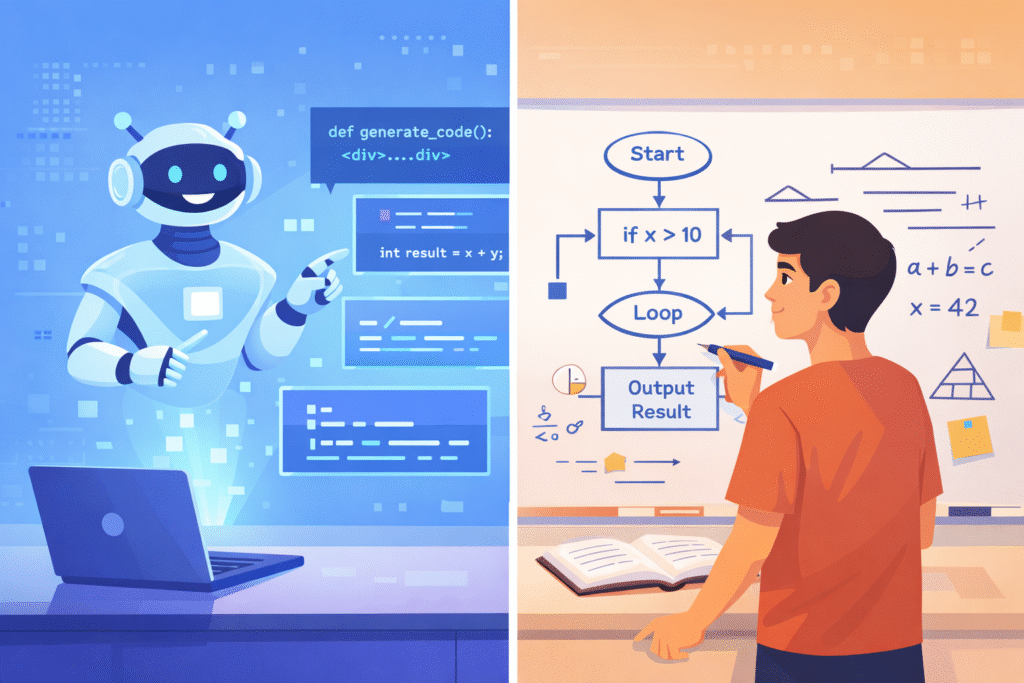
Yes, even heading into 2026, fundamentals still matter. AI code generators are only as strong as the person guiding them. Lean on them too heavily and understanding starts to fade.
Some research has even suggested noticeable drops in concept mastery when developers outsource too much thinking. The tools are useful, but they don’t replace judgment. As noted by the Mimo Blog,
“Learning to code is about agency in a world dominated by algorithms. When you understand how systems work, you can question them, modify them, and shape them.” – Henry Ameseder
We use tools like Copilot in our training labs, and they’re impressive. They generate scaffolding fast, refactor messy sections, and help beginners get moving. That lower barrier is real. You don’t need to memorize every syntax rule anymore, and that’s a good thing for new learners.
But the hard parts haven’t changed. Developers still need to:
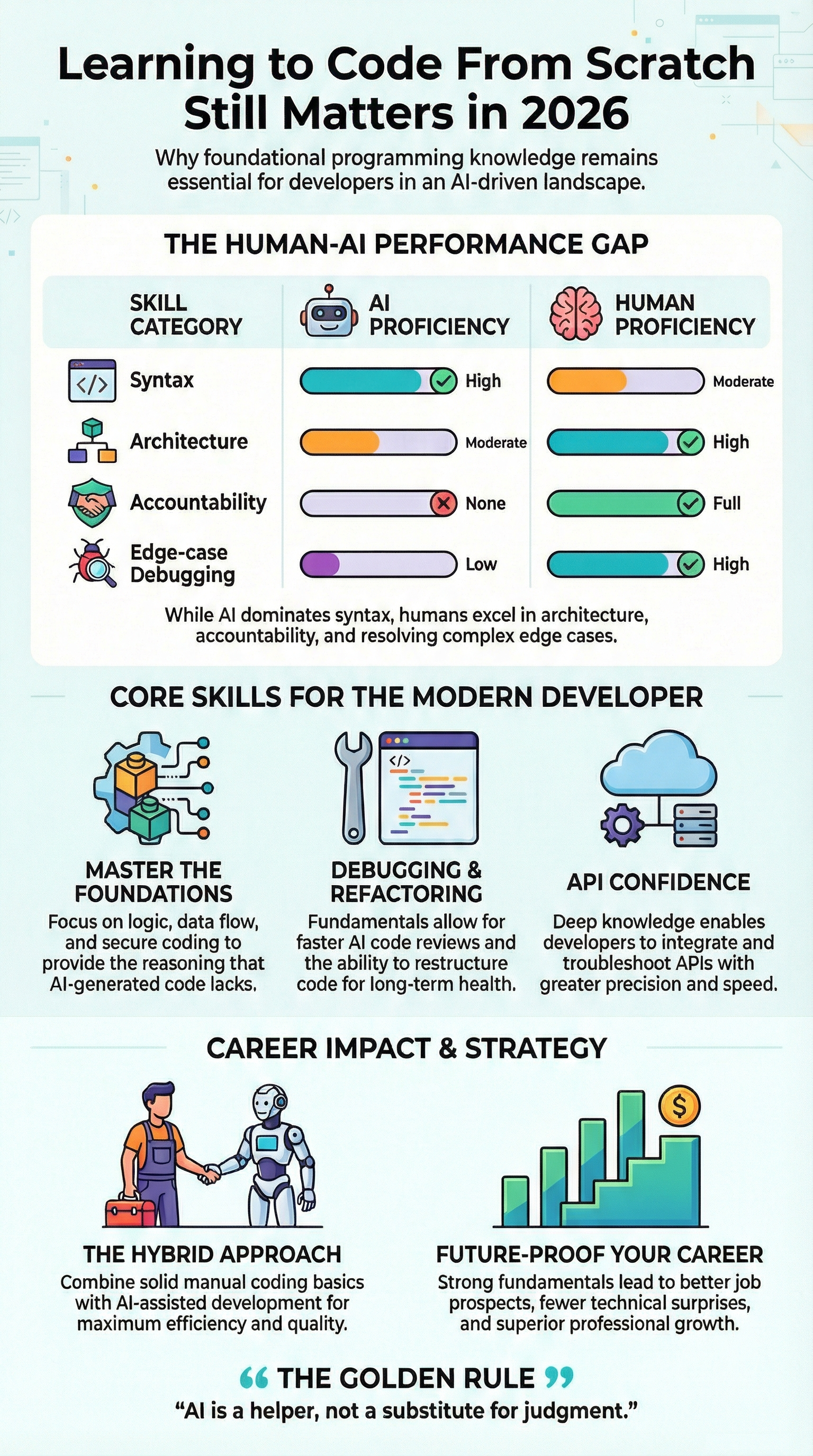
- Build logic from first principles
- Debug when outputs make no sense
- Understand data flow and structure
- Apply secure coding practices early
We’ve seen this firsthand. In one internal project, AI generated working auth code that quietly exposed session tokens. It ran fine, but it wasn’t safe. Without fundamentals, especially around secure development, that kind of risk slips through fast.
What Can AI Coding Tools Actually do in 2026?
Credits: Web Dev Simplified
They’re powerful, but the limits show up fast. AI tools in 2026 can generate clean code blocks, explain syntax, and spin up a project scaffold in seconds. That speed is useful in training labs. But they still struggle with context, ownership, and holding a full system in mind.
In our bootcamp, we use AI daily for repetitive work. It helps students draft tests, autocomplete logic, and clean up rough code. Adoption is real, and the productivity bump is obvious. Still, the tradeoff shows up when learners lean on it too early. This shift is closely tied to what new skills do modern programmers need as AI reshapes expectations
The friction appears during real problem-solving. Complex debugging, performance tuning, and distributed systems still require human reasoning. We remind students that computational thinking comes from practice, not better prompts.
Here’s how we frame it:
| Task Type | AI Strength | Human Strength |
| Syntax Generation | High | Moderate |
| Architecture Design | Moderate | High |
| Accountability | None | Full |
| Edge-Case Debugging | Low | High |
We’ve watched AI loop on a bug while a student traces the logic manually in minutes. That gap is where fundamentals prove their value.
What do Programming Fundamentals Actually Give You?
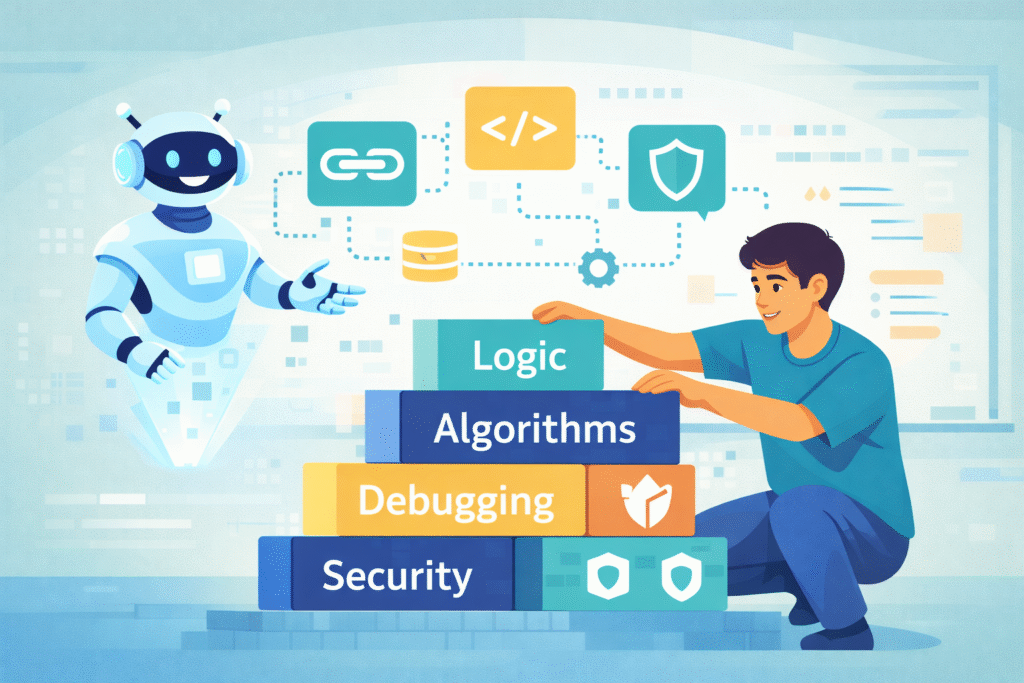
Fundamentals build the mental models that help developers adapt. Variables, loops, and basic algorithms train pattern recognition. That structure makes it easier to read code from anyone, or anything, and break problems into clear steps. The Blog highlights,
“While AI tools can automate or accelerate tasks, they can’t replace the structured thinking, analytical reasoning, and creative problem-solving that define true technical expertise. For software developers and aspiring technologists, this distinction matters more than ever: real progress still depends on strong foundations, thoughtful training, and the ability to adapt intelligently to new tools.” – City St George’s Short Courses
Many beginners start with Python, and we often recommend it in our early modules. It’s flexible, widely used, and beginner-friendly. But the real value isn’t the language. It’s learning how logic flows and how systems behave under pressure.
We see a clear shift in students over time. Early on, they ask AI to generate answers. Later, they ask better questions. Instead of “write this,” they compare options and trade-offs. That shift improves outcomes fast, especially in team projects.
The benefits show up in practical ways:
- Faster review of AI-generated code
- Stronger testing and debugging habits
- Better refactoring instincts
- More confidence with APIs and databases
We also teach secure coding practices from day one. Authentication, input validation, and error handling often break first in AI-generated code. Building that security mindset early helps students avoid risks before they ship anything real.
Is It Still Worth Starting From Scratch in 2026?
For long-term careers, starting from the ground up still pays off. The early effort feels heavy, but the payoff lasts. We’ve watched the entry-level market tighten as AI absorbs routine tasks. Syntax alone no longer makes someone stand out.
Hiring conversations reflect that shift. Teams now look for signals beyond surface knowledge. In our placement support, the candidates who move forward usually show:
- Clear code review skills
- Comfort with secure coding practices
- Basic system design thinking
- Familiarity with Git and simple CI/CD flows
This reflects the broader impact on developer skills & careers as hiring signals evolve beyond basic coding ability.
We also see a pattern with new learners. Those who rely only on AI often get stuck debugging the very code it generated. Students who practice logic and algorithms break out of that loop faster because they can trace problems manually.
No-code tools still have value. They’re great for quick prototypes and early validation. But once customization or scale comes into play, limits show up. That’s where deeper literacy matters. Owning the fundamentals gives developers more control when projects grow or shift direction.
How to Learn Coding Effectively in 2026 With AI
Start simple and build depth. We usually tell beginners to stick with one language early on. Python works well for backend work, automation, and data tasks. The key is consistency, not chasing trends.
Next comes the real foundation. Syntax fades, but thinking skills stay. Focus on:
- Control flow and problem-solving logic
- Core data structures and basic algorithms
- OOP and simple functional patterns
- Debugging from scratch with solid error handling
Projects make the learning stick. We encourage students to build small, useful tools first. Automate a task, create a basic API, or implement login flows. This is where secure coding practices start to matter, not later. These shifts also reflect how this changes the future of programming jobs as developers move toward hybrid AI workflows.
AI should support learning, not replace effort. Ask it to compare approaches, explain trade-offs, or walk through code step by step. In our cohorts, students who review every AI suggestion retain far more than those who copy outputs.
It also helps to learn the workflow early: Git, tests, and simple deployment pipelines. Those habits compound quickly.
FAQ
Is learning programming fundamentals still worth it in 2026?
Yes, learning programming fundamentals is still worth it in 2026. AI tools can speed up tasks, but they cannot replace deep understanding. When developers learn data structures basics, algorithms for beginners, and core software engineering principles, they adapt more easily.
These foundations improve programming problem solving and code reading comprehension, which remain essential as developer skills continue to evolve.
Do coding basics still matter with AI assisted development?
Yes, coding basics still matter even with AI assisted development. The AI code generation impact is real, but strong understanding still matters more than syntax memorization. Developers who practice logic building exercises and debugging from scratch can validate AI output more confidently.
This prevents overreliance and ensures natural language prompts coding stays grounded in real technical understanding.
Are no-code tools a real replacement for coding?
No-code tools can help with fast prototyping, but they rarely replace coding fully. Low-code platforms limits often appear when projects scale or require customization. Many teams face migration no-code pains when flexibility becomes critical.
Vendor lockin no-code and code ownership issues can also arise. Knowing frontend backend basics and database querying fundamentals makes transitions easier when tools stop fitting.
What skills matter most for future developers?
Future developers need strong computational thinking skills and solid fundamentals. Important areas include version control basics, API integration starter knowledge, and cybersecurity coding basics.
As AI human collaboration grows, code review skills and refactoring techniques become more valuable than pure syntax mastery. Understanding scalability concepts early helps developers build systems that last longer and perform better.
Can beginners rely fully on AI coding tools?
Beginners should not rely fully on AI coding tools. AI assisted development helps with speed, but it cannot replace real understanding. Skills like debugging from scratch and proper error handling still require practice.
Learners who skip fundamentals often face code ownership issues and liability from AI bugs later. A balanced junior developer roadmap combines programming fundamentals with modern tools for lasting independence.
Final Verdict: Should You Still Learn Coding From Scratch in 2026?
Learning to code from scratch still matters in 2026. AI raises the bar instead of removing it. We’ve seen faster output, but weaker judgment without fundamentals. Secure coding practices now sit at the baseline, not the edge. No-code tools and AI may lower entry barriers, yet ownership, risk, and long-term maintenance stay human.
Strong fundamentals give developers autonomy and adaptability across stacks and tools. If you want lasting leverage, build the base first, then layer AI on top. Start building your secure coding foundation with our hands-on bootcamp.
References
- https://mimo.org/blog/should-you-still-learn-to-code-in-ai-driven-world
- https://blogs.city.ac.uk/cityshortcourses/2025/10/10/why-programming-fundamentals-still-matter-in-the-age-of-ai/
Related Articles
