



Vibe coding helps junior developers move faster, but it can slow real skill growth when fundamentals stay weak. The term, popularized by Andrej Karpathy in 2025, describes using AI to generate code from simple prompts with minimal review. Many developers now rely on these tools, and learning habits are shifting.
We’ve seen this firsthand with students who ship quicker but struggle to explain what they built. It’s not just about productivity. The bigger issue is how this shapes confidence, depth, and long-term career paths. The trade-offs are real, keep reading to see what this means for growth.
Junior Developer Growth: What Vibe Coding Changes
- Vibe coding can make building prototypes 30–70% faster, but it often leads to weaker debugging skills and less practice thinking about system design.
- The job market in 2026 will value people who are good with AI and have a rock-solid grasp of core computer science concepts.
- Secure coding practices and human code reviews are still absolutely necessary for a junior developer to grow in a sustainable way.
What Is Vibe Coding and Why Does It Appeal to Juniors?
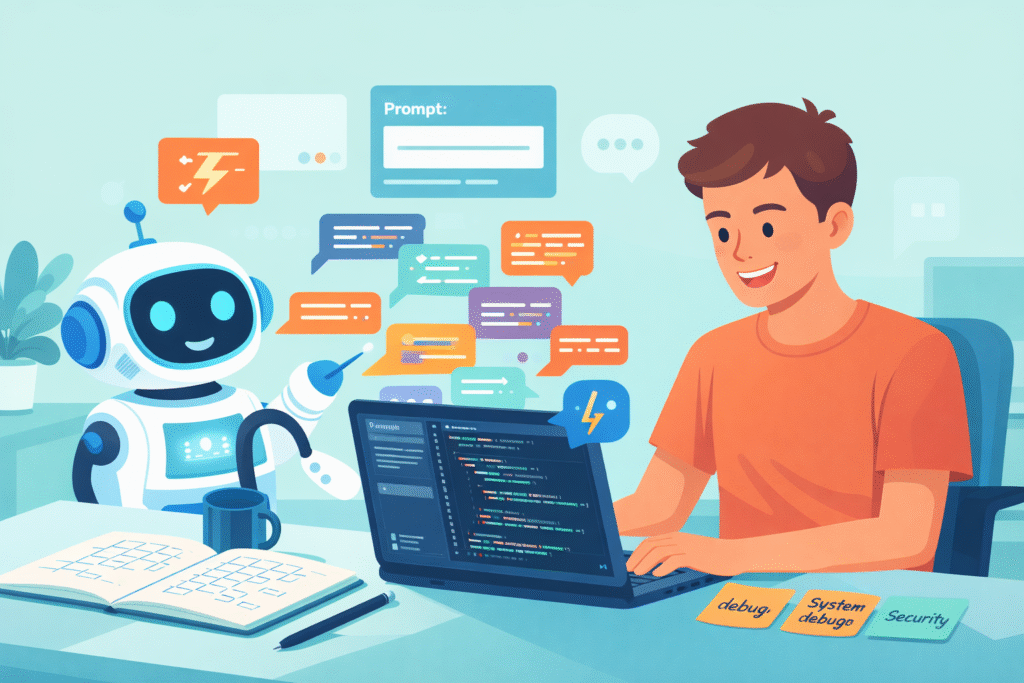
Vibe coding is a way of working where a developer tells an AI tool, like GitHub Copilot, Cursor, or ChatGPT, what they want to build. The tool writes the code, and the developer accepts it without really digging into how it’s structured or why it works.
The phrase itself has sparked curiosity, especially among newcomers wondering why the term “vibe” is used for coding and how it reflects a more instinct-driven workflow.
The appeal is obvious, especially for someone just starting out. Juniors can get past boring boilerplate code and frustrating syntax errors. They can go from a rough idea to a working prototype in hours instead of days. For many new coders, this AI help feels like a superpower.
In our bootcamp’s early tests with these tools, we saw junior students completing assigned features almost 40% faster during their project sprints. Reporting from MIT Technology Review backs this up, noting that AI code tools cut down dramatically on repetitive coding work.
This new workflow usually follows a simple, repeating pattern:
- The developer writes a plain-English prompt.
- The AI generates code.
- The developer makes small tweaks based on the output.
Speed becomes the main goal. Understanding becomes optional. That trade-off is the exact point where a developer’s growth either takes off or gets stuck.
Does Vibe Coding Accelerate Early Productivity?
Yes, it does. It lowers the barrier of tricky syntax and lets new developers build a “minimum viable product” very quickly. This is especially true in teams that are already using AI workflows, which are expected to be common by 2026.
We’ve had students in our secure development bootcamp use this approach to build full-stack features with React, Node.js, and Python in a fraction of the normal time. All the repetitive setup code vanishes.
Writing the small bits of code that connect different parts becomes instantaneous. For developers trying to understand how to start with AI-assisted coding, this early productivity boost is often the main entry point.
The Stack Overflow survey found that developers feel more productive when using AI tools, even if the actual measured output difference can be around 19%. The confidence boost is a real thing.
The short-term benefits are easy to see:
- Pull requests get submitted faster.
- They can iterate through the continuous integration and deployment pipeline more quickly.
- They spend less time stuck on trivial syntax mistakes.
Research from OpenAI suggests that AI-assisted coding can expose juniors to advanced programming patterns much earlier than the old, traditional learning path did.
But early output is not the same as long-term skill. That difference becomes more important every single year.
What Skills Do Juniors Risk Losing by Over-Relying on AI?

Over-relying on AI often shows up in the basics first. Juniors may ship code faster, but debugging, system design, and computational thinking tend to lag. Those gaps matter because they’re the skills that separate entry-level developers from mid-level engineers.
In our reviews, we’ve seen pull requests where the code runs locally but collapses in production. One student couldn’t explain why a simple loop kept hammering an external API. It worked with test data. Under real load, it broke fast. That’s usually a fundamentals issue, not a tooling issue. According to research,
“The largest gap in scores between the two groups was on debugging questions, suggesting that the ability to understand when code is incorrect and why it fails may be a particular area of concern if AI impedes coding development.” – Anthropic
Without strong grounding in data structures and logic, juniors struggle with:
- Spotting architectural flaws early
- Improving performance without guesswork
- Handling edge cases and null inputs
- Diagnosing failures after deployment
We treat secure coding as non-negotiable. Our training leans hard into root-cause thinking, not retries. Standards like OWASP, zero-trust models, and API security demand real understanding. AI can assist, but it can’t build the mental models earned by working through real failures.
How Does the Job Market Respond to AI-Dependent Juniors?
The market is starting to favor developers who mix AI fluency with strong fundamentals. This is raising the skill ceiling for entry-level jobs while reducing tolerance for shallow, surface-level knowledge. The long-term impact on developer skills and careers is already becoming visible in hiring patterns
The barriers for entry-level positions have gotten tighter. When we look at local tech job listings, they frequently ask for experience with cloud computing, modern DevOps practices, and tools like Docker and Kubernetes. Knowing how to use AI is not enough on its own anymore.
Here’s what the current landscape looks like:
| Aspect | Short-Term Benefit | Long-Term Risk |
| Speed | Faster prototypes | Creates an illusion of competence |
| Learning | Exposure to new patterns | Weakens architectural instincts |
| Career | Quick visibility in sprints | Risk of plateauing at a junior level |
| Tools | Easier onboarding | Can create a debilitating tool dependency |
The skills expected of senior developers now include mastering CI/CD pipelines, understanding identity and access management (IAM), awareness of web application firewalls and DDoS mitigation, and solid system design principles. In interviews, candidates are increasingly asked to explain their code’s logic without the help of a prompting tool.
We see this shift clearly in the industry. The ceiling for what’s possible is rising. But the floor, the basic level you need to get in, is disappearing.
What Is the Vibe Trap and Why Do Seniors Push Back?
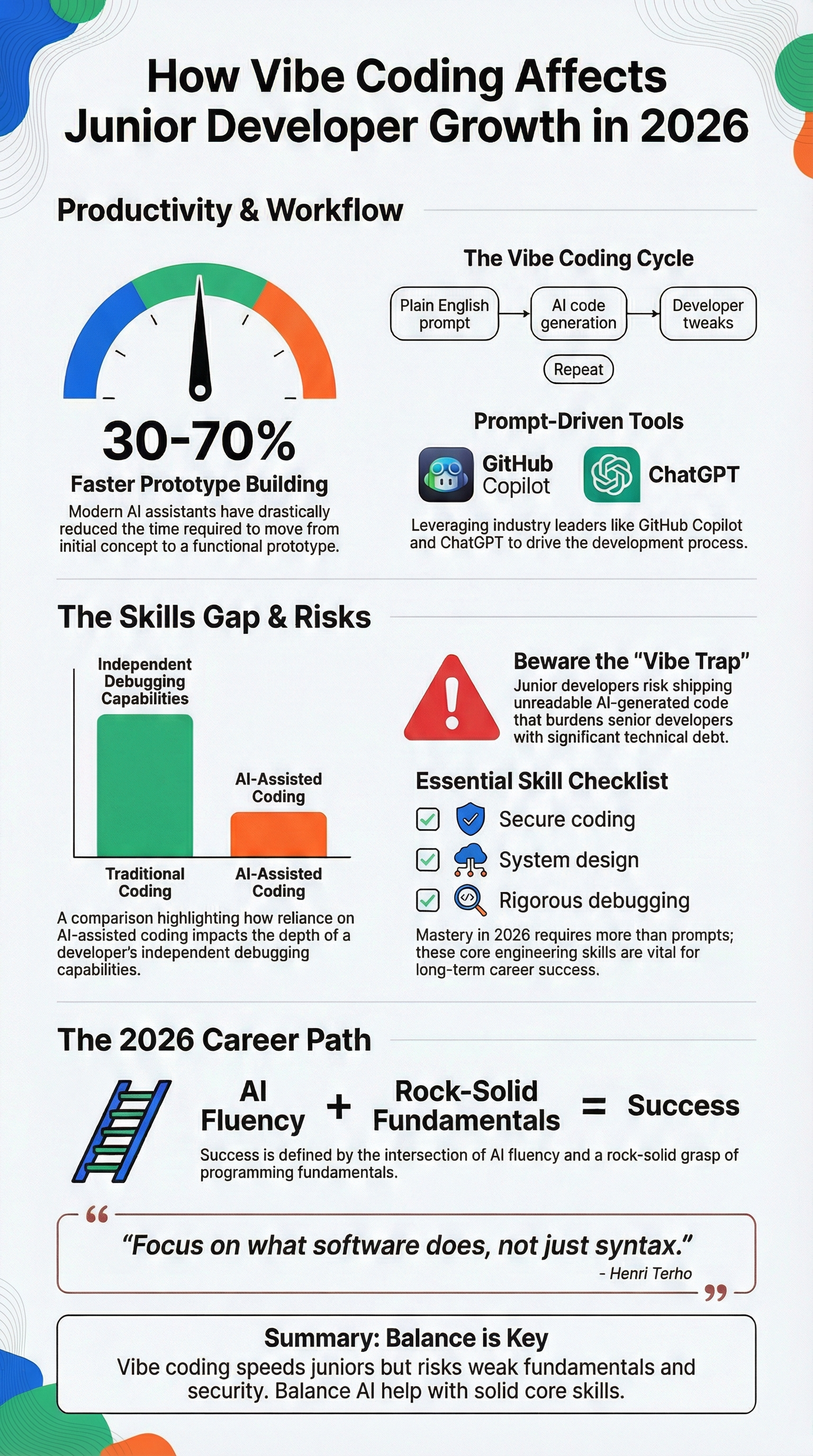
The “vibe trap” happens when a junior developer ships AI-generated code that they themselves cannot debug. This forces senior engineers to spend more time on reviews and increases the team’s technical debt.
We’ve experienced this directly with graduates entering the workforce. One junior used an AI to set up database logic that worked across both SQL and NoSQL databases. It worked perfectly with the small set of demo data. The indexing was wrong. The way it handled multiple users at once was broken.
Common complaints we hear from engineering managers and senior devs include:
- AI-generated system designs that don’t match real-world production limits.
- Missing handling for rare edge cases that an AI wouldn’t know about.
- Code that needs massive refactoring before it can be safely merged.
- Seniors spending hours untangling messy AI code.
Internal surveys across many engineering teams show debugging often consumes over 30% of developer time. When seniors have to clean up confusing AI-generated code, that percentage shoots up.
The burnout rants you see developers share online reflect a simple truth. Seniors want juniors who can troubleshoot production issues on their own. They don’t want juniors who escalate every single error back to an LLM for a solution.
Can Vibe Coding Be Used Safely for Junior Growth?
Credits: The Coding Koala
Yes, it can, if AI stays a tool, not a crutch. Juniors grow faster when they treat it as support, not a substitute. We often suggest keeping a good share of coding manual to build real mental models that stick.
Inside our secure development bootcamp, we teach a hybrid workflow rooted in secure coding practices. The goal isn’t speed alone. It’s building judgment that holds up in real environments. As noted by Eficode,
“If we no longer have to spend half our time fighting syntax or API docs, we can finally focus on what matters: What is this software supposed to do, and how do we know it’s doing it?” – Henri Terho
A simple starting framework:
- Write the core logic yourself before prompting AI
- Use AI to explain ideas or suggest refactors
- Review generated code line by line
- Practice debugging without AI safety nets
As confidence grows, the workflow can mature. Many students begin sketching architecture on paper, then use AI for repetitive parts. After that, they clean up structure, tighten performance, and write tests manually to think through edge cases.
This rhythm builds discipline without rejecting modern tools. We’ve seen it help developers stay sharp, avoid sloppy habits, and carry stronger instincts into secure, real-world engineering work.
FAQ
How does AI integration for coders reshape daily junior workflows?
AI integration for coders reshapes how juniors handle everyday work. They use generative AI workflows for glue code automation and then clean up messy AI code. This speeds delivery but can weaken computational thinking core skills if they skip fundamentals.
Strong vibe coding strategies require balancing automation with fundamentals DSA emphasis and real-world constraints coding. Juniors still need to reason through logic instead of accepting quick outputs.
Which modern programming skills matter most in 2026 job markets?
Job market realities 2026 show strong demand for modern programming skills. Employers expect cloud computing proficiency, containerization Docker Kubernetes, and CI/CD pipeline mastery.
Teams also want cybersecurity coding essentials, zero-trust security models, and API security best practices. Beyond tools, hiring managers value adaptability tech shifts, communication technical teams, and product thinking developers. Juniors who combine secure software development with multi-stack realities gain a clear edge.
Can vibe coding strategies weaken system design principles?
Vibe coding strategies can weaken system design principles when juniors rely on AI for structure. They may miss architectural flaw detection and skip mental models decomposition. Over time, they struggle with data structures algorithms modern trade-offs and performance optimization code decisions.
This creates computational debt avoidance problems. Developers still need practice with troubleshooting production issues, null input testing, and concurrency prod-scale reasoning to build durable skills.
What emerging developer abilities help juniors avoid computational debt?
Emerging developer abilities help juniors avoid computational debt and long-term rewrites. These include prompt engineering techniques, verification protocol skills, and strong AI collaboration interviews preparation. However, fundamentals AI era still matter.
Juniors need machine learning basics programmers understand and secure software development habits. Practicing autonomous code QA, anti-hallucination practices, and troubleshooting deployment fails builds resilience and supports maintainable codebases over time.
How can juniors build senior dev skills demand without overusing AI?
Juniors can build toward senior dev skills demand by strengthening fundamentals DSA emphasis and system design principles. Learning edge computing knowledge, IoT programming skills, and ethical hacking basics expands technical range.
They should also understand WAF DDoS mitigation and real troubleshooting production issues. Growth becomes clear through lived experience coding, handling technical edge cases devs face, and developing multi-language expertise across real systems.
Long-Term Impact of Vibe Coding on Junior Developer Growth
Vibe coding becomes a real growth multiplier only after fundamentals are solid. We see this across MSSP teams: AI fluency helps, but depth wins over time. The engineers who last can debug without tools, explain their decisions, and apply secure coding practices under pressure. AI will stay, but shortcuts fade fast in security-heavy work.
If you want skills that scale with AI, invest in the base first. Build stronger fundamentals with the Secure Coding Practices Bootcamp
References
- https://www.anthropic.com/research/AI-assistance-coding-skills
- https://www.eficode.com/blog/vibe-coding-when-ai-becomes-your-junior-developer
Related Articles
