


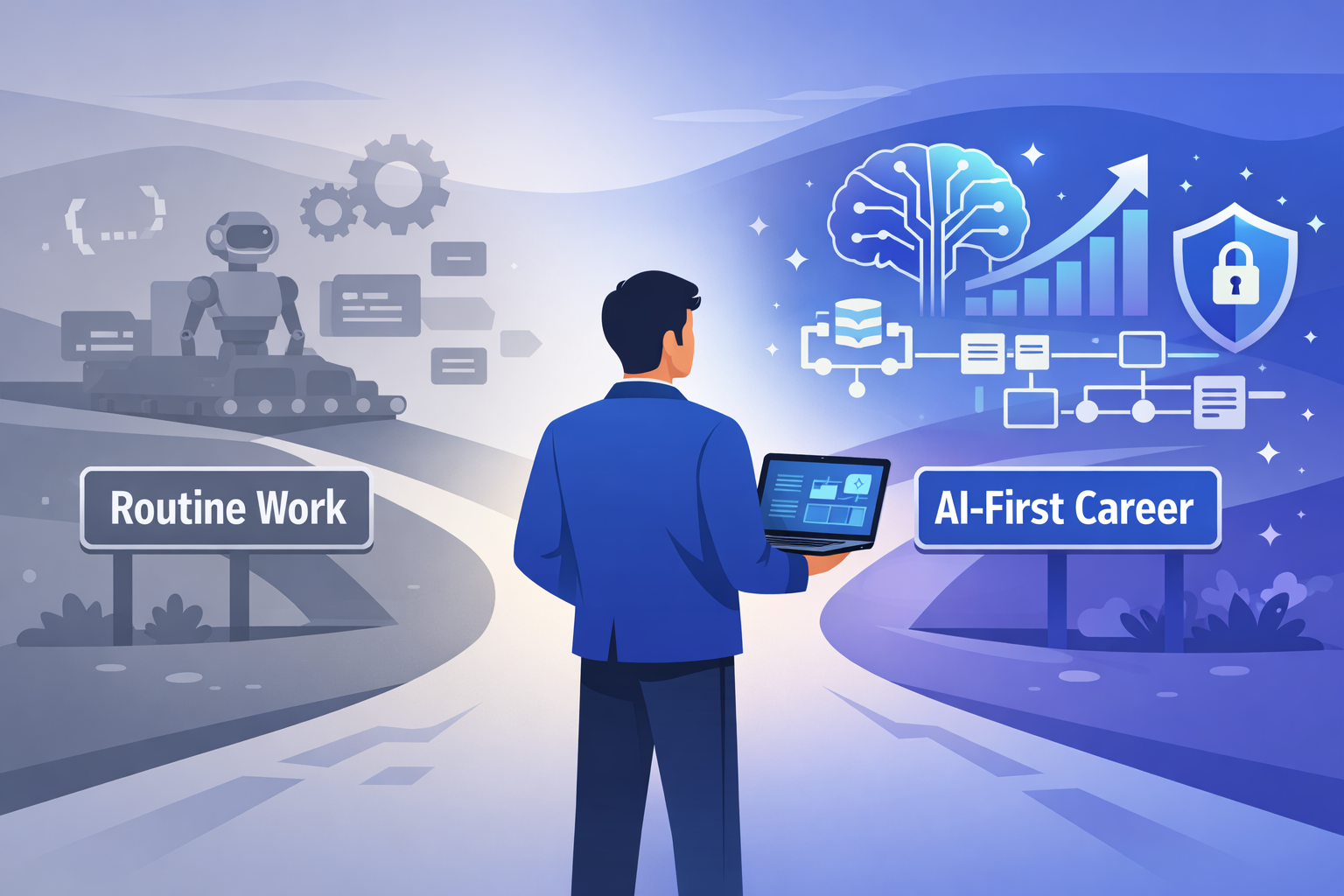
How to adapt your career for an AI-first world starts with a simple shift: stop competing with automation and start building around it. Many teams already use tools like Copilot and ChatGPT for routine thinking, and that trend is only growing. Some early-career roles are shrinking, especially in tech-adjacent work.
While demand moves toward oversight, system design, and judgment. We’re seeing employers reward people who guide AI, not just use it. The real change isn’t job loss, it’s job shape. If you want lasting leverage in the AI job market, keep reading for the strategy that works now.
AI Career Adaptation Takeaways
- AI is automating repetitive work first, creating a junior developer crunch and increasing demand for senior AI wranglers.
- The safest path blends AI literacy skills with human strengths like ethical judgment and systems thinking.
- Reinvention inside your current role often beats a risky pivot, especially when you prioritize Secure Coding Practices.
What does an AI-First World Actually Mean For Your Career?
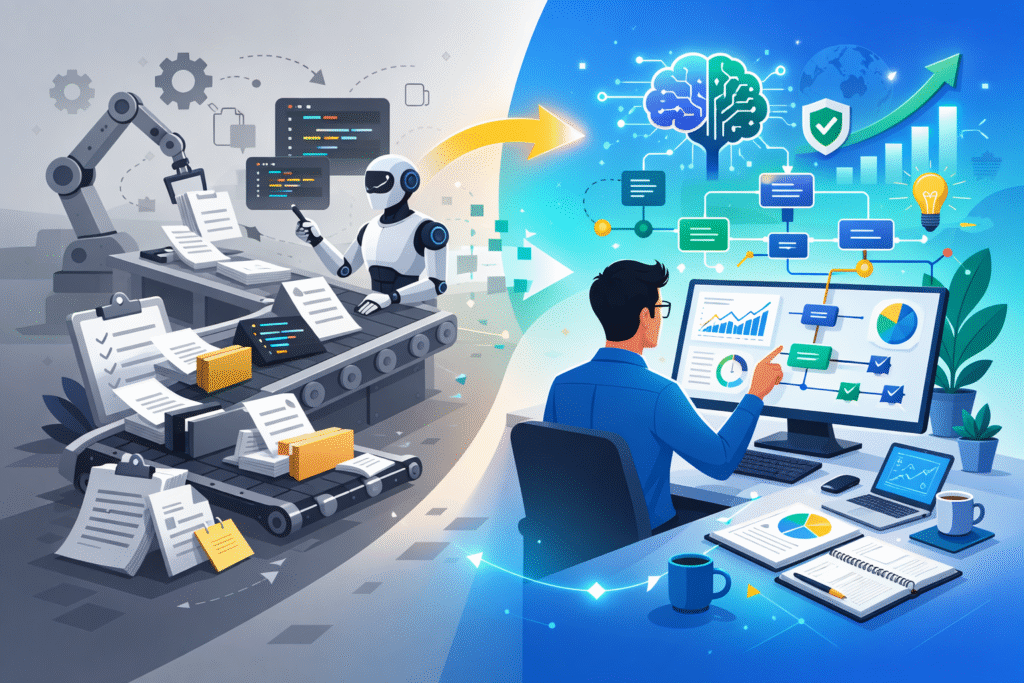
Writing boilerplate code, filling templated reports, sorting clean data, those are the first to go. Tools like Copilot already handle much of this. What stays behind are the parts that need human judgment: shaping systems, catching subtle risks, and deciding what “good” looks like. As noted by Boston Consulting Group,
“As AI transforms the workforce, the value of skills and tasks shifts. Work will be organized around lean, elite teams of specialized, well-paid employees. AI will take the toil out of work, enabling high performers to improve productivity and their own enjoyment on the job.” – Nicolas de Bellefonds and Amanda Luther
From what we’ve seen in our secure development training, teams don’t slow down when AI enters the workflow. They shift roles. A senior engineer might generate a draft fast, then spend real time on architecture and security tradeoffs. That’s where the hard thinking lives, especially when edge cases appear or trust is on the line.
In practice, the shift looks like this:
- Less manual execution, more review and validation
- Faster drafts, deeper design conversations
- Higher stakes around accuracy and safety
The tools matter, but control still sits with people. In AI-first teams, we’re not replaced, we’re responsible. Value moves from doing the task to guiding it, auditing outputs, and making the final call.
Is AI Replacing Jobs or Reshaping Them?
Credits: Don Georgevich
For now, most roles aren’t disappearing, they’re shifting shape. Entry-level jobs feel it first. We keep hearing about a “junior crunch” in tech.
If AI can handle boilerplate, some teams rethink how many juniors they hire. That pressure shows up most in starter roles where repetition used to be the training ground. This shift is already reshaping expectations around the career path for an AI-assisted coder, where guidance and oversight matter more than raw output.
Inside our secure development bootcamps, the pattern is clear. Teams lean harder on experienced builders once AI enters the stack. Someone still has to debug generated code, question odd outputs, and ship safely. We train people to treat AI like an eager intern, fast, helpful, but needing close review when the stakes are real.
What slows automation down:
- Work that needs judgment and context
- Security reviews and safe deployment
- Messy problems without clear templates
The safer side of the market is supervision. People who review AI output, reject weak code, and own the final release stay in demand. We’re not watching work vanish. We’re watching responsibility move upward.
How do You Assess Your Role’s AI Exposure?
A good first step is getting honest about how your week actually looks. Track what you do for a few days and notice the patterns.
When we run skills audits in our secure development training, many people are surprised by the results. A lot of time goes to repeatable work, standard queries, templated updates, predictable tickets.
Those are the areas AI improves fastest. The real impact becomes clearer when you examine the broader impact on developer skills and careers, especially how routine execution is giving way to judgment-heavy work.
Try a small test instead of guessing. Pick one repetitive task and run it through an AI tool. Then review it like you would in production. We tell our learners to watch two things closely: accuracy and cleanup time.
A simple way we frame it:
| Risk Level | Task Type | Examples | Career Implication |
| High Risk | Highly repetitive and rule-based | Boilerplate coding, templated reports, routine data entry | Strong risk of automation; requires fast upskilling |
| Medium Risk | Structured but still human-guided | Dashboards, survey analysis, reporting workflows | Safer short term but needs hybrid AI skills |
| Low Risk | Judgment-heavy and complex | System architecture, security decisions, strategy | Likely to grow in demand in AI-first teams |
If your strength sits in oversight and design, AI amplifies you. If not, it’s a signal to start shifting now.
What Skills Matter Most in an AI-First Economy?
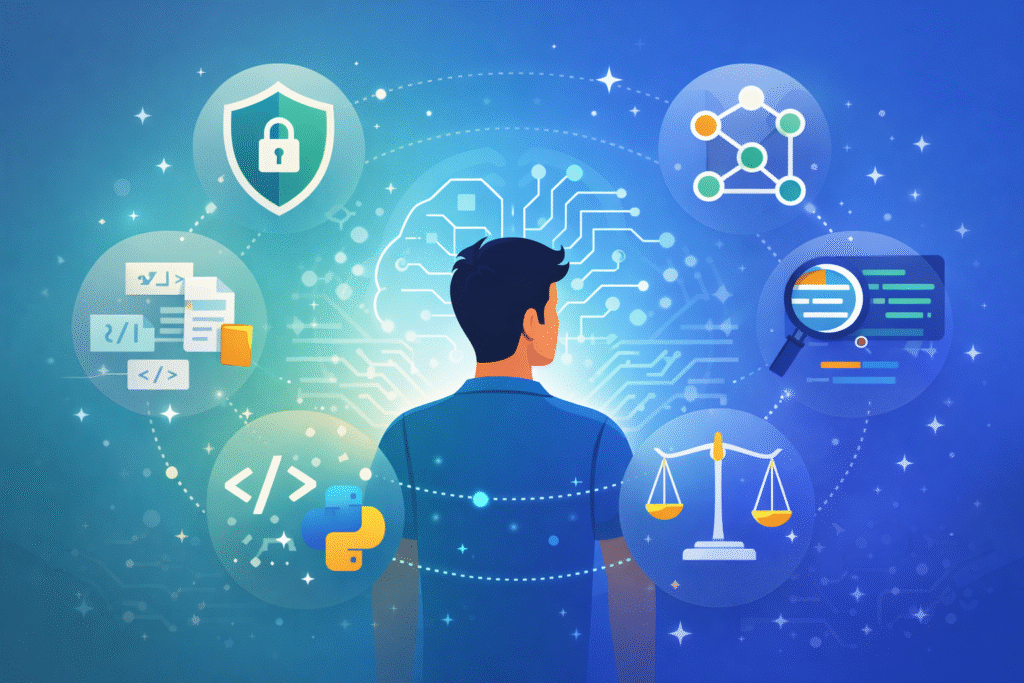
The winning combination mixes technical know-how with irreplaceably human skills. You need to speak the machine’s language and exercise human judgment.
On the technical side, Python is still king for AI and machine learning work. Understanding the basics of how these models work is non-negotiable. But just as crucial is knowing how to work with them securely.
From what we’ve seen in our secure development training, teams don’t slow down when AI enters the workflow. They shift roles. A senior engineer might generate a draft fast, then spend real time on architecture and security tradeoffs.
That’s where the hard thinking lives, especially when edge cases appear or trust is on the line. This is also why many teams are re-evaluating why architectural skills become more important in AI-assisted environments.
Beyond the code, you need “soft” skills that machines can’t replicate:
- Ethical judgment: Knowing when an AI’s suggestion is biased or unethical.
- Systems thinking: Seeing how the AI’s output fits into the bigger picture.
- Auditing & Oversight: The ability to review, correct, and approve AI work.
Harvard Business Review has highlighted that companies deploying AI without strong governance are taking on huge risk. The most resilient professionals are hybrids, they can code and they can strategize, they can use the tool and they can enforce the standards. That blend is what creates true career leverage.
How Can You Use AI as a Productivity Multiplier?
Think of AI as a brilliant but sloppy junior intern. It can produce a huge volume of work, but you must check everything it does. The multiplier effect only happens when human oversight is built directly into the workflow. This aligns with insights from the Forbes Tech Council,
“The procurement professional’s role shifts from spending days researching options to spending minutes evaluating AI-generated recommendations and making informed decisions. They become data detectives who spot problems before they happen… That’s what I see as the real story: multiplication, not replacement. AI handles large volumes of data processing so humans can focus on strategic thinking.” – Shaz Khan
In our projects, we use AI to accelerate the first draft, writing a function, drafting a document, or generating ideas. This can make early prototyping 5 to 10 times faster. But then we switch gears.
We review every line of code with a security lens. We fact-check every claim in a document. We interpret the analytics ourselves instead of taking the AI’s summary at face value.
The model is simple:
- Let the AI handle the volume and the first pass.
- You enforce quality, security, and strategic standards.
- Use Secure Coding Practices as the final gate before anything goes live.
Without this structured oversight, the so-called productivity gains vanish into a nightmare of debugging and fixing sloppy work. AI is a powerful amplifier. It makes a careful professional incredibly efficient, and it makes a careless one dangerously error-prone. The multiplier depends entirely on the human in the loop.
Should You Pivot Roles or Reinvent Your Current One?
For most people, reinvention works better than a full reset. Staying in your field while adding AI skills usually carries less risk. If you’ve spent years in security, marketing, or data, that context still matters. Layering AI on top turns you into a hybrid, and that’s what many teams are hiring for.
In our secure development programs, we see this play out often. Learners who build on existing experience move faster than those starting from zero. A full pivot means rebuilding credibility and competing with entry-level candidates again. That tradeoff isn’t always obvious at first.
A hard pivot only makes sense in narrow cases. If most of your work is repetitive and offers little strategic growth, then stepping sideways might help. But many “instant AI career” promises gloss over how hiring really works.
What tends to work better:
- Small AI projects tied to your current role
- Open-source work that shows real usage
- Mentors already applying AI in your field
- Using AI on one workflow and tracking results
We’ve found reinvention compounds. You keep your depth while adding leverage.
What Mindset Ensures Long-Term Resilience?
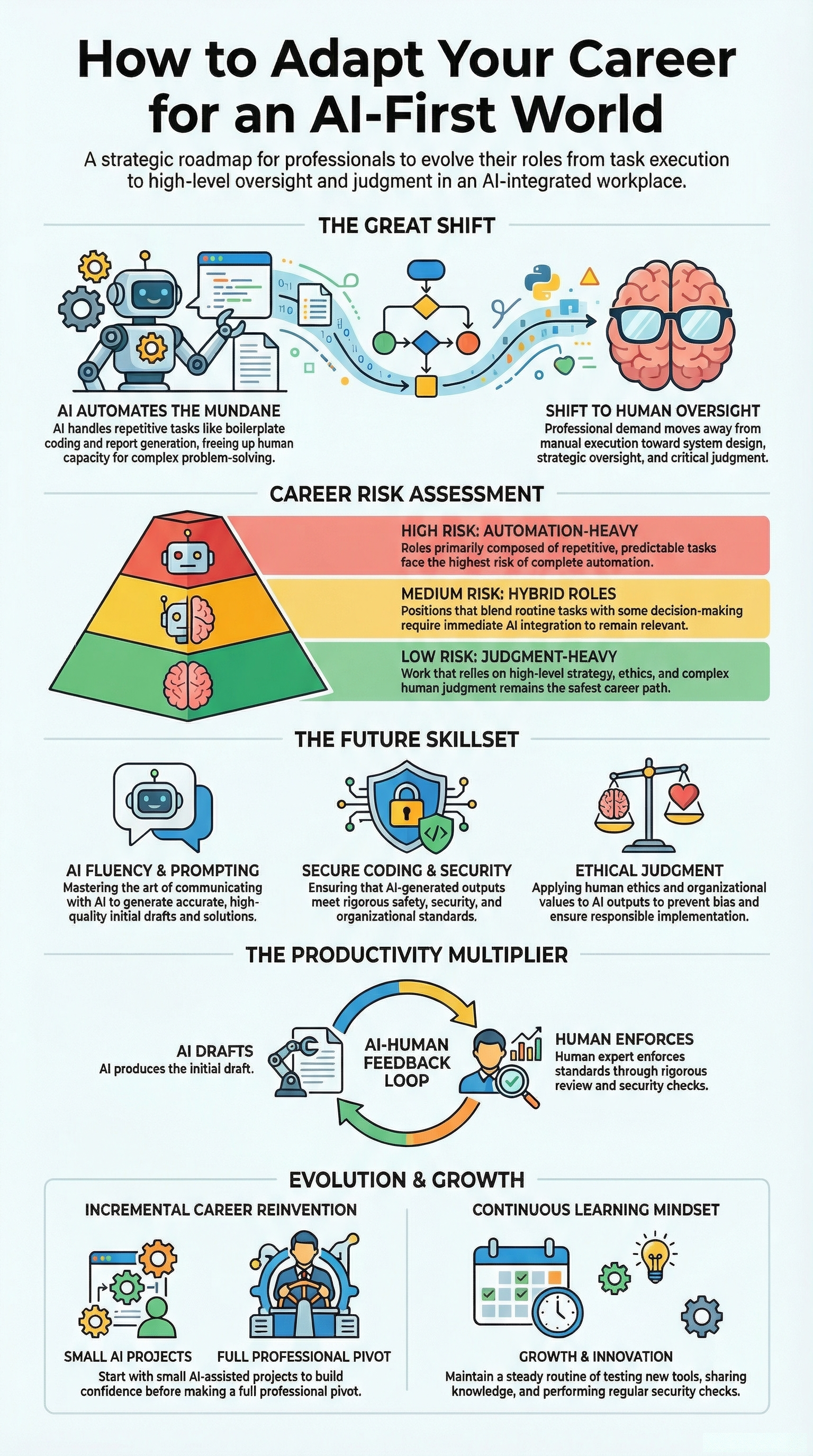
Curiosity tends to age better than fear. The people we see doing well aren’t chasing every trend, they’re testing tools steadily and learning where they break. A few focused hours each week often beats binge learning once a year.
From our side running secure development training, the healthiest mindset is practical. Skip the hype cycles and build a rhythm instead. Revisit your skills every few months. Try new AI tools, but review them with a builder’s eye. What works? Where does it fail under pressure?
We notice resilience in small, repeatable habits:
- Explaining how you’d handle an AI hallucination
- Applying security checks to generated code
- Guiding teammates on safe usage
- Saying no to weak outputs
This era rewards steady judgment. You don’t need to know everything early. What matters is staying teachable while holding strong standards. We tell our learners to anchor themselves in secure fundamentals, keep testing assumptions, and stay calm when the tools move fast. Adaptability compounds over time.
FAQ
Is an AI career shift realistic without quitting your current job?
Yes, an AI career shift can happen without leaving your job. Many people reskill by adding AI literacy skills to what they already do. Start by integrating AI into one workflow and tracking the results. Learning machine learning basics and documenting outcomes helps you build a hybrid profile and supports a practical developer adaptation strategy.
Which skills matter most for reskilling in the AI era?
The most useful skills combine strong foundations with AI awareness. Solid coding fundamentals AI, problem-solving AI, and AI debugging skills still matter. On top of that, learn system architecture AI concepts and ethical AI governance basics. These skills support AI-native engineering and help you work confidently within real-world AI constraints.
How can juniors survive the junior developer crunch?
Juniors can stay competitive by showing real capability, not just certificates. Build portfolio AI projects that include AI code review, edge cases handling, and AI hallucination fix examples. Share open-source AI contrib and resume hybrid projects publicly. Employers value proof of thinking and production system AI awareness more than entry-level titles.
What makes someone valuable in the AI job market 2026?
In the AI job market 2026, value comes from leverage and judgment. Hybrid developer roles that combine architectural design AI, AI workflow integration, and code auditing skills stand out. Companies look for people who can manage tech debt AI code, apply governance, and act as an AI force multiplier in real production environments.
How do I keep growing with continuous learning in AI?
Growth comes from steady habits. Treat continuous learning AI as a weekly practice. Run a skill gap analysis, test new tools, and reflect on lived experience AI outcomes. Join mentorship AI communities and contribute to open-source AI contrib. This cycle strengthens AI prompting mastery and builds a durable career playbook AI over time.
Staying Competitive in an AI-First Career
Adapting your career for an AI-first world comes down to discipline and direction. The gap is widening between passive users and builders who guide AI with strong foundations. Secure fundamentals, steady learning, and real oversight create lasting leverage.
If you’re ready to turn that mindset into practical skill, start with hands-on training. Start building your AI-resilient career framework today. The Secure Coding Practices Bootcamp helps developers ship safer code through real labs, live sessions, and practical patterns you can apply immediately.
References
- https://www.bcg.com/publications/2025/how-companies-can-prepare-for-ai-first-future
- https://www.forbes.com/councils/forbestechcouncil/2025/12/15/ai-as-procurements-productivity-multiplier-freeing-teams-for-strategic-work/
Related Articles
