


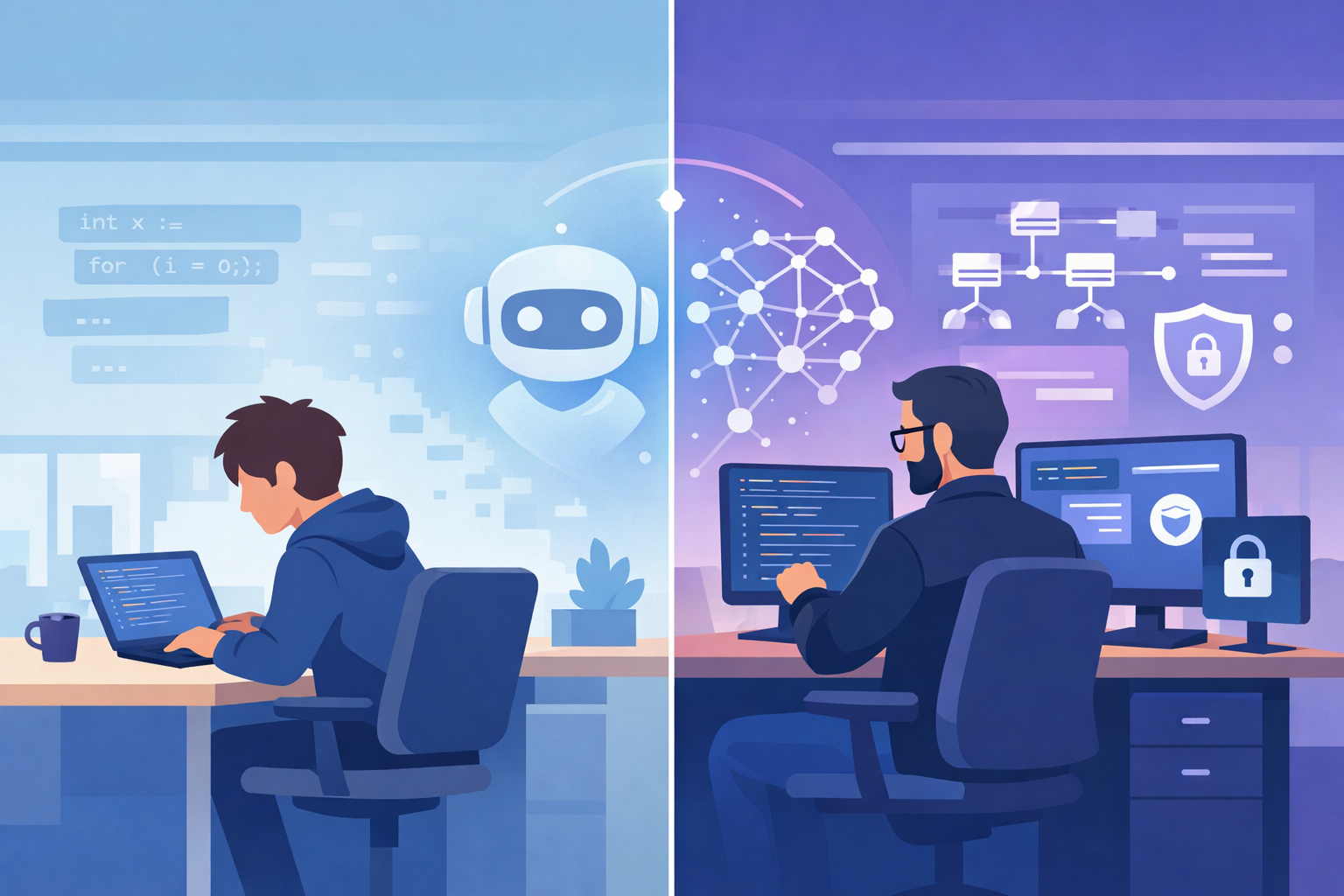
How this changes the future of programming jobs is simple: AI cuts routine coding and raises the bar for human developers. We see it daily. AI handles boilerplate fast, but developers still fix logic bugs and security gaps. In our projects, one AI function takes seconds to generate and far longer to verify.
Entry roles shrink as grunt work fades. At the same time, companies push harder for engineers who design systems, review AI output, and write secure code. The work isn’t gone, just shifting toward judgment and responsibility. Keep reading to see what this means for your next move.
Future Programming Job Shifts to Know
- AI automates syntax but makes system design, code auditing, and security practices more critical than ever.
- The bar for entry-level jobs is rising, while demand is booming for senior and AI-savvy developers.
- Long-term career success will belong to developers who learn to collaborate with AI, not just rely on it.
Is AI Replacing Programmers or Redefining Their Role?
Let’s call it straight: AI isn’t removing programmers, it’s reshaping the job. Tools like Copilot show up in most workflows now, acting more like a fast assistant than a replacement. In our classes, we watch students generate working snippets in seconds. The speed is real. Full automation, though, is rare. Most tasks are shifting, not disappearing.
AI works best as a force multiplier. It can sketch an endpoint or spin up test cases quickly. But it doesn’t join sprint debates or weigh long-term tradeoffs. Developers still decide what’s worth building and what’s safe to ship. That judgment keeps growing in value as output gets easier to generate. As noted in the GitHub Blog,
“As AI continues to shape the development landscape, developers are navigating a new frontier, not one that will make their careers obsolete, but one that will require their skills and instincts more than ever. Sure, AI is revolutionizing software development, but that revolution ultimately starts and stops with developers. That’s because these tools need to have a pilot in control.” – Sara Verdi
This shift highlights how it changes the core role of a programmer from syntax execution to decision-making and oversight.
We teach a clear split:
- AI helps with drafts, patterns, and quick refactors
- Developers own architecture, intent, and security reviews
In real projects, AI may draft the feature, but humans stress-test it. Our students spend more time asking: Will this scale? Is it safe? Does it belong here? That’s where real skill shows.
Why Are Entry-Level Programming Jobs Under Pressure?

Pressure on entry-level roles is real, and much of it comes from AI shrinking the old learning curve. Tasks that once trained juniors, small bug fixes, simple forms, routine debugging, are now handled faster by tools. We hear this often from hiring partners. Early roles aren’t gone, but they’re tighter and more competitive than before.
In our own cohorts, the shift shows up quickly. A lean startup might run with a few senior engineers and heavy AI use, doing work that once needed a larger team. That leaves fewer low-stakes tickets for newcomers. Recruiters tell us they care less about raw syntax and more about how candidates think. They want people who question system impact, check security early, and know how to review AI output.
Here’s how the structure is changing:
| Factor | Pre-AI Era | AI Era |
| Entry Skills | Syntax and basic logic | Systems thinking and validating AI output |
| Team Structure | More juniors learning on the job | More seniors amplified by AI |
| Biggest Risk | Slow onboarding | A weak pipeline to future seniors |
The real concern is long-term. If routine work disappears, fewer juniors build fundamentals. Without that base, fewer grow into the senior engineers the industry still needs.
How Is AI Increasing Demand for Senior and AI-Savvy Developers?
Credits: Modern Software Engineering
Paradoxically, by making individual developers more productive, AI is increasing demand for the best ones. When you can build features faster, the bottleneck shifts from writing code to designing good systems and making smart decisions. Analysts argue this productivity boom can actually lead to net hiring growth, because companies embark on more ambitious projects.
We see this demand daily in the job market our graduates enter. Organizations aren’t firing their architects and principal engineers. The need is intense for people who can design scalable microservices, harden backend systems, and integrate AI tools safely into existing workflows.
The high-value responsibilities now include:
- Making foundational architecture decisions.
- Leading security reviews and embedding secure practices from the start.
- Auditing AI output to catch “hallucinations” or subtle bugs.
- Managing the technical debt that poorly supervised AI can create.
This demand shows up in paychecks. Surveys consistently show a significant salary premium, sometimes 40% or more, for developers with expertise in AI/ML or specialized security skills. But a skilled senior who knows how to partner with AI truly can produce exceptional results, which is why their demand continues to rise.
What New Programming Roles Are Emerging in the AI Era?
AI isn’t just changing old jobs; it’s creating entirely new ones focused on oversight and integration. Researchers predict that by 2040, most routine code could be machine-generated. That doesn’t make engineers obsolete. It turns them into conductors, validators, and security guards for AI systems. As described by the Stack Overflow Blog,
“The truth is, what it means to be a developer is changing… In concert with this change, new roles are emerging that didn’t exist even a couple of years ago: AI orchestrators manage teams of AI agents, assigning tasks, reviewing outputs, and ensuring that coherent systems emerge from multiple AI collaborators working in parallel.” – Alexandra Francis
We’re already seeing new specialties emerge, roles we now prepare our students for:
- AI Code Auditor: Someone whose main job is to review AI-generated code for logic errors, security flaws, and compliance issues.
- AI Workflow Orchestrator: A developer who designs and manages the pipelines that chain multiple AI tools together to complete complex tasks.
- Technical Prompt Engineer: Beyond basic prompting, this is about crafting systematic inputs to get reliable, production-ready output from AI coders.
- Legacy Systems Integrator: An expert in stitching new AI capabilities into old, critical codebases without breaking them.
Imagine a real scenario: AI suggests an update to a core banking service. These new roles all rest on a foundation of secure coding practices. At our bootcamp, we teach that security isn’t the last step; it’s the first question you ask.
What Skills Will Matter Most in the Next Decade?

Forget memorizing every syntax detail. To stay relevant for the next ten years, developers need a different toolkit. Forecasts suggest over 80% of a programmer’s skill set will transform because of AI.
The skills that will future-proof a career are about thinking bigger and validating smarter. Which raises a key question many developers now ask: what new skills do modern programmers need to stay competitive?
Here’s the practical skill checklist we focus on:
- Systems Thinking: Seeing how pieces fit together in a large architecture.
- AI Collaboration & Auditing: Knowing how to guide AI tools and meticulously check their work.
- DevOps & CI/CD Fluency: Understanding the pipeline that takes code from an AI suggestion to a live, running service.
- Deep Security Knowledge: Building security in from the start, not bolting it on at the end.
- Debugging Complex Integrations: Tracing a problem through layers of human and AI-generated code.
A common story we hear illustrates why. A team uses an AI coder to build a new app feature in record time. A month later, the app crashes because the AI used an unstable, third-party dependency no one reviewed. The failure wasn’t in the AI’s ability to code, but in the team’s lack of validation discipline.
How This Changes the Future of Programming Jobs
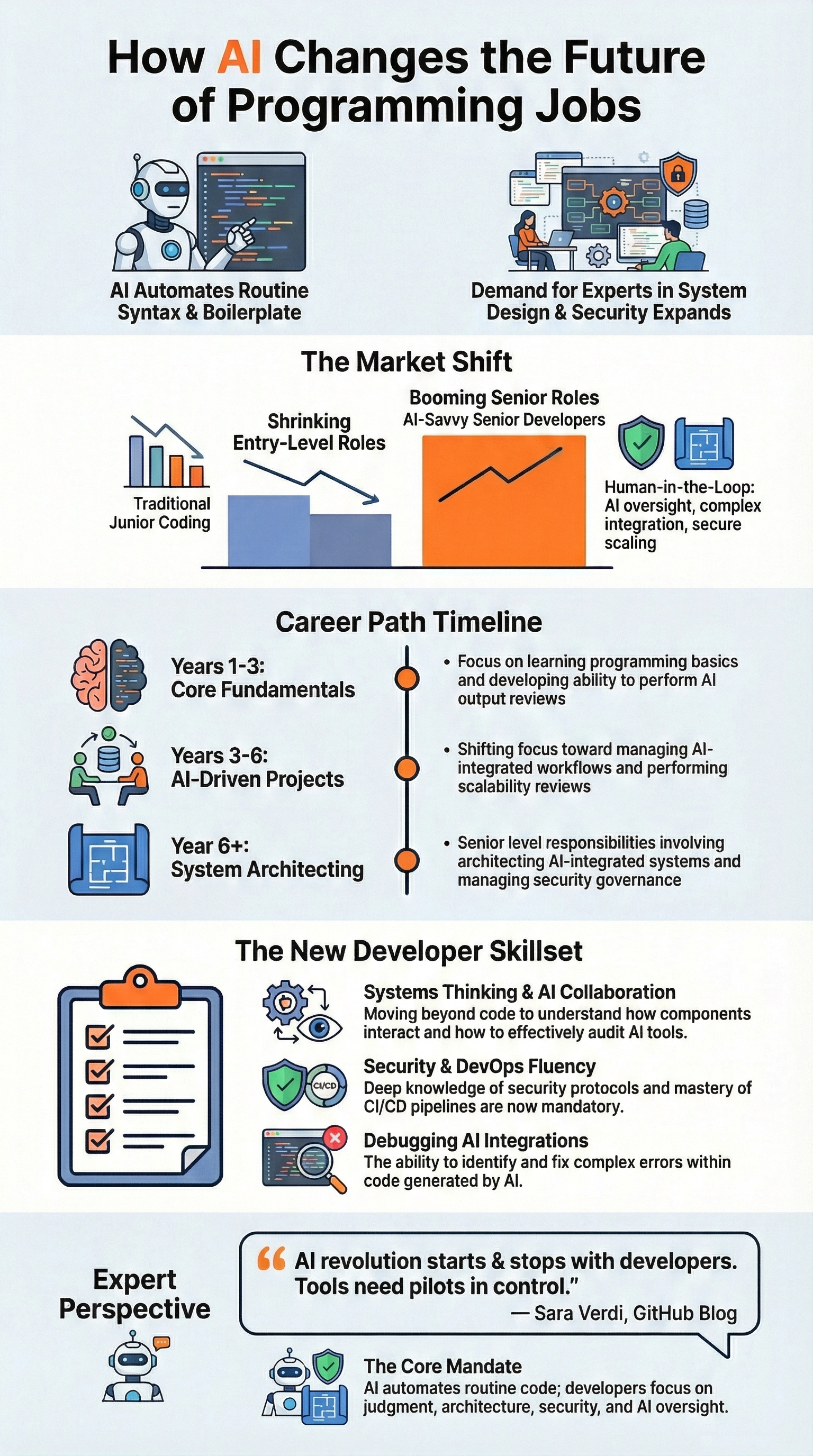
Adaptability will shape how durable a developer’s career becomes. The people who hold up best are those who fold AI into a steady, secure workflow, not those who treat it like autopilot.
The hype can swing wide, but the shift is obvious. AI tools are now part of daily engineering life, creating a lasting impact on developer skills & careers across every experience level.
From what we see in training labs, the right move depends on where someone stands:
- Beginners should focus on system basics and learn to review AI output carefully
- Mid-career developers benefit from going deeper into security, cloud patterns, or integration work
- Seniors need to guide how teams use AI with clear standards and guardrails
In our cohorts, small habits make a big difference. We push students to track where AI helps and where it adds cleanup. We also treat secure coding as non-negotiable, especially with AI in the loop. Many grow faster by joining projects that expose full architectures or by contributing to code they didn’t write.
Programming isn’t ending. It’s shifting toward developers who can guide AI with judgment and discipline.
FAQ
Will AI automation cause long-term tech job displacement?
AI automation is changing jobs, but it does not remove them entirely. Routine coding tasks are shrinking first, especially work tied to boilerplate automation. At the same time, new roles are growing around AI oversight jobs, system architecture focus, and security reviews. The bigger story is programming job evolution, not disappearance. Developers who adapt to AI-driven coding shifts usually remain in demand.
Why is there a junior developer decline but senior dev demand rise?
AI code generation removes many beginner-level tasks, which creates stronger entry-level barriers and mid-level compression. However, companies still need experienced engineers. This creates a talent shortage seniors can fill.
Teams rely on them to manage coding workflow changes, guide enterprise AI integration, and review AI outputs. This developer role transformation explains the junior developer decline and senior dev demand rise.
What skills matter most for future coder careers now?
Future coder careers rely more on judgment than syntax alone. Developers need strong AI collaboration skills and business logic mastery. They must review AI outputs, handle AI debugging challenges, and manage tech debt from AI-generated code. A clear system architecture focus also helps. These developer upskilling needs reflect a shift toward oversight and decision-making.
How will programming education reform after AI tool adoption?
Programming education reform is already happening as AI tool adoption grows. Schools and bootcamps are adding lessons on code auditing roles, prompt engineering basics, and system design. Instead of focusing only on syntax, programs now teach coding workflow changes and AI collaboration. The goal is to prepare AI-native engineers who can evaluate and guide generative AI coders responsibly.
Could AI-driven coding shifts increase developer burnout risks?
AI-driven coding shifts can increase developer burnout risks if teams move too fast. AI creates a coding productivity boost, but it also raises expectations. Developers must handle AI debugging challenges, constant reviews, and tighter productivity metrics. These pressures can build over time. Without healthy pacing and clear processes, rapid programming job evolution may strain even experienced engineers.
What the Future of Programming Jobs Means for You
We are not watching the end of programming. We are seeing a real developer role transformation. The future coder careers landscape will favor AI-native engineers who treat automation as a collaborator, not a crutch. Those who adapt with discipline will find wider paths, not fewer.
Ready to move forward? Start building your AI-resilient coding strategy today. The Secure Coding Practices Bootcamp delivers hands-on training in secure, real-world development, covering OWASP risks, input validation, authentication, encryption, and safe dependencies, so you can ship safer code from day one.
References
- https://github.blog/developer-skills/career-growth/hard-and-soft-skills-for-developers-coding-in-the-age-of-ai/
- https://stackoverflow.blog/2026/02/09/why-demand-for-code-is-infinite-how-ai-creates-more-developer-jobs/
Related Articles
