



AI is changing the core role of a programmer from manual code execution to strategic system design, validation, and decision making across complex software environments. Since 2023, tools embedded into mainstream workflows have accelerated this shift across enterprises and startups alike.
We have seen it firsthand in delivery cycles that now move faster with fewer people, yet demand sharper judgment. This article explains what changed, why it matters, and how programmers can stay relevant by leaning into strategy, oversight, and Secure Coding Practices. Keep reading to understand where real value now sits.
Key Takeaways
- AI reduces routine coding while increasing responsibility for system design and validation.
- Programmer value shifts toward judgment, architecture, and business aligned problem solving.
- Secure Coding Practices become more important as AI generated code increases volume and risk.
How Has The Traditional Role Of A Programmer Been Defined?
Traditionally, programmers focused on writing, debugging, and maintaining code manually, where value came from syntax mastery and execution speed rather than system level decision making.
Most programmers spent their days inside editors, translating requirements into precise instructions, long before modern workflow differences reshaped how tasks flow between planning, implementation, review, and deployment.
Large teams were organized around specialization, with clear boundaries between frontend, backend, and operations. Productivity was measured by output volume and defect reduction.
Daily work centered on repetitive tasks. Boilerplate creation, manual test case writing, and step by step debugging dominated schedules. We remember long release cycles where small changes required weeks of coordination and review.
Collaboration existed, but execution dominated. Design decisions were often locked early, leaving little room for iteration. Craftsmanship meant knowing a language deeply and producing reliable code under constraints.
This traditional model rewarded individual efficiency.
- Deep syntax knowledge in specific languages.
- Manual debugging and code refactoring.
- Incremental feature delivery tied to line by line changes.
It worked well for predictable systems, but it did not scale cleanly as software complexity increased.
What AI-Driven Shifts Are Redefining Daily Programming Work?

AI automates routine coding tasks, reducing manual implementation and allowing programmers to reallocate time toward higher-level design, review, and integration work. This change isn’t just about speed; it’s about a fundamental pivot in how security is handled during the development lifecycle.
This shift facilitates a more integrated approach, as noted :
“Shifting left allows the DevSecOps team to identify security risks and exposures early and ensures that these security threats are addressed immediately. Not only is the development team thinking about building the product efficiently, but they are also implementing security as they build it.” – IBM Think Blog [1]
AI driven development reshapes daily tasks:
- Routine task automation for data handling and setup.
- Code review automation that flags issues early.
- Rapid prototyping tools that compress feedback loops.
The result is not less work, but different work. Programmers now oversee systems that produce code at scale. This makes Secure Coding Practices essential. When we rely on generated output, we must validate inputs, outputs, and assumptions consistently to avoid hidden vulnerabilities.
How Does AI Change A Programmer’s Core Responsibilities?

Core responsibilities are shifting from writing code to validating AI output and aligning technical solutions with business goals. The modern programmer acts less like a pure implementer and more like a strategic guardian of the codebase. This transition redefines the developer as the primary stakeholder in the safety of the application.
This creates a new mandate for the profession:
“In this environment, traditional cybersecurity defenses can’t be trusted to shoulder the load. Instead, developers need to become the new frontline defenders. They require upskilling and resources, and a framework of contextual knowledge about secure coding. Developers need to be given ownership of their vital role in cybersecurity…” – Forbes Technology Council [2]
Responsibilities now cluster around oversight:
- Debugging AI outputs and edge cases.
- Code optimization oversight across services.
- Security code scanning and validation.
Instead of asking how to write a function, programmers now decide whether that function introduces systemic risk. Responsibilities now cluster around high-level oversight, ensuring that secure defaults and least-privilege access are baked into the architecture from day one.
This role evolution rewards programmers who understand the full system. It also reduces tolerance for shallow implementation knowledge.
Why Is Strategic Thinking Replacing Syntax Mastery?
You know, I was looking at some old code the other day. Perfect syntax, but it solved the wrong problem. That’s the shift. AI handles the boilerplate now, so our real job is the thinking part.
We’re not just coders anymore; we’re strategists. A Forbes report found that in AI-augmented teams, nearly 70% of developer time shifts to planning and review, not writing new code. The hard questions are architectural: How should services communicate? Where is failure acceptable? AI can’t answer those.
Strategic programming means focusing on the long game:
- Understanding real constraints, like long-term maintenance costs and team skills.
- Balancing trade-offs between performance tuning and delivery speed.
- Anticipating scale, seeing how a small design choice today becomes a big deal later.
Syntax is necessary, sure. But it’s not what sets you apart anymore. A single good strategic decision can save months of rework down the line, especially when weighing the pros and cons for senior developers who must justify architectural trade-offs, long-term risk, and system durability. That’s where the real value is now.
What New Skills Are Now Critical For Programmers?
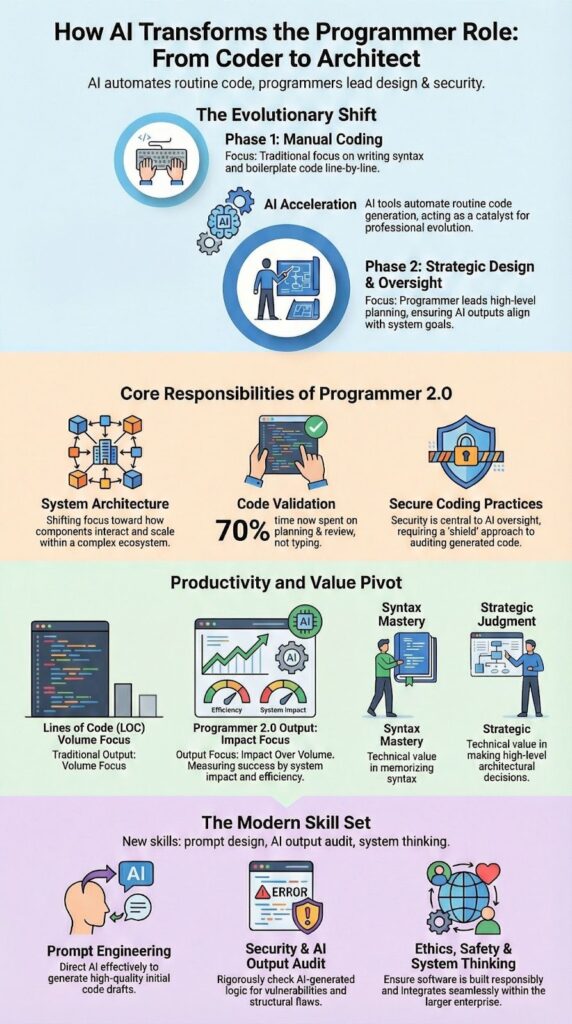
You can feel the job changing. It’s less about writing every line and more about guiding the whole process. That shift shows up in the data, LinkedIn reported a real spike in demand for prompt engineering skills alongside traditional coding roles last year.
So what’s actually critical now? The skills are all about orchestration and oversight.
- Prompt design and iteration. It’s a new way of talking to the machine. You’re not compiling, you’re collaborating.
- System-level architecture. AI writes functions. Humans design how entire systems communicate, scale, and fail safely.
Critical review of AI output. This is where our secure coding focus is vital, because real code quality comparisons only emerge when generated logic is tested against human judgment, edge cases, and long-term maintainability expectations.
We also can’t ignore the renewed weight on ethics and safety. When AI touches business logic, checking for bias and ensuring explainability becomes a daily chore, not a nice-to-have. Secure practices are the bedrock, applied in every quiet review.
The best programmers now are hybrids. They blend deep technical know-how with enough domain expertise to ask the right questions. They speak the language of the business and the language of the system. That’s the new core skill.
How Does The “Programmer 2.0” Model Change Long-Term Career Value?
Credits : SpringPeople Software
It’s less about writing every line and more about guiding the whole process. That shift shows up in the data, LinkedIn reported a real spike in demand for prompt engineering skills alongside traditional coding roles last year.
So what’s actually critical now? The skills are all about orchestration and oversight.
- Prompt design and iteration. It’s a new way of talking to the machine. You’re not compiling, you’re collaborating.
- Critical review of AI output. This is where our secure coding focus is vital. You must audit every suggestion for flaws, biases, and logic errors.
- System-level architecture. AI writes functions. Humans design how entire systems communicate, scale, and fail safely.
| Dimension | Traditional Programmer | Programmer 2.0 |
| Primary output | Manual code | System outcomes |
| Productivity metric | Lines or features | Impact and throughput |
| Core skill | Syntax mastery | Strategic judgment |
| Risk focus | Bugs | Systemic failure |
| Security approach | After implementation | Embedded Secure Coding Practices |
We also can’t ignore the renewed weight on ethics and safety. When AI touches business logic, checking for bias and ensuring explainability becomes a daily chore, not a nice-to-have. Secure practices are the bedrock, applied in every quiet review.
FAQ
How does AI change what programmers focus on day to day?
AI and automation are reshaping programming roles by handling routine task automation such as boilerplate code automation and basic test creation. This developer workflow change shifts daily work toward high-level problem solving, business logic design, and system architecture focus. Programmers spend less time typing syntax and more time making decisions that affect performance, scalability, and long-term software quality.
Which new skills matter most for programmers as AI adoption grows?
Software developer evolution requires prompt engineering skills, debugging AI outputs, and strong algorithmic thinking enhancement. Programmers must adapt to a syntax to strategy transition where intent and structure matter more than memorization. Programmer skill adaptation also includes code validation techniques, ethical AI coding, and clear reasoning to guide AI-driven development safely and effectively.
Does AI reduce coding jobs or change how programmers add value?
The software engineering shift emphasizes augmentation over replacement. Automation in coding reduces repetitive work, but programmers add value through creative problem solving, abstract thinking, and domain expertise coding. This strategic programming role focuses on shaping solutions, reviewing AI-generated logic, and ensuring software meets real business and user requirements without hidden risks.
How does AI affect software quality and long-term maintenance?
AI collaboration tools increase developer productivity and reduce ongoing maintenance effort, but they do not remove responsibility. Programmers oversee code quality assurance, security code scanning, and performance tuning strategies. Human review ensures generated code remains reliable, maintainable, and aligned with scalable system design rather than becoming difficult to debug or extend later.
What does the future core role of a programmer look like?
The future core role centers on a solution architect mindset and intelligent systems orchestration. Programmers design workflows, define constraints, and evaluate outcomes instead of writing every line manually. This next-generation role combines AI tool mastery, interdisciplinary skills, and lifelong learning to build adaptable systems that support evolving technical and business goals.
How It Changes the Core Role of a Programmer Moving Forward
The programmer’s role is getting an upgrade. AI handles the volume, freeing us to focus on what matters: direction, judgment, and responsibility. We move from typing to thinking, from execution to orchestration. Secure coding is the anchor, ensuring speed never outruns safety.
To build that critical, security-first judgment, join our hands-on Secure Coding Bootcamp. Get the practical skills to validate AI output and design secure systems.
Learn more and secure your spot.
References
- https://www.ibm.com/think/topics/devsecops
- https://www.forbes.com/councils/forbestechcouncil/2021/03/31/why-security-skilled-developers-are-key-to-defeating-cyberattacks-during-the-pandemic/
Related Articles
