


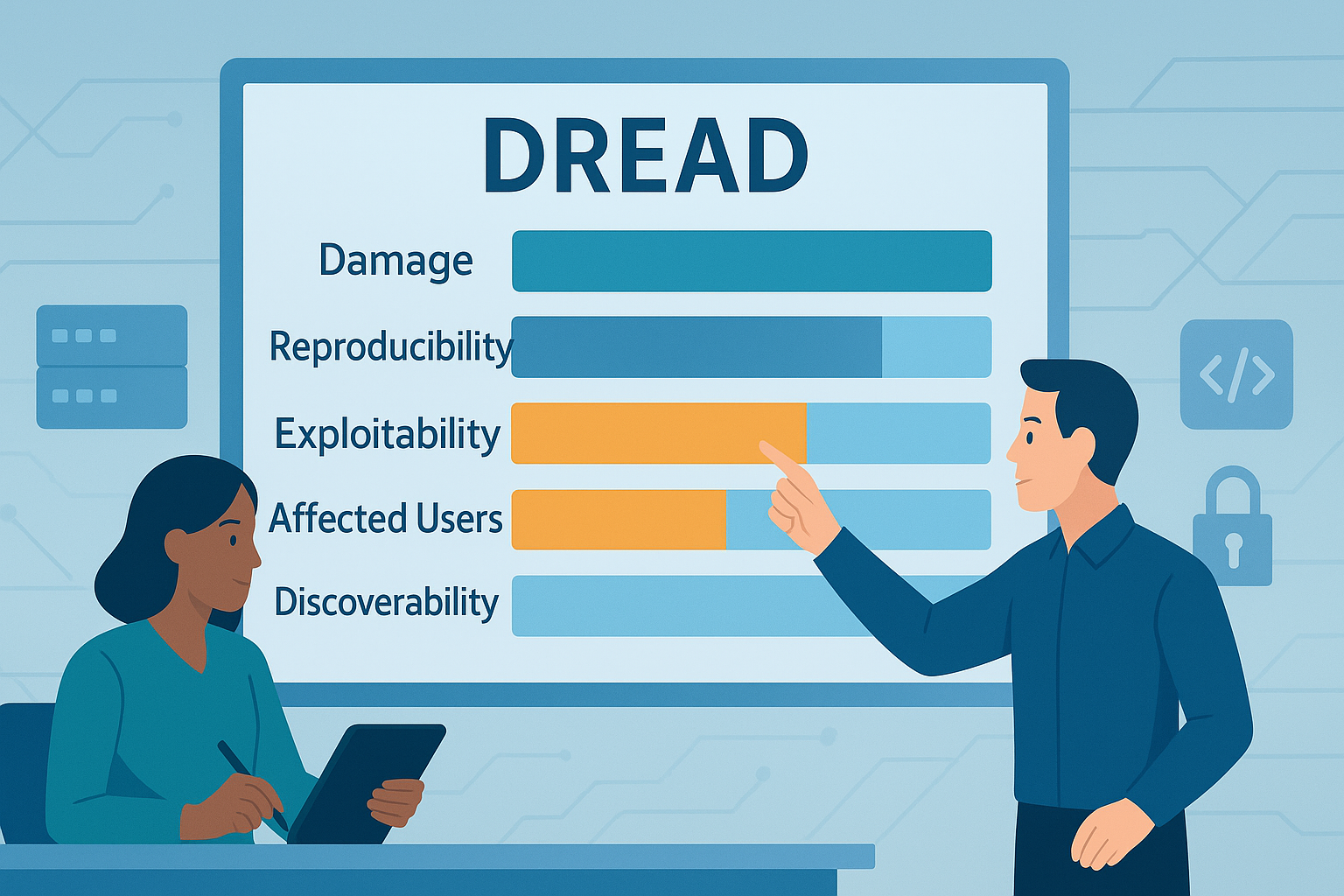
Cybersecurity’s never been easy, and risk assessment often feels like guesswork. In a 2023 survey of security professionals, 50 % of teams reported doing threat modelling with every release, whereas 23 % still treated it as an annual activity. (1) Over the years, we’ve tried many threat modeling methods, but DREAD keeps proving its worth. It breaks down risks into clear parts, Damage, Reproducibility, Exploitability, Affected users, and Discoverability, making it easier for developers to prioritize what really matters.
From our experience running secure coding bootcamps, this approach helps trainees focus on practical threats rather than abstract fears. It’s a straightforward tool that fits well into real-world workflows, not just theory. If you want to sharpen your secure development skills, keep reading, there’s more to uncover.
Key Takeaways
- DREAD breaks down cybersecurity threats into five categories, Damage, Reproducibility, Exploitability, Affected Users, and Discoverability, for clear risk assessment.
- Using DREAD scores helps teams prioritize which vulnerabilities to fix first, making risk management more data-driven.
- Practical scoring examples, like SQL injection or misconfigured access controls, show how DREAD guides developers in assessing real-world threats.
What is DREAD Threat Modeling?
DREAD isn’t just another complex framework. It’s a no-nonsense approach that builds on the principles found in basic threat modeling techniques, breaking down security risks into five measurable components. In our secure coding practices, we’ve found this method particularly useful when explaining risks to non-technical stakeholders.
Think of it as a security report card with five subjects:
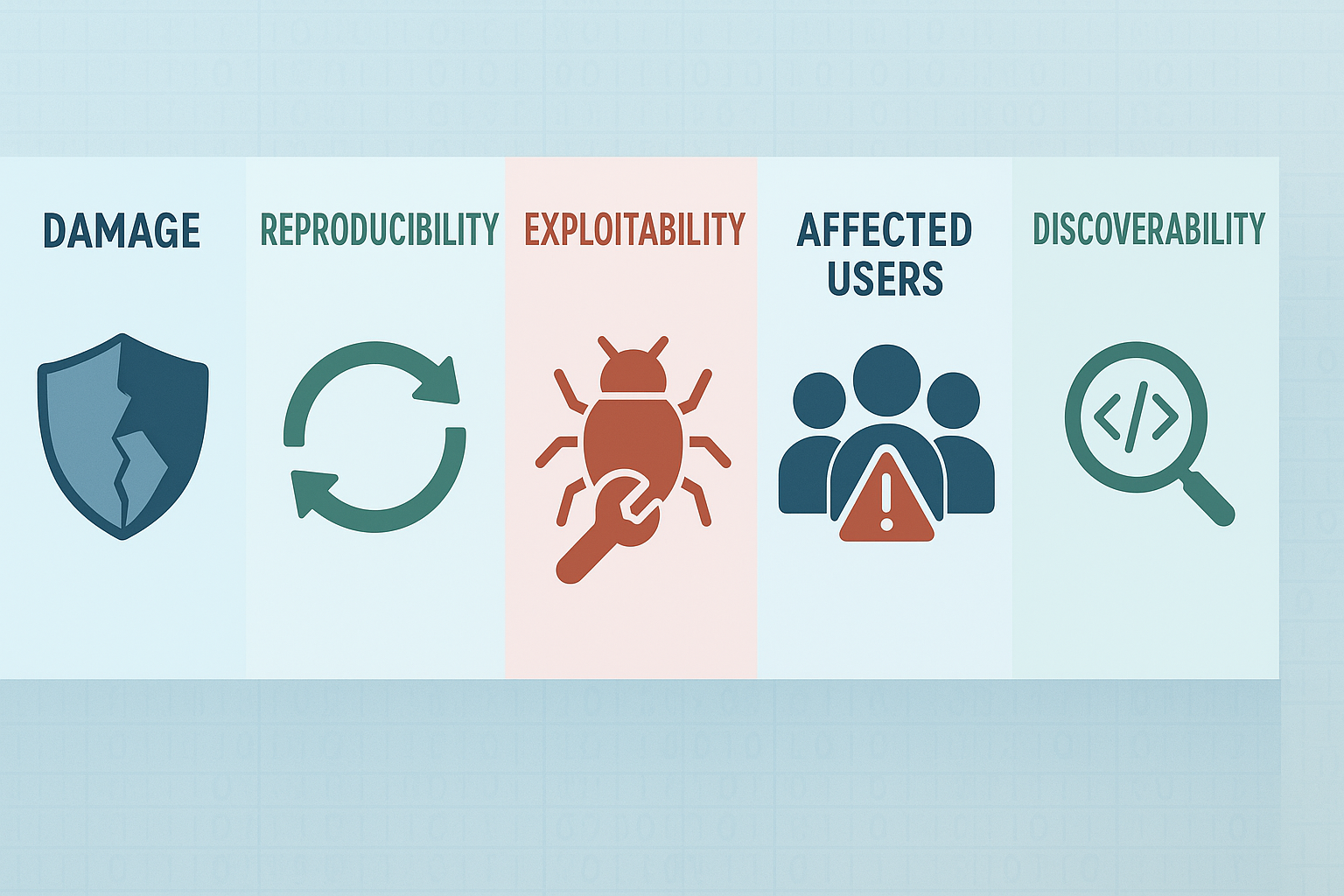
- Damage (how bad could it get?)
- Reproducibility (can they do it again?)
- Exploitability (how much work is it to break in?)
- Affected Users (who gets hurt?)
- Discoverability (how obvious is the weakness?)
Breaking Down the Components
Damage Assessment
Picture a scale from a paper cut to a fatal wound, that’s how we measure damage in DREAD. Including concrete examples of damage such as data breaches, system outages, or financial loss helps readers better visualize the potential impact of vulnerabilities and why thorough damage assessment is critical.
A score of 0 means no harm done, while 10 means total system destruction. We’ve seen seemingly minor vulnerabilities cascade into major breaches, which is why our secure coding practices always start with thorough damage assessment.
Reproducibility Factor
Some attacks are one-hit wonders, others can be repeated like a broken record. Emphasizing that reproducibility of attacks varies and often the most troublesome threats are those easily repeatable helps underscore the importance of this metric in prioritization.
Our experience shows that reproducible threats often cause the most headaches. A vulnerability that’s hard to reproduce might score a 2, while something anyone can do repeatedly hits a solid 10.
Exploitability Level

This measures how much sweat an attacker needs to break in. Clarify that exploitability can evolve over time as tools and automation lower the skill barrier, making early identification and mitigation vital to security. From our fieldwork, we’ve noticed that even complex exploits eventually get packaged into simple tools – what needs a PhD today might need just a script kiddie tomorrow.
Affected Users Count
The bigger the splash, the bigger the problem. Stressing that impact scale ranges from individuals to entire user bases emphasizes why understanding affected user count is crucial in risk assessment. A targeted attack affecting one user might score a 2, while something that hits every user gets a full 10. Through secure coding practices, we’ve learned that preventing wide-impact vulnerabilities starts at the design phase.
Discoverability Rating
Credits: Rapid7
Some flaws practically wave a red flag, others stay hidden for years. Highlighting that vulnerabilities easily discovered by attackers are typically exploited first reinforces the importance of this rating in prioritization decisions. Working with secure coding practices has taught us that obvious vulnerabilities get exploited first – they’re like leaving your house key under the doormat.
Putting DREAD into Action

The math’s simple: add up all five scores and divide by 5. But the real skill comes from experience – knowing when a 7 is really a 9, or when that scary-looking 8 is actually just a 5. Our secure coding team uses this daily, mixing hard numbers with gut feelings built from years of practice. Note that while scoring is quantitative, experienced teams combine numerical scores with qualitative judgment and consult stakeholders to reach more accurate threat prioritization.
For example:
- SQL injection vulnerability in a login form
- Damage: 9 (full database access)
- Reproducibility: 10 (works every time)
- Exploitability: 7 (needs some SQL knowledge)
- Affected Users: 10 (hits everyone)
- Discoverability: 8 (common attack pattern)
Average: 8.8 – Drop everything and fix this now
Remember: numbers guide us, but experience leads us. Through consistent application of secure coding practices and regular threat assessments, we’ve learned that DREAD works best as part of a larger security strategy.
Making DREAD Work for You

Start with secure coding practices, always. Then use DREAD to prioritize what needs fixing first, just as threat modeling for developers emphasizes the importance of aligning risk scoring with real development workflows. Keep your assessments honest, document your reasoning, and revisit scores as new information comes in.
Despite the momentum, fewer than 10% of organisations say they cover 90% or more of their applications with threat modelling, which is precisely where tools like DREAD become valuable to fill the gap. (2)
Recommend thorough documentation of scoring rationale and regular score updates to foster transparency, auditability, and adaptiveness in evolving threat landscapes. From hands-on experience: don’t get hung up on perfect scores. It’s better to be roughly right and moving forward than precisely wrong and stuck in analysis paralysis.
FAQ
What is DREAD threat modeling and why is it useful in cybersecurity?
DREAD threat modeling is a threat model framework that helps teams understand cybersecurity threats by breaking them into measurable parts: Damage potential, Reproducibility rate, Exploitability assessment, Affected users count, and Discoverability index. It simplifies threat classification, improves threat prioritization, and supports clear security risk evaluation for smarter cyber risk management.
How does DREAD help with threat prioritization and vulnerability scoring?
By scoring each factor, DREAD enables effective threat prioritization and vulnerability scoring. Teams can compare security flaws based on threat severity, exploit risk, and security breach potential. This threat risk analysis approach ensures that the most critical vulnerabilities are addressed first, improving overall software security and reducing attack surface exposure.
How does DREAD support risk mitigation and security threat assessment?
DREAD supports security threat assessment through structured threat quantification. It turns complex IT security threats into understandable data for better risk mitigation. Using a risk management framework, it connects vulnerability impact and threat likelihood, helping organizations design strong threat mitigation strategies and strengthen their security posture over time.
What’s the difference between DREAD and other threat modeling techniques?
Unlike some threat modeling techniques that rely on qualitative risk assessment, DREAD combines qualitative and quantitative methods. It uses a risk scoring methodology that ties directly into risk analysis tools and security risk identification processes. This hybrid method helps teams perform accurate security threat modeling and supports consistent vulnerability management.
How can DREAD improve ongoing cybersecurity defense and monitoring?
DREAD strengthens cyber defense strategies by improving threat detection and threat monitoring. It helps in identifying network vulnerabilities, analyzing attack vector analysis results, and guiding security incident response. Over time, integrating DREAD into a cybersecurity framework improves enterprise security risk management and enhances readiness against evolving cyber threat landscapes.
Conclusion
DREAD’s not perfect, but it’s practical. Our teams have used it successfully across hundreds of projects. When paired with solid secure coding practices, it’s an effective way to make sense of the chaos that is modern security threats.
Keep it simple, keep it practical, and most importantly, keep at it. Security’s not a destination, it’s a journey, and DREAD’s just one of the tools helping us navigate.
If you want to turn theory into practice, join the hands-on Secure Coding Practices Bootcamp, a developer-focused training that covers real-world skills like OWASP Top 10, secure authentication, encryption, and input validation. Build secure software through interactive labs, live expert guidance, and actionable frameworks you can apply from day one.
References
- https://seezo.io/blog/security-design-reviews-vs-threat-modeling-a-practical-guide
- https://www.helpnetsecurity.com/2021/07/12/threat-modeling-challenges/
Related Articles
