
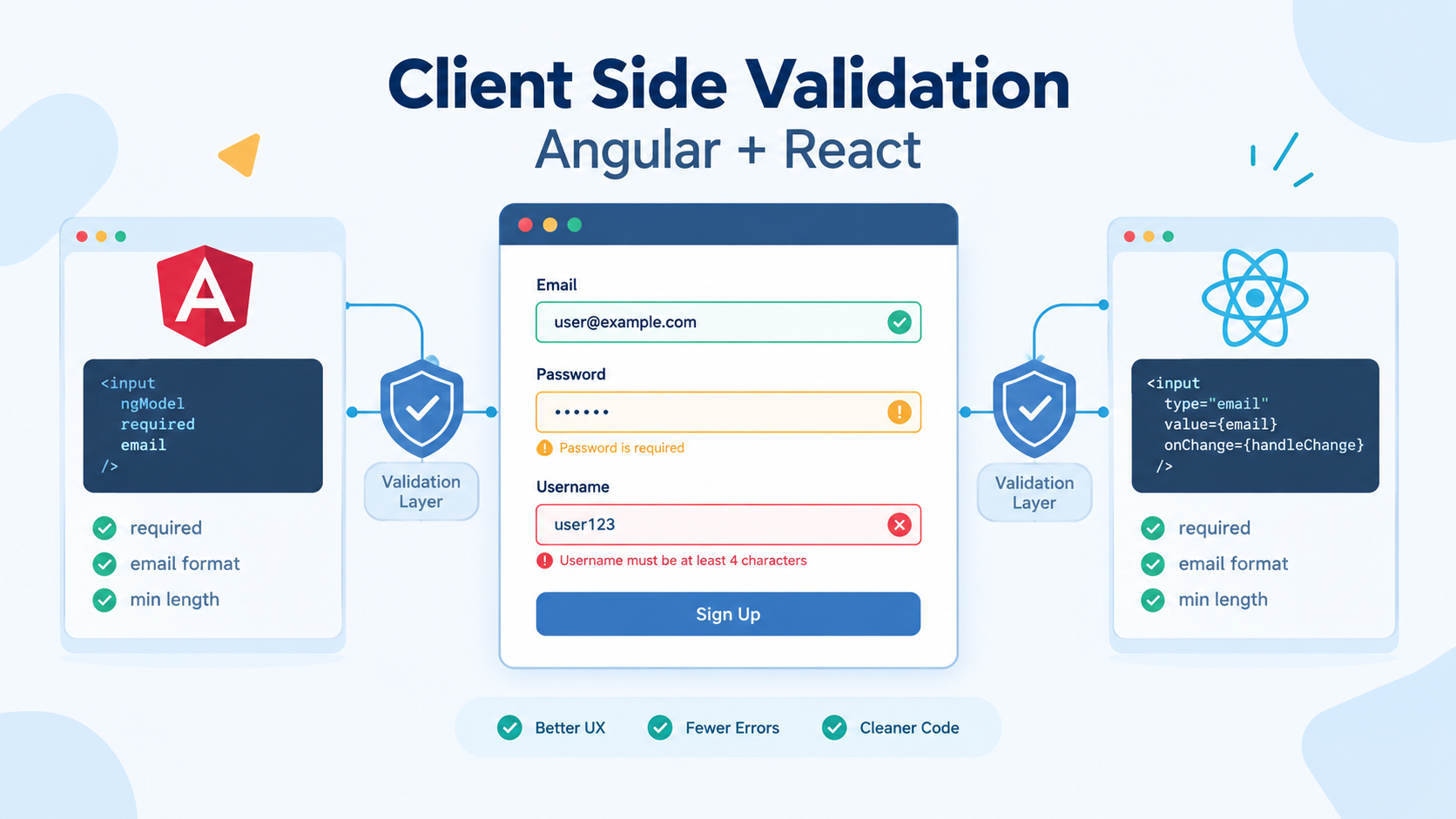

You’re probably looking for a client side validation framework Angular React because you want forms that are reliable without creating extra complexity. While frameworks and libraries can help, they do not replace good validation design.
At Secure Coding Practices, we focus on practical principles that keep validation clear, testable, and secure across different codebases. This guide looks at where frameworks fall short and what actually works for long-term maintainability. Keep reading to see how to build validation that lasts.
What You’ll Take Away
Good validation is not only about checking whether an input is correct. It also affects security, testing, and how easily your code can change later.
- Frameworks often overcomplicate validation with unnecessary abstraction, making simple rules hard to debug.
- Secure coding practices applied to validation logic prevent common data integrity and security flaws from the start.
- Treating validation as a core design pattern, not a plugin, leads to more resilient and testable applications.
What’s Wrong With Most Validation Frameworks?
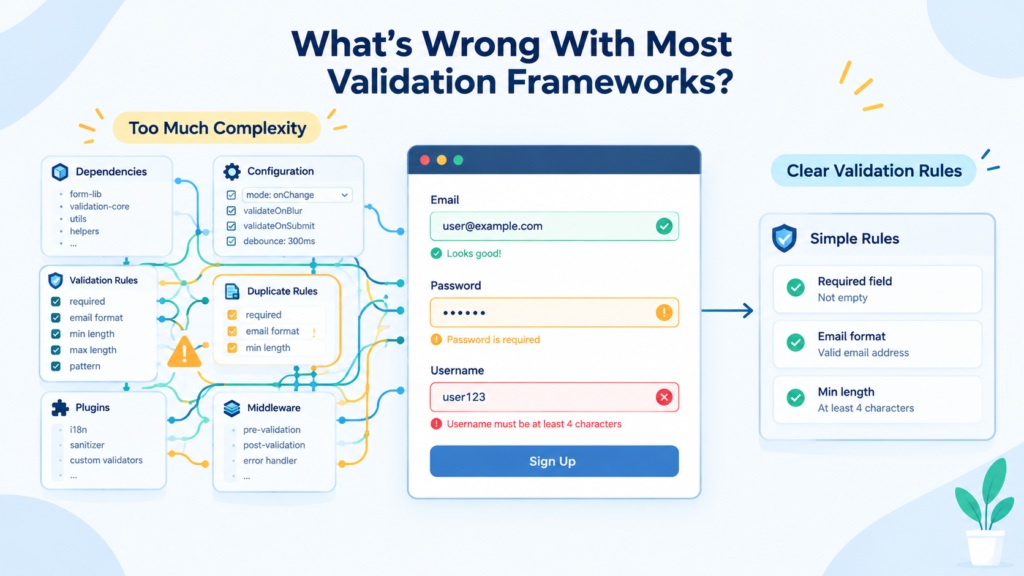
They sell a dream of less code. You import the module, define a schema, and magic happens. But then you need a custom async validator that checks a server-side field. The framework’s documentation gets fuzzy.
You’re deep in a GitHub issue thread from 2021, trying to make a square peg fit a round hole. The abstraction leaks, and suddenly you’re writing more code to fight the framework than you would have writing the logic yourself.
This complexity isn’t theoretical. I once inherited a React project using a popular validation library. A simple “password confirmation” rule was broken because the library’s conditional validation syntax was so obscure, the original developer misinterpreted it.
We spent half a day fixing what should have been a one-line function. The framework didn’t prevent errors, it just made them more mysterious.
Common pitfalls of validation libraries include:
- Opaque error paths that are hard to unit test.
- Tight coupling between validation logic and UI component lifecycle.
- Performance overhead from unnecessary re-renders or change detection cycles.
- Bloated bundle size for functionality you could write succinctly.
How Do Secure Coding Practices Fix This?
We stopped looking for a framework and started writing validation as if it were a public API. The principle is simple: validation is a pure function. It takes data, it returns a result. No side effects, no component state, no magic. In our codebase, we call these “validation contracts.” This approach is the heart of secure coding practices for the frontend.
“Some of the most rampant problems in software security originate from improper input validation… This is partly due to ad hoc approaches taken by software developers when dealing with user inputs… The main source of this problem is how the input validation countermeasures are implemented rather than the lack of good security solutions.” – Ieeexplore
This function lives in a /validators folder. It’s immediately testable with Jest or Vitest. It can be used in an Angular reactive form, a React Hook Form, a Vue component, or a Node.js API route while keeping input validation logic independent from the framework.
The logic is centralized and sovereign. This is secure coding because the rule is explicit, isolated, and auditable. There’s no “magic” string that could be misinterpreted.
When validation is just functions, security improves naturally. You can easily add common safeguards. For example, sanitizing input against XSS becomes another function in the chain. Checking for realistic birth dates or preventing oversized payloads is just another line of pure logic.
The framework doesn’t get in the way, and the developer stays in control of the data flow. This control is what prevents the subtle bugs that slip through abstracted validation layers.
Should You Use Built-in Framework Features?
| Framework | Built-in or Common Feature | How It Works With Pure Validators | Main Benefit |
| Angular | Reactive Forms | Use a custom validator adapter that passes the field value to your pure validation function. | Handles form state, change detection, and error management. |
| React | React Hook Form | Use a custom resolver to connect your function-based validation schema. | Handles form state, event binding, and validation flow. |
| Pure validation logic | Custom functions | Keep rules such as validateEmail() independent from the framework. | Makes validation rules simple, reusable, and portable. |
In Angular, Reactive Forms can work alongside pure function validators:
this.emailControl = new FormControl(”, [
(control) => validateEmail(control.value)
]);
This gives us Angular’s change detection and error-state management while keeping the actual validation rule portable. In React, React Hook Form can use a custom resolver to connect the same function-based validation schema.
The key is to let the framework handle the mechanism, such as state updates, event binding, and form status, while our code handles the rules. Built-in features are especially useful for user experience because they can manage errors on blur or after submit, along with dirty and pristine states.
What Does a Robust Validation Pattern Look Like?
Credits: Javid Code
It starts with a single source of truth. We define all validation rules in one place, as a collection of pure functions. These functions are organized by domain entity: userValidators, orderValidators, paymentValidators.
Each file exports small, composable functions like validateEmail, validatePasswordStrength, validateDateRange.
These validators are combined into “schemas.” A schema is just a plain JavaScript object that maps field names to an array of validator functions. It’s data, not code.
export const userRegistrationSchema = {
email: [validateRequired, validateEmailFormat, validateEmailNotTaken],
password: [validateRequired, validatePasswordLength, validatePasswordComplexity],
agreeToTerms: [validateIsTrue]
};
This schema can be consumed by a small, framework-specific adapter. We wrote a 50-line useValidation hook for React and a simple FormService class for Angular. These adapters loop over the schema, run the functions, and format the errors. The complex, important part, the rules, remain framework-agnostic and simple.
“Current practices in mainstream web development isolate the construction of the client component of an application from the server component… Independent development is problematic when the client and server share application logic. In this paper, we are concerned with a specific kind of application logic shared by the client and server: the input validation logic… Necessarily then the client and the server must implement the same input validation logic if the application is to give users the interactive experience they expect, while ensuring the security of the application.” –Usenix
How Do You Handle Async Validation Elegantly?
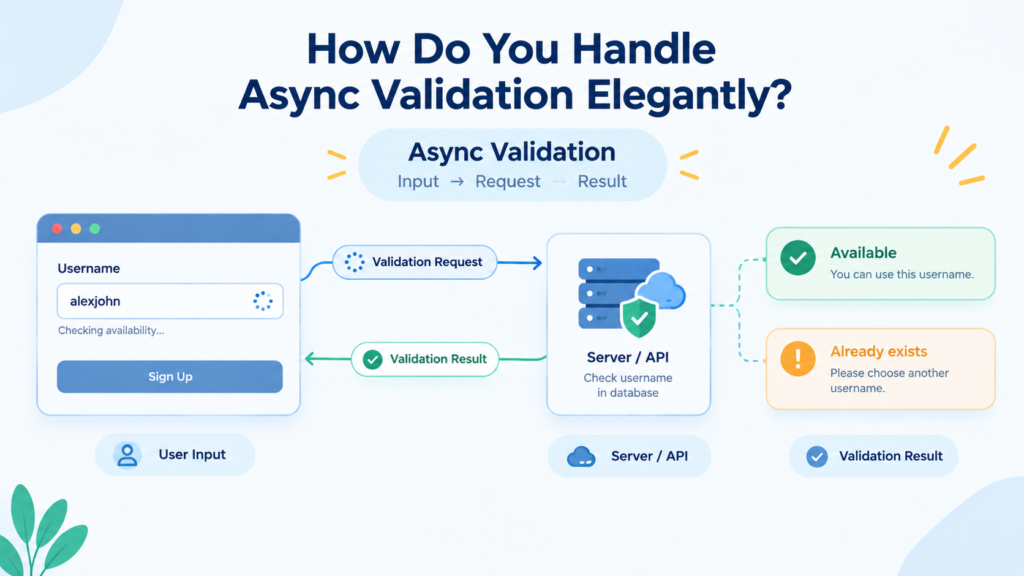
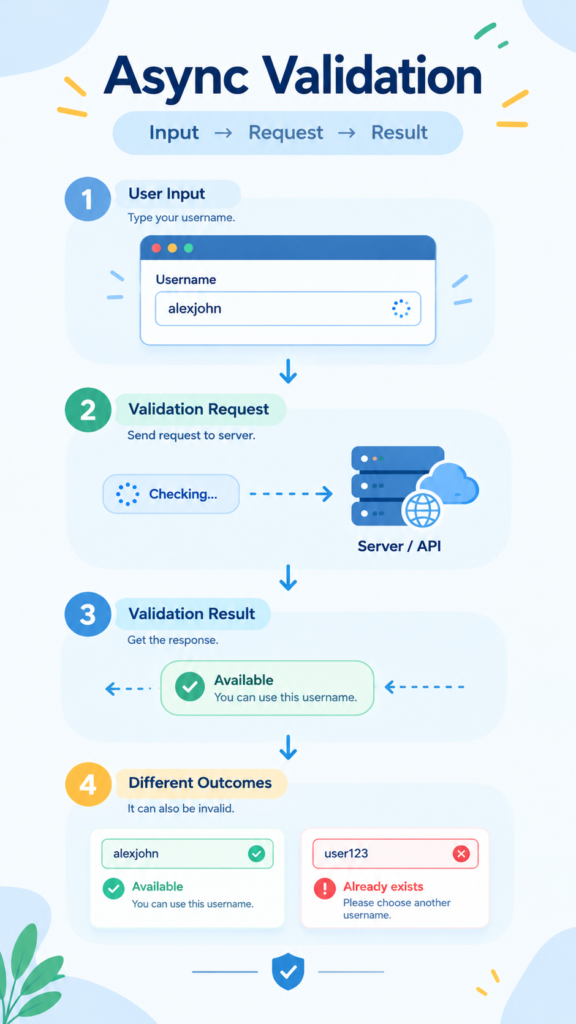
The pure function model handles this beautifully. An async validator is just a function that returns a Promise. In our schema, it’s another item in the array.
{
username: [
validateRequired,
validateMinLength(3),
async (value) => {
const isAvailable = await api.checkUsernameAvailability(value);
return isAvailable ? [] : [‘Username is taken’];
}
]
}
The adapter’s job is to run these functions, await the promises, and collect the results. It manages the loading states, perhaps debouncing the API calls to avoid spamming the server. The business logic, “is this username available?”, is still a clear, standalone function. It’s not hidden inside a framework’s proprietary async syntax.
This approach avoids the common pitfall of mixing async logic with form state management. The validation function is concerned only with validation. The adapter handles how the validation framework works with the form, including running validators in sequence, caching results where appropriate, and cancelling outdated requests.
This separation keeps your codebase nimble. When you need to change the API endpoint or add a new check, you modify one function, not a chain of framework configuration.
FAQ
Can I use this pattern with server-side validation?
Absolutely. It’s ideal for it. The same pure validator functions can and should be imported and run on your backend (Node.js, for instance) before data hits your database. This creates a true shared validation layer, eliminating logic drift between client and server.
Isn’t writing validators from scratch more work?
Initially, yes. You’ll write validateEmail once. But over a two-year project with dozens of forms, you’ll save hundreds of hours not debugging framework quirks, wrestling with major version upgrades, or reinventing logic that should be shared. It’s an investment in simplicity.
What about complex conditional validation?
Pure functions handle conditionals trivially. A validator can receive the entire form data object as a second argument. validateEndDateAfterStartDate(endDate, { startDate }) is straightforward. You write clear if statements, not complex configuration trees.
Doesn’t this add boilerplate code?
It adds explicit code. Every line does one clear thing. There’s no hidden behavior. This explicitness is the opposite of boilerplate, it’s direct communication of intent, which is the best kind of code for a team to maintain.
Building Validation That Lasts
The search for the perfect client-side validation framework can be a distraction. By using secure coding practices, such as pure, testable validation functions, you can build a system that lasts beyond any library. It works in Angular today, React tomorrow, and whatever comes next.
For developers who want practical security skills, the Secure Coding Practices Bootcamp covers input validation, secure authentication, encryption, OWASP Top 10, and safe dependency use through hands-on coding sessions. Start with one complex form and extract its rules into a simple JavaScript file.
References
- https://ieeexplore.ieee.org/document/7299956
- https://www.usenix.org/system/files/conference/webapps12/webapps12-final19.pdf