
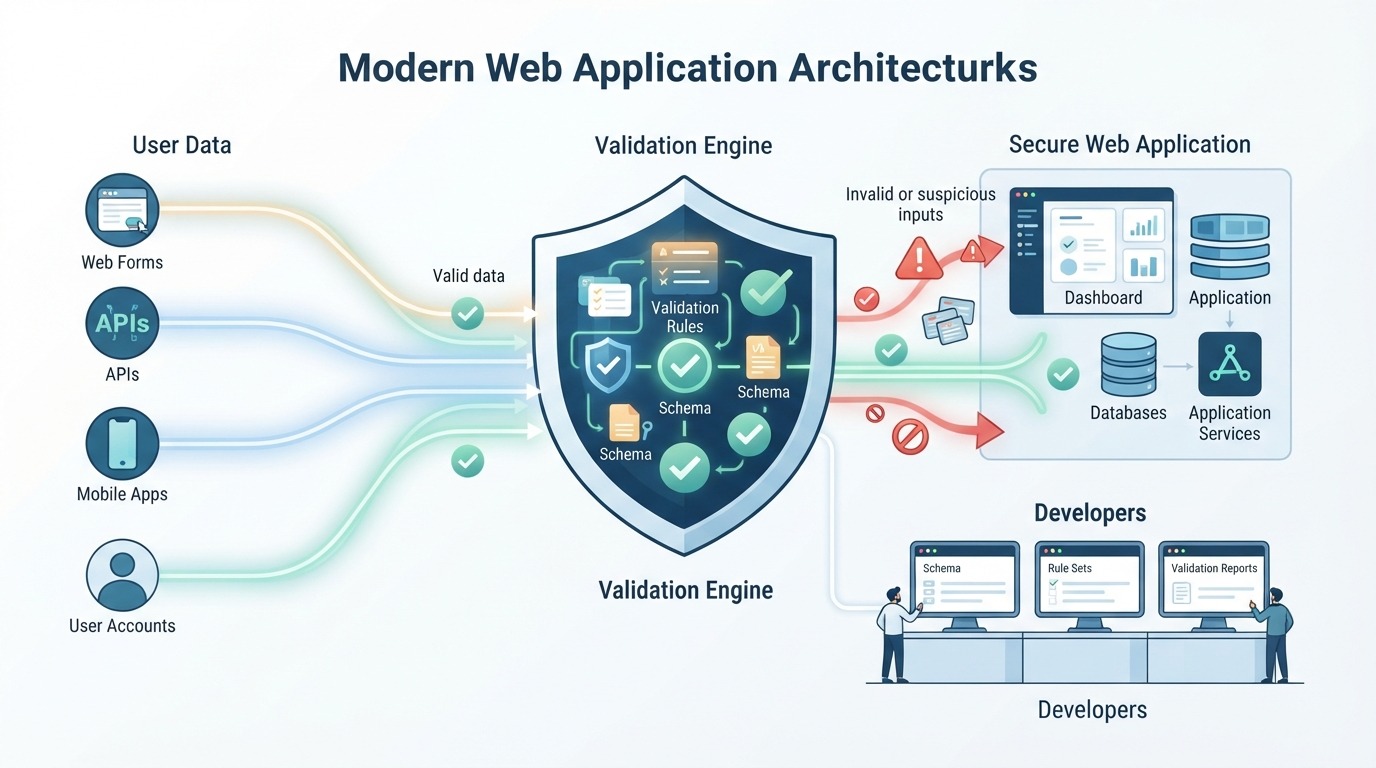

Every web application depends on data flowing from users, APIs, and external services. Without proper validation, that data can introduce bugs, security vulnerabilities, and inconsistent behavior throughout your system. At Secure Coding Practice, we encourage developers to treat validation as a foundational layer rather than an afterthought.
A well-integrated validation framework helps enforce rules consistently, keeps application logic cleaner, and protects critical components from harmful input. Keep reading to discover how a integrating validation framework web application can strengthen your application from the ground up.
Why Validation Frameworks Become Your Application’s First Line of Defense
Before data reaches your database, business logic, or external integrations, it should pass through a trusted validation layer. This approach creates a reliable checkpoint that improves both security and stability while reducing long-term maintenance costs.
- It stops bad or malicious data at the door, protecting your database and business logic.
- It centralizes your rules, making your code cleaner, more consistent, and easier to maintain.
- It’s a core pillar of secure coding practices, directly preventing common attacks like SQL injection.
Why Should You Care About Input Validation Right Now?
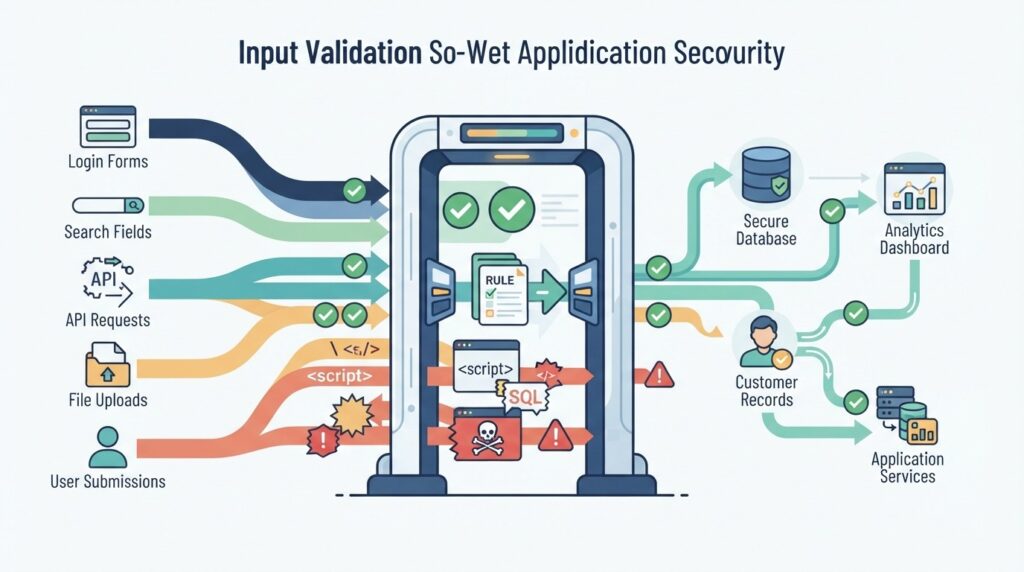
Think of your web application as a house. Every form field, every API endpoint, is a window or a door. Validation is checking those entry points, not just once, but every single time someone interacts with them. Without it, you’re inviting trouble. We once built a dashboard that pulled data based on a user ID from the URL.
“Input validation is a programming technique that ensures only properly formatted data may enter a software system component.” – Wikipedia
It worked perfectly, until someone changed the ID to ‘ OR ‘1’=’1. Suddenly, they saw everyone’s data. That was a long night. It wasn’t a complex hack, it was a missing validation check. These oversights happen when you’re moving fast, focusing on features.
But the cost of cleaning up a data breach or a corrupted database is always higher than the cost of building the guardrail in the first place. Validation isn’t a fancy add on, it’s basic digital hygiene.
What Exactly Does a Validation Framework Do For You?
A framework automates the tedious work. Instead of writing endless if statements in every controller function, you define rules in one place. Say you have an email field. Your rules might be: required, must be a valid email format, maximum 254 characters.
The framework checks incoming data against these rules. If the data passes, it flows through to your business logic, clean and trustworthy. If it fails, the framework catches it and returns a clear error message, like “Please enter a valid email address,” without you having to manually construct that response.
This consistency is huge. It ensures that an email is validated the same way on the login page, the registration form, and the profile update screen. You get uniformity and security, without the repetitive code. It turns a scattered defense into a unified front.
| Validation Approach | Where It Runs | Primary Strength | Key Limitation |
| Client-Side | User’s browser | Immediate user feedback, reduces server load. | Easily bypassed; cannot be trusted for security. |
| Server-Side | Your application server | Secure, authoritative, protects your core systems. | Feedback loop to user is slower. |
| Framework-Integrated | Server, with rule definitions | Centralized rules, consistent, maintainable, secure. | Requires initial setup and learning. |
How Do You Choose the Right Validation Tools?
Don’t start from scratch. Modern programming ecosystems have mature, battle-tested input validation frameworks and validation libraries. Your choice often depends on your tech stack.
The key is to pick something that integrates smoothly, not something that fights your architecture. Teams evaluating different approaches often review validation libraries in Python to compare schema design, rule definition, and error handling patterns. Look for clarity in defining rules and readability in error messages.
They help you build security in, not bolt it on later. The best tool is the one your team will use consistently across every project.
Where Do You Even Begin Implementation?
Start small. Pick one new form or one API endpoint. Map out all the data points it accepts. For each piece of data, ask: what does correct look like? Is it required? What’s the allowed format? What are the minimum and maximum lengths? Write these rules down. Then, using your chosen framework, implement them.
You’ll likely use a schema or a decorator-based system. For instance, you might annotate a data class with @IsEmail() or define a JSON schema that says “username”: { “type”: “string”, “minLength”: 3 }.
If you’re using a full-stack framework, it probably has a validation module built-in or as a first-party add-on. Start there. Developers working with validation frameworks in Java often benefit from using tools that align closely with their existing framework patterns, making adoption smoother across the codebase.
This declarative approach is powerful. You’re stating what you want, not writing every step to get there. Once it’s working for that one component, you’ve got a template. You’ll use it for the next one, and the next. The pattern spreads.
- Define your data models with validation rules attached.
- Apply validation at the boundary of your system, like in controller methods.
- Sanitize and escape data after it’s validated, before any processing.
- Always use parameterized queries for database access.
How Does Validation Tie Into Overall Security?
Credits: Inspire EU
Validation is your first, crucial filter. It works hand-in-glove with other security layers. It ensures data is sane before you sanitize it for output, and before you use it in a database query. Think of it as a sequence. First, validation asks, “Is this data shaped correctly?” Only if “yes” does the data move on.
Then, encoding or sanitization asks, “How can I safely display this data in HTML?” Finally, your database layer uses parameterized queries, which are immune to SQL injection from validated data. It’s a defense-in-depth strategy.
A validation framework formally enforces step one. It makes the secure path the default path for developers. By centralizing the rules, you ensure that a new developer on the team automatically follows the security standards you’ve set, simply by using the framework.
Can You Share a Real-World Integration Example?
We remember integrating a validation framework into a legacy Node.js service. The code was a patchwork of manual checks. We decided on a library that used schema validation. The first endpoint we tackled was a /user/update endpoint. It accepted a JSON payload.
We defined a strict schema: userId was a required number, email was an optional string that had to be an email format. The transformation was immediate. Gone were the 40 lines of conditional statements. They were replaced by a 10-line schema definition.
When a request came in with “email”: “not-an-email”, the framework rejected the entire payload with a 400 error, listing the precise violation. It didn’t touch our business logic. The code was cleaner, and we had confidence that any data passing through was pre-vetted. It felt less like adding code and more like installing a safety feature.
What Are the Common Pitfalls to Avoid?
The biggest mistake is relying solely on client-side validation. It’s great for user experience, providing instant feedback. But it’s purely cosmetic for security. Anyone can disable JavaScript or send a direct POST request to your API. Your server-side validation is the only authority. Another pitfall is being too permissive.
A “phone” field that accepts any character is asking for trouble. Define strict patterns. Also, avoid revealing too much in error messages. “Invalid SQL syntax near ‘@’” is a goldmine for an attacker.
Use generic but helpful messages like “Invalid input provided.” Finally, don’t forget to validate data types. A parameter expecting a number should reject the string “ten” immediately. Type safety is a form of validation, and your framework should help enforce it.
How Do You Maintain and Evolve Validation Rules?
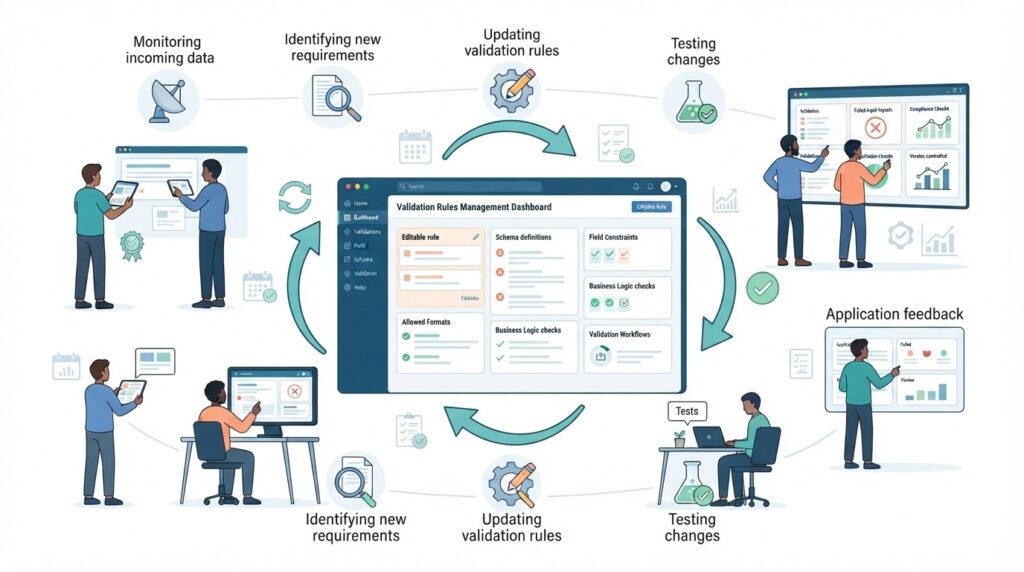
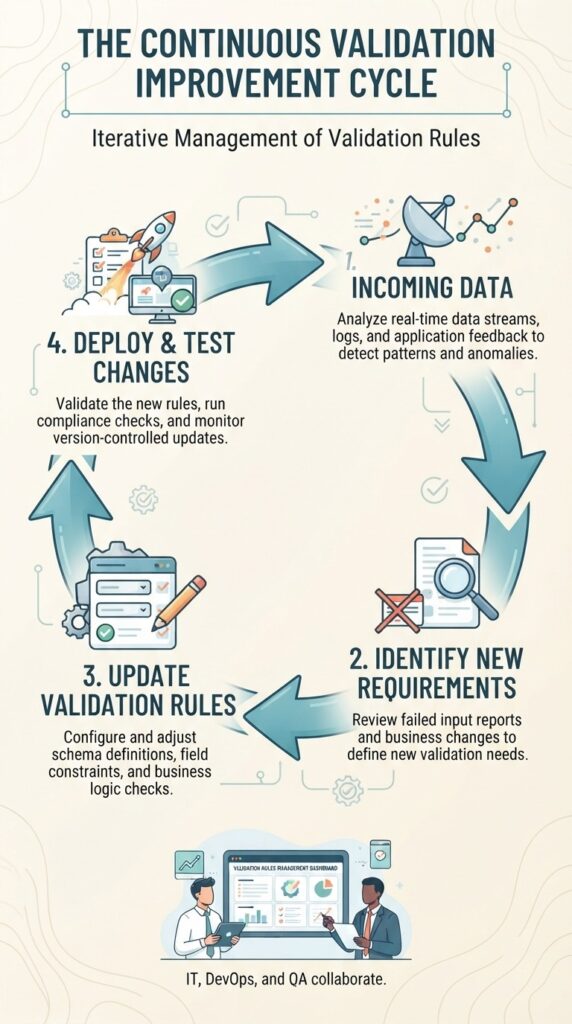
Your validation rules are a living document. As your application grows, so will your data structures. A field that was optional might become required. A product SKU format might change. This is where the centralized nature of a framework pays dividends. Instead of searching through dozens of files for if statements, you update one rule definition.
“Input validation does not always make data ‘safe’ since certain forms of complex input may be ‘valid’ but still dangerous. For example, a valid email address may contain a SQL injection attack or a valid URL may contain a Cross Site Scripting attack. Additional defenses besides input validation should always be applied to data such as query parametrization or escaping.” – Faster Capital
It’s good practice to treat your validation schemas as important application configuration. We often version them alongside our API versioning. When you change a rule, ask: will this break existing clients? If so, you might need to support the old rule for a while, or version your endpoint. Regularly review your rules.
An audit might reveal that a “comments” field you added years ago now accepts 10,000 characters, which could be a vector for a denial-of-service attack. Trim it down.
FAQ
Doesn’t client-side validation make server-side validation redundant?
Absolutely not. Client-side validation is for user experience, making the interface feel faster and more responsive. Server-side validation is for security and data integrity. It is non-negotiable. You must always validate on the server, as client-side checks can be trivially bypassed.
How do you handle complex, conditional validation logic?
Most mature frameworks support conditional rules. You can define logic like, “If the accountType field is set to ‘business’, then the taxId field is required.” This is done within the validation schema itself, keeping the complex logic out of your main application code and maintaining a single source of truth for data rules.
Is input validation enough to prevent SQL Injection?
No, it is a critical first step, but it is not sufficient on its own. Validation ensures data is in the expected format. You must also use parameterized queries or prepared statements for all database interactions. This two-layer approach, validation first, then safe query execution, is what provides robust protection.
Can validation impact my application’s performance?
There’s a minimal overhead, but it’s negligible compared to the performance cost of processing bad data, hitting the database with invalid queries, or dealing with a security incident. The performance impact of good validation is almost always a worthwhile trade-off for the stability and security it provides.
Your Foundation for Solid Applications
Integrating a validation framework may not be the most visible improvement you make, but it is one of the most valuable. Every validation rule strengthens the reliability, security, and maintainability of your application. Instead of reacting to bad data and security incidents, you create a proactive defense that protects your systems from the start.
Ready to build stronger security habits? Join the Secure Coding Practices Bootcamp and gain hands-on experience with input validation, secure authentication, OWASP Top 10 risks, and practical secure coding techniques. Learn more at Secure Coding Practices Bootcamp
References
- https://en.wikipedia.org/wiki/Web_framework
- https://fastercapital.com/content/Validation-Framework–Ensuring-Integrity–The-Role-of-Validation-Frameworks-in-Model-Audit-Rules.html