
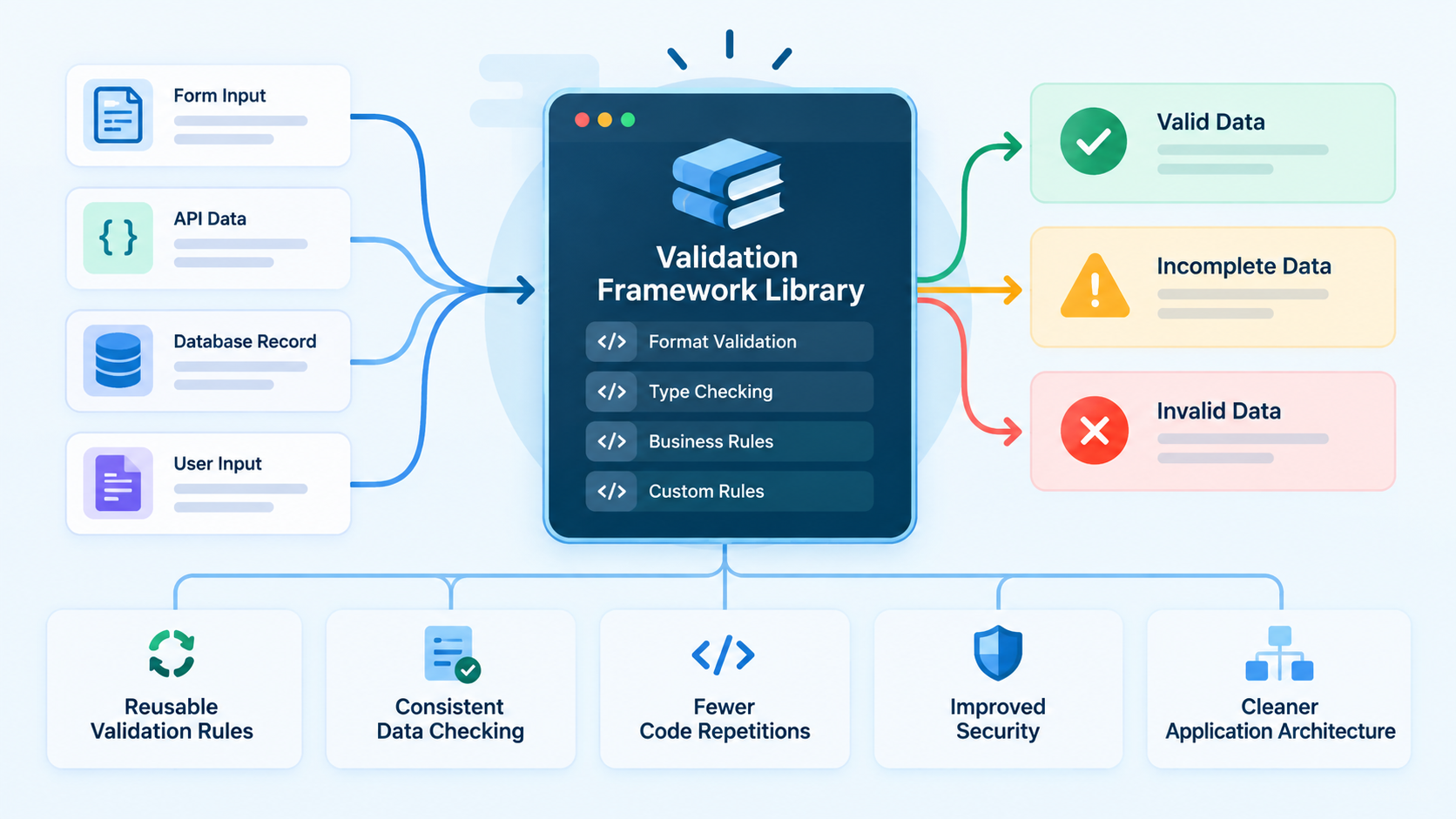

A benefits using validation framework library can make input validation faster, safer, and easier to maintain. Instead of writing every validation rule from scratch, developers can use structured and reusable rules for common checks.
This reduces repetitive code and helps prevent small mistakes from spreading across an application. It can also support Secure Coding Practices by making validation more consistent and easier to review. From saving development time to improving code quality, the benefits go beyond simple convenience. Keep reading.
3 Benefits Benefits Using Validation Framework Library Worth Using
Using a validation framework library can improve both the development process and the code itself. Here are three key benefits:
- A validation framework eliminates repetitive, error-prone code, centralizing rules for consistency and security.
- It provides built-in protection against common threats like injection attacks and data type confusion by default.
- The declarative nature of these libraries makes business rules clear, speeding up both development and onboarding.
What Problem Does a Validation Framework Actually Solve?
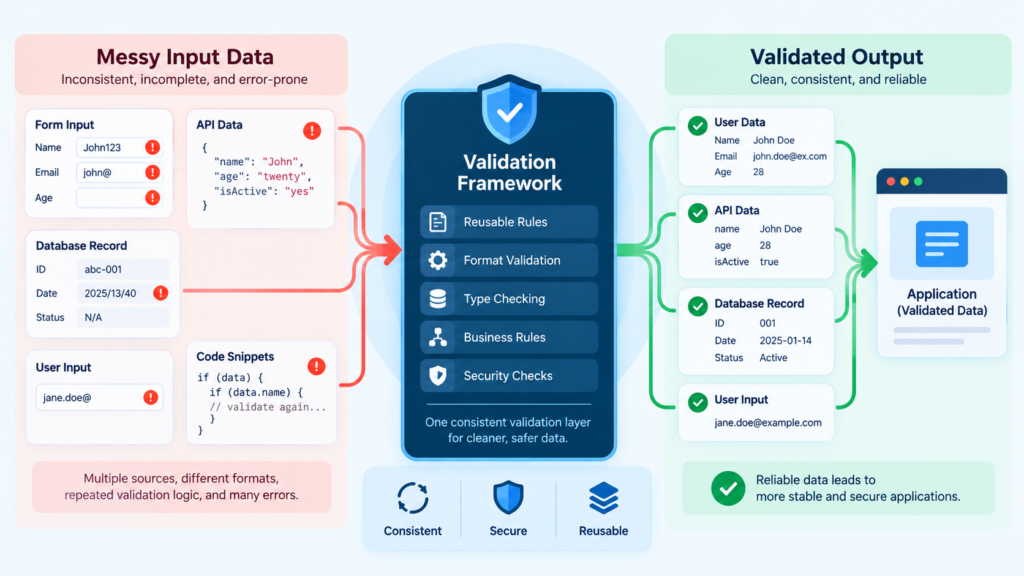
It solves the problem of human memory. We forget. We write a popular validation rule for an email field in the registration form, but then forget to apply the same rule in the profile update endpoint.
Now you have two different definitions of a “valid email” in your system. A framework library defines that rule once, in a model, a schema, a declarative block. Everywhere that data object is used, the same rules apply automatically.
It’s not just about consistency for the user, it’s about security. An inconsistency is a crack, and cracks are where vulnerabilities form. By centralizing the rules, you eliminate an entire category of oversight.
How Does It Make Your Application More Secure?
Security isn’t just about keeping bad data out, it’s about ensuring good data is well-formed. A robust validation framework does this by operating on principles, not just patterns. Instead of checking for a single malicious character, it defines the entire shape of what is allowed. It validates type, length, format, and range in one atomic operation.
This comprehensive check stops injection attacks at the door because the payload simply doesn’t fit the allowed shape. The framework handles the edge cases, unicode, null bytes, extreme lengths, that handwritten regex often misses. It turns security from a feature you bolt on into a property that emerges from the design.
Can It Really Speed Up Development?
Credits: Codecademy
The first time you use one, it might feel slower. You’re learning a new syntax. But quickly, it becomes a massive accelerator. Think of the steps you skip: writing the conditional logic, writing the error message, wiring that error back to the user, logging the failure for debugging.
The framework does all that. You declare: “This field is a string, required, between 3 and 50 alphanumeric characters.” The library generates the runtime logic, the error messages, and the hooks for your UI. What used to take 20 lines of code per field becomes one.
That time compounds. It lets you prototype faster and, more importantly, refactor with confidence. Changing a rule is a one-line edit, not a scavenger hunt through a dozen controller files.
What Does Consistency Look Like Across a Team?
Chaos is the default on a team without shared validation. One developer uses a regex for phone numbers, another uses a string length check, a third finds a npm package from 2017. The user gets three different error messages for the same problem. A framework library is the team’s standard. It’s the style guide for data.
“Input validation is a programming technique that ensures only properly formatted data may enter a software system component. An application should check that data is both syntactically and semantically valid (in that order) before using it in any way.” – Socket
New developers onboard by reading the validation schema; they immediately understand the business rules for a “Customer” or an “Order.” Code reviews shift from “did you validate this?” to “is this the right rule?” This consistency is a silent force multiplier.
It reduces bugs, makes the codebase predictable, and turns a collection of individual efforts into a unified system.
How Does It Improve Data Quality and System Reliability?
Garbage in, gospel out. If your core data is messy, everything built on it can become unstable. A validation framework library works as a quality filter at every entry point, checking whether data matches the expected rules before it reaches your database, API, or cache.
This helps prevent malformed records from spreading through the system. Instead of fixing bad data later, developers can catch problems earlier and keep the application more predictable.
The benefits include:
- Cleaner data: Required fields, formats, data types, and value ranges can be checked before data is accepted.
- Fewer downstream errors: Business logic does not need to handle as many unexpected or malformed values.
- Consistent rules: The same validation standards can be reused across different parts of the application.
- Easier maintenance: Developers can update validation rules in a structured and centralized way.
- More reliable analytics: Reports and analytics have a stronger foundation when the underlying data follows known rules.
This also reduces repetitive defensive checks throughout the code. When validation happens consistently at the entry point, developers spend less time adding safeguards for problems that should have been caught earlier. The result is a cleaner data layer and fewer issues caused by inconsistent input.
Is the Learning Curve Worth It?
Any new tool requires investment. The curve for a good validation library, however, is surprisingly shallow. The concepts are familiar: required fields, string patterns, number ranges. The real learning is in adopting a declarative mindset, describing what you want, not instructing how to check it.
This shift pays for itself quickly. The time saved on debugging bad data alone often justifies the initial learning. Plus, most modern frameworks integrate seamlessly, making the setup straightforward. The initial hours of learning save hundreds of hours of future debugging and rewriting.
| Development Phase | Without Validation Library | With Validation Library |
| Initial Coding | Write 10-20 lines of conditional checks per field. | Declare 1-2 lines of schema rules per field. |
| Adding a New Field | Manually update every relevant form and API endpoint. | Add rule to central schema; enforcement is automatic. |
| Changing a Rule | Search and replace across multiple files, risk missing one. | Edit the single rule definition in the schema. |
| Onboarding a New Dev | Explain the “pattern” of validation scattered in the codebase. | Point them to the schema files as the source of truth. |
| Security Review | Audit countless conditional statements for logic flaws. | Review the centralized schema and framework config. |
What About Performance Overhead?
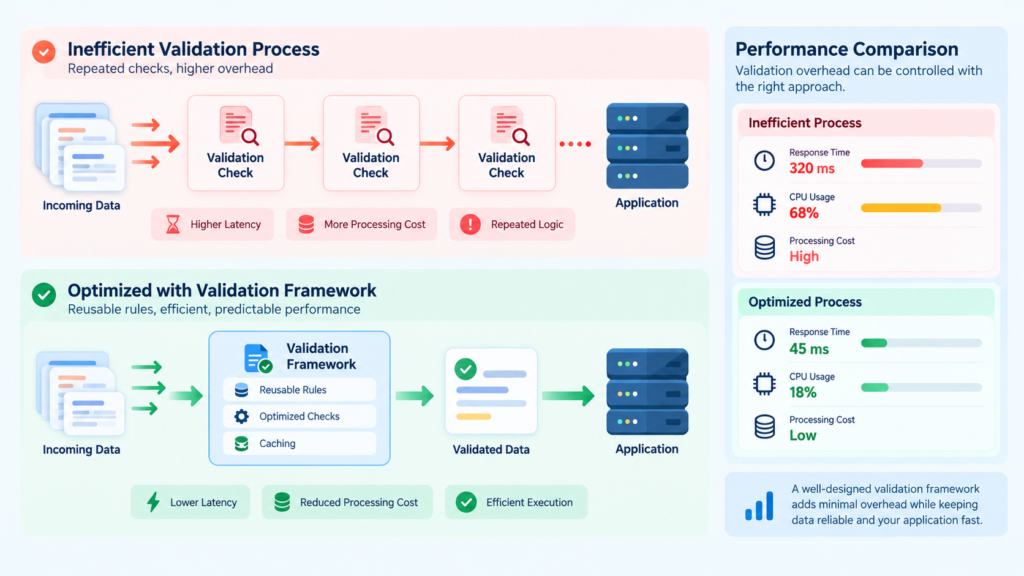
It’s a fair concern. An extra layer of abstraction must cost something. In practice, the overhead of a well-designed validation library is negligible for most applications, especially when weighed against the cost of a security breach or data corruption.
“Checking the valid syntax and semantics of information system inputs verifies that inputs match specified definitions for format and content. Input validation helps to ensure accurate and correct inputs and prevent attacks such as cross-site scripting and a variety of injection attacks.” – StigViewer
These libraries are highly optimized. More importantly, they often improve performance by catching invalid requests early, before they trigger expensive database operations or complex business logic.
You’re trading a few microseconds of CPU time for a guarantee that the data flowing into your core systems is valid. That’s a trade that makes sense in almost every real-world scenario.
How Does It Fit with Our Secure Coding Practices?
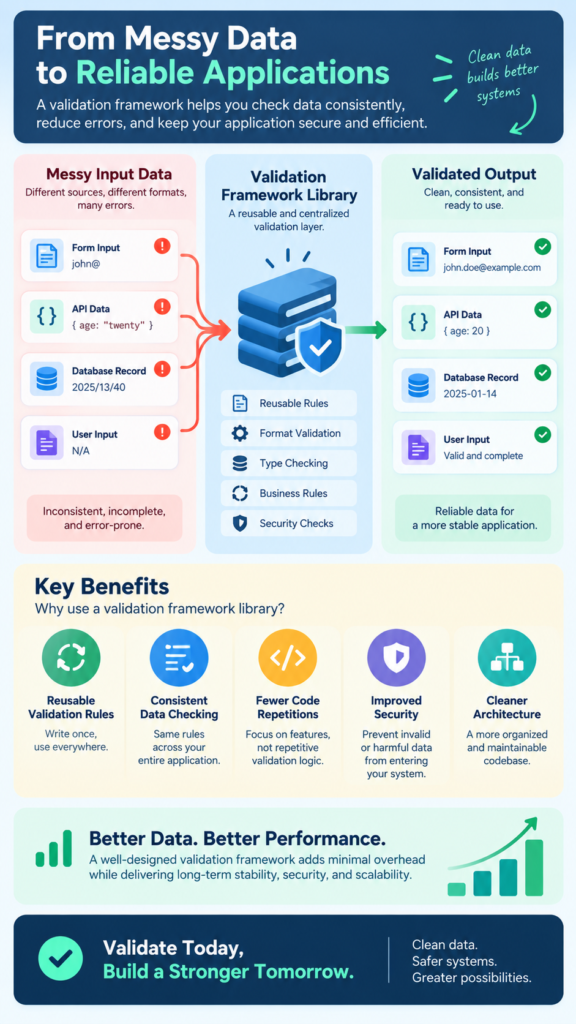
This is where it clicks. A validation framework isn’t a replacement for our secure coding practices, it’s the foundation that makes them scalable and enforceable. Our practice is to never trust input.
The framework gives us a systematic, reusable way to enforce that practice through robust input validation routines. Instead of each developer remembering to validate, sanitize, and escape, the framework provides the structure to do it consistently.
It becomes part of the fabric of the application, not an item on a checklist. We use the framework to establish the guardrails, so writing secure code becomes the path of least resistance, not a special effort.
FAQ
Doesn’t my web framework already do basic validation?
Most do, but it’s often minimal, checking for required fields or basic types. A dedicated validation framework provides depth and richness: custom validators, complex conditional logic, cross-field validation, and a unified approach for both client and server-side. It turns basic checks into a comprehensive data integrity strategy.
Can I validate complex, nested data structures?
Absolutely. This is where these libraries truly shine compared to handwritten code. They allow you to define schemas for deeply nested objects, arrays of objects, and conditional fields with ease. Validating a complex JSON API payload becomes straightforward, whereas doing it manually is a nightmare of nested loops and conditionals.
What if I need a validation rule that’s very specific to my business?
Every good library provides an escape hatch: the ability to write custom validator functions. You can encapsulate your unique business logic, like checking if a promotion code is valid for a specific product category, in a reusable function that plugs right into the declarative schema. You get the power of custom code with the framework’s consistency.
How do I handle internationalization of error messages?
This is a common pain point with roll-your-own validation. Robust frameworks have i18n built in or easily supported. You can define error message templates, and the library will interpolate the failed values. This separates the logic of validation from the presentation of errors, making it clean to support multiple languages.
Building on a Solid Foundation
A validation framework library turns repetitive checks into a consistent part of your codebase. It helps improve data quality, reduce bugs, simplify maintenance, and support safer development.
These benefits make validation an important part of Secure Coding Practices, not an afterthought. If you want practical training on input validation, OWASP Top 10, secure authentication, encryption, and safe dependencies, explore the Secure Coding Practices Bootcamp and build safer software with hands-on guidance.
References
- https://socket.dev/npm/package/tyforge#1
- https://www.stigviewer.com/controls/nist-800-53/SI-10