
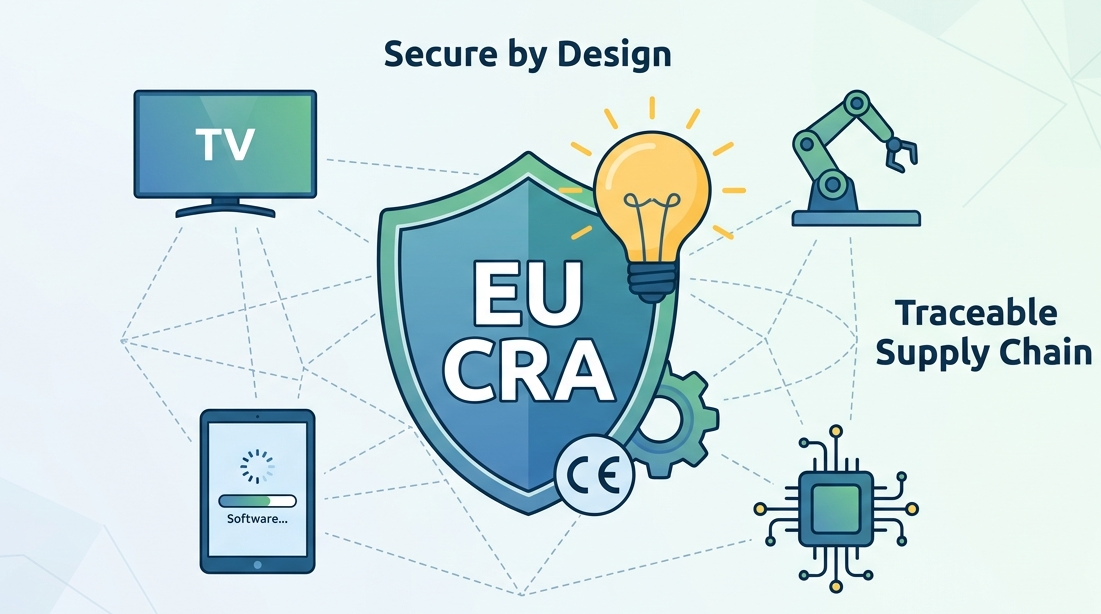

The European Union has created new rules to make digital products safer and more secure. These rules are part of the Cyber Resilience Act (CRA). They apply to many products such as smart devices, software, and connected systems.
The main goal is to make sure security is included from the beginning and kept throughout the product’s life. Companies must also report serious cyber problems quickly. These rules help reduce cyber risks, protect users, and build more trust in digital products used across Europe. Keep reading.
Key Insights on EU Digital Product Security Rules
There are three main ideas:
- The CRA makes security-by-design and default mandatory for all products with digital elements.
- Manufacturers must provide security updates and structured incident reporting, starting in September 2026.
- Non-compliance risks include fines, recalls, and CE mark revocation.
Products Covered by the CRA
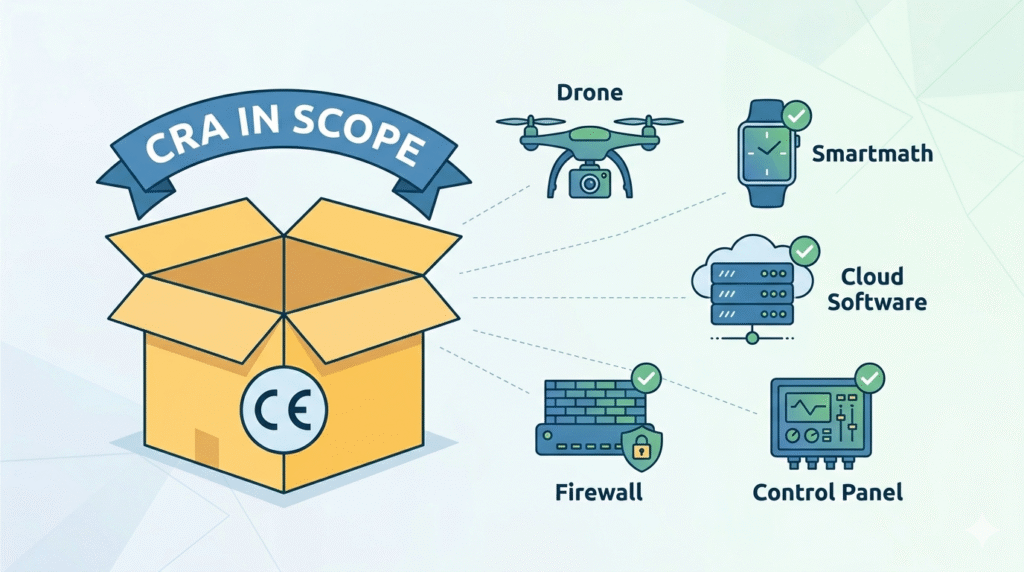
The CRA applies to a wide range of products that include digital elements. It does not matter if the product is physical or online. If it connects to software, networks, or data, it is included.
Examples of covered products:
- Consumer IoT devices like smart TVs, cameras, and wearables
- Industrial systems such as robots, sensors, and control machines
- Software applications and cloud-based services
- Cybersecurity tools like firewalls and antivirus systems
- Hardware components such as chips and embedded systems
Because the scope is very broad, most modern technology products are affected. Companies must first check whether their product is covered before entering the EU market.
| Product Type | CRA Requirements | Practical Action |
| Consumer IoT | Security-by-design, updates, incident reporting | Internal testing, self-assessment |
| Industrial Systems | Security-by-design + criticality assessment | Third-party conformity assessment for critical products |
| Software/Cloud Services | Secure lifecycle, privacy protection | Secure coding, automated scans, SBOM |
Security-by-Design and Default
The CRA requires that security shapes the product from concept to delivery. Key obligations:
- Security risk assessment: Identify threats and vulnerabilities.
- Secure Coding Practices: We integrate these from day one.
- Secure defaults: Disable open ports and default passwords.
- Data minimization: Collect only necessary data.
“Two major problems adding costs for users and society should be addressed: a low level of cybersecurity of products with digital elements, reflected by widespread vulnerabilities and the insufficient and inconsistent provision of security updates to address them, and an insufficient understanding and access to information by users, preventing them from choosing products with adequate cybersecurity properties or using them in a secure manner.” – European Commission
This ensures products are secure when unboxed and maintain integrity throughout their lifecycle.
Updates, Vulnerability Handling, and Incident Reporting
Credits: Hogan Lovells
Security doesn’t end at delivery:
- Automatic security updates for the product lifetime.
- Vulnerability handling: Receive reports, validate, remediate quickly.
- Incident reporting: Starting 11 September 2026, severe incidents must be reported:
- 24h: Early warning
- 72h: Full incident report
- 14d / 1 month: Root cause and remediation
Secure Coding Practices reduce the likelihood of incidents and support fast remediation.
Supply Chain Responsibilities
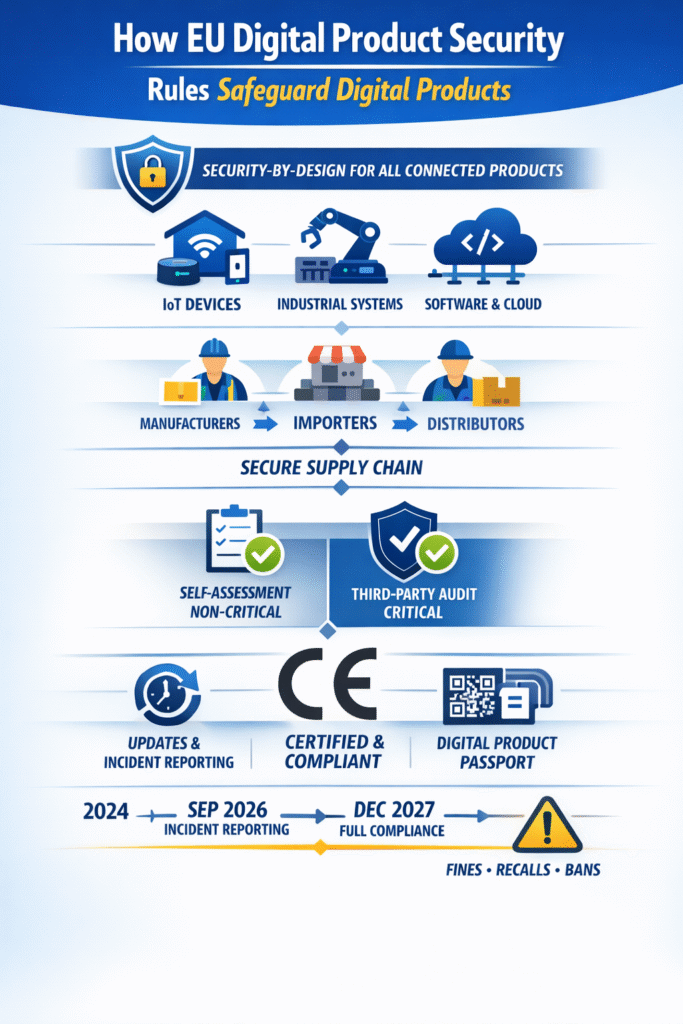
The CRA also requires accountability across the supply chain. Many digital products are built using parts from different companies, who must comply, so responsibility is shared.
Roles include:
- Manufacturers: Ensure full compliance and CE marking
- Importers: Check that products meet EU requirements before selling
- Distributors: Avoid selling unsafe or non-compliant products
Companies must also track software and hardware sources. This includes checking suppliers, software libraries, and third-party components.
Clear documentation helps ensure transparency and reduces risks from hidden vulnerabilities in the supply chain.
Certification and Critical Product Classification
Not all products are equal:
- Non-critical: Self-assessment with internal documentation.
- Critical: Products affecting safety or infrastructure require third-party conformity assessment.
“The vulnerability handling obligations set out in this Regulation, which manufacturers have to comply with when placing a product with digital elements on the market and for the support period, apply to products with digital elements in their entirety, including to all integrated components.” – ENISA
CE marking signals compliance and security readiness to consumers and partners.
Integration with Digital Product Passport
Digital Product Passports (DPPs) enhance security and transparency:
- Track material origin, software versions, carbon footprint, and repairability
- Accessible via QR codes or RFID/NFC tags
- Combine with Secure Coding Practices to unify cybersecurity and sustainability compliance
Timelines and Non-Compliance Risks
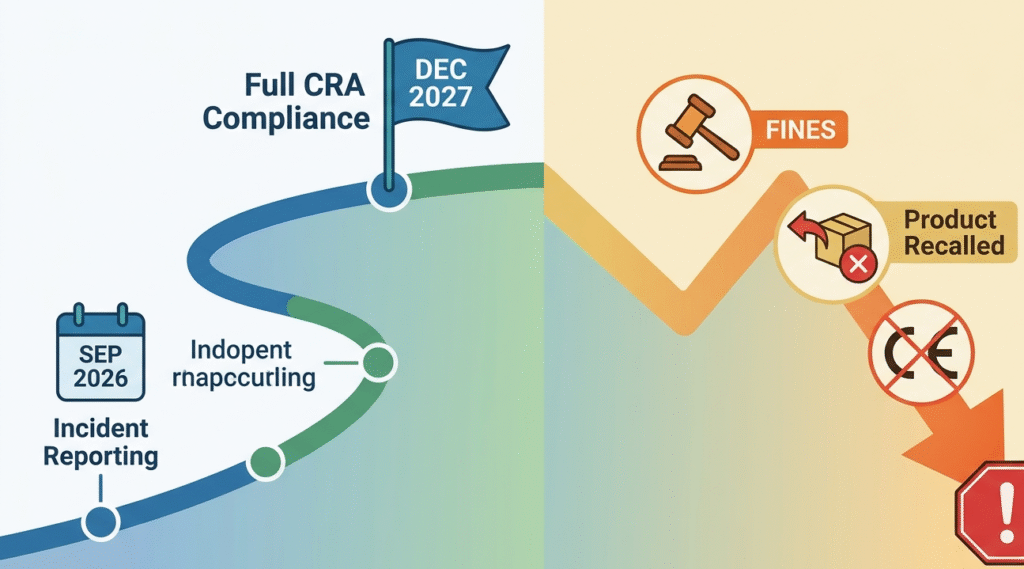
The CRA will be applied in stages, giving companies time to prepare for compliance.
Important deadlines include:
- 11 September 2026: Incident reporting becomes mandatory
- 11 December 2027: Full CRA compliance required
Companies must prepare before these dates to avoid risks.
Non-compliance can result in:
- Large financial fines
- Product recalls from the EU market
- Loss of CE marking
- Damage to company reputation
Because of these risks, companies should start preparing early by improving their security systems and processes.
Security Governance and Organizational Responsibilities
The Cyber Resilience Act (CRA) is not only about technology. It also requires companies to manage security in an organized way. This means every company must clearly assign responsibility for product security.
Key points:
- Companies must define clear security roles (who is responsible for what)
- Leaders must include cybersecurity in business planning
- Teams like developers, product managers, and security staff must work together
- Security must be part of every stage of product development
Companies must also keep important records. These include risk assessments, test results, and security updates. These documents are needed for audits and CE marking compliance.
Employee training is also very important. Staff must understand basic security rules like:
- Secure coding
- Handling vulnerabilities
- Reporting security problems
Without training, human mistakes can cause security problems even if the system is strong.
Companies also need to manage third-party suppliers carefully. This means:
- Checking if suppliers follow security rules
- Making sure external software is safe
- Reducing risks from weak partners
In short, security governance means building a “security culture” inside the company. It is not just about tools, but also about people, roles, and responsibility. This helps companies follow CRA rules and build safer digital products.
Risk Management and Vulnerability Handling Lifecycle
The Cyber Resilience Act (CRA) requires companies to manage security risks during the whole product lifecycle. This includes before and after a product is released.
At the beginning, companies must identify possible risks such as hacking, data leaks, or system failure. They should decide which risks are most serious and need priority.
Key steps in risk management:
- Identify security risks early in development
- Rank risks based on impact and likelihood
- Use secure coding to reduce weak points
- Test products before release
After the product is launched, companies must continue monitoring for problems. They should collect reports from users, researchers, and internal systems.
When a vulnerability is found:
- Check if the issue is real
- Measure how dangerous it is
- Fix it using updates or patches
Companies must also report serious issues within strict deadlines. This ensures fast response to cyber threats.
Documentation is also required. Companies must record:
- Risk findings
- Fixes and updates
- Incident reports
Good risk management helps reduce cyberattacks and system failures. It also keeps products safe, reliable, and compliant with CRA rules throughout their entire lifecycle.
FAQ
How can businesses ensure supply chain transparency for digital products under EU regulations?
Businesses need to keep supplier information accurate and updated. They must also track all Tier-1 suppliers and deeper parts of the supply chain to know where every component comes from. This helps companies avoid hidden risks and improve accountability.
One important tool is the Digital Product Passport (DPP). It uses QR codes or RFID tags to store and share product information such as material composition, product data, and end-of-life instructions. This system helps companies follow the Cyber Resilience Act rules, improves tracking of product lifecycles, and supports better transparency and reporting across the European Union.
What role does a Digital Product Passport play in managing product lifecycle data?
A Digital Product Passport (DPP) is a digital system that collects and organizes important product information in one place. It includes details such as material origin, product composition, carbon footprint, and sustainability information.
It also allows different companies in the supply chain (economic operators) to share data more easily. This supports wider goals like the Circular Economy Action Plan and helps ensure compliance with CE marking rules.
How should companies manage security updates for connected electronic and digital devices?
Under the Cyber Resilience Act, companies must continuously provide security updates for all connected electronic and digital devices. This means updates are not optional and must be maintained throughout the product’s lifetime.
Companies should also actively monitor cyber threats and use security systems to detect and fix vulnerabilities quickly. This helps ensure that devices stay safe while they are being used by customers.
What information should be included in supplier and product data for compliance?
Companies must collect and store detailed supplier and product information to meet EU requirements. This includes raw materials, material composition, chemical content, and the country where the product is manufactured.
They should also record product identifiers, carbon emissions data, and instructions for end-of-life treatment, such as recycling or disposal methods. This improves product transparency and supports sustainability reporting.
Preparing Your Product Portfolio
Start now: map your products against CRA requirements, conduct risk assessments, and verify suppliers’ secure development practices. Integrating Secure Coding Practices and traceable updates ensures products are robust, compliant, and ready for a connected European market.
To strengthen your team’s skills, consider the Secure Coding Practices Bootcamp, a hands-on 2-day course covering OWASP Top 10, secure authentication, encryption, and practical coding labs, equipping developers to build safer, compliant software from day one.
References
- https://digital-strategy.ec.europa.eu/en/policies/cyber-resilience-act
- https://www.enisa.europa.eu/topics/product-security-and-certification