


How will AI change software development workflows? AI is transforming workflows by automating repetitive coding tasks, running tests, generating scaffolds, and accelerating delivery cycles, freeing developers to focus on architecture, security, and strategic problem solving.
McKinsey & Company reports that AI-enabled product development can compress release timelines while improving quality outcomes. In our experience working with multiple engineering teams, AI-driven code generation and iterative testing have shortened feedback loops, reduced bottlenecks, and increased overall productivity.
This shift is already active inside sprint boards, CI pipelines, and pull request reviews. Keep reading to explore how these changes unfold in real-world workflows.
Quick Reads, Accelerating Development with AI
AI is already reshaping software workflows by automating repetitive tasks and streamlining iterations, but structured human oversight remains critical.
- AI acts as a workflow velocity multiplier, cutting cycle times and automating boilerplate without removing human oversight.
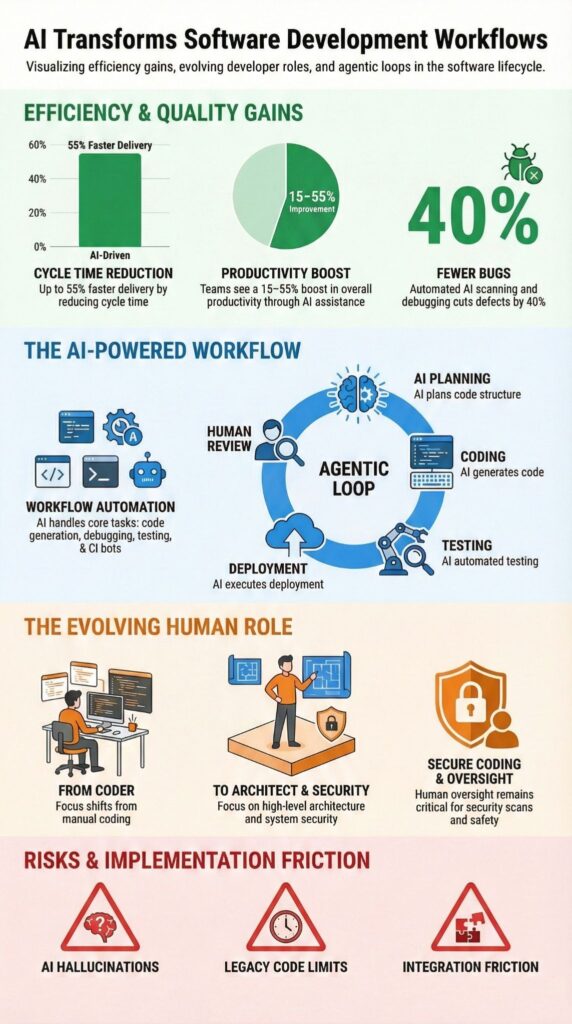
- Productivity gains range from 15% to 55%, with up to 40% fewer defects in structured environments.
- Secure Coding Practices remain essential as AI expands code volume and complexity.
How Is AI Automating Core Development Tasks?
AI is taking over repetitive coding, debugging, and testing tasks, letting engineers focus on architecture and complex system design. Across the teams we work with, AI-driven workflows have reduced turnaround times by up to 55%, accelerating delivery without sacrificing quality.
In our daily work, AI handles boilerplate code generation for CRUD endpoints, validation logic, and common UI components, cutting hours of repetitive effort into minutes.
As highlighted by healthit.gov
“When the AI chatbot is being used… it affects several business processes related to agency operations and core task structures… enhancing productivity and efficiency across these roles by providing coding assistance.” – healthit.gov
We often run AI pair programming sessions to isolate regression bugs during test-driven development workflows, ensuring changes remain safe and predictable.
Common AI-assisted workflow improvements include:
- Automating boilerplate code for APIs and front-end components
- Generating automated tests to increase coverage and consistency
- Accelerating code review via semantic diff analysis
- Drafting documentation from structured comments
When repetitive tasks are handled by AI, our focus shifts upward toward architecture, governance, and high-level problem solving. In our experience, that is where the most lasting value and innovation occur.
Does AI Really Increase Developer Productivity?

Yes, AI can boost developer productivity, but results depend heavily on workflow integration and governance. In our experience, structured AI-assisted processes reduce bug rates by roughly 40% and speed up code reviews by about 60%, especially when Secure Coding Practices are applied from the outset.
Research from sei.cmu.edu shows
“Generative AI promises to improve developer productivity and rate of production of related artifacts, and in some cases their quality.” – sei.cmu.edu
Key areas where AI improves workflow include:
- Automating repetitive code generation for APIs and UI components
- Generating unit and integration tests automatically
- Drafting documentation from structured comments
- Accelerating semantic diff code reviews
Productivity gains are strongest when AI integrates cleanly with version control, CI/CD pipelines, and automated DevOps workflows.
| Area | Reported Improvement |
| Task completion time | Up to 55% faster |
| Code review speed | ~60% increase |
| Bug reduction | ~40% fewer defects |
| Routine automation efficiency | 15–20% average gain |
When AI workflows are disciplined, structured, and continuously validated, productivity compounds, removing friction while keeping code reliable, secure, and maintainable.
What Are Agentic Workflows in Software Development?

Agentic workflows use AI agents to plan, write, test, and refine code in iterative loops, while humans maintain oversight to ensure quality, alignment, and security, reflecting broader shifts in AI-assisted development toward structured human-AI collaboration. These workflows aren’t about handing over control, they’re about structured collaboration between AI and developers.
The concept has gained attention through research from teams like OpenAI, which highlight autonomous development loops augmented with human validation.
From our perspective at Secure Coding Practices, the key is layering control. We always start with security: AI-driven vulnerability scans and compliance checks form the first layer before granting broader autonomy.
Here’s how agentic loops typically operate:
- Define feature using natural language specifications.
- AI proposes architecture and implementation plans.
- AI generates code along with unit and integration tests.
- Preview environments deploy isolated builds via AI.
- Human review validates logic, security, and performance.
We’ve found that these loops rely on measurable trust metrics, clear audit trails, and continuous monitoring. Without visible guardrails, AI autonomy degrades quickly. When combined with continuous security scanning and structured DevOps stages, agentic workflows allow teams to accelerate development safely, keeping human judgment central while leveraging AI efficiency.
Where Does AI Fall Short in Development Workflows?
AI excels at repetitive coding and scaffolding, but it struggles with legacy systems, ambiguous requirements, and undocumented edge cases, a limitation that becomes more visible as teams experiment with faster-paced vibe coding workflows.
In those situations, it can hallucinate logic that requires senior developers to step in and correct. Industry experts, including Google developer advocates, emphasize that human oversight remains essential for production-critical systems.
From our experience integrating AI into large monolithic applications, we’ve seen context-aware code generation perform impressively on modular microservices and orchestrated AI patterns. However, tightly coupled legacy systems expose gaps in semantic understanding that no AI model can fully anticipate.
Common friction points we encounter include:
- AI hallucinations in edge case handling
- Weak inference across undocumented legacy codebases
- Over-reliance by junior developers on AI suggestions
- Unexpected behavior during CI/CD pipeline integration
To mitigate these risks, we enforce Secure Coding Practices at every stage. Structured review gates, performance validation by optimization agents, and mandatory human approvals ensure AI expands output safely. Scaling AI-generated code requires scaling security in parallel, keeping oversight and accountability central to every workflow.
How Will AI Reshape Team Roles and Collaboration?
Credits : Depot
AI changes how teams work by taking over repetitive coding tasks, allowing developers to focus on architecture, security, and integration strategy while preparing teams for the future of conversational programming in daily development workflows. It doesn’t replace engineers; it reshapes their responsibilities.
From our experience, senior engineers now spend more time designing scalable AI agents and managing custom model fine-tuning pipelines.
Mid-level developers focus on prompt engineering and retrieval-augmented generation strategies using vector search across codebases. Junior developers benefit as well, routine task automation exposes them earlier to high-level problem solving, accelerating skill growth. AI acts as a bridge for skills rather than a replacement for humans.
Collaboration patterns evolve naturally with AI integration:
- Real-time collaboration agents enhance productivity for remote teams
- Git worktrees AI enable parallel feature development streams
- Continuous integration bots reduce merge conflicts
- QA automation tools shorten validation cycles
We’ve observed that while coding remains essential, the real value now comes from orchestrating these AI-assisted workflows. Teams that embrace this shift find architecture focus and strategic oversight becoming central to everyday development, with AI serving as an enabler rather than a substitute.
FAQ
How will AI-driven code generation reshape daily software development workflows?
AI-driven code generation changes daily workflows by automating repetitive coding tasks with clear intent.
Software development automation handles boilerplate code automation, basic tests, and common patterns. This creates a real developer productivity boost by reducing manual effort. Teams achieve measurable cycle time reduction dev results, fewer defects through bug reduction AI, and faster delivery while maintaining human oversight loops for quality control.
Can agentic AI coding safely improve reviews, debugging, and junior developer growth?
Agentic AI coding improves workflows by accelerating code review acceleration and supporting structured debugging with AI.
AI pair programming helps junior dev augmentation by explaining logic and suggesting fixes in context. Safety comes from hallucination mitigation dev practices, trust metrics coding, and required human oversight loops. These controls ensure learning benefits without sacrificing code correctness or team accountability.
What changes should teams expect in DevOps pipelines and deployment with AI?
DevOps pipeline AI introduces automated checks across testing, security scanning AI, and deployment streamlining.
Continuous integration bots catch issues earlier, while monitoring anomaly AI detects runtime problems. Rollback automation code reduces downtime during failures. Combined with version control smarts and preview environment AI, teams deploy faster, reduce errors, and maintain compliance through consistent audit and approval steps.
Will AI shift developer roles toward architecture and higher-level problem solving?
AI shifts developer focus away from routine task elimination and toward architecture focus shift and system design.
Developers spend more time on API design automation decisions, microservices orchestration AI planning, and performance tradeoffs. Full-stack dev acceleration improves frontend backend AI balance. However, creative decision AI limits require human judgment for complex tradeoffs, long-term maintainability, and responsible innovation acceleration dev.
What risks and metrics matter most when adopting AI across development workflows?
Successful adoption requires tracking ROI metrics AI tools, cost savings dev teams, and real productivity gains.
Risks include vendor lock-in risks, data privacy code AI concerns, and ethical AI development issues. Teams must apply bias detection workflows, compliance automation tools, and audit trail AI gen. Clear governance, transparent metrics, and human-AI symbiosis code ensure sustainable enterprise adoption.
AI Won’t Replace Developers, It Will Amplify Them
AI can speed coding and testing, but without secure coding practices and structured human oversight, faster loops become fragile systems.
When humans lead architecture, ethics, and validation while AI handles routine work, software becomes more reliable, maintainable, and innovative. The question isn’t if AI changes workflows, it’s whether you’re ready to guide it responsibly.
Take control of your AI-driven development. Join the Secure Coding Practices Bootcamp to embed security-first workflows, measure trust, and empower your team to build software that is fast, safe, and future-ready.
References
- https://cloud.google.com/discover/how-test-driven-development-amplifies-ai-success
- https://www.ibm.com/think/topics/test-driven-development