


Why a hybrid coding approach is often best? It combines native and cross-platform development with AI-assisted or workflow-first methods to balance speed, cost, and maintainability.
In our experience, putting Secure Coding Practices first ensures teams deliver efficiently without compromising safety. Frameworks like Flutter and React Native can reduce multi-platform development costs by 50–60%, while still allowing high-quality user experiences.
We have seen teams move faster, maintain cleaner codebases, and scale confidently. Keep reading to explore why hybrid strategies often outperform purely native or low-code approaches and how to apply them in practice.
Hybrid Coding Highlights, Practical Wins
These points capture why a hybrid coding approach is often best, summarizing the main benefits for teams balancing speed, cost, and maintainability.
- Cost & speed advantage: Reusing a single codebase can cut development costs by up to 60% and accelerate time-to-market.
- Performance balance: Native modules complement cross-platform frameworks for critical tasks without sacrificing user experience.
- Wide applicability: Hybrid approaches excel in mobile apps, AI workflows, and multi-platform scaling while mitigating technical debt when properly managed.
What Is a Hybrid Coding Approach?
A hybrid coding approach blends native and cross-platform tools with AI-assisted and manual coding methods to balance speed, cost, and maintainability across platforms.
In our Secure Coding Practices bootcamps, we start every project by embedding security first. This ensures each module meets baseline safety standards while giving teams the flexibility to choose workflow-first or code-first strategies depending on project needs.
As highlighted by TECHCOMMUNITY.MICROSOFT.COM
“A hybrid approach is not about picking one over the other; it’s about balancing them.” – TECHCOMMUNITY.MICROSOFT.COM
We combine multiple layers of development:
- Native development using Swift for iOS and Kotlin for Android
- Cross-platform frameworks like React Native and Flutter
- Low-code and AI-assisted generation for rapid prototyping
- Multi-platform deployment, from mobile apps to web platforms and AI orchestration
From our hands-on experience, hybrid methods reduce duplicated effort across iOS and Android, allowing smaller teams to maintain broader functionality.
In practice, Flutter and React Native provide strong cross-platform performance while retaining access to native features for critical components.
We have observed that hybrid approaches also support faster iteration cycles, simpler maintenance, and easier onboarding of new developers.
Why Does Hybrid Development Reduce Time and Cost?

Hybrid development reduces time and cost by allowing developers to reuse a single codebase across platforms. In our experience at Secure Coding Practices, this eliminates duplicated work while still letting teams apply platform-specific optimizations where needed. The result is faster delivery without sacrificing flexibility or quality.
Research from Wikipedia
“A hybrid algorithm … combines two or more other algorithms … so that the overall algorithm is better than the individual components.” – Wikipedia
Key benefits we have observed include:
- A unified codebase across platforms, reducing redundancy
- Faster iteration cycles for both features and fixes
- Lower maintenance overhead over the project lifecycle
- Fewer siloed teams, making coordination simpler
Here’s a practical comparison of approaches:
| Approach | Dev Cost | Time-to-Market | Maintenance |
| Native-only | High | Slower | Separate per platform |
| Hybrid | Up to 50–60% lower | Faster | Unified updates |
| Low-code only | Low (initially) | Fast | Limited scalability |
From our own projects, staged hybrid scaling avoids large upfront investment while keeping the option to optimize natively later. By blending reuse, speed, and selective native access, teams achieve measurable efficiency without compromising maintainability or security.
How Does Hybrid Balance Performance and Flexibility?
Hybrid approaches allow teams to manage most features with cross-platform frameworks while reserving native modules for performance-critical components, avoiding unstructured vibe coding that can undermine long-term maintainability.
In our Secure Coding Practices bootcamps, we always start with security as the foundation. Once modules meet baseline safety standards, we layer functionality to balance speed, usability, and maintainability.
We typically structure projects in multiple layers:
- Workflow-heavy features, like forms, dashboards, and data entry, are implemented with cross-platform frameworks.
- Native modules handle high-load, real-time, or time-sensitive tasks.
- AI-assisted coding accelerates iteration for repetitive logic and prototyping.
Native modules become necessary in areas such as:
- High-load messaging systems
- Real-time data processing pipelines
- Hardware integrations, including camera, GPS, and Bluetooth features
From our hands-on experience, modular architectures help prevent performance bottlenecks even in complex applications. We’ve also observed that over 70% of AI-generated codebases develop technical debt if monitoring and validation are skipped. Staged integration, incremental testing, and strict review loops reduce that risk.
By combining cross-platform speed with selective native optimization, hybrid approaches maintain smooth user experiences, support scalability, and let teams ship functional apps efficiently. Our approach ensures security, performance, and flexibility coexist without compromising maintainability.
Where Is Hybrid Coding Most Effective?
Credits : Programming Librarian
Hybrid coding works best when speed, cost efficiency, and moderate performance needs outweigh the need for fully native architecture. In our Secure Coding Practices bootcamps, we help teams evaluate projects to see where hybrid frameworks deliver the most value while maintaining security and maintainability.
We’ve observed hybrid coding excel in several key areas:
- Mobile applications: Cross-platform frameworks like React Native or Flutter allow teams to build dashboards, forms, and apps while reducing duplicated effort across iOS and Android. This approach often speeds development by consolidating shared logic.
- AI workflows and agents: Hybrid methods support workflow-first prototyping alongside code-first scalability layers. Our experience aligns with discussions from IdeaForge Studios, where hybrid orchestration models help teams manage complex AI pipelines without slowing iteration or increasing error rates.
- Startup and scale-up environments: Hybrid frameworks accelerate MVP-to-scale transitions, enabling smaller teams to deploy features faster, maintain consistent code, and reduce internal silos.
From our firsthand experience, hybrid frameworks strike a balance between flexibility, efficiency, and security. They allow teams to iterate quickly, maintain cross-platform consistency, and avoid unnecessary duplication while keeping maintainability and long-term technical health intact.
What Are the Trade-Offs of a Hybrid Approach?

Hybrid approaches can deliver speed, cost efficiency, and cross-platform consistency, but they also introduce challenges if not planned carefully without advanced workflows to control complexity and technical debt.
In our Secure Coding Practices bootcamps, we emphasize understanding these trade-offs before teams commit to hybrid strategies. Awareness of potential pitfalls helps prevent rushed implementations that create long-term maintenance issues.
Some common challenges we’ve observed in practice include:
- Minor UI lag in animation-heavy applications
- Dependence on framework updates that may introduce breaking changes
- Increased debugging complexity for AI-assisted or generated components
- Potential technical debt in poorly modularized code
To manage these risks, we implement a few key strategies:
- Maintain modular architecture to isolate critical components and reduce cross-impact
- Enforce strong hybrid testing practices, including unit, integration, and regression tests
- Separate AI-generated code from manually written code for easier review and accountability
- Conduct periodic performance audits to catch bottlenecks early
Developer forums and case studies confirm that hybrid frameworks can face scalability limits under extreme loads.
From our hands-on experience, hybrid approaches deliver the best results when applied intentionally, with staged integration, careful planning, and continuous validation. Following these principles ensures efficiency and flexibility without compromising long-term maintainability or security.
How Should Teams Decide If Hybrid Is Right?
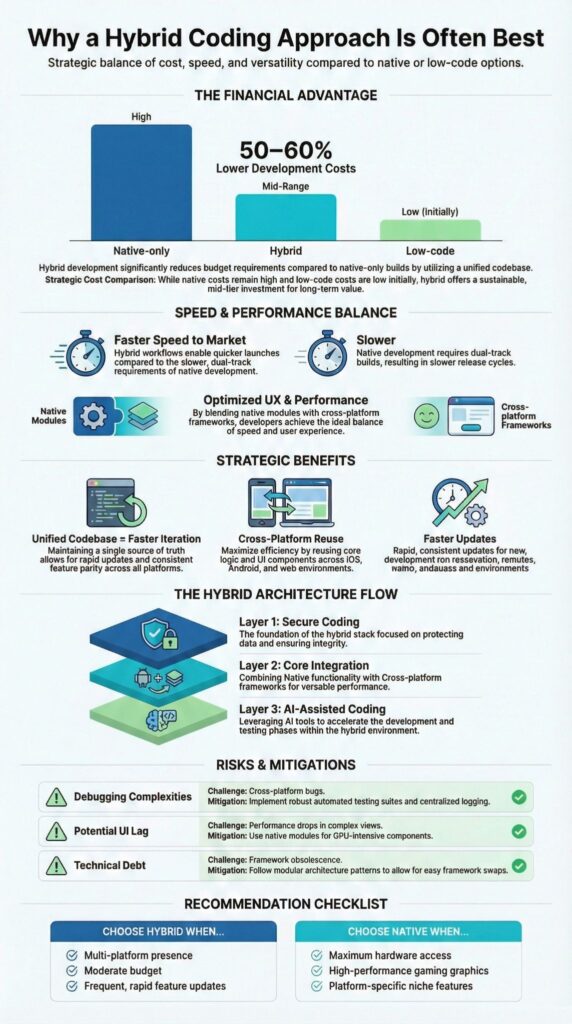
Teams should consider hybrid when speed, cross-platform reach, and cost efficiency are top priorities, especially when teams already automate refactoring to keep shared codebases maintainable at scale.
In our Secure Coding Practices bootcamps, we guide developers to evaluate each project’s needs before committing to a hybrid strategy. Hybrid isn’t always the default, it works best when clear benefits outweigh potential trade-offs.
We’ve found hybrid is most effective in situations like:
- Launching apps across both iOS and Android simultaneously
- Working within tight budget constraints
- Developing workflow-heavy features, such as dashboards and forms
- Prioritizing fast MVP delivery to validate ideas quickly
Fully native solutions are preferable when performance and deep integration matter most:
- Real-time processing or mission-critical performance is required
- Hardware integration, like camera, sensors, or Bluetooth, is complex
- Long-term platform dominance or fine-grained optimization is planned
From our hands-on experience, evaluating these factors early helps teams avoid costly rewrites or technical debt.
We guide teams to choose intentionally, not by trend, ensuring every architecture decision aligns with security, scalability, and project goals.
FAQ
What are the main hybrid coding advantages for modern app development?
Hybrid coding advantages include faster time-to-market, cost-effective coding, and code reusability benefits. By combining native and cross-platform coding, developers can maintain a single codebase strategy while leveraging platform-agnostic development.
This approach enables smoother hybrid app development, easier debugging of hybrid apps, and hybrid scalability solutions, ultimately reducing technical debt in hybrid projects and supporting both mobile and web applications efficiently.
How does a code-first hybrid approach differ from workflow-first coding?
A code-first hybrid approach prioritizes writing efficient and maintainable code while ensuring hybrid state management and modular hybrid UI components. Workflow-first coding, by contrast, emphasizes structured processes like CI/CD hybrid workflows and DevOps hybrid pipelines.
Selecting the right approach affects hybrid testing practices, hybrid backend integration, and hybrid deployment strategies, improving performance optimization and long-term scalability of hybrid applications.
Is hybrid vs native performance a concern for my app?
Hybrid vs native performance depends on factors such as the chosen hybrid framework, tree shaking hybrid, and service worker optimizations.
While native apps may perform better in resource-intensive tasks, hybrid mobile development using React Native hybrid, Flutter hybrid framework, or Ionic hybrid apps can achieve comparable performance. Optimizations like hybrid lazy loading, bundle size reduction, and hybrid caching strategies further improve load times and responsiveness.
What cross-platform coding tools help with hybrid app development?
Cross-platform coding tools such as Capacitor hybrid development, Xamarin hybrid coding, and progressive web apps hybrid simplify hybrid app creation.
Low-code hybrid tools, no-code hybrid integration, and AI-assisted hybrid coding accelerate development while maintaining quality. Integrating hybrid analytics, Firebase hybrid integration, or AWS Amplify hybrid ensures seamless hybrid backend integration, while hybrid monitoring tools support testing, logging, and performance tracking effectively.
How do hybrid security practices and updates affect app reliability?
Hybrid security practices safeguard user data and ensure compliance in hybrid mobile development. Combining hybrid push notifications, API-driven hybrid apps, and serverless hybrid apps requires monitoring with hybrid alerting setups, Sentry hybrid error tracking, and hybrid disaster recovery strategies.
Regular hybrid versioning, changelog practices, and rollback strategies guarantee uptime and maintain reliability, ensuring hybrid applications remain secure, maintainable, and fully operational for users.
Hybrid Coding Works Best When Security Leads
Hybrid coding unlocks speed, scalability, and maintainability, but only when structure and security guide every step. Starting with Secure Coding Practices, modular workflows, and frameworks like Flutter or React Native ensures your team delivers efficiently without sacrificing safety. The real question is, do you want fast results, or results you can trust under pressure?
Don’t let complexity or shortcuts compromise your code. Join the Secure Coding Practices Bootcamp to master secure, practical hybrid development, gain hands-on experience, and build software your team can confidently ship from day one.
References
- https://techcommunity.microsoft.com/blog/azurearchitectureblog/building-ai-agents-workflow-first-vs-code-first-vs-hybrid/4466788
- https://en.wikipedia.org/wiki/Hybrid_algorithm