
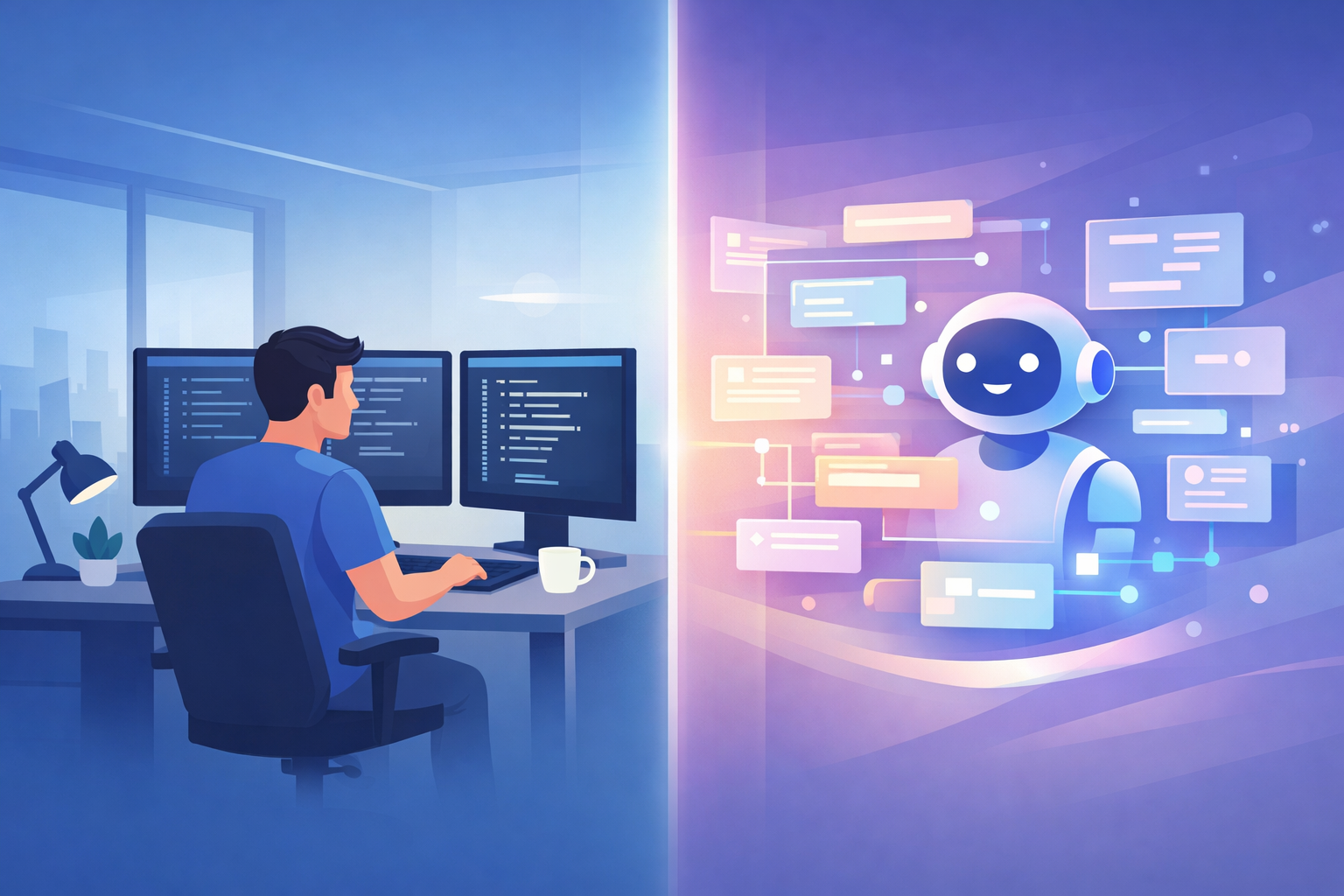

Vibe coding won’t replace software developers. It will reshape how we build software and which developers stand out. We’ve seen teams use large language models to spin up code from simple prompts, a term Andrej Karpathy popularized in 2025. Even Y Combinator’s Winter 2025 batch reported startups generating most early code with AI.
The speed is real, and we feel it in our own workflows. But fast prototypes aren’t secure or scalable products, and that gap still needs skilled engineers. If you care about your career or building software that lasts, keep reading.
What Vibe Coding Means for Software Developers
- Vibe coding speeds up prototypes but can’t handle secure, scalable engineering.
- Developer roles are shifting toward design, review, and security.
- The future is a mix: AI generates, but humans must govern.
What is Vibe Coding, and Why is Everyone Talking About It?
We see it all the time now. A developer types a plain English sentence into a tool, and out comes a chunk of code. That’s vibe coding. It’s great for throwing together a quick prototype or a demo. According to Red Hat Developer,
“This is vibe coding, the practice of building software by conversing with AI rather than writing every line yourself. Andrej Karpathy coined the term earlier this year, and it’s stuck because it captures something real about how millions of people are now approaching development. You describe the vibe, the AI handles the details.” – Todd Wardzinski
Tools like Cursor and Claude Code, which launched in 2025, make it feel almost like having a conversation to build something. The data backs up the hype. Some teams report building prototypes over 50% faster. In that Y Combinator group, many startups built their first versions almost entirely with AI.
This has sparked huge debates online. Is this the end of traditional coding? The appeal is easy to see. Founders with big ideas but little technical skill can get started. Teams can iterate on a concept in hours, not weeks. But in our bootcamp, we frame it differently.
We tell our students that AI is a powerful assistant for the boring, repetitive stuff. The hard parts, designing the system’s architecture, ensuring it’s secure, making sure it won’t break under real use, that’s still on us. That distinction is everything.
Can Vibe Coding Actually Replace A Developer?
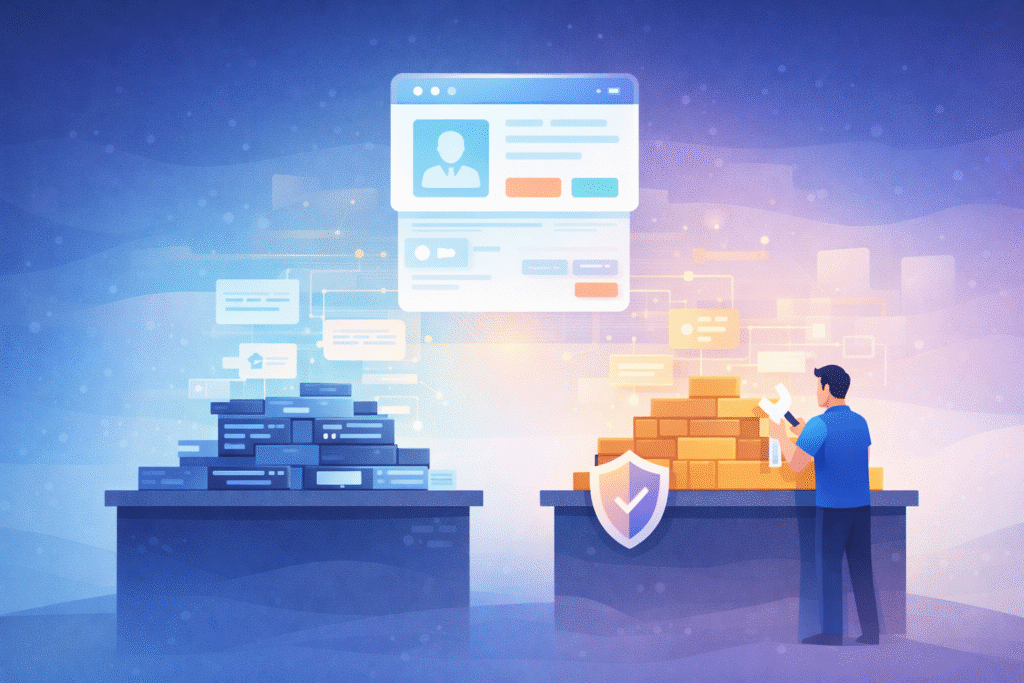
No. Vibe coding can spin up a demo fast, but it doesn’t replace developers who build secure, durable systems. From what we’ve seen training teams, replacing engineers would require four things AI still struggles with: security, scalability, maintainability, and compliance.
In practice, security is where the cracks show first. We’ve reviewed AI-generated login flows that looked polished but failed basic checks, missing rate limits, weak validation, poor session handling. The code ran, but it wouldn’t survive real traffic. That gap is why secure coding practices still need human review and threat thinking.
Standards bodies like NIST outline structured steps for secure software development, and those steps involve planning, reviews, and accountability. AI can help draft code, but it doesn’t own risk. Oversight still lands on experienced engineers.
Here’s a simple comparison:
| Aspect | Vibe Coding | Traditional Engineering |
| Speed | MVP in hours | Weeks or months |
| Security | Often introduces gaps | Built with structured reviews |
| Scalability | Fine for prototypes | Designed for real-world load |
| Skill Needed | Writing prompts | Deep system design knowledge |
In the end, AI-generated code still needs a professional review. For anything real, that’s not optional, it’s part of doing the job right.
What Problems do Developers Run Into with Vibe Coding?
Credits: devdojo
Talk to engineers who use it heavily, and you’ll hear the same stories. They get a quick win, then spend days cleaning up a mess. The initial code works, but it’s bloated, hard to understand, and brittle. One senior dev described it as “managing three over-eager interns”, productive, but you have to watch them constantly.
On forums, experienced developers warn that coding without understanding the underlying syntax creates fragile systems. Files get huge. Strange dependencies pile up. Debugging becomes a nightmare because you didn’t write the code and the AI can’t explain its own logic.
The common pitfalls we see are:
- AI “hallucinations”: The model inserts plausible-looking code that’s just wrong.
- Debugging black boxes: Fixing errors in code you didn’t write is incredibly time-consuming.
- Security blind spots: Prompts that don’t explicitly ask for security often produce vulnerable code.
- Skill erosion: New developers who rely only on AI tools can miss fundamental concepts, leaving them lost when things go wrong. This concern shows up repeatedly in discussions around how vibe coding affects junior developer growth. Especially where fundamentals get skipped too early.
In our training, we stress that AI-generated code must be reviewed line by line. It’s a starting point, not a finished product. Secure coding practices aren’t optional; they’re the bedrock you build on, especially when AI is involved.
So Where does Vibe Coding Actually Work Well?
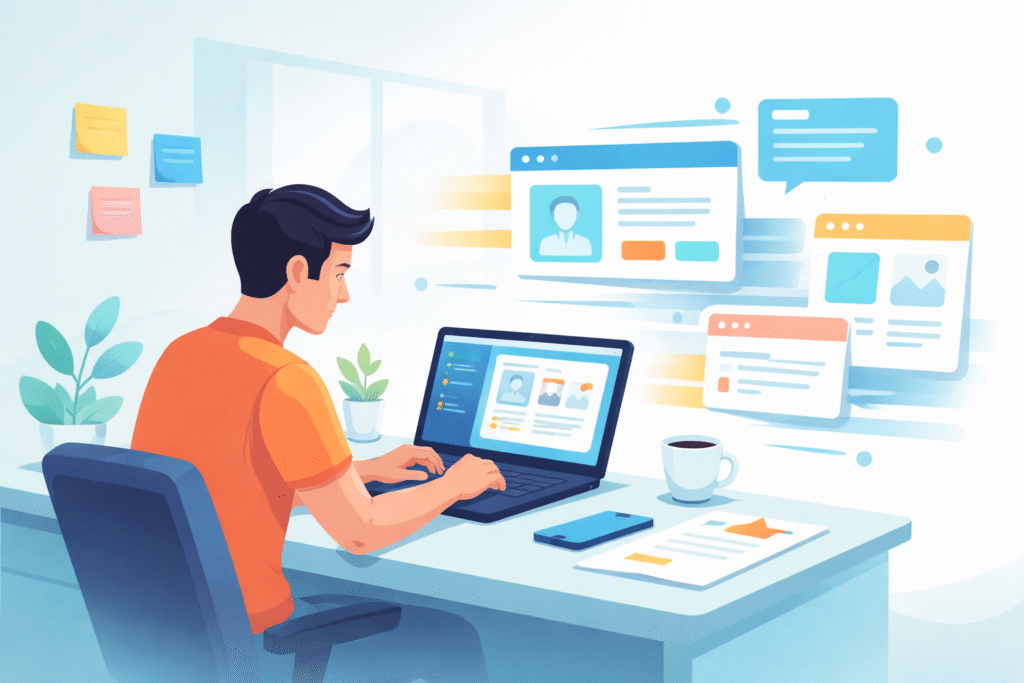
It has its place. Vibe coding is fantastic when you need speed above all else and the stakes are low. It excels at turning an idea into something you can see and click on, fast. As noted by Medium,
“Rapid Prototyping & hackathons: Need to demo an idea by tomorrow? AI code generation can materialize a working prototype incredibly fast. It’s okay if the code is messy, as long as it showcases the concept. Speed and iteration matter more than robustness at this stage. Vibe coding lets you try three different approaches in a day, something traditional coding would never allow.” – Addy Osmani
We’ve found it works best for:
- Building a landing page to test a marketing idea.
- Creating internal tools to automate a boring task.
- Putting together a demo for a hackathon or a class.
- Experimenting with a new feature concept before committing serious engineering time. For teams trying to draw clear boundaries, the real question often becomes when should you use a vibe coding workflow. Especially when balancing speed against long-term maintainability.
Even as AI tools get smarter, we believe this will remain their sweet spot, handling the repetitive groundwork so human developers can focus on the complex, critical problems.
How is This Changing What It Means To be a Developer?
The developer’s job is changing, not disappearing. We’re moving away from writing every single line of syntax toward a role that’s more about directing and judging AI’s work. It’s becoming less about typing code and more about being an architect and a quality assurance lead.
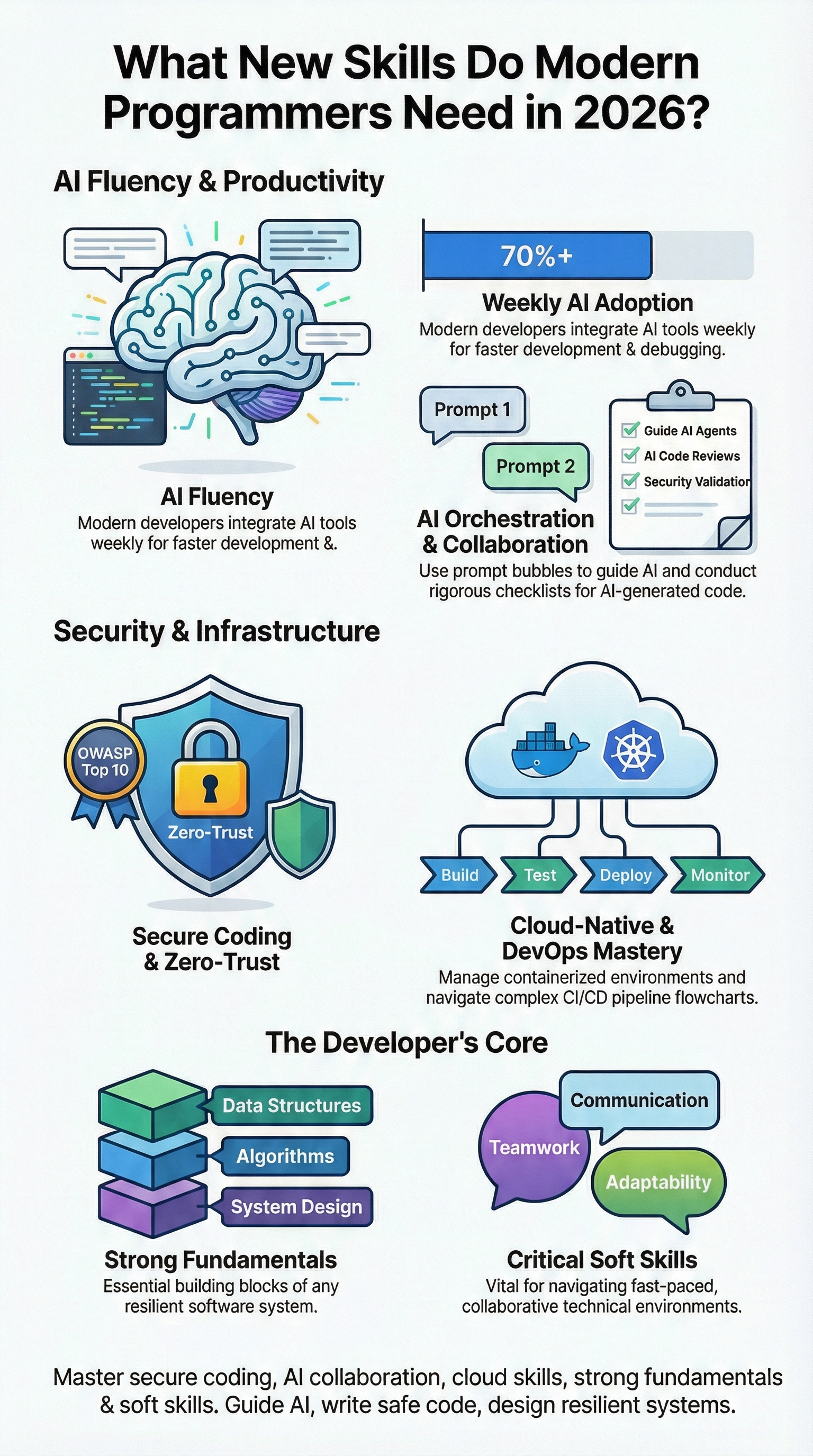
The developer of the near future needs to be great at:
- Prompt Engineering: Knowing how to ask the AI the right questions to get useful output.
- Validation & Review: Critically examining every piece of AI-generated code for errors, inefficiencies, and security holes.
- System Design: Planning how all the pieces fit together into a coherent, scalable whole.
- Security Auditing: Making sure the final product is robust and safe.
There’s a real risk for juniors who skip the fundamentals. Someone who only knows how to prompt an AI will hit a wall when they need to debug a complex system failure or design a secure architecture.
Many teams are already seeing the broader impact on developer skills and careers as responsibilities move toward review, architecture, and security ownership.
In our bootcamp, we see the future clearly: the most successful developers will be those who combine AI fluency with deep, traditional engineering rigor. They’ll use AI as a powerful tool, not a crutch.
What does The Future Look Like?
The future is hybrid. It’s a partnership. AI will generate code and suggest solutions at incredible speed. Humans will provide the vision, enforce security, and take responsibility for the final product.
By 2026, the hype will calm down, and vibe coding will just be a normal part of the toolbox. AI will handle a lot of the repetitive coding tasks. But after the prototype stage, you’ll still need engineers to build something that can grow, handle real users, and protect their data.
Here’s a simple way to think about it:
- AI’s Job: Generate, iterate, and suggest.
- The Human’s Job: Design, secure, and govern.
Before you let AI build something for your team, ask:
- Is this for a critical, customer-facing system?
- Does it need to comply with regulations or handle private data?
- Do we have an experienced developer available to review the final code?
Developers who learn to work alongside AI, while deepening their knowledge of security and system design, will be more valuable than ever. Those who expect AI to do all the thinking for them will struggle. The future of software belongs to builders who use every tool wisely, but never forget that the final responsibility is theirs alone.
FAQ
Is vibe coding really a software developers replacement or just hype?
Vibe coding drives bold claims about software developers replacement, but the reality is more balanced. Most teams see it as a productivity shift rather than extinction. AI coding helps create faster prototypes and MVPs, yet complex systems still require human judgment. The hype often ignores limits around security, scalability, and ownership. Many engineers treat vibe coding as evolution, not replacement.
How big is the developer jobs AI threat over the next decade?
The developer jobs AI threat depends on how people adapt. Routine coding tasks may shrink as AI assisted programming and low code tools expand. However, experienced engineers still guide architecture, security, and scaling decisions.
Over a ten-year view, roles are more likely to shift than disappear. Many teams are moving toward hybrid coding models that blend prompts with traditional engineering skills.
What risks come with heavy reliance on AI coding workflows?
Heavy reliance on AI coding can introduce risks that teams often overlook. Common issues include AI hallucination code, security vulnerabilities, and fragile logic that fails in production. Technical debt grows quickly when prototype coding moves straight into live systems. Debugging AI generated code can also take longer because intent is unclear. Without strong reviews, small issues can grow into serious failures.
Will junior developers struggle more than senior engineers in AI workflows?
Junior developers may face uneven challenges in AI workflows. AI tools can boost output but weaken core skills like debugging and system design. Senior engineers still shape architecture, review risks, and manage complex systems.
This dynamic can widen the gap between entry-level and experienced roles. Developers who build fundamentals alongside AI skills usually adapt better than those relying only on automation.
What skills matter most in the software engineering future shaped by vibe coding?
The software engineering future will favor developers who combine AI fluency with strong fundamentals. Skills like prompt engineering, secure design, and AI code review will become essential. Understanding scalability limits and enterprise complexity will also matter more. Engineers who blend domain expertise with hybrid coding approaches are likely to stand out as workflows continue to evolve.
The Final Verdict: Will Vibe Coding Replace Developers?
The hard truth: this isn’t about AI replacing developers, it’s about a mindset shift. The vibe coding hype fades when you look at real systems. We see evolution, not extinction. Developers who pair AI-assisted programming with strong secure coding practices will move ahead, while vibe-only builders risk fragile code and mounting debt.
The future belongs to disciplined engineers who treat AI as leverage, not authority. Build responsibly. Code deliberately. Lead the shift.
References
- https://developers.redhat.com/author/todd-wardzinski
- https://medium.com/@addyosmani/vibe-coding-is-not-the-same-as-ai-assisted-engineering-3f81088d5b98