


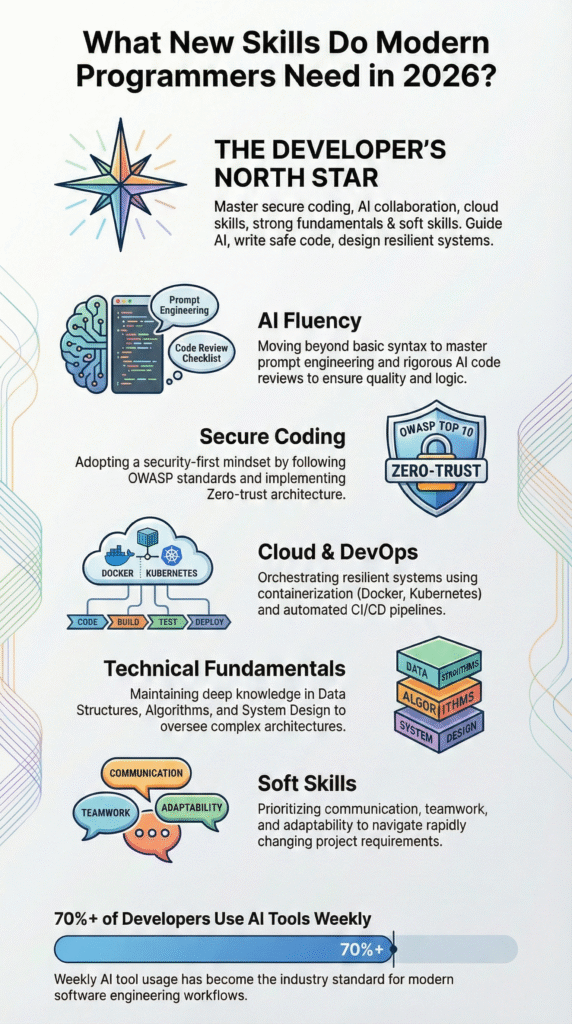
Modern programmers need a mix of fundamentals and practical skills shaped by AI and cloud-first development. We see this clearly when working with developers: those who stay relevant don’t chase every trend. They build strong foundations, write secure code early, and understand how systems run in the real world.
Many now use AI tools weekly, but hiring still favors people who grasp data structures, architecture, and deployment. The role is shifting from typing code to guiding systems and making sound technical calls. If you’re deciding what to learn next, keep reading, we’ll break down what actually matters and why.
Core Skills Modern Programmers Need in 2026
- Secure Coding Practices and AI fluency now anchor modern programming skills.
- Fundamentals like data structures and system design still determine career longevity.
- Cloud, DevOps, and communication skills separate adaptable developers from replaceable ones.
Is AI Mastery Now a Core Programming Skill?

Yes, but not as deep AI research. It’s about knowing how to work with AI tools in real projects. Developers don’t need to build models, but they do need to guide them well and spot where they fail.
In our training programs, we see students use AI daily. It’s great for drafting functions, writing tests, or speeding up repetitive tasks. Still, AI doesn’t understand architecture or long-term risks. We’ve reviewed code that looked clean but skipped input validation or exposed small security gaps. That’s where human judgment matters most.
From what we teach and practice, real AI fluency looks like this:
- Writing clear, structured prompts with constraints
- Reviewing every output like a junior dev’s code
- Watching for logic flaws, not just syntax issues
- Avoiding sensitive data in public tools
- Knowing when to rely on experience instead
Hiring is shifting too. Some teams now test how candidates guide AI, not just how they code alone. The skill isn’t hype anymore, it’s becoming part of everyday development, especially as teams evaluate the broader impact on developer skills & careers in AI-assisted environments.
Why do Fundamentals Matter More in the AI Era?
It sounds counterintuitive, but stronger AI makes fundamentals more important, not less. When tools can generate basic code, real value shifts to understanding how and why systems work. This is also why many developers are revisiting why traditional coding skills are still relevant even as AI accelerates daily workflows.
In our bootcamps, we keep seeing the same pattern. Developers who grow fastest aren’t chasing tools, they build deep foundations. Data structures, algorithms, and system design still shape how people debug, optimize, and make safe decisions under pressure.
AI can write working code, sure. But production problems rarely look clean. A function might pass tests and still fail at scale. A small race condition might crash an API at peak traffic. When systems break, someone needs a mental model, not just generated code.
Here’s how it usually plays out:
| Task | AI Can Help? | Human Required? |
| Writing correct syntax | Yes, very well | Rarely |
| Designing system architecture | Suggests options | Yes, final trade-offs are human |
| Performance tuning & optimization | Limited support | Yes, requires deep fundamentals |
| Debugging edge cases | Often weak | Yes, experience matters most |
We’ve helped teams untangle messy, sometimes AI-generated code. Fixing memory leaks or fragile schemas always comes back to first principles. Tools evolve, but fundamentals stay.
How Important Are Cloud and DevOps Skills Today?
They’re no longer optional. Most modern apps run in the cloud, and teams expect developers to understand how software ships, scales, and stays reliable in that environment.
In our training programs, nearly every project ends in a cloud deployment. Students don’t just write features, they package apps, push updates, and monitor live systems. That shift changes what “being a developer” really means.
Instead of managing a single server, you’re working with distributed systems. That comes with a new toolkit we see used across real teams:
- Containers and orchestration: Docker packages apps; Kubernetes keeps them healthy and scalable
- CI/CD pipelines: Automated testing and deployment on every commit
- Infrastructure as Code: Define servers and services using tools like Terraform
- Monitoring and observability: Track metrics and logs before issues escalate
This shift is becoming even more pronounced as automation grows. According to the Firefly Blog, generative AI isn’t replacing infrastructure discipline, it’s reinforcing it. As they note,
“The more autonomous our systems become, the more we need codified, version-controlled representations of what they’re doing” – Eran BIbi
We emphasize this because secure development depends on it. Misconfigured pipelines or cloud permissions create real risks. Cloud and DevOps skills aren’t a bonus anymore, they’re part of the baseline developers are expected to bring.
What Security Skills Are Non-Negotiable in 2026?
Secure coding isn’t a final checklist, it’s part of how modern developers think. From the first function, security decisions shape how safe and reliable the software becomes.
Industry signals point the same way. As reported by blog,
“Data security and privacy engineering are becoming non-negotiable foundations, not governance add-ons. When organizations can’t answer basic questions such as what data exists, where it lives, who can access it… every initiative built on data becomes fragile.” – The Hacker News
In our bootcamps, we treat security as a daily habit, not a specialty. We’ve seen small oversights turn into real incidents. AI-generated code makes this more urgent. It can look clean but still skip validation or use unsafe defaults. That’s why developers must stay in control.
The core areas we train around include:
- OWASP Top 10: Injection, broken auth, and data exposure still show up everywhere
- Secure coding habits: Validate input, manage dependencies, handle auth carefully
- API security: Protect endpoints with tokens, rate limits, and strict validation
- Zero-trust thinking: Verify every request and limit permissions by default
We also teach students to audit AI-generated code for vulnerabilities. Linting rules, threat modeling, and peer review all help build muscle memory. Security isn’t extra work, it’s part of being a responsible developer today.
Do Modern Programmers Need Full-Stack Versatility?
Credits: WebBraces
In most cases, yes. Specialists still matter, but developers who understand the full flow of an app tend to move faster and collaborate better across teams.
We see this often in our programs. Students who learn both frontend and backend gain confidence quickly. They don’t just build features, they understand how everything connects, which makes debugging and secure design easier.
Versatility today usually means working knowledge across key layers:
- Frontend: Building responsive interfaces with tools like React and TypeScript
- Backend: Writing APIs and business logic using Node.js, Python, or similar stacks
- Databases: Using SQL and NoSQL systems based on data needs
- Integration: Understanding how data flows safely between layers
In real projects, tasks rarely stay in one lane. A developer might tweak UI logic, trace an API issue, then fix a database query. That range builds stronger system thinking. It also improves communication with designers and product teams. Full-stack awareness doesn’t replace depth, but it opens far more doors.
Which Soft Skills Differentiate Programmers in AI-Driven Teams?

As AI handles more routine coding, human skills stand out more. Strong communication, adaptability, and product awareness now shape how developers grow inside real teams.
In our training cohorts, we notice this early. Some students write solid code but struggle to explain decisions. Others communicate clearly and quickly earn trust. That difference shows up fast in remote or hybrid environments.
The soft skills that consistently matter most include:
- Clear communication: Explaining trade-offs, writing clean docs, and leaving useful comments
- Adaptability: Staying calm while learning new tools, stacks, or workflows
- Product thinking: Understanding user problems, not just technical tasks
- Collaboration and empathy: Giving helpful feedback and supporting teammates
We’ve seen talented coders stall because they worked in isolation. Meanwhile, developers who share ideas clearly often lead reviews and guide teams. Technical skill opens the door, but people skills shape long-term growth, especially in AI-assisted workplaces.
How Can Developers Future-Proof Their Careers in 2026?
Future-proofing isn’t about guessing the next trendy language. It’s about building skills that hold up as tools change. The developers who last focus on strong foundations and practical experience, especially those actively learning how to avoid the programming skill gap as expectations shift faster than traditional learning paths.
From what we see in our programs, growth comes from stacking durable habits. AI can speed up work, but long-term success still comes from judgment and consistency. That’s the difference between quick wins and real careers.
A roadmap we often share looks like this:
- Strengthen fundamentals: Data structures, algorithms, and system thinking
- Use AI intentionally: Treat it as a partner, not a shortcut
- Ship real projects: Build full apps and deploy them in the cloud
- Practice secure development: Validate input and review dependencies early
- Learn system design: Study scalability and real architecture trade-offs
- Collaborate publicly: Contribute, write, and share ideas with others
We remind students that programming now means managing complexity, not just writing syntax. Careers grow when developers combine fundamentals, security habits, and real-world shipping experience, one step at a time.
FAQ
What modern programming skills matter most beyond syntax in 2026?
Modern programming skills go beyond writing syntax alone. Developers need strong computational thinking, clear system design principles, and a solid grasp of data structures and algorithms.
Employers also value adaptability, strong communication with technical teams, and the ability to troubleshoot production issues. The biggest shift is toward judgment, where developers handle real-world constraints and messy edge cases instead of relying only on clean tutorial examples.
How important is AI integration for coders entering today’s job market?
AI integration for coders is now a core expectation in many roles. Developers should understand generative AI workflows, practical prompt engineering techniques, and basic anti-hallucination practices. They also need verification habits when reviewing outputs.
Entry-level competition is rising because companies want people who can guide AI tools responsibly rather than use them blindly in daily development work.
Which cloud and DevOps practices 2026 should developers actually learn first?
Developers should begin with cloud computing proficiency and practical DevOps skills. This includes containerization using Docker and Kubernetes and CI/CD pipeline mastery. It also helps to understand monitoring and troubleshooting deployment failures in real environments.
These skills prepare developers for production systems where reliability, scalability, and operational awareness matter as much as writing clean code.
Why are cybersecurity coding essentials now required for most developers?
Cybersecurity coding essentials have become baseline expectations across most software roles. Developers should understand secure software development, OWASP standards, and zero-trust security models. Knowledge of API security and identity and access management is also important. Many security incidents begin with small oversights, so building safe coding habits early helps prevent costly issues later.
Do fundamentals still matter with full-stack development trends and AI tools?
Yes, fundamentals still matter even with modern full-stack trends and AI assistance. A strong foundation in data structures, algorithms, and mental models helps developers detect architectural flaws and solve performance issues. AI tools can support coding tasks, but they struggle with complex edge cases. Developers who keep their fundamentals strong adapt faster as technology continues to evolve.
What Defines Modern Programmers in 2026
Modern programming isn’t shrinking, it’s widening. The developers who thrive in 2026 blend AI collaboration, strong fundamentals, cloud fluency, and security-first thinking into daily work. Architecture, reliability, and safe defaults define real skill. The bar is higher, but the path is clearer for those willing to build intentionally.
If you want hands-on, practical training, explore the Secure Coding Practices Bootcamp. It teaches real-world secure development through live labs, covering OWASP Top 10, input validation, authentication, encryption, and safe dependencies.
References
- https://www.firefly.ai/blog/2026-predictions-ai-wont-kill-iac-it-will-make-it-non-negotiable
- https://thehackernews.com/2026/02/cybersecurity-tech-predictions-for-2026.html