


AI-assisted coding is already changing the job. It speeds up workflows and shifts what developers need to know. The idea of “vibe coding,” popularized by Andrej Karpathy in 2025, captures how people now guide AI with simple instructions instead of writing everything by hand.
Growth is still strong. The U.S. Bureau of Labor Statistics projects 25% growth for software developers from 2022 to 2032, which tells us demand isn’t disappearing. From what we see working with teams, the opportunity is real, but so are the risks. The real shifts are happening now, keep reading to see what they mean for your future.
Developer Skills & Career Shifts at a Glance
- AI tools boost how much code gets written, but they can make skill gaps worse. This hits junior developers and weakens understanding of system design.
- Programming skills today mean knowing how to talk to AI, checking its work, and writing secure code, all while keeping your core skills sharp.
- Developer jobs aren’t vanishing. They’re changing. There’s more need for people who design systems, specialize in security, and manage how AI tools are used.
How Vibe Coding Affects Junior Developer Growth?
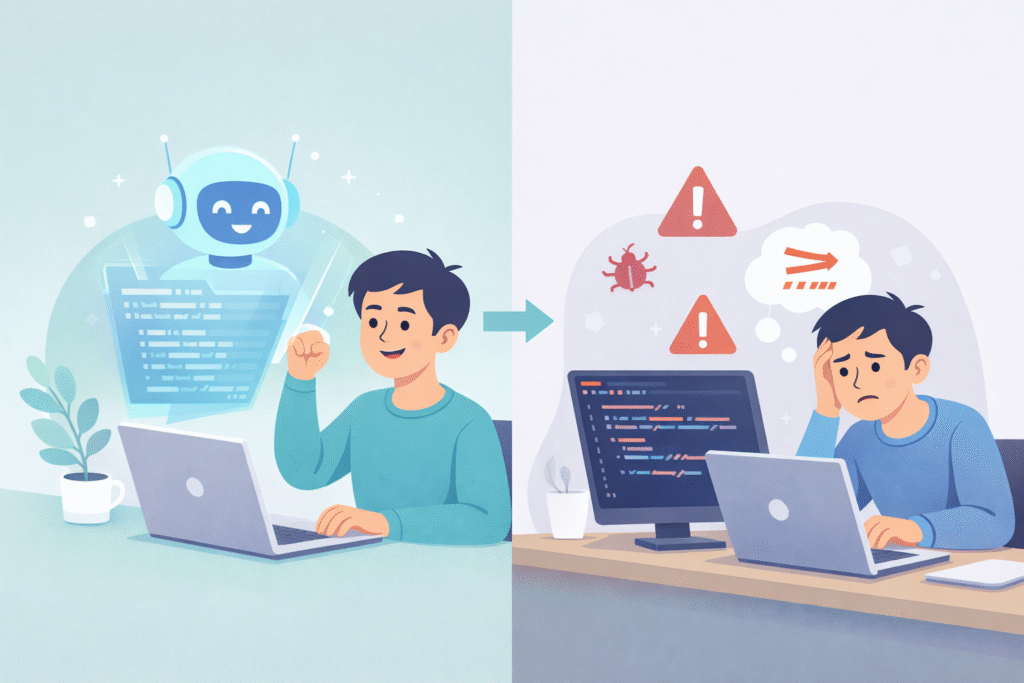
Vibe coding gets features out the door fast. For a junior developer, that speed can come at a cost, especially when vibe coding affects junior growth more than they expect. When you skip the fundamentals, your growth gets stunted.
A junior might use AI to build an API layer in a few minutes. It passes all the basic tests in a staging environment. Then it hits production and falls apart the moment ten users try to use it at once.
This creates a clear pattern of risk. You should watch for these signals:
- Skill stagnation: This happens when AI writes 40% or more of a junior’s daily code.
- Shallow understanding: They can’t explain what the code they’re submitting actually does, line by line.
- Pseudo-developer incidents: They cause production outages because they trusted AI output they didn’t understand.
- Automation without validation: They rely on AI-generated boilerplate code without ever questioning if it’s right or safe.
Surveys, like the one from Stack Overflow, tell us over 70% of developers use AI tools every day. But many of those same developers say they feel less confident debugging code that an AI wrote. The work goes faster. True understanding often doesn’t keep up. That tension is the new reality for anyone starting out.
What New Skills do Modern Programmers Need?
A programmer in 2026 carries a different toolkit, which reflects the new skills modern programmers need in an AI-driven workflow.. Knowing a language still matters, but it’s no longer the whole game.
Assessments now lean heavily on reasoning and judgment. Instead of asking someone to write everything from scratch, companies want proof that a developer can guide AI, question its output, and know when to slow down. In our sessions, the strongest engineers aren’t the fastest typists. They’re the ones who can explain why a suggestion is safe, or why it isn’t.
The skill stack is changing in three clear directions:
- Clear prompting and high-context instructions that shape useful output.
- AI review and debugging, especially spotting subtle hallucinations.
- Secure coding and validation as daily habits, not afterthoughts.
At our bootcamp, we teach developers to treat AI-generated code like untrusted input. Validate it, test it, question it. That mindset builds real defensive instincts. Guidance from NIST echoes the same idea: strong secure development practices sharply reduce risk, even with automated code.
Beyond security, modern developers grow broader:
- Understanding architectural trade-offs AI might miss.
- Thinking about scale across distributed systems.
- Blending human judgment with machine speed.
The ones who thrive build a tight feedback loop with AI. They move faster, but they stay grounded in real understanding.
Will Vibe Coding Replace Software Developers?
No. What it replaces is a narrow version of the role, which fuels ongoing debates about whether vibe coding replaces software developers at all.
The World Economic Forum projects AI may displace about 92 million jobs by 2030, yet create roughly 170 million new ones. That aligns with what many forecasts show: continued developer growth, just shaped differently.
Across the U.S., most teams already use AI in some form. The demand hasn’t vanished, it’s moving toward people who can guide systems, validate outputs, and secure what ships.
From what we observe in real code reviews, the workflow has changed more than the headcount. The comparison looks like this:
| Aspect | Traditional Coding | Vibe Coding Impact |
| Productivity | Manual, steady pace. | Faster for developers who understand the tools. |
| Job Creation | Linear growth. | Net growth, but roles shift toward orchestration and architecture. |
| Vulnerability | Lower with strong fundamentals. | Higher if AI replaces understanding. |
| Review Process | Human-to-human reviews. | Reviewing prompts, outputs, and security implications. |
| Risk Profile | Mostly human error. | Adds AI hallucinations and hidden vulnerabilities. |
The replacement narrative misses the nuance. We consistently see AI handling repetition while developers handle judgment. That actually raises the bar. Secure design, threat awareness, and architectural clarity matter more now, not less.
How This Changes The Future of Programming Jobs
The future of programming is less about writing syntax and more about designing, orchestrating, and securing systems, reshaping the future of programming jobs in measurable ways.
In some companies, AI is already generating over 40% of the new code. When that happens, the role of senior developers changes. They spend less time nitpicking syntax and more time reviewing the instructions given to the AI and validating the outcomes. Their oversight becomes more strategic.
We’re observing three major shifts in how large companies work:
- Using AI in pair programming to reduce simple merge conflicts and speed up prototyping.
- Evolving code reviews into “prompt reviews” to ensure the right questions are being asked.
- A much higher demand for developers with deep scalability and architecture expertise.
This changes the job market in concrete ways. Hiring in 2026 will stress architectural skills and the ability to solve complex logic puzzles. Some companies might slow down hiring for pure entry-level coders, while they compete fiercely for seniors who can leverage AI effectively.
The programming job of the future rewards people who design the blueprint for the entire system, not just who assemble a single room.
Is Learning to Code from Scratch Still Necessary?

The danger of AI is that it lets you prototype so quickly, you can fool yourself into thinking you know more than you do. We’ve worked with developers who built impressive-looking apps with AI, only to hit a wall when they needed to fix a subtle bug or implement a security-critical feature the AI couldn’t handle.
Foundational knowledge is what makes you adaptable when technology shifts, which is why learning to code from scratch still holds long-term value. Harvard Business Review has published analysis showing that deep expertise is what allows professionals to pivot during technological change.
Our advice to juniors is counterintuitive: slow down on purpose.
- Write core algorithms and data structures by hand.
- Try to debug a problem yourself before asking AI for the answer.
- Study system architecture diagrams and design documents until you can draw them from memory.
Learning to code from scratch builds a mental model that you can’t get any other way. It gives you the “gut feeling” to distrust an AI’s output when it looks plausible but is actually flawed. Without that foundation, you risk becoming unemployable in a competitive market. With it, every AI tool becomes a powerful ally that expands what you can do.
How Senior Developers Can Leverage This Workflow?
For a senior developer, vibe coding isn’t a threat; it’s a superpower. It can multiply their productivity by five times or more, while they keep full ownership of the system’s design.
In our own projects, we use AI for the tedious parts: generating boilerplate code, setting up standard project structures, and rapid prototyping. Then we apply our experience. We run the output through our security checklists, review it for scalability, and validate it at the system level before anything goes live.
This hybrid approach combines the best of both worlds and shows how senior developers leverage AI workflows without giving up ownership. It includes:
- AI orchestration, where seniors plan and sequence prompts to build entire features.
- Strategic oversight, reviewing AI-generated code with a focus on integration and design, not just syntax.
- Security audits specifically for AI-generated components before they’re deployed.
Experienced engineers benefit the most from this shift. Industry reports consistently show that developers with strong fundamentals see the biggest productivity jumps, sometimes fivefold, when they let AI handle the repetitive scaffolding.
The key is maintaining ownership. The senior developer provides the intent, the design, and the critical review. The AI handles the detailed syntax. Drawing that line clearly is what preserves job security and value.
What is The Career Path for an AI-Assisted Coder?
The career path for an AI-assisted coder evolves from being an executor, to an orchestrator, and finally to an architect or specialist, defining a clear career path for AI-assisted coders over time.
New engineers need to build hybrid skills, mastering both traditional coding and effective prompt engineering. In the mid-career stage, the focus shifts toward validation expertise and learning how to design systems. As professional, the path leads to architect-level roles, where you oversee how AI integrates across teams and products. As noted by the GitHub Blog,
“Your role as a developer in the age of AI is to be the human-in-the-loop: the person who knows why code works, why it sometimes doesn’t, what the key requirements in your environment are, and how to debug, guide AI tools, and go beyond vibe coding.” – Laura Lindeman & Staff
A typical roadmap might look like this:
- Years 1-3: Solidify your core programming fundamentals. Become proficient at reviewing and debugging AI-generated code.
- Years 3-6: Lead projects that use AI. Develop the feedback loop between your team and the tools. Take responsibility for scalability and integration reviews.
- Year 6+: Architect entire systems that leverage AI. Design the security frameworks and governance models for AI use across an organization.
The overall job growth statistics stay positive because AI is helping the industry tackle more complex applications than ever before. While it’s true that AI lets non-developers build simple apps, the demand for experts who can build and maintain secure, large-scale enterprise systems is only getting stronger.
How It Impacts Team Collaboration and Code Reviews
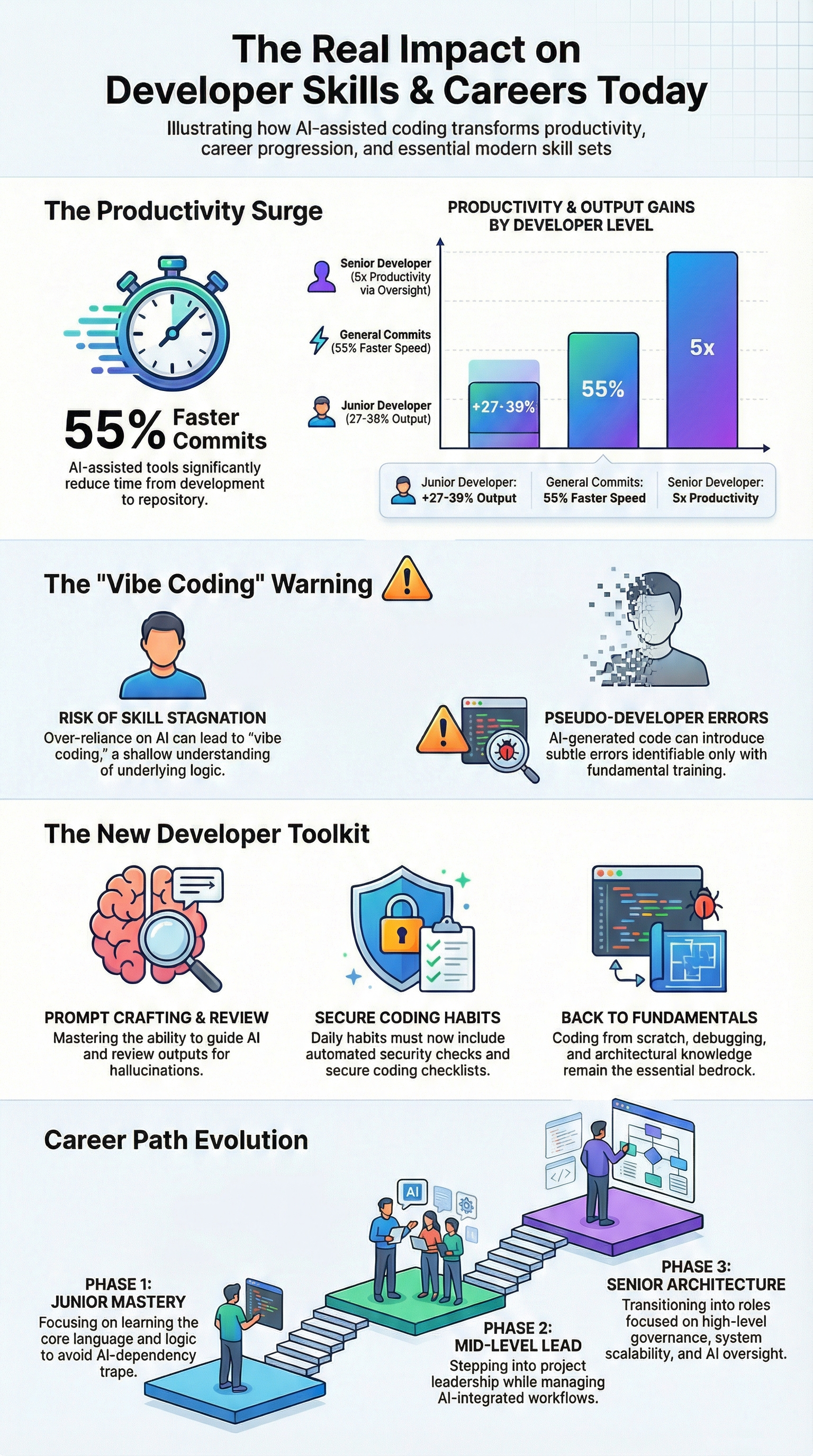
AI-assisted coding changes how teams work together, especially in team collaboration and code reviews where intent matters more than syntax. It shifts the focus of collaboration from syntax correction to validation and clear intent.
Code reviews now have new items on the checklist: inspecting the prompt that was used, actively hunting for AI hallucinations, and implementing strategies to reduce integration conflicts. Pair programming sessions might involve one developer crafting prompts while the other instantly reviews the output, reducing friction but doubling the responsibility for getting it right.
On our teams, we’ve implemented a few non-negotiable standards:
- A mandatory secure coding checklist must be completed before any AI-generated code is merged.
- The developer submitting the code must be able to explain not just the code, but why the AI produced it and what it’s meant to do.
- Juniors must receive continuous, specific feedback on the architectural reasoning behind changes, not just whether the code works.
Teams using AI report much faster prototyping cycles. But they also report wider swings in code quality when there aren’t strict standards in place. Establishing strong human-in-the-loop feedback processes is what closes that quality gap.
This evolution doesn’t remove human judgment from code reviews. It makes human judgment more important than ever.
Why Architectural Skills Become more Important
Credits: Skill Advancement
Architectural skills are becoming the most valuable asset a developer can have, reinforcing why architectural skills matter more in the AI era. Here’s why: AI can write code, but it cannot design a coherent, scalable, and secure system.
As the act of writing basic syntax becomes more automated, the demand for people who can do this high-level design skyrockets. As highlighted by Thoughtworks,
“Focusing on productivity in the way McKinsey suggests can cause us to mistakenly see coding as the ‘real’ work of software engineering, overlooking things like architectural decisions, tests, security analysis, and performance monitoring.” – Ken Mugrage
In our bootcamp projects, we see a clear divide. Developers who understand distributed systems, caching strategies, database design, and fault tolerance consistently build better, more resilient software than those who are just skilled prompt operators. Truly complex logic and novel problems still require human modeling and creativity.
Strong architecture is your best defense against new risks:
- AI dependency: Your system shouldn’t collapse if the AI tool has an outage or changes its output format.
- Security exposure: You need to understand the security limits of AI-generated code and design safeguards around it.
- Fragile integrations: AI might write a great microservice, but a human needs to design how it talks reliably to a dozen others.
Combining deep scalability knowledge with secure design principles is what creates long-term stability. In the AI era, your architectural skill is your professional moat.
How to Adapt Your Career for an AI-First World
Adapting for an AI-first world means working on three things at once: mastering fundamentals, achieving AI fluency, and learning secure system design, all part of how developers adapt careers for an AI-first world.
Developers who will succeed in the 2026 job market follow a deliberate plan. It’s not about reacting to every new tool; it’s about building a durable foundation.
Here is a structured upskilling roadmap we recommend:
- Build depth first. Get genuinely good at coding from first principles. Don’t use AI to bypass this step.
- Develop AI fluency. Learn prompt crafting not as a trick, but as a form of clear communication. Become an expert at reviewing and debugging AI output.
- Prioritize security. Make secure coding practices and validation your default mode of operation. Treat security as a core skill, not an afterthought.
- Specialize. Find a high-value domain like security, data engineering, or machine learning operations (MLOps) where deep human expertise is irreplaceable.
We believe the right mindset is to see AI as a powerful force multiplier for your own skills, not as a source of judgment or creativity. The developers who combine the raw productivity gains of AI with unwavering critical reasoning will be the ones shaping the next decade of software.
FAQ
Will vibe coding slow junior developer growth long term?
It can slow growth if junior developers rely too much on automation early. Vibe coding can speed exposure, but it may weaken fundamentals like debugging, edge case handling, and deep code understanding.
Without guidance, juniors may build shallow habits and dependency patterns. Healthy growth still requires structured practice, continuous feedback, and deliberate effort to learn core programming basics beyond AI outputs.
What AI coding skills matter most for software developer careers?
The most valuable skills include prompt engineering, AI code review, and strong validation habits. Developers who can guide code generation tools and recognize unreliable outputs stand out.
Modern programming skills now include debugging hallucinations, designing clear intent, and blending logic with architectural awareness. These hybrid skills help developers maintain judgment while working inside AI-assisted coding workflows.
How will AI-assisted coding shape the programming job future?
AI-assisted coding will likely reshape roles rather than reduce them. Productivity gains will accelerate routine tasks, but complex logic and system design will still require human judgment.
Expect growth in AI orchestration roles, architectural ownership, and validation-heavy work. The future will reward developers who close skill gaps early and follow clear adaptation strategies as software engineering continues evolving.
How can senior developer strategies leverage AI workflows safely?
Senior developers can use AI safely by focusing on oversight and structure. They guide workflows through disciplined reviews, strong architectural decisions, and clear validation standards.
Pair programming with AI and reviewing prompts before outputs also helps maintain quality. The goal is not speed alone, but preserving system integrity while scaling delivery in a controlled and responsible way.
Are fundamentals still necessary in an AI-first career adaptation?
Yes, fundamentals remain essential. Learning core programming basics builds the judgment needed to question outputs and avoid shallow skill development. Developers who skip fundamentals face higher dependency risks and weaker reasoning.
Strong foundations support better edge case handling, safer code validation, and long-term adaptability. In an AI-first environment, fundamentals make careers more durable and resilient.
Preparing for the Next Era of Developer Skills & Careers
The next step isn’t waiting to see how AI reshapes careers, it’s choosing how you evolve with it. In two focused days, you’ll practice OWASP Top 10 defenses, validation, authentication, encryption, and safe dependencies through hands-on labs.
It’s practical, developer-first training that helps you build safer systems while growing into the AI-driven future. If you want stronger fundamentals and real-world secure coding skills, explore the Secure Coding Practices Bootcamp.
References
- https://github.blog/developer-skills/career-growth/why-developer-expertise-matters-more-than-ever-in-the-age-of-ai/
- https://www.thoughtworks.com/en-ca/insights/blog/technology-strategy/why-embracing-complexity-real-challenge-software-today
Related Articles
- https://securecodingpractices.com/how-vibe-coding-affects-junior-developer-growth/
- https://securecodingpractices.com/what-new-skills-do-modern-programmers-need/
- https://securecodingpractices.com/will-vibe-coding-replace-software-developers/
- https://securecodingpractices.com/how-this-changes-the-future-of-programming-jobs/
- https://securecodingpractices.com/is-learning-to-code-from-scratch-still-necessary/
- https://securecodingpractices.com/how-senior-developers-can-leverage-this-workflow/
- https://securecodingpractices.com/what-is-the-career-path-for-an-ai-assisted-coder/
- https://securecodingpractices.com/how-it-impacts-team-collaboration-and-code-reviews/
- https://securecodingpractices.com/why-architectural-skills-become-more-important/
- https://securecodingpractices.com/how-to-adapt-your-career-for-an-ai-first-world/