
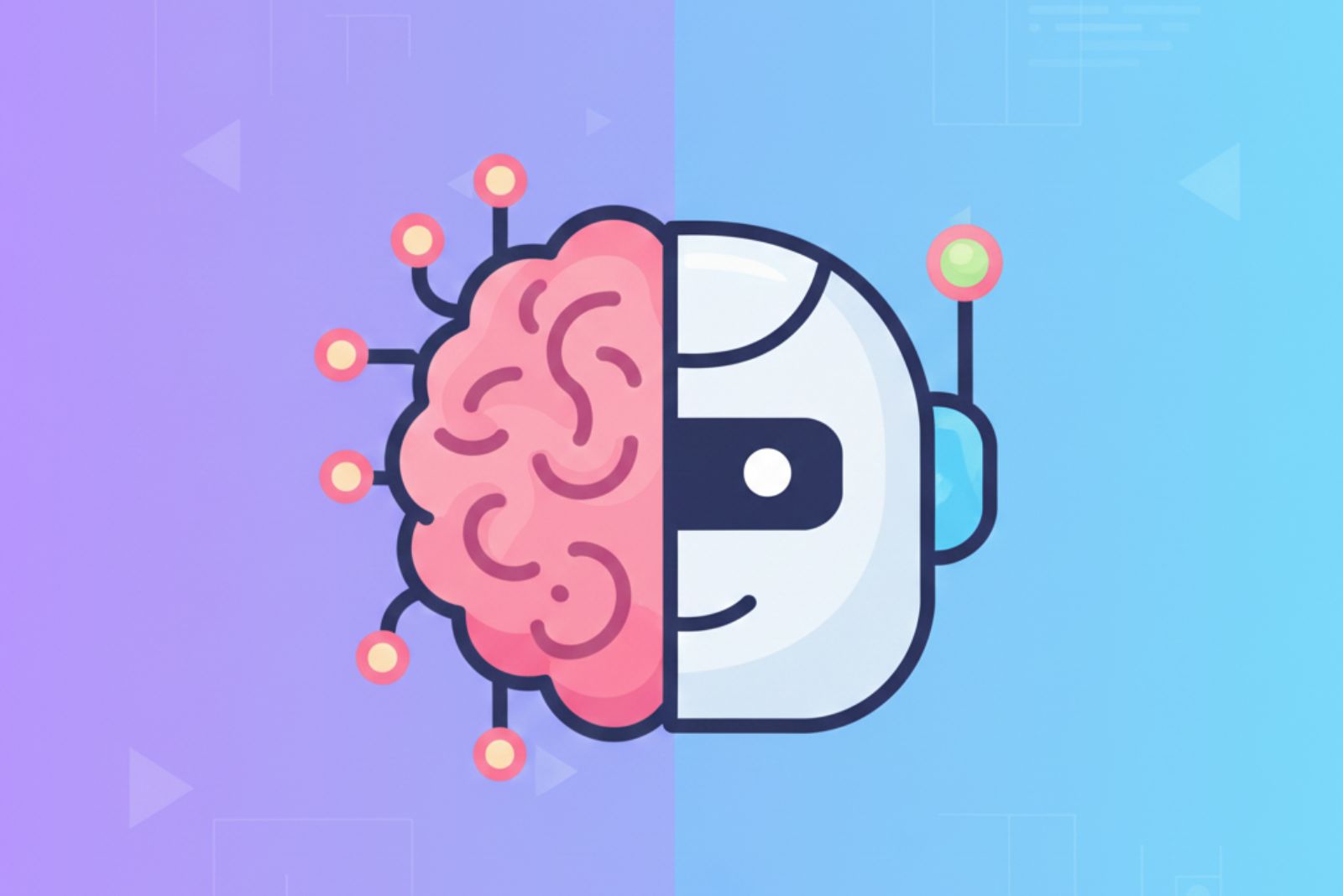

Vibe coding is building software by telling an AI what you want in plain English. You describe the outcome, the AI writes the code, and you just run it. It started with Andrej Karpathy in 2025, and it flips everything we knew about programming on its head (1).
This isn’t about typing syntax. It’s about having a conversation with a machine that does the heavy lifting. The goal is to forget the code exists and just focus on the vibe of your creation. It’s a radical shift, especially for rapid prototyping.
Keep reading to see what are the fundamental principles of vibe coding.
Key Takeaways
- Focus on what you want, not how to code it.
- Trust the AI’s output and iterate based on results.
- This method is best for fast prototypes, not critical systems.
The First Rule: Talk, Don’t Type
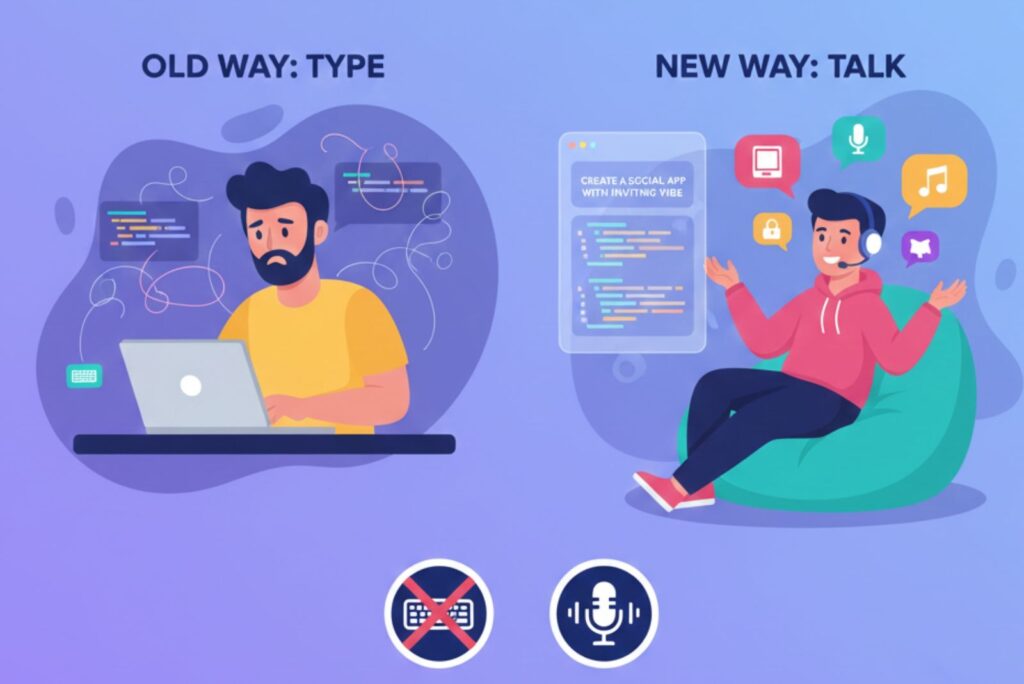
The most important principle of vibe coding is intent-driven development. You stop thinking about variables, functions, and libraries. You start thinking about the final product.
You tell the AI, “I need a website that lets people upload a photo and turns it into a cartoon.” You don’t say, “First, I need an HTML input form, then a Python script using OpenCV.”
It feels strange at first. We’re used to being in control of every line. But the power here is in the abstraction. It lets people who have great ideas but zero coding experience build functional prototypes.
They can describe a dream, and see it start to take shape in minutes. The AI acts as the translator, converting your vision into a language the computer understands, a process that aligns closely with how natural language is transformed into working code.
This shift is fundamental. The developer becomes a director, not a craftsman.
- Describe the end goal clearly.
- Provide examples if you have them.
- Use natural, conversational language.
The AI handles the technical implementation. Your job is to guide it with clear intent and information about what are the fundamental principles of vibe coding
Embracing the Black Box
This is the hardest pill to swallow for experienced coders: the principle of code invisibility. In pure vibe coding, you never read the code the AI generates especially for understanding what are the fundamental principles of vibe coding. You accept it as a black box. You run it. If it works, you move on. If it fails, you don’t open the file to debug:
- Accept the rule of invisibility:
For experienced coders, this is the hardest shift: in pure vibe coding, you don’t read the code the AI writes. You treat it like a sealed artifact. You run it. If it works, great. If it fails, you send the error back and say, “Fix this.” - Let the codebase grow like a living organism:
Instead of hand-crafting every part, you describe the outcome you want, and the AI grows the system into shape. Over time, the structure becomes something you might not fully understand, especially when seen in the context of vibe became central to this coding philosophy - Recognize when the vibe breaks:
The moment you peek inside the files, try to understand the logic, or manually debug, you’ve stepped out of vibe territory. You’re no longer vibe coding—you’re just coding with help. - Take the leap of trust:
True vibe coding requires faith in the AI as a creative partner. You supply the vision; the AI brings it to life. It’s a collaboration built not on control, but on direction.
The Conversational Loop of Creation
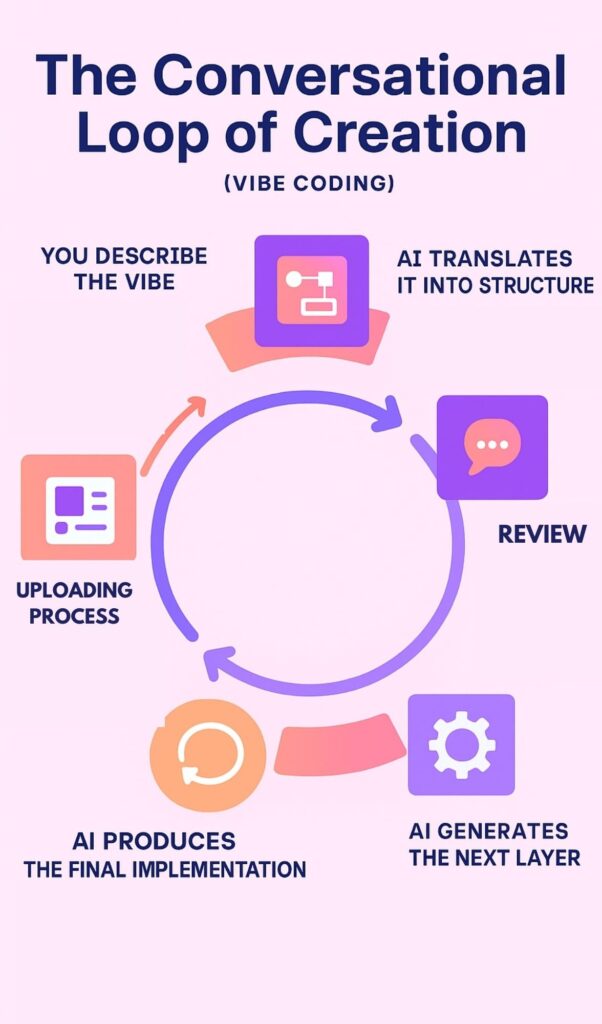
Vibe coding isn’t a one-shot command. It’s a rapid, conversational iteration cycle. The workflow is a loop. You give a prompt. The AI generates code. You run the code. You observe the output. You provide feedback. “The button is blue, but I want it green.” Or, “It crashed when I uploaded a large file.” Then you refine your prompt based on what you saw.
Tools are built for this. Some let you compose prompts in a special window. Others let you code by just talking into your microphone. The idea is to minimize keyboard use and maximize this back-and-forth dialogue.
The philosophy is to embrace exponential speed, reflecting the core ideas behind vibe coding fundamentals. A project that might take a weekend of traditional coding can be prototyped in an hour.
It turns development into a dynamic conversation. Each cycle brings you closer to your vision. The speed of this process is its most addictive quality. You’re not stuck in the details. You’re always moving forward, shaping the software through observation and description.
It feels less like engineering and more like sculpting with words in gaining a deeper knowledge on what are the fundamental principles of vibe coding
AI as Your Coding Teammate
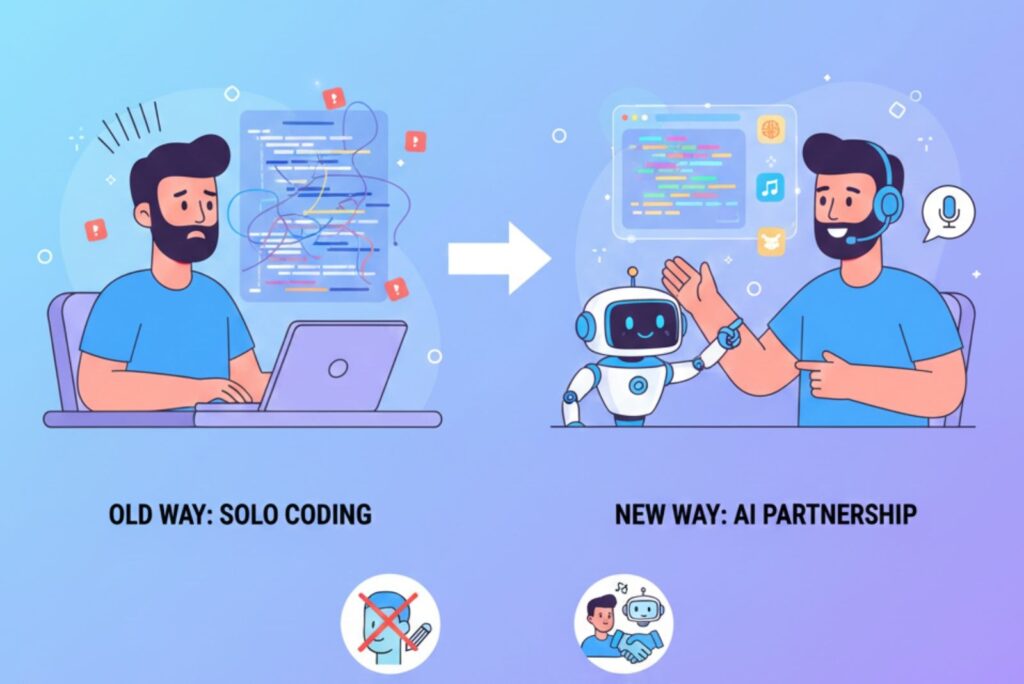
This leads to the principle of human-AI symbiosis. The AI is not just a tool. It’s a teammate. Think of it as an exocortex, an external brain that handles the implementation. You offload the boilerplate, the bug fixes, the UI tweaks. Your role is to provide high-level context and strategic direction. You are the architect. The AI is the entire construction crew.
This is most effective for low-stakes projects. Think weekend prototypes, MVPs for a new startup idea, or personal automation scripts. It’s for when the goal is to see if an idea is feasible, quickly.
You wouldn’t use pure vibe coding for a bank’s transaction system or a medical device. The risks are too high. But for getting a concept off the ground faster than ever before, it’s unparalleled. It democratizes creation. Suddenly, anyone with a clear idea can be a builder in what are the fundamental principles of vibe coding.
A Mindset of Creative Flow
Source: Matt Palmer
Underpinning all of this is a mindset that embraces imperfection and experimentation. Bugs are not failures. They are expected steps in the process. You fix them by talking to the AI, not by spending hours in a debugger. The priority is maintaining creative flow over achieving perfect, clean code.
It’s about the “vibe check.” You run the software. Does it feel right? Does it do the main thing you wanted? If yes, you iterate. If no, you describe the problem. This mindset is liberating.
This doesn’t mean abandoning the principles. It means adding a step to the conversational loop. After the AI generates code for a login feature, your next prompt might be, “Great, now please rewrite this to be secure against common attacks.” You’re still working with intent. You’re just making security a core part of that intent.
We can use the AI to help with this. We can prompt it to, “Analyze this code for potential security vulnerabilities.” It becomes a collaborative effort where we guide the AI to think about safety.
The key is to make security a non-negotiable part of the vibe from the beginning, not an afterthought. This hybrid model,vibe coding for velocity, with a security-aware conscience,is likely the future for serious application development in what are the fundamental principles of vibe coding.
The Limits of the Vibe
The statistics from 2025 show both the promise and the pitfalls. Over 90% of developers use AI daily, and a huge portion of code is now AI-generated (2). Productivity gains are real; prototypes get built 5 to 10 times faster. But there are limitations.
Error rates can be 20-30% higher when code isn’t reviewed. Less than 10% of enterprise production code is built this way purely.
It’s not suitable for everything. Complex logic, regulatory compliance, healthcare, and financial systems require a level of precision and auditability that pure vibe coding can’t yet guarantee.
The “black box” is a liability when you need to prove how every decision was made. It’s a tool for innovation and exploration, not yet for foundational infrastructure. Knowing when to use it, and when to switch to a more traditional or hybrid approach, is a critical skill in what are the fundamental principles of vibe coding.
FAQs
What is vibe coding?
Vibe coding means building software by talking to AI in plain English. You tell the AI what you want to create, and it writes all the code for you. You don’t need to know how to program. Just describe your idea like you’re talking to a friend.
The AI does all the hard work. Then you run the program and see if it works. It’s like having a robot helper that builds apps for you and gaining deeper understanding on what are the fundamental principles of vibe coding.
How does vibe coding work?
You start by telling the AI your idea in simple words. The AI creates the code automatically. Then you test it to see what happens. If something needs fixing, you just tell the AI what’s wrong.
The AI fixes it for you. You keep going back and forth like a conversation. Each time, your app gets better. You never have to read or write code yourself. It’s all about talking and testing.
Who created vibe coding?
Andrej Karpathy started vibe coding in 2025. He showed people a new way to build software without typing code. Before this, everyone had to learn programming languages. Now, anyone with a good idea can create apps.
You just need to explain what you want clearly. The AI handles everything technical. This changed how people think about making software. Now more people can be creators, not just trained programmers.
What can I build with vibe coding?
You can build websites, apps, and tools for personal projects. It works great for quick prototypes and weekend projects. You could make a photo editor, a menu generator, or a game. It’s perfect for testing new ideas fast.
But don’t use it for important systems like banking apps or medical tools. Those need extra safety checks. Vibe coding is best when you want to see if your idea works quickly.
Do I need coding experience for vibe coding?
No, you don’t need any coding experience at all. That’s what makes vibe coding special. If you can describe what you want in regular words, you can do it. You just talk to the AI like a normal person.
The AI knows all the programming stuff. Your job is having good ideas and explaining them clearly. Even kids can use vibe coding to build cool things. It’s made for everyone, not just programmers, for those who eager to understand what are the fundamental principles of vibe coding
Is vibe coding safe for important projects?
Vibe coding isn’t safe for critical systems yet. Don’t use it for banks, hospitals, or anything dealing with people’s money or health. The AI-made code can have more errors than human-written code. You can’t always see how it makes decisions.
For serious projects, you need experts to check everything carefully. But for learning, practicing, or testing ideas, it’s totally fine in applying what are the fundamental principles of vibe coding. Use it for fun projects, not life-or-death situations.
How fast is vibe coding compared to regular coding?
Vibe coding is much faster than regular coding. Projects that take a whole weekend normally can be done in just one hour. You skip all the typing and debugging work. Instead, you just talk and test. You can try five or ten ideas in the time it used to take for one. This speed is perfect for brainstorming. You can see which ideas work without wasting days on each one.
What is the black box principle in vibe coding?
The black box principle means you never look at the code the AI writes. You treat it like a mystery box. You just run it and see what happens. If it breaks, you tell the AI to fix it.
You don’t open files or try to understand the programming. This feels weird for people who know coding. But it’s the key to vibe coding. You trust the AI completely to handle the technical stuff.
Can vibe coding replace programmers?
Vibe coding won’t replace all programmers. Real coders are still needed for big, important systems. Complex apps need human experts to check for safety and quality. But vibe coding does let non-programmers create simple apps.
It’s like how calculators didn’t replace mathematicians. They just made math easier for everyone. Programmers will focus on harder problems. Regular people can now build their own simple tools. Both groups can exist together.
What tools do I need for vibe coding?
You need an AI assistant that can write code, like Claude or similar tools. Some let you type your requests. Others let you speak into a microphone. You also need a way to run the code the AI creates.
This might be a web browser or a simple program on your computer. That’s really all you need. No fancy equipment or expensive software. Just an AI helper and something to test your creations on.
Final Thought on What Are The Fundamental Principles of Vibe Coding
Vibe coding is more than a technique. It’s a cultural shift. It inverts the traditional process of software development. It prioritizes the human idea over the machine’s language. It accelerates innovation and dramatically lowers the barrier to entry for creating software. For rapid prototyping, brainstorming, and learning, it’s a revolutionary step forward.
Its principles,focus on intent, embrace the black box, iterate conversationally, and partner with AI,point toward a future where we spend less time on implementation and more time on imagination. The best approach for most will be a blend.
Use the vibe to accelerate the initial creation and then apply Secure Coding Practices and careful review as the project matures by applying what are the fundamental principles of vibe coding. This combines the best of both worlds: the speed of magic and the safety of engineering. The future of coding isn’t just about writing better code. It’s about having better conversations.
If you want to sharpen the “engineering” side with practical, real-world secure coding skills, the Secure Coding Practices Bootcamp is designed for exactly that.
References
- https://medium.com/software-architecture-in-the-age-of-ai/from-fire-to-prompts-fe1833b170f9
- https://medium.com/@nanthakumar18122000/the-ai-revolution-no-one-saw-coming-why-90-of-developers-now-code-with-artificial-intelligence-7249b827ea31