
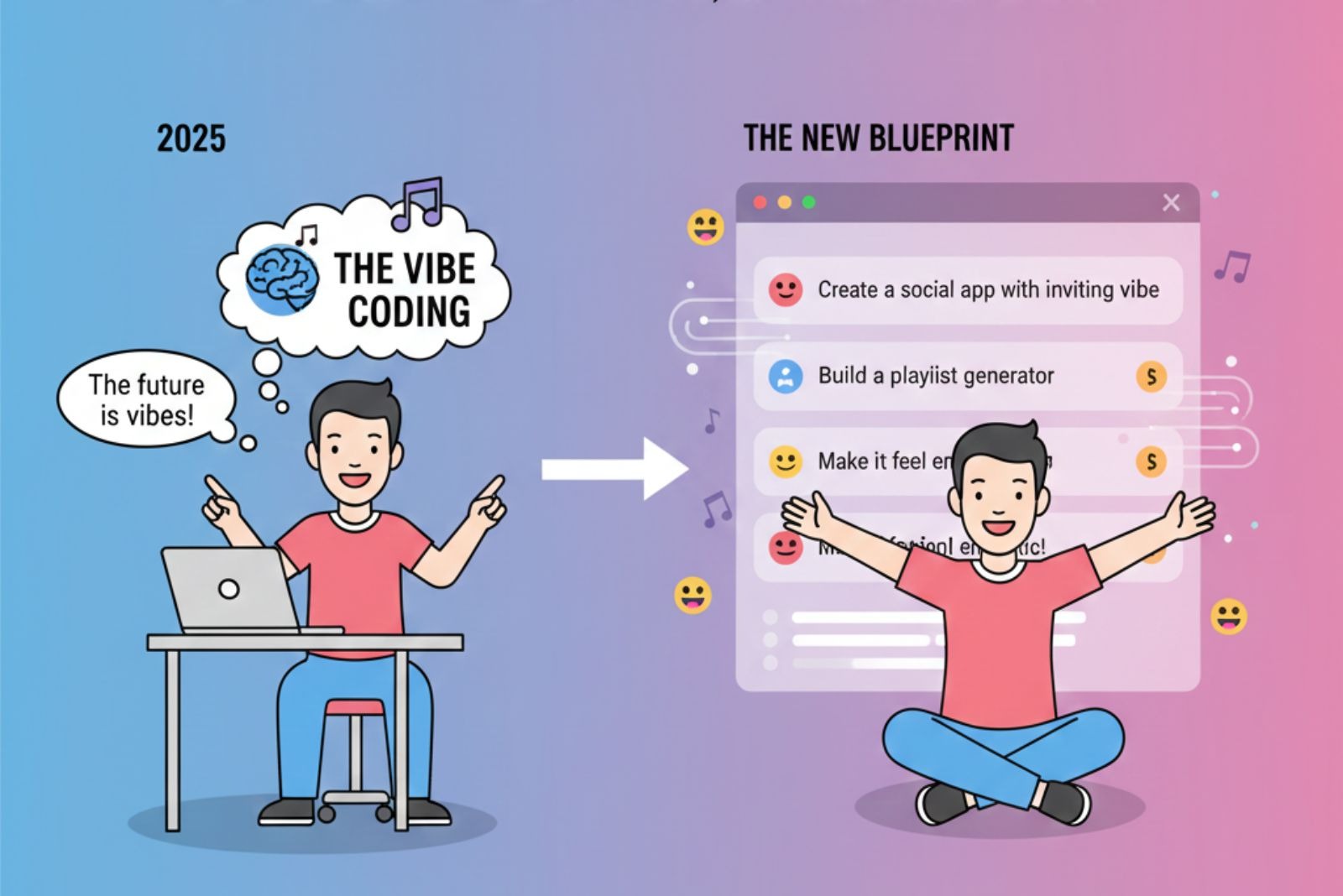

It started with a single post. Andrej Karpathy, a respected AI researcher, typed a phrase that would define a generation of programmers. “Vibe coding.” Two words that perfectly capture how we build software now.
The term describes an intuitive approach to AI-assisted programming where you describe what you want in plain language and trust the AI to handle the details. It’s less about writing perfect code and more about getting the “vibe” right.
This method focuses on intention and rapid iteration over strict syntax. It feels more like a conversation than construction. To understand why this simple term fits so well, we need to look at its cultural roots and philosophical implications. Keep reading to see why is the term vibe used for coding
Key Takeaways
- “Vibe” resonates with modern, intuitive ways of working.
- It represents a shift from precise engineering to creative flow.
- The term makes advanced AI tools feel accessible to everyone.
The Cultural Fit of “Vibe”
You hear the word “vibe” everywhere now. It’s Gen Z and millennial slang for an intuitive feeling about a person or place. You get a good vibe or a bad vibe. It’s about energy and understanding without overthinking. This is exactly how vibe coding works.
You get a feeling for what the AI can do that aligns closely with the principles in vibe coding fundamentals
Karpathy’s now-famous X post broke it down simply. “See stuff, say stuff, run stuff, copy paste stuff.” That’s the whole process in four steps. You see what you want to build. You tell the AI what you want. You run the code it gives you. You paste it into your project if it works. There’s no deep analysis of the code itself. You’re judging the output by its vibe.
This approach mirrors how we use technology in our daily lives. We don’t need to know how our phones work internally to use them effectively. We vibe with them. The same is becoming true for creating software. The term feels natural because the process feels natural. It’s less about technical mastery and more about clear communication.
- It uses familiar, contemporary language
- It describes a process that feels instinctive
- It lowers the psychological barrier to creating software
The word itself is sticky. It’s memorable and spreads quickly. Which explains what happened next.
From Viral Post to Dictionary Entry
Karpathy has a knack for creating phrases that stick. Think about “zero to one” or his “spelled-out intro to language modeling.” These terms capture complex ideas in simple packages. “Vibe coding” did the same thing but on a much larger scale. The concept went viral almost instantly.
By March 2025, Merriam-Webster listed it as trending slang. Collins Dictionary named it the Word of the Year for 2025. This wasn’t just a tech community inside joke anymore. It became a cultural milestone. The speed of this adoption tells you something important. The term filled a need. It gave a name to something many people were already doing.
Reddit discussions about this approach spiked 300 percent after Karpathy’s post (1). Suddenly, people had a word for that feeling when you’re working with an AI teammate. That sense of flow when the code just appears as you describe your intentions. The phrase validated an experience that was becoming common.
Its memorability comes from its simplicity. “Vibe coding” is easy to say and hard to forget. It doesn’t sound technical or intimidating. It sounds like something you can try right now. Which is precisely the point. The name invites participation rather than gatekeeping. It suggests that coding might be more accessible than we thought.
A Different Kind of Coding
Traditional programming demands exactness. Every character matters. A missing semicolon can break everything. You need to understand deep logical structures and architectural patterns. Debugging requires tracing problems through complex chains of code. It’s a discipline of precision.
Vibe coding is different. It prioritizes the feeling of functionality working. You might not understand every line the AI generates, and that’s okay. The goal is the outcome, not the internal perfection of the code. This embraces imperfection as part of the creative flow. It’s more about iteration than getting it right the first time.
This doesn’t mean throwing away all the rules. When we practice secure coding, we still think about safety. But we might ask the AI to “implement this feature securely” rather than writing each security check manually. We guide the vibe toward safety while letting the AI handle the implementation details. It’s a partnership.
The process feels more artistic than engineering. Like an artist vibing with a canvas, adding strokes based on feeling. A coder vibes with the AI, refining prompts based on the results. It’s a dialogue. You say something, the AI responds, you react to that response. The code emerges from this conversation.
This shift is possible because the AI handles the mechanical translation in vibe coding as a development workflow. It converts your intentions into syntactically correct code.
The Philosophy Behind the Vibe
At its heart, vibe coding is about intuitive creation. You’re building based on feel rather than detailed specifications. This requires a certain trust in the AI as a black box. You don’t always peek inside. You judge the results.
This mirrors a “vibe check” in music production. A producer might listen to a track and say “the vibe is off” without technical analysis. They’re feeling the overall effect. Similarly, a vibe coder looks at the working software and senses if it’s right. The details under the hood matter less than the user experience.
This approach also democratizes software creation. When the barrier is language rather than syntax, more people can participate. About 63 percent of people using these AI coding tools aren’t traditional developers (2). They’re designers, product managers, scientists, artists. They have ideas but never learned to code in the traditional sense.
For them, vibe coding is a revelation. They can now build tools, prototypes, even full applications by describing their vision. The AI acts as a translator between their imagination and the computer. This is a profound shift. It moves software creation closer to a universal skill.
How Vibe Coding Changes Who Can Build
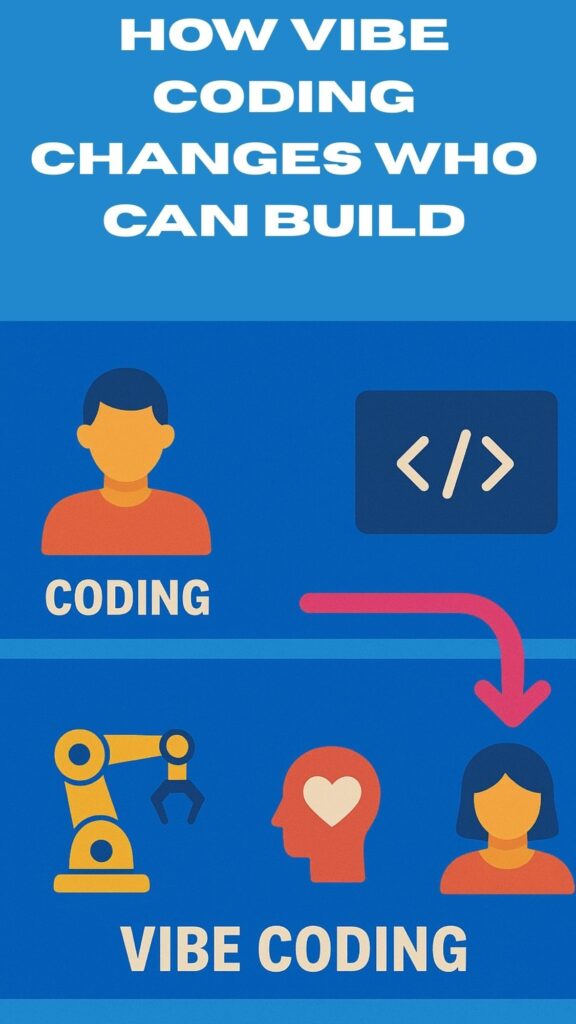
The statistics around this shift are striking. Ninety-two percent of US developers use AI tools daily. Seventy-four percent report significant productivity gains. Teams complete tasks about 51 percent faster. But the more interesting number is about who is building.
Sixty-three percent of vibe coders are non-developers. They’re creating UIs and apps without writing code in the traditional sense. They’re using natural language to bring their ideas to life. This is the real revolution. It’s not just about making programmers faster. It’s about creating new programmers.
These new creators often start with small projects. A script to organize their photos. A tool to analyze their spending. A simple game for their kids. The low stakes encourage experimentation. There’s no fear of “breaking” the right way to code because they’re following a different path.
They learn by doing. By seeing what different prompts produce. By developing a sense for what the AI understands well. They’re building intuition rather than memorizing syntax. This is a fundamentally different way to learn software development. It’s more about communication than computation.
This doesn’t mean traditional skills are obsolete. Understanding core programming concepts still helps. But the entry point has widened dramatically. You can start creating immediately and learn the details as you go. This inverted learning path is more engaging for many people. They see results first, then understand how they were achieved.
The Practice of Vibe Coding
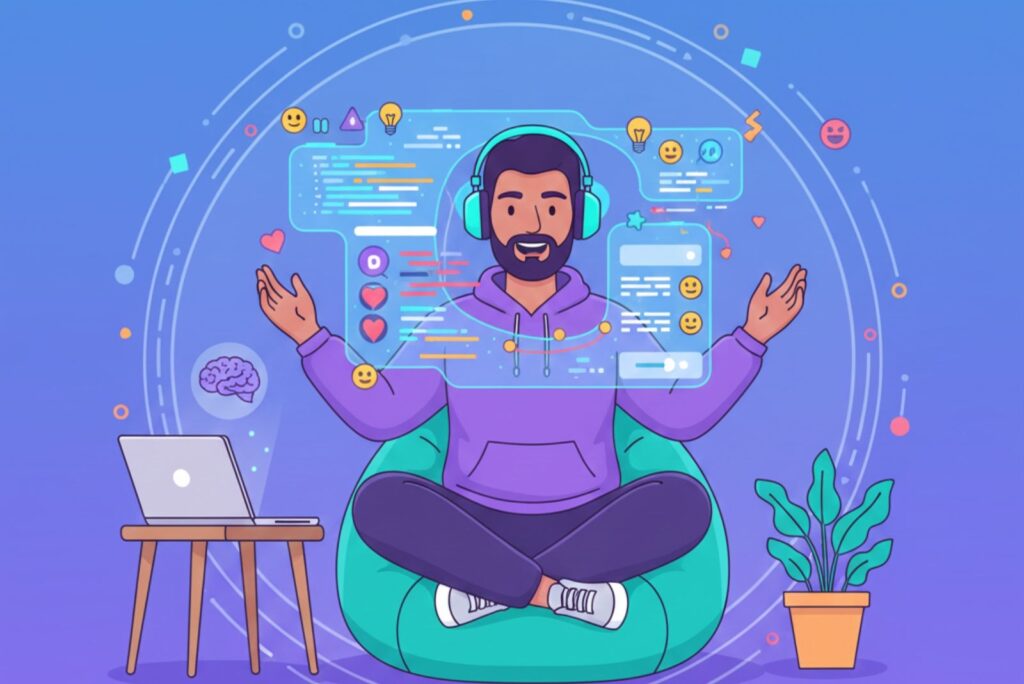
So what does vibe coding look like in practice? It often starts with a simple description. “I need a function that takes a list of emails and returns only the ones from educational institutions.” You write that in your AI coding tool. It generates Python or JavaScript code that does exactly that.
You run the code. If it works, you use it. If it doesn’t, you might tweak your prompt. “Make sure it handles domain variations like .edu and .ac.uk.” The AI adjusts the code. You’re having a conversation about the functionality, not the implementation, a dynamic that mirrors conversational AI programming works.
This process embraces the “code invisibility principle.” You’re not meant to focus on the code itself. You’re meant to focus on what the code does. The AI-generated code becomes a means to an end, not the end itself. This is a radical shift in perspective for traditional developers.
The Future Feels Right
Vibe coding represents a partnership between human intuition and machine precision. We bring the vision and direction. The AI brings the technical execution. Together, we create software through conversation. This feels like a more natural way to build things.
The term “vibe” fits because the experience is vibrational. It’s about resonance between your intention and the AI’s output. When it clicks, it feels right. When it doesn’t, you adjust until it does. This iterative, feeling-based process is what the word captures so well.
This approach is particularly valuable for prototyping and exploration. When you’re figuring out what’s possible, vibe coding lets you move quickly. You can test ideas without investment in perfect code. Once an idea proves valuable, you can always refine the implementation.
For learning, it’s transformative. New programmers can see immediate results from their ideas. This positive reinforcement encourages deeper exploration. They learn by seeing what works, building intuition through experience. The fear of making mistakes decreases when the AI handles the syntax.
FAQs
What does “vibe coding” actually mean?
Vibe coding refers to creating software by describing what you want in natural language and letting AI generate the actual code. Instead of focusing on syntax, you focus on intention, clarity, and iteration. You guide the AI with your instructions, react to its output, and continue refining the idea. The “vibe” part comes from relying more on feel and flow than on strict engineering. It’s a conversational, intuitive approach to programming.
Why is the word “vibe” used instead of something more technical?
The word “vibe” captures the intuitive, feeling-based nature of this new coding style. Traditional programming requires precision, but vibe coding focuses on guiding the AI through natural language and judging the results by whether they “feel right.”
The term is modern, relatable, and easy for non-developers to understand. It removes intimidation and lowers the barrier to entry. By using a familiar word, it makes advanced AI tools feel more accessible and human-centered.
Who started the term “vibe coding”?
The term was popularized by AI researcher Andrej Karpathy, whose viral post summarized the process as “see stuff, say stuff, run stuff, copy paste stuff.” His phrasing resonated instantly because it captured the simplicity and flow of working with AI systems.
From there, the term spread rapidly across Reddit, X, YouTube, and tech communities. By 2025, dictionaries even listed “vibe coding” as trending slang, proving how quickly the idea entered mainstream tech culture.
Why did vibe coding become so popular so quickly?
Vibe coding exploded in popularity because it gave people a simple name for something they were already doing: using AI to generate code based on natural language. The term validated a growing shift in how software is built.
It also spread easily because it’s catchy, memorable, and culturally relevant. As AI tools improved, more developers and non-developers began relying on them daily, making the phrase feel like an accurate description of a new normal.
How does vibe coding differ from traditional programming?
Traditional programming requires exact syntax, detailed logic, and careful debugging. Vibe coding, on the other hand, prioritizes outcome over internal structure. Instead of writing every line yourself, you describe what you want, evaluate the AI’s output, and iterate.
You focus on direction rather than mechanics. The code becomes secondary to the result. This makes programming feel more creative and conversational. However, traditional skills are still helpful when refining or scaling the final product.
Is vibe coding only for beginners or non-developers?
Not at all. While vibe coding is popular among beginners because it removes technical barriers, experienced developers use it too. Professionals rely on AI to speed up routine work, explore ideas quickly, and write boilerplate code.
Vibe coding helps developers focus on architecture, logic, and problem-solving instead of manual typing. It’s a productivity booster for experts and an entry point for newcomers. The universality of the method is part of its appeal.
Does vibe coding mean I don’t need to understand code?
You can create useful tools without deep programming knowledge, but understanding code still helps,especially for debugging, optimizing, or scaling projects. Vibe coding doesn’t eliminate the value of traditional skills; it simply changes where you start.
Instead of beginning with syntax, you begin with intent. Over time, many vibe coders naturally pick up programming concepts by observing AI-generated output, making it a more intuitive and motivating learning path for many people.
Is vibe coding safe or secure to rely on?
Vibe coding can be secure when approached responsibly. You can instruct the AI to generate code with safety considerations, such as input validation or secure authentication. Developers should still review the code, test it thoroughly, and apply best practices.
Think of the AI as a fast assistant, not a flawless authority. The method speeds up development, but human judgment remains essential for ensuring reliability, security, and proper performance in real-world applications.
Will vibe coding replace traditional programming entirely?
Vibe coding will not fully replace traditional programming, but it will redefine how much manual coding people need to do. Complex systems, performance-critical apps, and deep architectures still benefit from expert hands.
However, early prototyping, small tools, and routine tasks are increasingly handled through natural language prompting. Vibe coding expands who can build, not who gets replaced. The future likely involves a hybrid model where humans guide AI through conversation while handling higher-level decisions.
Why does vibe coding feel more creative than conventional coding?
Vibe coding feels more creative because the process resembles artistic exploration rather than mechanical construction. You interact with the AI like a creative partner,describe your vision, see the result, react, refine, and repeat.
This rapid feedback loop creates flow and removes the pressure of writing perfect code from scratch. It lets you focus on what you want to build, not the technical hurdles. The freedom, speed, and experimentation make the process feel naturally expressive.
The New Understanding On Why The Term Vibe Used For Coding
The rise of vibe coding signals a broader shift. Software development is becoming less about writing code and more about directing intelligence. We’re moving from being mechanics to being conductors. We specify the outcome, and the AI orchestra plays the notes.
The word “vibe” sticks because it’s honest. It admits that this process involves feeling and intuition. It’s not purely logical. It’s creative. It’s collaborative. It’s a bit messy. And that’s okay. Software creation was always more art than science, now we have a term that acknowledges that.
So the next time you describe what you want to an AI and get code that works, you’ll understand. You’re not just coding, you’re vibe coding. You’re participating in a new way of building that’s more accessible, more intuitive, and frankly, more fun. The vibe is just right.
And if you want to build not just faster, but safer, the Secure Coding Practices Bootcamp can help you level up with practical, hands-on secure coding skills, no jargon, just real techniques you can use right away.
References
- https://shekhar14.medium.com/andrej-karpathy-it-will-take-a-decade-to-work-through-the-issues-with-agents-988a1dc15096
- https://flatlogic-manager.medium.com/ai-dominates-web-development-63-of-developers-use-ai-tools-like-chatgpt-research-results-a0da56960778